

Business
Shadowfax IPO GMP Jumps Ahead Of Launch; Check Price Band And Key Details


New Delhi: Shadowfax Technologies Ltd, a well-known name in India’s logistics and delivery space, is set to enter the stock market this week with its much-awaited initial public offering (IPO). The company aims to raise up to Rs 1,907.27 crore through the issue which includes a fresh share sale as well as an offer for sale by existing investors.
When will the Shadowfax Technologies IPO open?
The IPO will open for subscription on January 20, 2026, giving investors a chance to bet on the fast-growing logistics sector, and will close on January 22, 2026, with the company slated to make its debut on the BSE and NSE on January 28, 2026.
IPO Price Band and Investment Details
The company has set the IPO price band at Rs 118 to Rs 124 per share, with a face value of Rs 10 each. Retail investors can apply for at least one lot consisting of 120 shares, which means an investment of Rs 14,880 at the upper end of the price band. ICICI Securities is managing the issue as the book-running lead manager, while Kfin Technologies has been appointed as the registrar.
IPO Price Band, Lot Size and Key Managers
The company has set the IPO price band at Rs 118–124 per share, with a face value of Rs 10 each. Retail investors can apply for a minimum of one lot comprising 120 shares, which means an investment of Rs 14,880 at the upper end of the price band. ICICI Securities is the book-running lead manager for the issue, while Kfin Technologies has been appointed as the registrar.
Shadowfax Technologies IPO GMP: What It Signals for Listing
Shadowfax Technologies’ unlisted shares are currently trading at around Rs 134 in the grey market, reflecting a premium of about 8.06 per cent over the IPO’s upper price band of Rs 124, according to market observers. This suggests that investors may see modest listing gains when the stock debuts on January 28, 2026. The allotment of shares is expected to be finalised on January 23, 2026.
It is important to note that the grey market premium (GMP) is driven purely by market sentiment and can change frequently. GMP indicates how much extra investors are willing to pay over the issue price before the stock officially lists.
How Shadowfax Plans to Use IPO Funds
Shadowfax Technologies intends to use the money raised from the fresh issue primarily to strengthen and expand its logistics network. Of the total proceeds, around Rs 423 crore will be spent on capital expenditure for building network infrastructure, while Rs 138.6 crore is earmarked for lease payments for new first-mile, last-mile and sortation centres. The company also plans to invest about Rs 88.6 crore in branding and marketing, with the remaining funds set aside for inorganic growth opportunities and general corporate needs.
The company has chosen the confidential pre-filing route for its IPO, a process that allows key details in the draft red herring prospectus (DRHP) to remain private until a later stage. This approach is becoming increasingly popular among Indian companies as it offers greater flexibility and room to fine-tune IPO plans before going public.
Business
Asian stocks today: Markets inch higher mirroring Wall Street gains; Kospi jumps 10%, Nikkei up 1,400 points – The Times of India
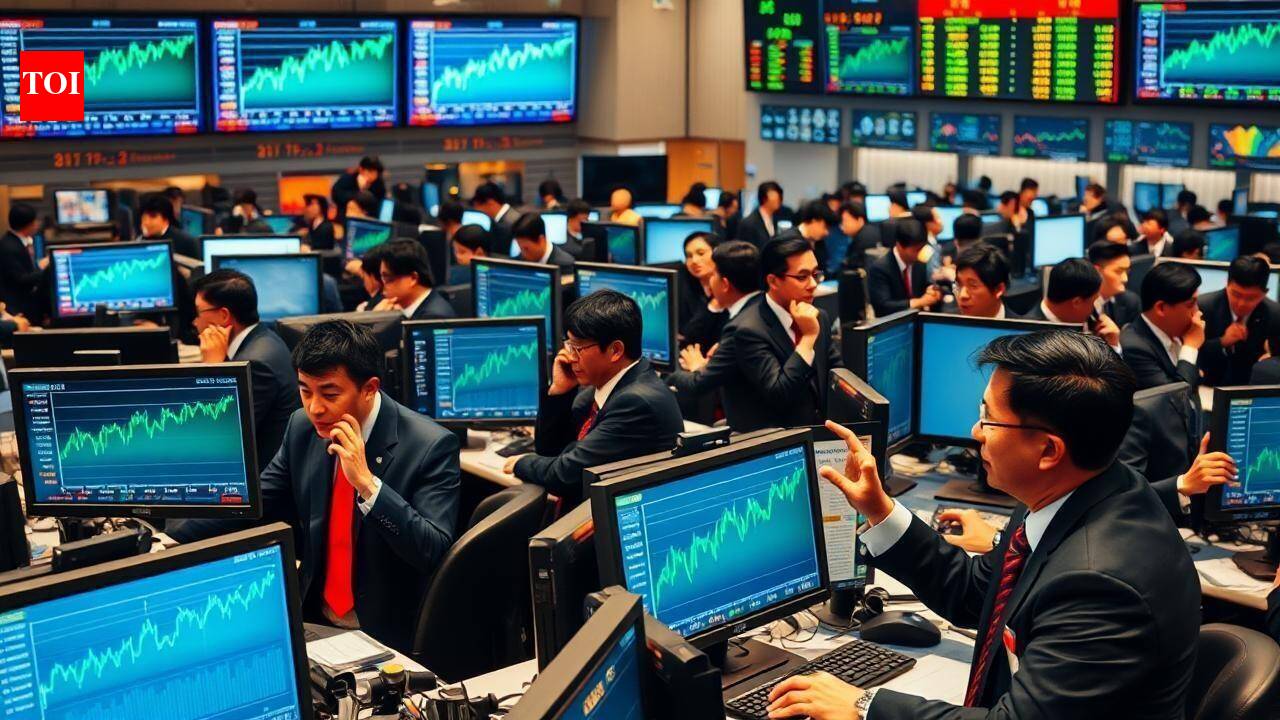
Asian stocks inched higher on Thursday, after days of trading in red amid ongoing Middle East tensions. This comes as equities were lifted by a rebound on Wall Street as oil prices paused their recent spike and economic updates painted a more positive picture of the American economy. In South Korea, Kospi hit a pause on its downward rally to add a whopping 10% or 513 points, to reach 5,606. Japan’s Nikkei 225 also climbed 2.7% to 55,713. Hong Kong’s HSI also traded in green, rising 353 points to 25,603 as of 9:10 am. Shanghai and Shenzhen added 0.9% and 1.7% respectively. Gains elsewhere in the region were more modest. Australia’s S&P/ASX 200 added 0.3% to 8,927.20, while New Zealand’s benchmark index moved 0.9% higher. In contrast, US futures indicated a subdued start ahead. Futures linked to the Dow Jones Industrial Average were almost unchanged, while S&P 500 futures ticked up 0.2%. The S&P 500 advanced 0.8% on Wednesday, clawing back much of the decline seen since the onset of the Iran conflict. The Dow Jones Industrial Average rose 0.5%, and the Nasdaq Composite outperformed with a 1.3% gain. Globally, market sentiment has remained sensitive to developments in the Middle East, with oil price swings continuing to steer trading direction. Crude prices eased during Wednesday’s session. Brent crude briefly moved above $84 a barrel before settling at $81.40, roughly matching the previous day’s level. US benchmark crude edged up 0.1% to finish at $74.66 per barrel. By early Thursday, however, oil was on the rise again. Brent crude climbed 2.4% to $83.32 per barrel, while U.S. benchmark crude jumped 2.5% to $76.53 per barrel.
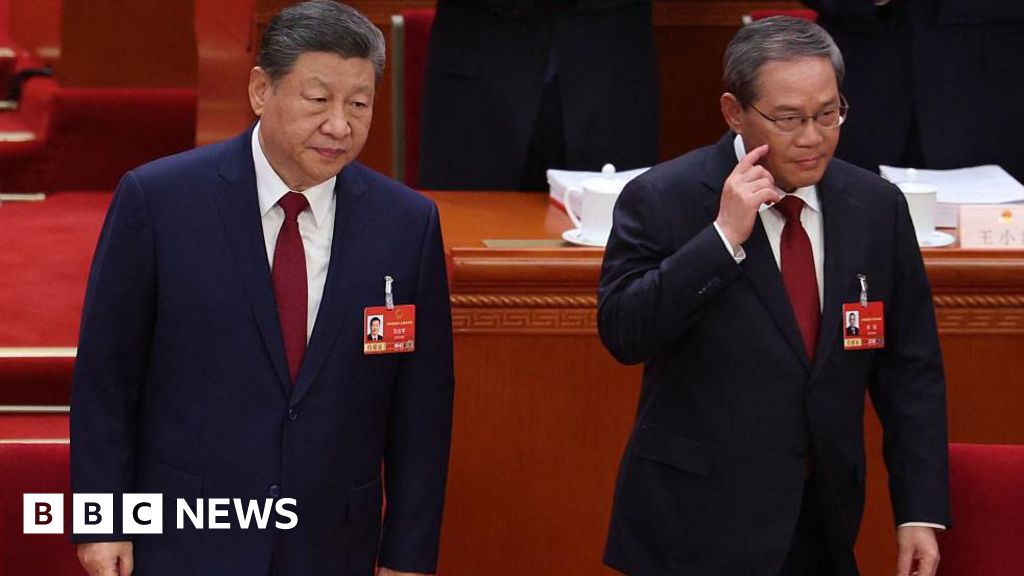
It is also the first time the target has been lowered since it was cut to “around 5%” in 2023.
Source link
Business
China takes ‘high stakes’ tech race up a notch with US as economic imbalances worsen | The Express Tribune
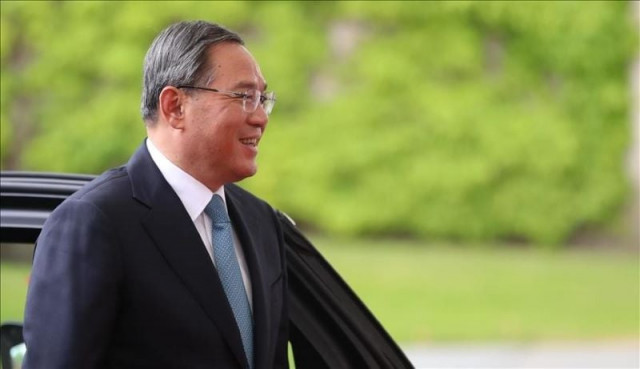
Premier Li Qiang said ‘multilateralism, free trade are under severe threat’, 7% increases in the defence budget, R&D
Chinese Prime Minister Li Qiang. PHOTO: ANADOLU
China on Thursday vowed to deepen investment in high-tech industries and scientific innovation, framing them as essential to bolstering national security and self-reliance amid rising geopolitical tensions and an intensifying rivalry with the US.
At the opening of the annual parliament meeting, Premier Li Qiang praised China’s ability to withstand US President Donald Trump’s tariff hikes, but said “multilateralism and free trade are under severe threat” and announced 7% increases in the defence budget and in research and development.
Li acknowledged an “acute” imbalance between strong supply and weak demand, subdued market expectations, and ongoing risks from a persistent property-sector downturn and high local government debt.
These challenges have pushed Beijing to set a slightly lower growth target of 4.5%–5% for this year, down from last year’s 5%, which was met largely through a one‑fifth surge in its trade surplus to a record $1.2 trillion.
China’s 15th five-year plan, as widely expected, pledged investments in innovation and industrial upgrading, as well as a “notable” – but unspecified – increase in household consumption as a share of economic output.
The combination of a lower growth target and higher outlays on research and strategic industries underscores Beijing’s bet that technological upgrading- not consumption – will drive its next phase of development despite growing structural pressures.
Last year’s trade punches with the Trump administration, which briefly escalated to embargo-like conditions of triple-digit tariffs, also showed the importance of its supply chain dominance as leverage.
“China’s government remains laser-focused on spurring technological breakthroughs and high-tech investment,” said Fred Neumann, chief Asia economist at HSBC. “In part, this is motivated by competition with the United States for control over the technologies of the future.”
“Many international observers may be left disappointed, therefore, by slower progress in rebalancing the economy away from investment towards consumption.”
China invests 20 percentage points of GDP more than the global average, while its households spend roughly 20 points less – a state-controlled, debt-driven development model that creates industrial overcapacity and fuels trade tensions abroad and deflationary pressures at home.
“The rebalancing challenge that China faces, and that will take years to achieve, is implicitly acknowledged by a weaker growth target for the coming year,” Neumann added.
The five-year plan aims to raise the value-added of “core digital economy industries” to 12.5% of GDP and roll out new policies for an integrated national data market and establish a system for AI security risk prevention.
These goals reflect President Xi Jinping’s vision of developing “new productive forces” to escape the middle-income trap, counter the demographic downturn, and enhance national security by insulating China from US export controls.
China pledged support for “breakthrough” developments across a range of industries, from farm seeds and biomedicine to areas at the cutting-edge of science, such as machine-brain interfaces. State-owned enterprises were urged to create demand for made-in-China technology like semiconductors and drones.
But the five-year plan also lists new ambitions in areas China already dominates. While accounting for 85% of the electric vehicle charging stations in the world, China aims to double their number within three years.
In AI, Beijing promised to build out “hyper-scale” computing clusters supported by cheap and abundant electricity.
“Beijing is trying to manage a ‘controlled glide’ in growth while building a new economy based on technology rather than property,” said Andy Ji, Asian FX & rates analyst at ITC Markets.
“It is a high-stakes rebalancing where the government is betting the house on AI and advanced manufacturing.”
Steady stimulus plans
Economists say a lower growth target allows Beijing to experiment with adjustments to industrial overcapacity, which could lead to some factory closures and job losses, but cautioned that this did not mean a departure from its production-focused growth model.
The US Supreme Court’s decision to strike down some of Trump’s tariffs and expectations that a meeting between the two countries’ presidents later in March could stabilise relations in the short term, bode well for such adjustments.
“The bigger context here is the China-US competition, but this year is the trade truce,” said Dan Wang, China director at Eurasia Group.
“It seems that China is taking advantage of this year to do some structural reform, which is the right direction for the economy in the long term, but it also means in the short term, the job market pressure is way higher.”
In terms of stimulus, China plans a budget deficit of 4.0% of GDP and has set special debt issuance quotas at 1.3 trillion yuan ($188.5 billion) for the central government and 4.4 trillion yuan for local authorities – all unchanged from last year.
China pledged to raise minimum monthly pensions by 20 yuan per person and basic medical insurance subsidies for rural, non-working people by 24 yuan – marginal, rather than structural, moves. It said it wants to increase education spending, subsidise childcare and reform public hospitals, acknowledging the demographic downturn.
Yuan Yuwei, fund manager at Trinity Synergy Investment, warned that China’s growth and policy aims for this year, prepared at the end of 2025, do not take into account the US-Israeli attacks in Iran.
“That’s very negative to China, which counts the Strait of Hormuz as a crucial trade route,” said Yuan.
($1 = 6.8969 Chinese yuan renminbi)


Employment in Germany continues to drop in Jan 2026

Canada’s Gildan posts $3.6 bn 2025 sales, growth supported by Hanes

Harry Styles shares marriage plans amid rumoured romance with Zoe Kravitz

India Us Trade Deal: Fresh look at India-US trade deal? May be ‘rebalanced’ if circumstances change, says Piyush Goyal – The Times of India

What are Iran’s ballistic missile capabilities?

Attock Cement’s acquisition approved | The Express Tribune

-
Business6 days ago
India Us Trade Deal: Fresh look at India-US trade deal? May be ‘rebalanced’ if circumstances change, says Piyush Goyal – The Times of India
-
 Politics7 days ago
What are Iran’s ballistic missile capabilities?
-
Business7 days ago
Attock Cement’s acquisition approved | The Express Tribune
-

 Politics1 week ago
US arrests ex-Air Force pilot for ‘training’ Chinese military
-
 Business1 week ago
Households set for lower energy bills amid price cap shake-up
-
 Fashion1 week ago
OECD GDP growth slows to 0.3% in Q4 amid mixed trends
-

 Fashion7 days ago
Policy easing drives Argentina’s garment import surge in 2025
-

 Sports6 days ago
LPGA legend shares her feelings about US women’s Olympic wins: ‘Gets me really emotional’