

Business
Sheffield breakfast club for parents helps with high cost of food


Lucy AshtonSouth Yorkshire political reporter
 BBC
BBCDawn Hayes is cooking sausages and hash browns in the kitchen of Shirecliffe Community Centre in Sheffield.
She is helping out at an adult breakfast club where parents and grandparents who have children at the adjoining Meadows nursery can have a hot meal for £1.
“It stops a lot of people going home and being lonely and it makes sure single parents get a meal,” she says.
The club is unusual in catering for adults at a time when many families are struggling with the cost of food – and parents may go without full meals to ensure their children are fed.


Ms Hayes, 47, explains: “I originally started coming to the centre when I brought my daughter to the nursery. When we looked at what people wanted within the community, we decided to set up a breakfast club.
“As parents drop off their children, we decided they needed somewhere to go rather than just going straight home.”
She has been the cook since it began and says it was set up to provide both food and company.
“It stops a lot of people from going home and just being alone. There are a lot of single parents around here and as a single parent, you often don’t get time to eat for yourself as you get up, get the kids ready and give them breakfast.
“We’re a bit of a social activity but we also make sure parents are eating as well.”
Parents can have a breakfast butty, along with hot drinks and cereal. A nearby Tesco store donates tea and coffee but the club does not receive any grants. It relies on occasional community events for fundraising and on the £1 contributions.
Many schools and nurseries now operate breakfast clubs for pupils, often with sponsorship from the major supermarket chains and brands.
The government has also launched an “early adopter” scheme for 750 schools, which will be given funding to offer free breakfast clubs lasting 30 minutes.
Lina, 34, has three children. Her two eldest boys were born during the pandemic so she struggled to meet other parents when playgroups were closed.
“I was feeling so lonely with nobody to speak to, and trying to deal with my two little boys, but the breakfast club gave me chance to build my confidence and make friends.
“The hot meal is a bonus for everyone. When it’s Thursday, I know I’m going to have my coffee and breakfast and it’s like a treat.
“I don’t have the chance to go to cafes because of the cost and also because the kids will be crying, but I know all these people, they are my friends. We are not just a breakfast club, not even a community, we are a family now.”
Jane Clark, 61, is a grandmother now but also enjoys the club.
“I’ve got a lot of time on my hands now and I like having a chat with people, learning stuff from them and maybe them learning stuff from me,” she says, nursing a cup of tea.
“Being around children keeps you young. Happy kids, happy mums, happy grannies!”
Business
Middle East heat may ripple across India’s energy supply chain, flags Goldman Sachs – The Times of India

As tensions continue to heat up in the Middle East, concerns are raising about disruptions to one of the world’s most critical energy shipping routes, the Strait of Hormuz. Any disruption could significantly affect major oil-importing countries such as India, as the narrow Strait of Hormuz is central to global energy trade. The strait sees almost 20 million barrels of oil passing through each day, or about a fifth of the world’s consumption, pass through the route. The waterway also carries roughly 19% of global liquefied natural gas (LNG) shipments, making it a crucial corridor for energy-importing economies.A recent report by Goldman Sachs has flagged early signs of stress in the region. The report warned that tanker traffic through the Strait of Hormuz has already begun showing signs of disruption, with shipping firms, oil producers and insurers adopting a cautious approach following reports of damaged vessels in nearby waters.According to the firm, financial markets have already begun factoring in the geopolitical risk. Oil prices currently carry an estimated risk premium of $18-per-barrel, reflecting the potential market impact if energy flows through the Strait of Hormuz were disrupted for about a month.
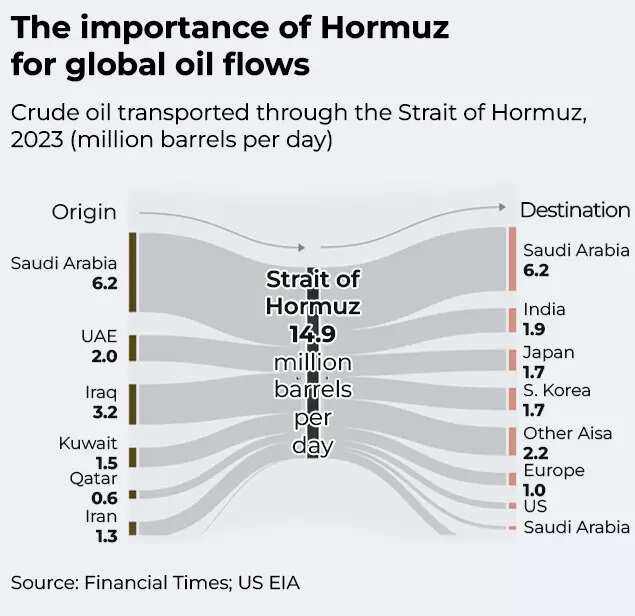
Even is the oil facilities are not directly damaged, a shutdown of the shipping route could expose a significant portion of global supply. The report estimates that in an event of full closure, about 16 million barrels per day of oil flows could be affected, despite the availability of some pipeline routes designed to bypass the strait.And the risks are not limited to crude oil shipments with almost 80 million tonnes of LNG exports annually, much of it from Qatar, moving through the passage. Any prolonged disruption could tighten gas supply globally and potentially drive European benchmark gas prices back to levels seen during the 2022 energy crisis.
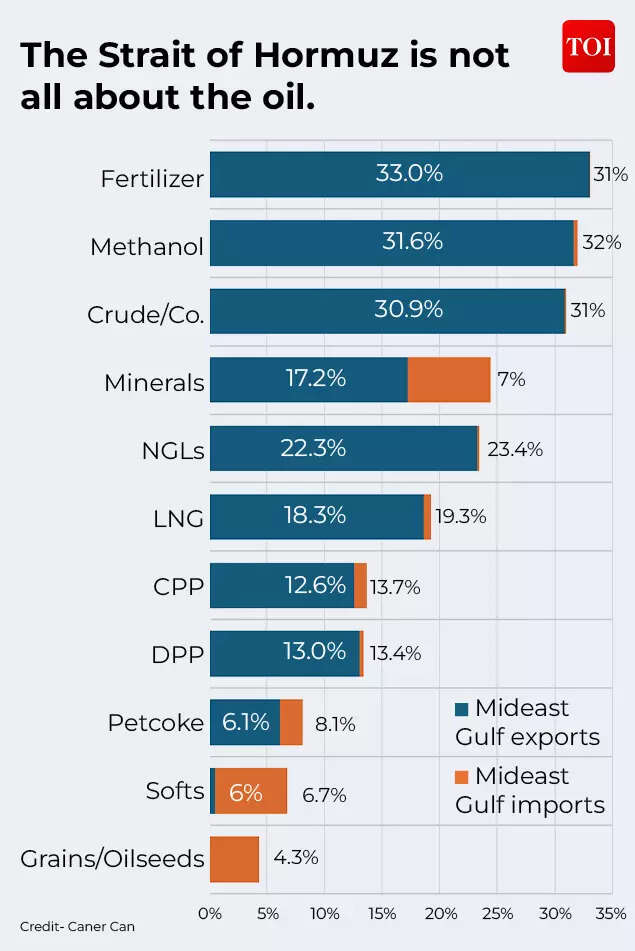
Asian economies stand among the most exposed to such disruptions. Major importers such as China, India, Japan and South Korea depend heavily on oil and LNG shipments that transit through the strategic corridor.While global oil inventories and spare production capacity could help cushion short-term shocks, the report warned that sustained disruption to Gulf shipping routes could trigger sharp volatility in global energy markets and push prices higher across oil, gas and refined fuel products.Market participants and governments are closely watching tanker traffic in the Strait of Hormuz, along with diplomatic and military developments involving the United States, Iran and Gulf nations, to assess whether the current disruptions remain temporary or escalate into a broader energy supply shock.

KARACHI: The Pakistan Stock Exchange rallied on Thursday after Saudi Arabia assured Pakistan of facilitating crude oil shipments through the Red Sea port of Yanbu Port, easing concerns over potential fuel supply disruptions.
The benchmark KSE-100 Index climbed sharply during the trading session, rising 4,439.93 points (2.85%) to reach an intraday high of 160,217.14 points.
Market Recovery
Analysts attributed the market rebound to renewed institutional buying and improving investor sentiment after Saudi assurances on oil supplies.
Market expert Ahsan Mehanti, CEO of Arif Habib Commodities, said easing fuel supply concerns played a key role in the recovery.
He added that rising global crude prices, expectations of a new International Monetary Fund loan tranche for Pakistan, and positive economic indicators also boosted investor confidence.
Alternative Oil Route
Pakistan sought an alternative supply route after Iran announced the closure of the Strait of Hormuz, a crucial global oil transit corridor.
Federal Petroleum Minister Ali Pervaiz Malik held talks with Nawaf bin Said Al-Malki, requesting Saudi support for uninterrupted energy supplies.
Saudi authorities reportedly assured Pakistan that oil shipments could be routed through Yanbu, and one crude vessel has already been prepared for dispatch.
Global Oil Market Impact
Oil prices continued to rise amid tensions in the Middle East conflict involving Iran, Israel and the United States.
Brent crude: up 3.26% to $83.99 per barrel
West Texas Intermediate (WTI): up 3.70% to $77.42 per barrel
Energy markets remain volatile as shipping disruptions threaten supply through the Strait of Hormuz, a route that handles nearly 20% of global oil trade.
Analysts say the Saudi assurance helped calm fears about Pakistan’s energy supply chain, contributing to the strong recovery at the PSX.
Business
Asian stocks today: Markets inch higher mirroring Wall Street gains; Kospi jumps 10%, Nikkei up 1,400 points – The Times of India

Asian stocks inched higher on Thursday, after days of trading in red amid ongoing Middle East tensions. This comes as equities were lifted by a rebound on Wall Street as oil prices paused their recent spike and economic updates painted a more positive picture of the American economy. In South Korea, Kospi hit a pause on its downward rally to add a whopping 10% or 513 points, to reach 5,606. Japan’s Nikkei 225 also climbed 2.7% to 55,713. Hong Kong’s HSI also traded in green, rising 353 points to 25,603 as of 9:10 am. Shanghai and Shenzhen added 0.9% and 1.7% respectively. Gains elsewhere in the region were more modest. Australia’s S&P/ASX 200 added 0.3% to 8,927.20, while New Zealand’s benchmark index moved 0.9% higher. In contrast, US futures indicated a subdued start ahead. Futures linked to the Dow Jones Industrial Average were almost unchanged, while S&P 500 futures ticked up 0.2%. The S&P 500 advanced 0.8% on Wednesday, clawing back much of the decline seen since the onset of the Iran conflict. The Dow Jones Industrial Average rose 0.5%, and the Nasdaq Composite outperformed with a 1.3% gain. Globally, market sentiment has remained sensitive to developments in the Middle East, with oil price swings continuing to steer trading direction. Crude prices eased during Wednesday’s session. Brent crude briefly moved above $84 a barrel before settling at $81.40, roughly matching the previous day’s level. US benchmark crude edged up 0.1% to finish at $74.66 per barrel. By early Thursday, however, oil was on the rise again. Brent crude climbed 2.4% to $83.32 per barrel, while U.S. benchmark crude jumped 2.5% to $76.53 per barrel.

Middle East heat may ripple across India’s energy supply chain, flags Goldman Sachs – The Times of India

Princess Beatrice ‘marital woes’: Edoardo issues surprise update

LaLiga side Celta Vigo put out plea to Madonna to find 1990 jersey

India Us Trade Deal: Fresh look at India-US trade deal? May be ‘rebalanced’ if circumstances change, says Piyush Goyal – The Times of India

What are Iran’s ballistic missile capabilities?

Attock Cement’s acquisition approved | The Express Tribune

-
Business6 days ago
India Us Trade Deal: Fresh look at India-US trade deal? May be ‘rebalanced’ if circumstances change, says Piyush Goyal – The Times of India
-
 Politics1 week ago
What are Iran’s ballistic missile capabilities?
-
Business7 days ago
Attock Cement’s acquisition approved | The Express Tribune
-
 Business1 week ago
Households set for lower energy bills amid price cap shake-up
-

 Politics1 week ago
US arrests ex-Air Force pilot for ‘training’ Chinese military
-

 Fashion7 days ago
Policy easing drives Argentina’s garment import surge in 2025
-

 Sports6 days ago
LPGA legend shares her feelings about US women’s Olympic wins: ‘Gets me really emotional’
-

 Fashion6 days ago
Texwin Spinning showcasing premium cotton yarn range at VIATT 2026