

Business
Single-digit rates re-enter market debate | The Express Tribune

Cooling inflation, stronger growth indicators fuel expectations of up to 75bps cut
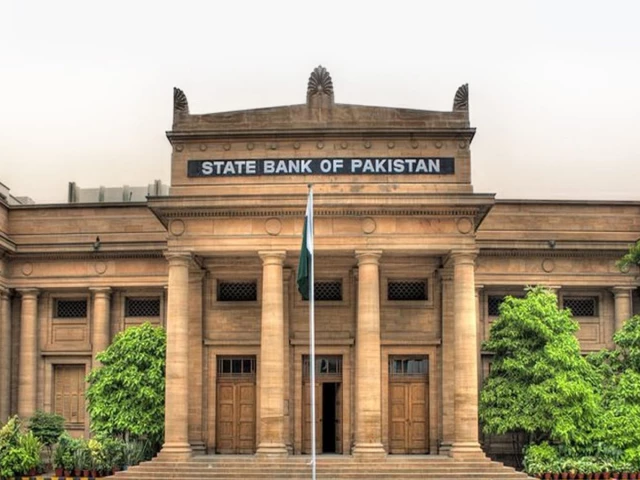
State Bank of Pakistan. Photo: File
KARACHI:
After nearly four years of double-digit interest rates, Pakistan appears poised for a symbolic and economically significant shift, with expectations building that the State Bank of Pakistan (SBP) may bring the policy rate back into single-digit territory at the upcoming Monetary Policy Statement (MPS).
“Nearly four years after rates last dipped below 10% in March 2022, the idea of a single-digit policy rate is moving from a historical reference into the present debate,” said Sana Tawfik.
“We believe the SBP is likely to deliver a 75bps cut in the upcoming MPS (Jan 26th), potentially taking the policy rate to 9.75%, signalling a long-awaited return to single-digit territory,” noted an Arif Habib Limited (AHL) report.
. If realised, this would mark the first sub-10% policy rate since March 2022 and signal a shift from crisis-era monetary tightening toward a more normalised stance.
According to AHL, such a move would reflect growing confidence in macroeconomic stabilisation and a gradual shift toward supporting growth, while maintaining caution against renewed inflationary and external account risks.
Market sentiment points to a strong expectation of easing. AHL’s pre-MPS survey shows that 43.5% of participants expect a 75bps cut, 39.1% anticipate a 50bps reduction, and only 17.4% expect no change, indicating a broad consensus in favour of a rate cut.
The case for easing is underpinned by improving high-frequency and macroeconomic indicators, according to Shankar Talreja, Director of Research at Topline Securities. A Topline Economy Alert dated January 20, 2026, showed Pakistan’s economic momentum strengthening in December 2025, driven by improved performance across key real-economy sectors.
Cement dispatches remained healthy at 4.3 million tonnes, supported by infrastructure development and sustained private sector construction activity. Urea offtake reached an all-time monthly high of 1.4 million tonnes, reflecting improved farm economics and stronger agricultural demand.
Former FPCCI vice president Shabbir Mansha Churra has urged the SBP to implement a meaningful interest rate cut to support industry and break what he described as a recurring “boom-bust cycle”. He argued that lower rates for industry and exports would stimulate production, increase electricity consumption to help reduce circular debt, and ease the government’s heavy debt-servicing burden. While acknowledging concerns over sticky core inflation, he said persistently high rates were causing financial stress and constraining growth.
The auto sector also showed resilience, with passenger car and motorcycle sales rising 35% year-on-year to 13,300 units and 158,200 units, respectively, supported by new model launches and improved supply conditions. Power generation increased by 8.8% year-on-year to 8,487 GWh, indicating stronger industrial and commercial activity. These indicators suggest a broad-based recovery rather than a narrow, policy-driven rebound.
On the macro front, economic activity remained resilient. Remittance inflows reached $3.6 billion in December, up 17% year-on-year, providing support to the external account, while large-scale manufacturing recorded growth of 10% year-on-year. Reflecting easing inflationary pressures and improving monetary conditions, the six-month T-bill yield declined to 10.41%, reinforcing expectations of an easing cycle.
Inflation trends continue to strengthen the policy case for a rate cut. Headline inflation has settled within the SBP’s 57% medium-term target range, while first-half FY26 average inflation stood at around 5.1%, down sharply from 7.3% a year earlier. Core inflation has also eased, creating what AHL analysts describe as sufficient policy space for easing without destabilising price dynamics.
The broader macroeconomic environment has also become more supportive. The exchange rate remains broadly stable, international commodity prices, particularly oil, have softened, and domestic demand indicators are improving, reducing imported inflation risks.
However, risks remain. Base effects could temporarily push year-on-year inflation higher later in the fiscal year, while seasonal pressures linked to Ramadan and Eid in the second half of FY26 may affect monthly readings. Geopolitical uncertainty also persists. Despite this, analysts view these pressures as transitory. AHL projects inflation to average around 8% in the second half of FY26, bringing the full-year average to about 6.7%, within the SBP’s comfort zone.
External pressures have partially resurfaced, with a December current account deficit of about $244 million, taking the first-half FY26 balance to a deficit of roughly $1.17 billion. Despite this, the position remains manageable, supported by SBP reserves of around $16.1 billion, secured rollovers, timely debt servicing and strong remittances.
Lower rates could also ease fiscal pressures, as domestic debt servicing remains a heavy burden. Markup payments stood at about Rs1.37 trillion in 1QFY26 alone, underscoring the fiscal incentive for a gradual reduction in interest rates.









Sir Keir Starmer says it is “deeply concerning” the rapper is set to headline a festival after recent antisemitic comments.
Source link
Business
Stock markets outlook: Dalal Street braces for swings as RBI MPC decision, war risks weigh on sentiment–Check key triggers – The Times of India

Domestic equities are expected to remain volatile this week as investors track the Reserve Bank’s monetary policy decision, global macroeconomic cues and evolving developments in the West Asia conflict, analysts said, according to PTI.Market participants will also keep a close watch on crude oil price movements and foreign fund flows, which continue to influence sentiment.Vinod Nair, Head of Research at Geojit Investments Ltd, said the RBI’s Monetary Policy Committee (MPC) meeting will be the key domestic trigger, with investors focusing on the central bank’s stance on inflation and growth.“A rate pause is near-certain consensus, the central bank walks a tightrope between crude-driven inflation risks and a four-year low Manufacturing PMI signalling a softening growth impulse. The governor’s commentary on the rate cycle trajectory and FY27 projections will be closely monitored.“Globally, the US March CPI reading will carry significant importance, as it buries residual Fed rate-cut hopes, strengthens the dollar and tightens financial conditions for emerging markets, including India,” Nair said.He added that geopolitical developments in West Asia will remain the dominant factor shaping market direction.“Indian markets return after a three-day gap and remain acutely vulnerable to weekend war developments, with crude trajectory and any credible ceasefire signal being the decisive variable that could either trigger a sharp relief rally or extend the current sell-on-rise mode,” he said.In the previous holiday-shortened week, the BSE Sensex declined 263.67 points, or 0.35%, while the NSE Nifty fell 106.5 points, or 0.46%.Siddhartha Khemka, Head of Research (Wealth Management) at Motilal Oswal Financial Services Ltd, said investor sentiment will remain closely linked to developments in the West Asia conflict.Brent crude prices have stayed elevated near $107 per barrel, fuelling concerns around imported inflation. Currency pressures have also intensified, with the rupee weakening sharply before recovering towards Rs 93 against the US dollar following RBI intervention, he noted.Foreign institutional investor (FII) outflows remain a key overhang, with March witnessing heavy selling of Rs 1.2 lakh crore, among the highest monthly outflows in recent years.“Investors will monitor the US Federal Open Market Committee (FOMC) meeting minutes, GDP data, and initial jobless claims for further cues on growth and the policy trajectory.“Overall, markets are expected to remain volatile as geopolitical developments, crude price movements, FII flows and global macro data continue to drive sentiment,” Khemka said.Analysts said any signs of de-escalation in the West Asia conflict could ease crude prices and stabilise the currency, offering relief to markets, while further escalation may prolong risk aversion and keep pressure on foreign flows.

One elderly couple had to find £1,000 for an oil delivery and suppliers are not giving quotes, a councillor says.
Source link


Olivia Munn urges fans for ‘early’ cancer checkup

Islanders fire head coach Patrick Roy with four games left in the season amid playoff race

Actress Tori Spelling hospitalized after Southern California crash; authorities investigating cause

-

 Sports1 week ago
USMNT handed reality check by Doku, Belgium ahead of World Cup
-

 Sports1 week ago
2026 NCAA men’s hockey tournament: Schedule, results
-

 Fashion1 week ago
EU apparel imports slump 15.48% YoY in Jan; Bangladesh hardest hit
-
Uncategorized6 days ago
[CinePlex360] Please moderate: “Further tariff
-

 Tech2 days ago
Our Favorite iPad Is $50 Off
-
Uncategorized3 days ago
[CinePlex360] Please moderate: “Trump signals p
-

 Entertainment1 week ago
The Avett Brothers’ bassist explains why he wrote a book about John Quincy Adams
-
Uncategorized1 week ago
[CinePlex360] Please moderate: “Apple scrapping