

Sports
Sinner defeats Auger-Aliassime to set up US Open final clash with Alcaraz – SUCH TV

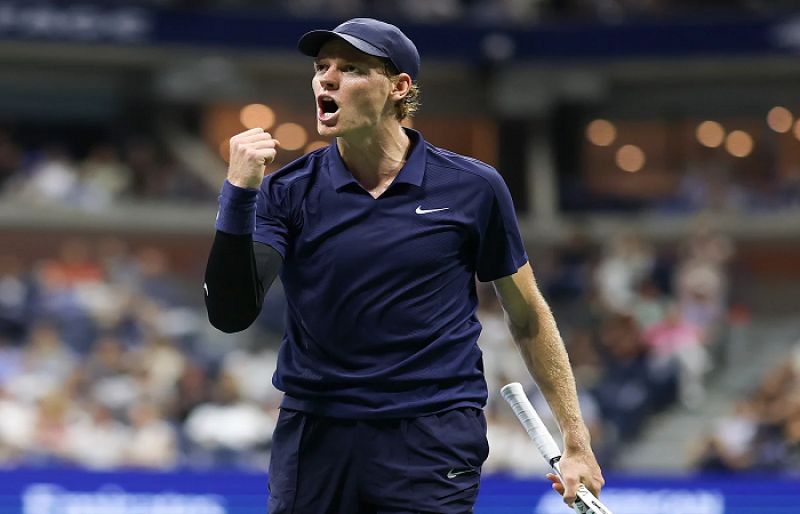
Defending champion Jannik Sinner battled past 25th seed Felix Auger-Aliassime 6-1, 3-6, 6-3, 6-4 in the US Open semi-finals on Friday to book a blockbuster title clash with Carlos Alcaraz, reigniting one of tennis’s most captivating rivalries.
Earlier in the evening, Alcaraz produced a masterclass to dismantle 24-time Grand Slam champion Novak Djokovic at Arthur Ashe Stadium.
Sinner, less clinical than usual, wavered at times but ultimately held firm to secure his third straight Grand Slam final against the Spaniard.
The victory puts the Italian world number one in elite company as only the fourth man in the Open Era, after Novak Djokovic, Rod Laver, and Roger Federer, to reach all four Slam finals in a single season.
“It’s been an amazing season. The Grand Slams are the most important tournaments we have, and finding myself in another final the last one of the year, with this amazing crowd it doesn’t get any better,” Sinner said.
Reflecting on Auger-Aliassime, he added: “We played recently in Cincinnati, and he’s a completely different player now.
He served and struck the ball much better, so it was a tough match.
I noticed he seemed injured at one point, and I really hope it’s nothing serious. He’s an amazing player and person, and it’s always a pleasure to share the court with him.”
Sinner seized control early, fending off resistance in the fifth game of the opener before clinching the set as Auger-Aliassime sent a backhand wide.
From there, despite losing the second set, the Italian’s relentless intensity carried him over the line and into another showdown with Alcaraz.
Auger-Aliassime settled his nerves in his second New York semi-final, breaking for a 5-3 lead in the next set en route to levelling the match, before going toe-to-toe with Sinner in the third set, only for the momentum to shift again.
Sinner, who took a medical timeout for an unspecified issue, found his groove to close out the third set, staving off a strong challenge from his reinvigorated Canadian opponent with some clutch serving in the next set to advance.
He told reporters afterward he felt twitching in his stomach while serving at 4-3 in the second set but played down concerns about his fitness.
“After the treatment, was feeling much better,” he said.
“At some point, I didn’t feel anything anymore. I was serving back at normal pace, so it was all good.
“Nothing to worry about. But I preferred to go off court because it’s on a different spot.”
The victory set up a mouth-watering encounter with second seed Alcaraz, who saved three matchpoints in their French Open final meeting in June to retain his title before surrendering his Wimbledon crown to the Italian in July.
Sinner looked ahead to their major trilogy meeting, which will take place on Sunday, three years after the pair duelled in the New York quarter-finals in an entertaining five-setter that Alcaraz won before going on to lift the sterling silver trophy.
“I feel our rivalry started here, playing an amazing match,” Sinner said.
“We’re two different players now, different confidence too, so let’s see what’s coming. We’ve played quite a lot this year so we know each other very well.
In any case, it has been an amazing tournament, an amazing feeling to play in front of you.
“I’m looking forward to doing it again.”








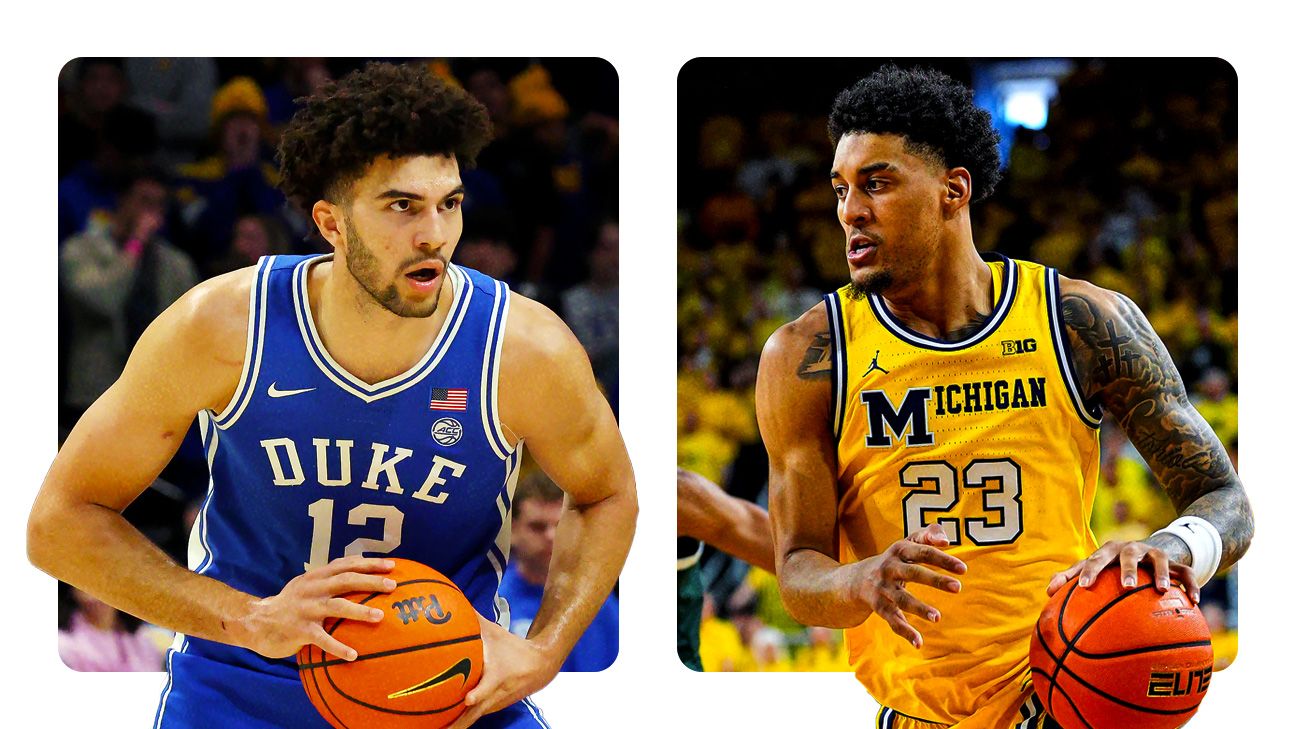
IT’S MARCH, and the madness begins Tuesday with the First Four men’s games. As we buckle up for college basketball chaos and buzzer-beater glory, we have everything to prepare you for the men’s and women’s NCAA tournaments. From where the term “March Madness” originated — the answer might surprise you — to how teams are seeded, how to fill out a bracket, and more, we have everything to prepare for the Big Dance.
WHAT YOU NEED TO KNOW
How are teams selected for the tournaments?
Thirty-one teams automatically qualify by winning their respective postseason conference tournament. The remaining 37 teams must earn an at-large bid, determined by the selection committee. (What’s the selection committee? We’ll come back to this later. )
What is the First Four?
The first four elimination games cut down the number of teams from 68 to 64 for the first round. The men’s First Four games will air on truTV on March 17-18, and the women play March 18-19 on ESPN, ESPN2, ESPNU and ABC.
What is Selection Sunday?
The 68-team field and seeds for the men’s and women’s tournaments were revealed on March 15.
What is the Sweet 16? What about the Elite Eight? Or the Final Four?
Teams that advance past the first two rounds of the tournament enter the regional semifinals, also known as the Sweet 16, when the field has been reduced from 68 teams to 16. The next round, the regional finals, is called the Elite Eight. Then, it’s on to the Final Four, where schools are just two wins from a championship. Here are the dates for the key rounds:
-
Men’s Sweet 16: March 26-27
-
Men’s Elite Eight: March 28-29
-
Men’s Final Four: April 4
-
Men’s championship: April 6
-
Women’s Sweet 16: March 27-28
-
Women’s Elite Eight: March 29-30
-
Women’s Final Four: April 3
-
Women’s championship: April 5
THE BACKSTORY AND FORMAT
What is March Madness?
March Madness is the term used to describe the annual men’s and women’s NCAA Division I basketball tournament. Every March, 68 teams play in up to seven rounds of single-elimination games for the chance to win a national championship.
Who invented the term “March Madness”?
H.V. Porter, an Illinois High School Association official, first used the term “March Madness” in a March 1939 essay about the excitement surrounding the state high school basketball tournament. “March Madness” wouldn’t enter the college basketball lexicon until broadcaster Brent Musburger popularized the term during the 1982 NCAA men’s tournament.
When did the tournament start?
The first NCAA Division I men’s basketball tournament happened in 1939. Four teams played in an Eastern regional, while another four played in a Western regional. Oregon won the inaugural national title, defeating Ohio State 46-33 in front of 5,000 spectators at Northwestern University’s Patten Gymnasium.
The first NCAA women’s championship didn’t take place until 1982, when Louisiana Tech defeated Cheyney University 76-62. Until then, the women’s tournament was organized by the Association for Intercollegiate Athletics for Women. On the same day Louisiana Tech won the inaugural NCAA women’s championship, Rutgers defeated Texas 83-77 in what would be the last basketball championship hosted by the AIAW.
How do the women’s and men’s March Madness tournaments differ in format?
The women’s and men’s tournaments are largely structured the same. Starting in 2022, both tournaments featured 68 teams. It was also the first time the women’s tournament was allowed to use the trademarked March Madness brand, the result of an NCAA-commissioned gender equity report highlighting resource disparities between the men’s and women’s tournaments.
Though host locations for the men’s tournaments are predetermined, the location of the first and second rounds of the women’s tournament is determined by seeding. The top 16 seeds host the First Four, along with the first and second round of tournament games.
What is “One Shining Moment”?
“One Shining Moment” is a video montage and song written by David Barrett that has played at the end of every men’s national championship broadcast. The video package highlights various moments from the men’s tournament and has been synonymous with the men’s basketball tournament since its debut in 1987. The song has been re-recorded by various artists, including Luther Vandross’ rendition, which remains the most popular.
SEEDING
How are March Madness seeds determined?
The tournament’s 68 teams are initially ranked by the selection committee from 1 to 68, using a seed list. The seeding process is based on several performance metrics and the selection committee’s expert evaluation. This helps determine team strengths and guides the structure for tournament matchups. The tournament field consists of 37 at-large teams and 31 automatic qualifiers who earned their spot by winning their conference tournament.
The brackets are then organized into four regions, with teams ranked 1 to 16. This system rewards the higher-ranked teams by pairing them against lower-ranked opponents in the early rounds.
How does a team become a No. 1 seed?
The selection committee designates the No. 1 seed to a team based on several season-long performance measures. Both tournaments feature four No. 1 seeds, each assigned to one of the four separate regions.
The tournament’s top-seeded teams are widely recognized as the leading contenders to win the national championship. Since 1982, 172 teams have competed as a No. 1 seed in the women’s tournament. In that time, the No. 1 seed has won the national championship 33 times in 43 tournaments. As of the 2026 NCAA Women’s Basketball Tournament, the UCONN Huskies hold the record for most No. 1 seed appearances with 23.
Throughout the history of the men’s tournament, No. 1 seeds have also consistently progressed deep into the bracket. Since the men’s field expanded to 64 teams in 1985, a No.1 seed has won the national championship 26 times. According to NCAA data, at least one No.1 seed has reached the Final Four in 37 of the past 40 tournaments. Compared with other rankings, No.1 seeds hold the best record for most wins in the men’s tournament (534-134).
What are “at-large bids”?
The men’s and women’s selection committees award 37 at-large bids to teams that did not secure an automatic qualification. These at-large selections did not win their conference tournament but have a strong résumé to join the 31 automatic qualifiers that finalize the field of 68 teams.
Each committee participates in a voting process that evaluates teams that help determine the tournament field. These committees consist of administrators, conference commissioners and athletic directors. In total, each committee has 12 members, who serve a five-year term.
What is a “bubble team”?
A “bubble team” is a term used to describe a team that has an uncertain spot in the tournament. The “bubble team” is either on the edge of qualifying as one of the last four teams or on the “bubble” of being left out as one of the last four out.
Heading into the tournament, ESPN is tracking several teams on bubble watch:
Tracking the Men’s Bubble teams
Tracking the Women’s Bubble teams
BRACKETS AND ODDS
How do you fill out a March Madness bracket?
-
Go to Men’s Tournament Challenge or the Women’s Tournament Challenge.
-
Click on “Create a Bracket” button on the front page
-
A confirmation panel will appear with options to either “Create a Group or Join a Group.” Click the “X” to dismiss the confirmation
-
Fill out your bracket, you can select all your winners manually one by one or you can choose one of the several autofill options to fill a bracket in seconds.
Players are allowed to edit their selections before the brackets are officially locked in. The men’s brackets will lock selections at 12:15 p.m. ET on Thursday. The women’s bracket will lock selections at 11:30 a.m. ET on Friday.
Has anyone had a “perfect” March Madness bracket?
The NCAA estimates that there are 60 million to 100 million brackets submitted every year. Since 2016, the NCAA has monitored around 20 million to 25 million brackets online each year, using public leaderboards, game reports and information collected from various platforms. Despite millions of entries, there has never been a perfect verified March Madness bracket. The odds of having a perfect bracket are 1 in 9.2 quintillion. The chances improve only slightly to 1 in 120.2 billion for someone with more familiarity with the sport and its surrounding factors.
Over the years, notable bracket entries have generated memorable streaks. In 2019, a bracket created by neurophysiologist Gregg Nigl correctly predicted the first 49 games until the second round, when he incorrectly picked his 50th game. Just last year, two bracket entries created on ESPN’s Tournament Challenge had notable success. “LisaVT22’s Picks 1” correctly picked the first 50 games of the women’s tournament before falling in the Elite Eight round. Another bracket in 2025 entitled “#roadtoperfection” had 43 correct entries in the men’s tournament, but the bracket was knocked out in the second round.
Who coined the term “Bracketology”?
The word “Bracketology” first appeared in a Philadelphia Inquirer article when Joe Lunardi referred to himself as a “Bracketologist.” In the 1996 article, Lunardi, now an ESPN Bracketologist, was speaking to writer Mike Jensen about the Temple Owls’ chances of making the NCAA tournament that season.
Lunardi, who was the editor and publisher of the Blue Ribbon College Basketball Yearbook at the time, has continued to popularize the word over the years and now releases an annual digital ” Bracketology” guide that publishes on ESPN. Lunardi further cemented the phrase when he released a book in 2021 titled “Bracketology: March Madness, College Basketball, and the Creation of a National Obsession.”
The term is now universally recognized to describe the science and art of predicting tournament brackets.
What is a “Cinderella” team?
One of the biggest highlights of March Madness every year is the underdog team that finds a way to win multiple games against much higher-seeded opponents. These lower-seeded teams surprisingly outperform their tournament expectations and are commonly known as “Cinderella” teams.
In 1894, just three years after basketball was invented by Dr. James Naismith, the concept of a Cinderella team was already capturing the public’s imagination. Herm Melville, a writer from a newspaper in Fall River, Massachusetts, notably used the term “Cinderella team” to describe a basketball team from Wappinger Falls, New York.
ESPN has spotlighted some of the most memorable Cinderella stories in the history of the tournament.
BETTING
Is it legal to bet on March Madness everywhere in the U.S.?
Betting on March Madness is not legal everywhere in the United States. Sports betting remains prohibited in several U.S. states. According to the American Gaming Association, it is not legal to place online sporting bets in 19 of the 50 U.S. states. Retail betting, however, is allowed in 38 states.
To clarify, retail betting requires you to place a bet in person at a physical location. In contrast, online betting allows you to place wagers through a website or phone app, without having to visit a sportsbook or casino in person. Most states require sports bettors to meet a minimum age requirement, which is typically 21 years old. A few states allow sports betting at 18 years old.
How do March Madness pools work?
A March Madness pool is a group competition where participants all compete in the same bracket contest. Every participant submits their own bracket predicting the outcomes of the NCAA tournament games. These pools can be public or private and often award a prize to their top competitor.
ESPN March Madness pools are tied to its bracket games. The Tournament Challenge includes the men’s and women’s versions of the March Madness bracket competition. Both tournaments are free to play, with prizes available to win. Players are allowed to create up to 25 brackets for each tournament. The key is to select the most winning teams. Points increase every round for each correct pick.
Another option available through ESPN is the Tournament Challenge Eliminator contest. Participants in the survivor-style pool pick one team per day. If your chosen team wins, then you survive to the next day. If your team loses, you are eliminated. Each team can be selected only once during the tournament. The men’s and women’s brackets are available to play in this format.
How do March Madness squares work?
In March Madness squares, players select one or more squares from a 10×10 grid. Each row and column is assigned a number, ranging from 0 to 9. One axis represents one team, while the other axis represents the opposing team. After the game ends, winners are determined by the last digit of each team’s final score. The square that matches the combination wins the round.
Marshall University dropped plans to eliminate its women’s swimming and diving program on Wednesday, citing concerns raised in a lawsuit over compliance questions involving Title IX.
The reversal was announced after a special meeting of the Marshall Board of Governors and came a week after a group of swimmers filed a lawsuit seeking to retain the sport.
“Leadership is about making difficult decisions and tradeoffs, and sometimes those decisions are unpopular,” Marshall President Brad Smith said at a news conference. “But leadership is also about having humility to listen, to learn, and to adjust course if new facts and information emerge. And that’s what we have done here.”
Marshall swim coach Ian Walsh said he was “incredibly proud” of those within his program, especially the athletes.
“How you’ve navigated the past month has been nothing short of exceptional,” Walsh said.
Last month, Marshall announced it would drop swimming and add stunt – a sport that incorporates aspects of cheerleading – to its women’s sports offerings. The swim team found out the day before the start of its conference championship meet that its program would end after 23 years.
Athletic director Gerald Harrison told the Marshall Board of Governors on Feb. 17 that the swim team has a $819,000 annual budget, its facilities don’t meet NCAA competition standards and that the athletic department couldn’t commit the funding needed to upgrade the facilities and sustain the program. Stunt, which could support up to 65 athletes, would cost an estimated $320,000 per year, according to Smith.
Title IX ensures equity between men and women in education and prohibits discrimination on the basis of sex in any education program or activity receiving federal funds. Compliance can be measured in multiple ways, including whether the overall program’s gender breakdown is proportionate to that of the general student body.
The swimmers’ lawsuit brought to light an independent audit conducted last fall showing Marshall has struggled to meet Title IX requirements for athletic participation opportunities for women. Smith cited the audit Wednesday, saying that eliminating women’s swimming “could potentially place our university outside the safe harbor framework of Title IX.”
Smith said that information was different than the advice it received entering the process. Wednesday’s decision also was influenced by the costs of a potentially lengthy lawsuit, he said.
Marshall will continue plans to add stunt as a varsity sport, Smith said.
Over the past year, a growing number of universities have added or dropped entire sports programs as dramatic changes roll through college athletics under a $2.8 billion NCAA settlement.
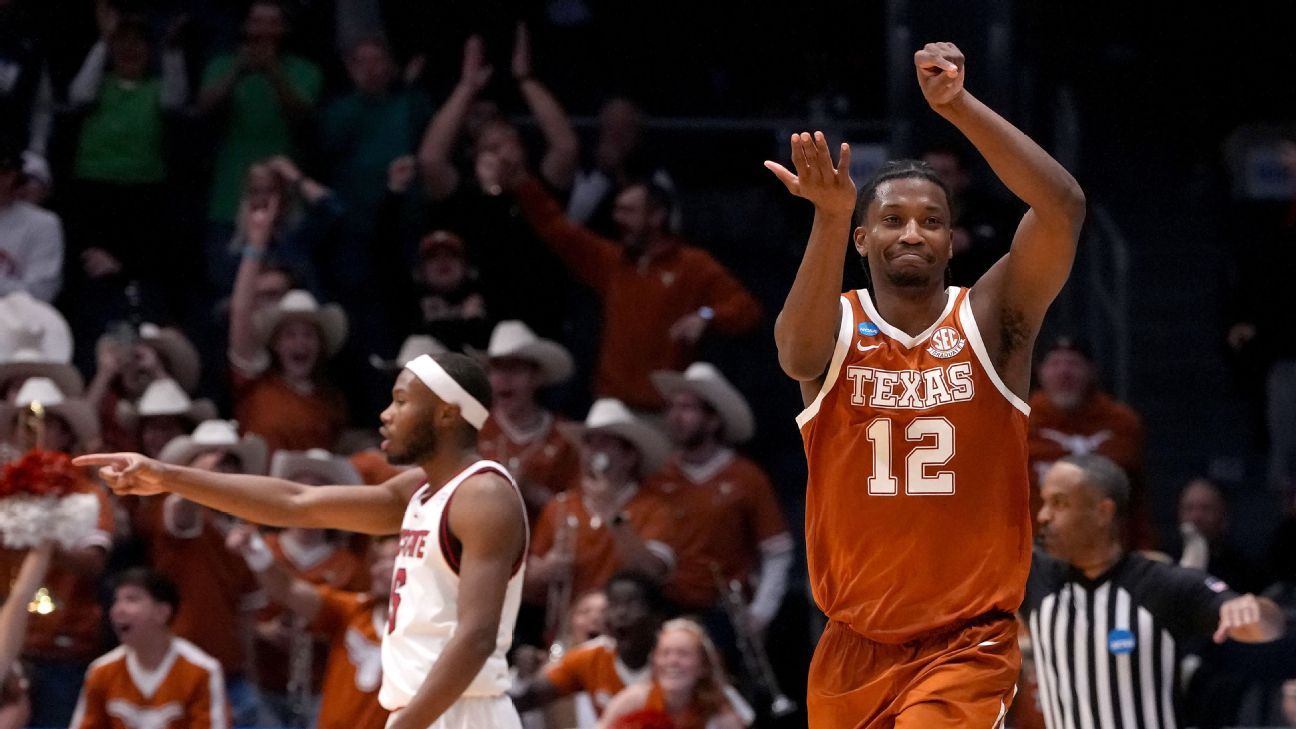
DAYTON, Ohio — The moment was getting to Texas.
Unable to handle the press or, seemingly, the pressure, the Longhorns had finally lost the lead, and their best defensive effort of the season was potentially going to waste as NC State had tied the score at 66 with 20.8 seconds left Tuesday night in their First Four game at UD Arena.
“When you get into March and you’re in this tournament, the magnitude of being able to advance versus not can sometimes take over a player’s mind,” Texas coach Sean Miller said.
But sixth-year senior Tramon Mark‘s mind was resolute. As the final seconds ticked away, Mark liked the look he had, even with NC State’s Tre Holloman lurking. He rose up from the right wing, and the ball swished through with 1.1 seconds left. Texas survived 68-66, preserving its season a little bit longer.
The No. 11 seed Longhorns advanced to face No. 6 BYU in a first-round West region matchup in the NCAA tournament Thursday in Portland, Oregon.
“I guard T-Mark every day [in practice], and he makes those shots on me,” Texas guard Chendall Weaver said.
Hollomon was Mark’s victim this time. Mark finished with a team-high 17 points, including four in the final 37 seconds after NC State finally got hot from long range.
According to ESPN Research, Mark’s last jumper marked his fourth career game winner with less than five seconds remaining, and his first since 2025 against Texas A&M.
“This one is definitely [best] for me,” Mark said. “The way the game was going, the way the game felt, we had a big lead, they started making some shots. And then I was able to silence the crowd with a big shot like that.”
The big shots actually came late for both teams after a game that barely resembled the teams’ first meeting. In that contest in November at the Maui Invitational, Texas and NC State combined for 199 points and 25 made 3-pointers, including 16 from the victorious Longhorns.
Tuesday brought a dramatically different tone until the final minutes. Texas didn’t sink a field goal for the final 8:40 of the first half and saw a comfortable lead dwindle to one at the break. Neither team reached 50 points until Texas center Matas Vokietaitis swished a free throw with 7:42 remaining.
NC State had only three 3-pointers in the first 58:29 and then matched that in a minute with two shots from Paul McNeil Jr. and another from Darrion Williams.
“This might be, like, the first game that I can really look at and say we won because of our defense,” Miller said. “When you play NC State, this year’s team, you have to defend the 3-point shot. And if you really look at the game until the very, very end, it’s the thing we did the very best, and that’s what I think we can hang our hat on as we leave here.”
Miller also recognized how tight the margin was Tuesday, and throughout the NCAA tournament. He has had teams play better than Texas did Tuesday in the tournament and go home for good.
His first Longhorns team hadn’t been great in close games and had dropped a heartbreaker in overtime to Oklahoma to cap the regular season. But Miller also knows that with players such as Mark, there’s always a chance to play on.
“As often is the case in this tournament, players make plays,” Miller said. “And we’re here in large part because the guy, Tramon Mark, made two incredible shots.”
Texas needed Mark and Weaver, who recorded his first career double-double with 11 points and 10 rebounds. He provided a bench boost on a night when top scorer Dailyn Swain struggled with his shot (2-of-9).
“I always tell them I have their backs, and tonight, they had mine,” Swain said. “I didn’t have my best game, but Chendall Weaver, the most impact on the court, and Travon Mark, when he put that shot up, I knew it was good.”
Miller won in the First Four for the second straight year, with a different team. Last year, he guided Xavier past Texas, in a game he called “one of the greatest” he had witnessed. This time, his Longhorns prevailed after an even better ending.
Although last year’s Xavier squad would lose its first-round matchup against Illinois, and Texas had a long night of travel ahead to the West Coast, Miller saw value in logging a game and finding a way to win, especially when the Longhorns weren’t always at their best.
“There’s power in playing a game in this tournament,” Miller said. “Sometimes a player or a team is not themselves. It’s just kind of like that. I don’t want to say jitters, but March Madness looms big. Our nerves sometimes can settle through Game 1. You can gain confidence … but we’re going definitely have to play better than we played tonight.”


March Madness 101: NCAA tournament format, history, facts

EU raises alarm over Russian tanker in Mediterranean

Val Kilmer revived 1 year after death through AI

Stock market crash today (March 12, 2026): Nifty50 opens below 23,600; BSE Sensex down over 900 points on continuing US-Iran war – The Times of India

Intertextile Shanghai 2026: Fringe events spotlight market trends

German brand Adidas posts 13% revenue growth in 2025

-
Business7 days ago
Stock market crash today (March 12, 2026): Nifty50 opens below 23,600; BSE Sensex down over 900 points on continuing US-Iran war – The Times of India
-
 Fashion1 week ago
Intertextile Shanghai 2026: Fringe events spotlight market trends
-
 Fashion1 week ago
German brand Adidas posts 13% revenue growth in 2025
-

 Fashion1 week ago
UK’s Topshop unveils Tolu Coker capsule collection
-

 Entertainment1 week ago
What time will NASA’s 600 kg satellite crash to Earth today— 14 years after launch?
-

 Fashion1 week ago
India’s textile recycling market may reach $3.5 bn by 2030: Report
-

 Tech1 week ago
Meta Developed 4 New Chips to Power Its AI and Recommendation Systems
-
 Business1 week ago
US ignites Iran war, but Gulf Arab states pay the price | The Express Tribune