

Business
Starbucks’ barista strike could undermine its turnaround plan

Danielle Kaye,Business reporter and
Natalie Sherman,Business reporter
 Reuters
Starbucks has been working hard to bring back customers, promising faster service and a return its coffeehouse roots, with ceramic mugs and hand-written notes.
But though sales show signs of perking up, the company is still wrestling with a years-long labour fight that threatens to hamper its turnaround.
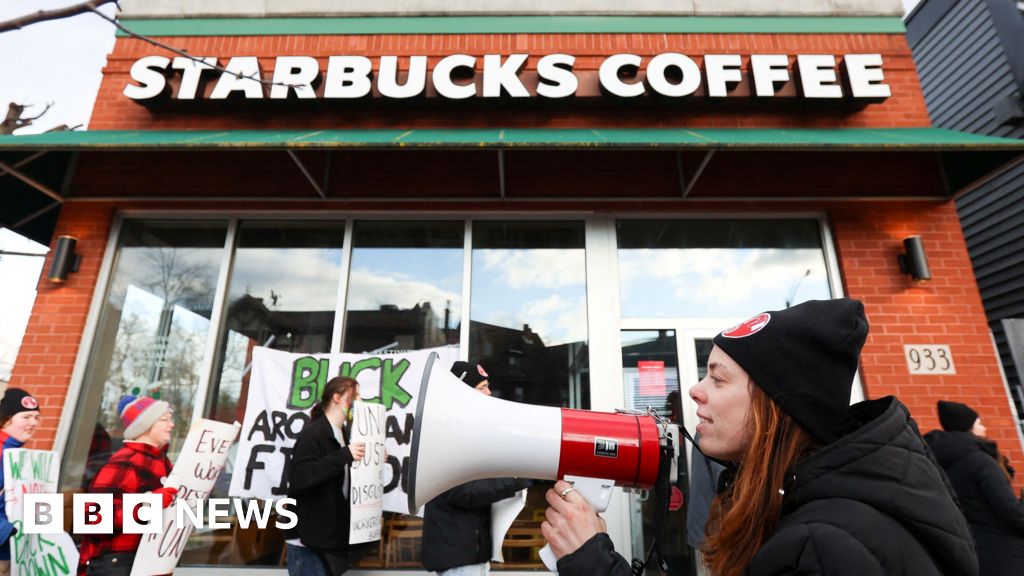
Picket lines could greet customers collecting their morning latte at some US stores on Thursday, as the company faces another strike by unionised baristas, calling for better pay and increased staffing.
The walkout, expected to affect stores in at least 25 cities, is the third major strike to hit the company in the US since the union, Starbucks Workers United, launched four years ago.
Baristas and their union say the new turnaround policies, have only added to their workload.
“Every single day at this company, as of recently, has been very, very difficult to be a barista,” said Michelle Eisen, a spokesperson for the union, which says it represents workers at more than 600 stores in the US.
“You should not be evolving to the point of running your workers to the ground,” said Eisen, who worked as a barista for 15 years before leaving Starbucks this May.
Starbucks says it does not expect the strike to disrupt operations at the “vast majority” of its more than 10,000 company-operated stores in the US.
But the action, timed to coincide with Starbucks’ Red Cup day, a major holiday sales event, risks returning unwanted scrutiny to the company at a delicate moment.

 Getty Images
In recent years the brand has faced consumer boycotts, a wave of new competitors and a customer backlash over high prices, as well as turmoil in its leadership ranks.
The arrival last year of new chief executive Brian Niccol, a veteran of successful turnarounds at Chipotle and Taco Bell, raised hopes he could do the same for Starbucks. Investors sent the chain’s shares up 24%.
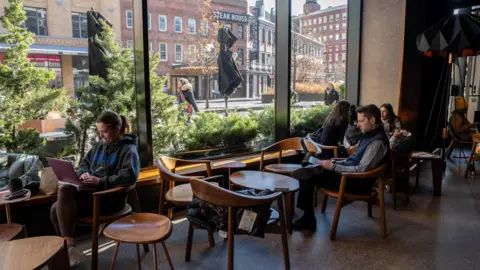
He quickly embarked on changes, part of what he called his “Back to Starbucks” strategy. He banned non-customers from bathrooms, enforced a stricter dress code for staff and re-introduced comfy seating that he said would help restore the chain’s appeal.
At the same time, Starbucks has outlined plans to invest more than $500m to improve coffeehouse staffing and training.
‘Building momentum’
Progress has been slow. Last month, Starbucks reported 1% growth in sales at global stores open at least one year – its first quarterly increase in almost two years. But in the US, sales were flat.
“We have more work to do, but we’re building momentum,” Mr Niccol said on a recent call with analysts.
But the new strategy has been accompanied by hundreds of store closures, thousands of layoffs and the sale of a 60% stake in its China business, and labour tensions have continued to fester.
Starbucks Workers United leaders say relations improved last year, but that contract discussions stalled when Mr Niccol – who was in charge of Chipotle when it faced complaints of labour rights violations – took the helm of the company last September.
Even after the two sides agreed to bring in a mediator in January, they remained at odds over pay, staffing and hundreds of unresolved charges of unfair labour practice.
 Getty Images
A union spokesperson said Starbucks has offered no pay raises in the first year of a contract, then 2% in the years following, which he said fails to account for inflation and the cost of healthcare. Baristas overwhelmingly voted down the contract offer in April.
The company, on the other hand, blames the union for stalled talks. The union’s demands for pay increases would “significantly affect store operations and customer experience”, Sara Kelly, the company’s chief partner officer, said in a statement last week.
“When they’re ready to come back, we’re ready to talk,” Jaci Anderson, a spokesperson for Starbucks, said in a statement.
“Any agreement needs to reflect the reality that Starbucks already offers the best job in retail,” she added, pointing to low staff turnover rates, and pay and benefits, that the company says add up to an average hourly wage of $30.
Pressure on the brand
Unionised coffeeshops account for only about 5% of all Starbucks stores that are directly owned by the corporation in the US, but union organisers say they have added roughly 100 more stores over the last 12 months.
This continued stand-off could pose both an operational and a reputational risk for the firm, say analysts.
The brand had already shown signs of being under pressure, said Laurence Newell, managing director in the Americas for Brand Finance, a consultancy that tracks brand strength. Starbucks fell to 45th place in its 2025 annual ranking – its lowest level since 2016 – driven in part by a decline in its reputation among customers.
“Happy customers have to come from happy employees,” said Stephan Meier, a professor of business strategy at Columbia Business School. “You can’t do that top down.”
This week, more than 80 Democrats in the House and Senate sent letters to Mr Niccol, accusing Starbucks of “union-busting” and urging the company to bargain in good faith.
Joe Pine, management adviser and co-author of the “Experience Economy”, said Mr Niccol had a lot on his plate, but he was “surprised” that he had allowed the issue to remain unresolved.
“This would seem to be one of the first things you need to do: you need to have your people on board,” he said.

A Nike logo is displayed at a Nike store in Austin, Texas, Feb. 5, 2026.
Brandon Bell | Getty Images
Shares of Nike fell in extended trading Tuesday after the retailer warned sales will fall for the rest of the calendar year, led by an expected 20% decline in its key China market during the current quarter.
Chief Financial Officer Matt Friend said during the company’s earnings call that Nike expects sales for its current fiscal fourth quarter to drop between 2% and 4%, compared with Wall Street estimates of a 1.9% increase, according to LSEG.
For the duration of the calendar year, Friend said, the company expects sales to fall by a low single-digit percentage, led by growth in North America and offset by declines in China. That outlook wasn’t comparable to estimates.
Nike beat expectations across the business on both the top and bottom lines for its fiscal third quarter, but its guidance left investors with more questions about how long its turnaround will take. Friend also cautioned that Nike’s guidance was based off of where the global economic picture stands today — and it could change given recent geopolitical volatility.
“We also recognize that the environment around us has become increasingly dynamic, and we could experience unplanned volatility due to the disruption in the Middle East, rising oil prices and other factors that could impact either input costs or consumer behavior,” said Friend. “We are focused on what we can control.”
Shares fell more than 8% in extended trading.
Here’s how the world’s largest sneaker company did for its fiscal third quarter, compared with estimates from analysts polled by LSEG:
- Earnings per share: 35 cents vs. 28 cents expected
- Revenue: $11.28 billion vs. $11.24 billion expected
The company’s reported net income for the three-month period that ended Feb. 28 was $520 million, or 35 cents per share. That’s a 35% decline from $794 million, or 54 cents per share, a year earlier. That plunge came as Nike’s gross profit margin slid 1.3 percentage points to 40.2%, “primarily due to higher tariffs in North America,” the company said.
Sales were flat at $11.28 billion, compared to $11.27 billion last year.
While Nike beat expectations on the top and bottom lines, it posted a mixed picture regionally. Nike’s largest market of North America continued to show steady growth, as revenue climbed 3% to $5.03 billion, but that was just shy of Wall Street’s expectations of $5.04 billion, according to StreetAccount.
Meanwhile, Nike’s Greater China market continued to shrink, with revenue down 7% to $1.62 billion during the quarter. Still, that total beat analyst estimates of $1.50 billion, according to StreetAccount.
Nike is continuing to work through a colossal turnaround under CEO Elliott Hill. About a year and a half into his tenure, Hill has made strides in repairing parts of the business, but has been clear that it’ll take time for the entire company to improve given the retailer’s scale and complexity.
He reiterated that expectation on Tuesday, saying in a news release that “the pace of progress is different across the portfolio.”
“The areas we prioritized first continue to drive momentum,” Hill said. “The work is not finished, but the direction is clear, our teams are moving with focus and urgency, and our foundation is getting even stronger to build the future of NIKE.”
Friend said Nike’s turnaround efforts “will continue to impact results over the balance of the calendar year.”
Nike’s recovery was already coming at a tough time as a global trade war dented its efforts to improve profitability and drive sales from inflation-weary shoppers. But now the athletic company will have to contend with a new war in the Middle East that’s already led to rising gas prices and is expected to send consumer prices even higher, which could push shoppers to cut back on nice-to-haves like new clothes and shoes to save money elsewhere.
“We continue to be encouraged by the momentum in North America. We’ve got a strong order book for summer,” Friend said. “We’re seeing positive signs and sell through. We’re not seeing a consumer reaction to what’s going on in the Middle East at this point in time, in North America.”
Hill has focused in part on revitalizing Nike’s business with wholesale partners as opposed to direct sales on its website and in stores. Wholesale revenue climbed 5% to $6.5 billion.
Meanwhile, direct sales slid 4% to $4.5 billion.
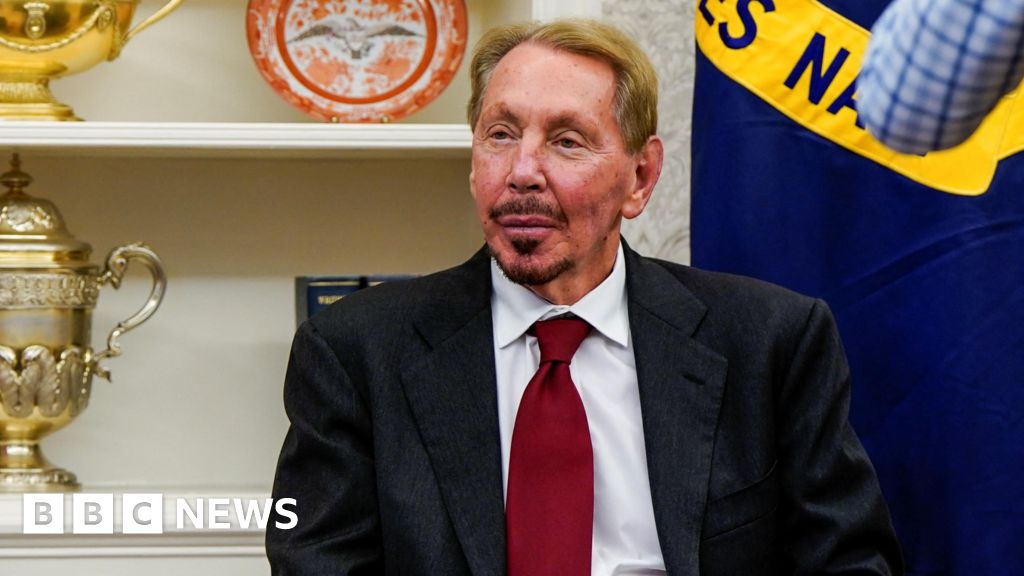
It is thought that thousands of people may have lost their jobs at Oracle, one of the world’s largest tech companies.
Source link
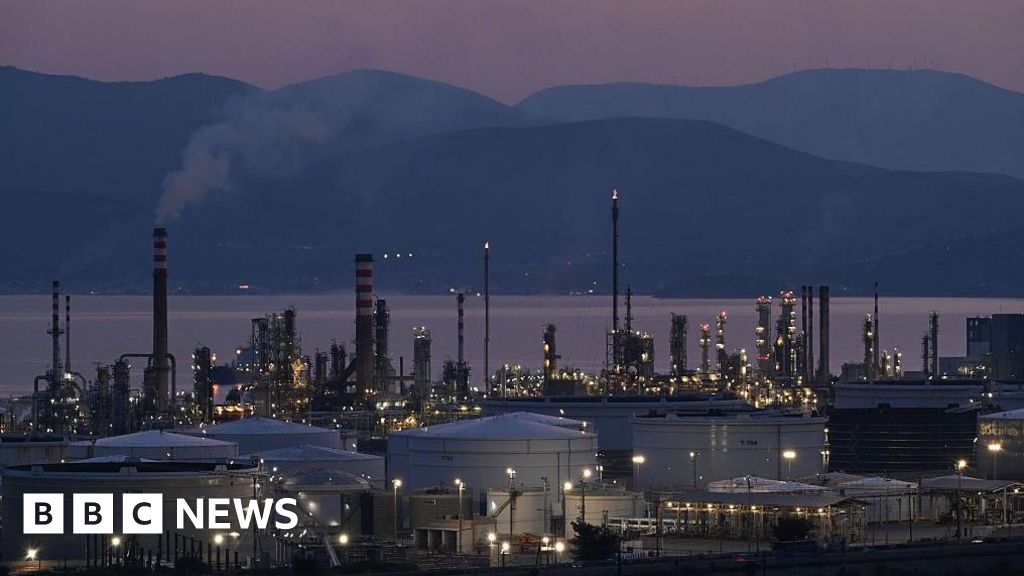
The US-Israel Iran war has halted almost all traffic in a key waterway and the price Brent crude has surged.
Source link

Nike shares fall 9% on weak outlook, expected 20% sales decline in China

Prince Harry surprises crowd by calling attendees his source of hope

Wrigley Field to host Big Ten/SEC volleyball doubleheader

-

 Politics1 week ago
Afghanistan announces release of detained US citizen
-

 Sports1 week ago
Broadcast industry CEO says consolidation is ‘essential’ to compete for NFL soaring media rights prices
-

 Entertainment1 week ago
UN warns migratory freshwater fish numbers are spiralling
-

 Tech1 week ago
Can a Home Appliance Fix the Problem of Soft-Plastic Waste?
-
 Business1 week ago
Property Play: Home flippers see smallest profits since the Great Recession, real estate data firm says
-
 Business1 week ago
Gold prices soar in Pakistan – SUCH TV
-

 Fashion1 week ago
ICE cotton slips on weaker crude, profit booking
-
 Business1 week ago
More women are entering wealth management, but few are in advisory roles, study finds