

Business
Stocks hit by Greenland worry and Japan bond slump

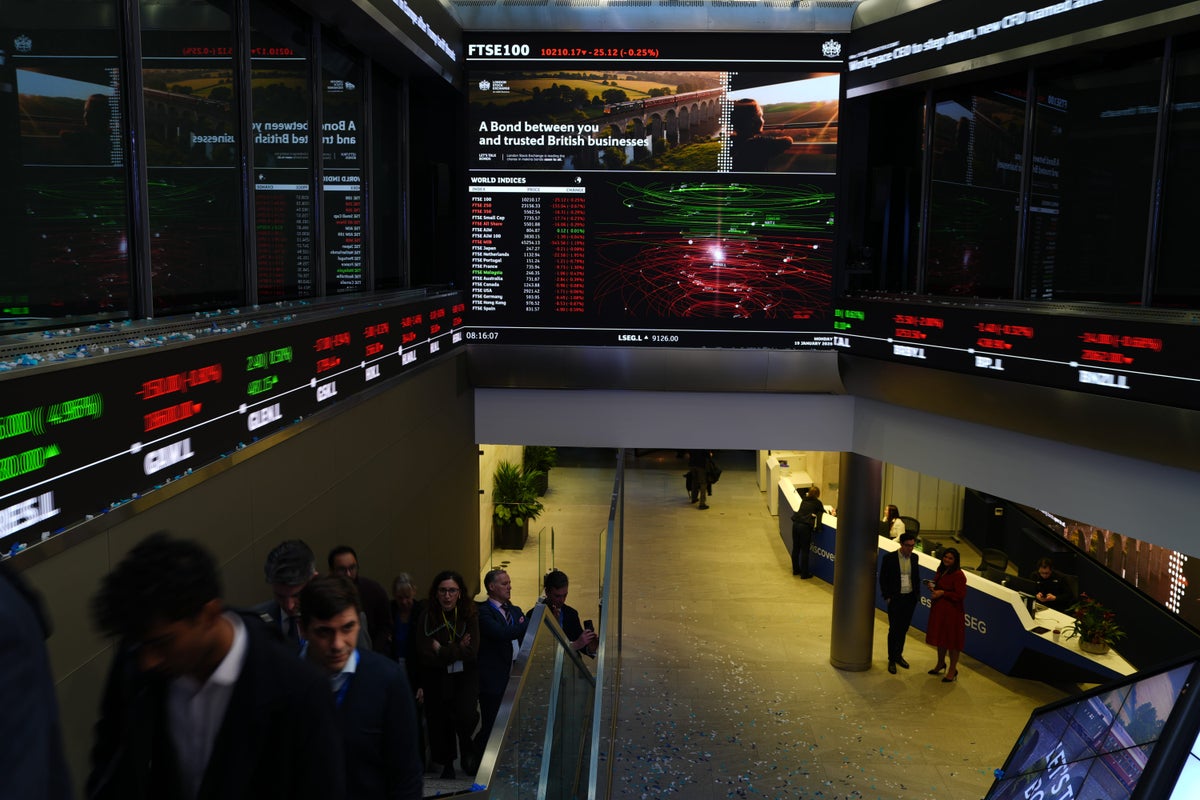
Stocks fell sharply while the bond market creaked amid ongoing tension and increased rhetoric over the future of Greenland.
The FTSE 100 index closed down 68.57 points, 0.7%, at 10,126.78 on Tuesday.
The FTSE 250 ended 153.94 points lower, 0.7%, at 22,957.87, and the AIM All-Share closed down 2.35 points, 0.3%, at 801.14.
The threat of tariffs from US President Donald Trump continued to weigh heavy on European markets, while screens on Wall Street were a sea of red as trading resumed following Monday’s public holiday.
In European equities on Tuesday, the CAC 40 in Paris closed down 0.6%, while the DAX 40 in Frankfurt ended 1.0% lower.
In New York, financial markets were lower at the time of the London equity market close.
The Dow Jones Industrial Average was down 1.3%, the S&P 500 was 1.4% lower and the Nasdaq Composite faltered 1.5%.
Mr Trump said at the weekend that, from February 1, Britain, Denmark, Finland, France, Germany, the Netherlands, Norway and Sweden would be subject to a 10% tariff on all goods sent to the US until Denmark agrees to cede Greenland.
The announcement drew angry charges from US allies who are pondering countermeasures.
“Trade concerns are now front and centre, with European leaders pushing back against Washington’s stance and reportedly discussing countermeasures,” said David Morrison, senior market analyst, at Trade Nation.
“The potential use of the EU’s Anti-Coercion Instrument has added to market unease, particularly for export-heavy sectors such as autos and luxury goods, which have already come under pressure.”
Mr Morrison pointed to apparent split over how Europe should respond to Mr Trump’s threats.
“While UK Prime Minister Starmer pursues a softly-softly approach, insisting that jaw-jaw is better than war-war, French President (Emmanuel) Macron favours a more aggressive approach and wants to fight US tariffs with European ones,” he said.
European Commission president Ursula von der Leyen cautioned that Mr Trump risked plunging US ties with the EU into a “downward spiral”.
While Mr Macron warned against US attempts to “subordinate Europe”, and blasted as “unacceptable” Mr Trump’s threats to impose tariffs of up to 25% on countries opposed to his Greenland plans.
Reports suggested Europe could consider retaliatory tariffs and also possibly a concerted strategy to offload US treasury bonds.
The yield on the US 10-year treasury was quoted at 4.28%, widening from 4.21% on Friday.
The yield on the US 30-year treasury was quoted at 4.91%, stretched from 4.82% on Friday.
The focus now switches to Davos, which Mr Trump is due to address on Wednesday.
“Escalation or softening in tone seems likely to set the direction for European risk assets in the days ahead,” said Mr Morrison.
Adding to the bond market angst was a sharp sell-off in Japan.
Kathleen Brooks at XTB Research said while the sell off in long end bond yields was global, the biggest move “by far” was in Japan.
The 30-year Japanese bond yield rose 26 basis points, as investors “fret about an expansionary fiscal policy if PM (Sanae) Takaichi wins the February 8 election,” she pointed out.
“The Greenland issue is taking the headlines today, however, in the long term, the insane rise in Japanese bond yields could have a bigger global effect,” Ms Brooks suggested.
“Japan is central to global capital flows, if there is disruption in Japanese financial markets then this could have a knock-on effect on global capital flows and overall risk sentiment,” she added.
Ms Brooks said the risk is that the sell off in bonds causes “something to break, either a Japanese bank or fund gets into trouble like Silicon Valley Bank back in 2023, which is why it is worth watching the Japanese bond market as well as the Trump show this week.”
The pound was quoted higher at 1.3462 dollars at the time of the London equities close on Tuesday, compared to1.3428 dollars on Monday.
The euro stood at 1.1733 dollars, higher against 1.1643 dollars.
Against the yen, the dollar was trading at 157.95 yen, lower from 158.11 yen.
In London, analysts weighed data which pointed to a cooling labour market and a slowing in average wage growth.
According to the Office for National Statistics, the jobless rate was 5.1% in the three months to November, unchanged from the three months to October.
This came slightly above the FXStreet-cited market consensus, which had pencilled in a slight fall in unemployment to 5.0%.
The ONS said pay-rolled employees in the UK fell by 155,000, or 0.5%, on-year in November, and fell by 33,000, or 0.1%, on-month.
Annual growth in regular earnings, excluding bonuses, was 4.5% in the three months to November, slowing from 4.6% in the three months to October.
Annual average regular earnings growth was 7.9% for the public sector and 3.6% for the private sector.
“Today’s labour market data showed easing wage pressures, weak employment and rising redundancies. We judge this to be consistent with our view that the labour market continues to ease and has further to go in coming months,” said analysts at Barclays.
Informa led the blue chip risers, up 4.6%, after reporting “strong trading” in the fourth quarter.
The London-based events, digital services, and academic publishing business expects revenue of at least £4.0 billion in 2025, up 13% from £3.55 billion in 2024, representing underlying revenue growth of 6.3%.
On the FTSE 250, the weak labour statistics weighed on PageGroup, down 3.8%, and Hays, down 0.3%.
Morgan Stanley reiterated an ‘underweight’ stance on both recruitment firms and cut share price targets.
Elsewhere, Funding Circle jumped 14% as it reported stronger-than-expected revenue and profit growth in 2025, achieving its financial 2026 revenue target a year earlier.
The London-based lending platform focused on small and medium enterprises said revenue for the year was about £204 million, up 28% from a year earlier, beating market expectations of £191 million.
Profit before tax rose to around £20 million from £3 million in 2024, also ahead of consensus of £17 million.
Wise Group jumped 15% as analysts raised profit forecasts amid strong third quarter trading.
The London-based money transfer services provider expects full-year underlying income to be around the middle of its guided range of 15% and 20% growth, and expects underlying pre-tax profit margin for financial 2026 to be “towards the top” of the guided 13% to 16% target range.
JPMorgan analyst Craig McDowell said the underlying income forecast was better than consensus at 16.3%, while the underlying pre-tax profit margin projection was ahead of consensus at 14.3%.
McDowell predicted 9% to 12% pretax profit upgrades for financial 2026, while Bank of America was more bullish, raising numbers by 20%.
Brent oil traded higher at 64.89 dollars a barrel on Tuesday, down from 64.13 dollars late on Monday.
Gold was quoted at 4,742.56 dollars an ounce on Tuesday, up from 4,671.76 dollars on Monday.
The biggest risers on the FTSE 100 were Informa, up 39.8 pence at 912.2p, Haleon, up 11.8p at 372.9p, Endeavour Mining, up 112.0p at 4,208.0p, Rentokil Initial, up 8.0p at 461.7p and Melrose Industries, up 9.0p at 625.8p.
The biggest fallers on the FTSE 100 were Mondi, down 41.2p at 845.4p, Beazley, down 44.0p at 1,126.0p, Pershing Square Holdings, down 134.0p at 4,442.0p, Land Securities, down 19.0p at 635.0p and Bunzl, down 57.0p at 1,989.0p.
Wednesday’s global economic calendar has UK inflation figures and Canadian producer price inflation data.
Wednesday’s UK corporate calendar has trading statements from luxury goods manufacturer Burberry, sports retailer JD Sports, electrical retailer Currys and pub chain JD Wetherspoon.
– Contributed by Alliance News
Jonathan Josephs,Business reporterand
Nick Edser,Business reporter
 Bloomberg via Getty Images
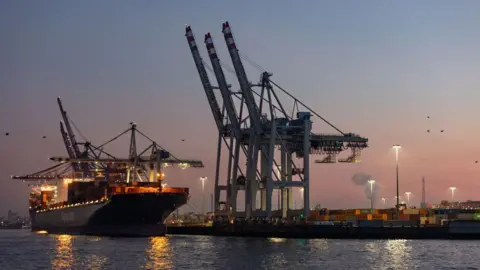
The European Parliament is planning to suspend approval of the US tariffs deal agreed in July, according to sources close to its international trade committee.
The suspension is set to be announced in Strasbourg, France on Wednesday.
The move would mark another escalation in tensions between the US and Europe, as Donald Trump ratchets up his efforts to acquire Greenland, threatening new tariffs over the issue on the weekend.
The stand-off has rattled financial markets, reviving talk of a trade war and the possibility of retaliation against the US for its trade measures.
Shares on both sides of the Atlantic were lower on Tuesday, with European stock markets seeing a second day of losses. In the US, the Dow Jones was down 1.3% in midday trading, while the S&P 500 dropped 1.5% and the Nasdaq was 1.7% lower.
On the currency markets, the US dollar also fell sharply. The euro climbed 0.7% against the dollar to $1.1731 while the pound rose by 0.2% to $1.346.
Borrowing costs also rippled higher around the world, as the biggest sell-off of long-term government debt in months drove up yields on 30-year bonds in markets including the US, UK and Germany.
Trade tensions between the US and Europe had eased since the two sides struck a deal at Trump’s Turnberry golf course in Scotland in July.
That agreement set US levies on European goods at 15%, down from the 30% Trump had initially threatened as part of his “Liberation Day” wave of tariffs in April. In exchange, Europe had agreed to invest in the US and make changes at on the continent expected to boost US exports.
The deal still needs approval from the European Parliament to become official.
But on Saturday, within hours of Trump’s threat of US tariffs over Greenland, Manfred Weber, an influential German member of European Parliament, said “approval is not possible at this stage”.
The EU had put on hold plans to retaliate against the US tariffs with its own package targeting €93bn ($109bn, £81bn) worth of American goods while the two sides finalised the details.
But that reprieve ends on 6 February, meaning EU levies will come into force on 7 February unless the bloc moves for an extension or approves the new deal.
French Prime Minister Emmanuel Macron was among those urging the EU to consider its retaliatory options, including the anti-coercion instrument, nicknamed a “trade bazooka”.
Washington’s “endless accumulation” of new tariffs is “fundamentally unacceptable, even more so when they are used as leverage against territorial sovereignty,” he said in a speech at the World Economic Forum in Davos.
American response
Also speaking in Davos, US Treasury Secretary Scott Bessent reiterated his warning to European leaders against retaliation, urging them to “have an open mind”.
“I tell everyone, sit back. Take a deep breath. Do not retaliate. The president will be here tomorrow, and he will get his message across,” he said.
Commerce Secretary Howard Lutnick and US Trade Representative Jamieson Greer warned that the US would not let retaliation go without response.
“What I’ve found is that when countries follow my advice, they tend to do okay. When they don’t, crazy things happen,” Greer said, in remarks reported by the Agence France-Presse.
The US has previously expressed impatience with European progress toward approval of the deal amid ongoing disagreements over tech and metals tariffs.
The US and the 27-nation European Union are each others’ single biggest trade partners, with more than €1.6tn ($1.9tn, £1.4tn) in goods and services exchanged in 2024, according to European figures. That represents nearly a third of all global trade.
When Trump started announcing tariffs last year, it prompted threats of retaliation from many political leaders, including in Europe.
In the end, however, many, opted to negotiate instead.
Only China and Canada stuck by their threats to hit American goods with tariffs, with Canada quietly withdrawing most of those measures in September, concerned they were damaging the Canadian economy.
In a speech in Davos on Tuesday, Canadian Prime Minister Mark Carney urged “middle powers” to unite to push back against the might-makes-right world of great power rivalry that he warned was emerging.
“When we only negotiate bilaterally with a hegemon, we negotiate from weakness. We accept what is offered. We compete with each other to be the most accommodating,” he warned. “This is not sovereignty. It is the performance of sovereignty while accepting subordination.”
Looming in the background of the trade tensions is a pending Supreme Court decision over whether many of the tariffs Trump announced last year are legal.

Netflix has significantly increased its all-cash offer to acquire Warner Bros Discovery’s studio and streaming business, intensifying an ongoing takeover battle with rival Paramount Skydance.
The revised bid aims to secure Warner Bros’ extensive film and television library, alongside its premium HBO Max streaming service, in a move that could reshape the entertainment landscape.
In December, Netflix agreed to pay $23.25 in cash, $4.50 (£3.35) worth of Netflix stock per share to buy Warner Bros assets.
The deal valued the business at around $82.7bn (£61.5 bn). However, shares in Netflix have dropped by almost 15 per cent since the deal was first announced.
The US-based streaming giant has said it will now offer $27.75 (£20.64) per share in cash to buy the business, which will include Warner Bros’ extensive library of film and TV rights, as well as its HBO Max streaming service.
Analysts have said the new terms are favourable for investors in Warner Bros Discovery.
Despite the improved financial terms, Warner Bros Discovery continues to back Netflix over a competing bid from Paramount Skydance.
The rival studios and media giant had put forward an offer of $30 per share in cash, but crucially, this was for the entire Warner Bros Discovery company, rather than just its studio and streaming divisions, highlighting a key difference in the acquisition strategies.
David Zaslav, president and chief executive of Warner Bros Discovery, expressed his enthusiasm for the impending merger.
He stated: “Today’s revised merger agreement brings us even closer to combining two of the greatest storytelling companies in the world and with it even more people enjoying the entertainment they love to watch the most. By coming together with Netflix, we will combine the stories Warner Bros has told that have captured the world’s attention for more than a century and ensure audiences continue to enjoy them for generations to come.”

Greg Peters, Netflix’s co-chief executive, underscored the strategic and financial benefits of the amended agreement.
He commented: “By amending our agreement today, we are underscoring what we have believed all along: not only does our transaction provide superior stockholder value, it is also fundamentally pro-consumer, pro-innovation, pro-creator and pro-growth. Our revised all-cash agreement demonstrates our commitment to the transaction with Warner Bros and provides WBD stockholders with an accelerated process and the financial certainty of cash consideration, while maintaining our commitment to a healthy balance sheet and our solid investment grade ratings.”
The agreed deal is contingent on Warner Bros Discovery completing a proposed spin-off of its cable channels, which include CNN, TBS, and TNT Sports in the UK.

Last Updated:
India’s Index of Eight Core Industries rose 3.7 percent in December 2025, led by cement and steel growth, while oil and gas output declined.



Infrastructure-Linked Sectors Push Core Index Higher in December
India’s core industrial sectors showed stronger momentum in December 2025, with the Index of Eight Core Industries (ICI) rising 3.7 per cent year-on-year, according to provisional government data. This marks an improvement from November’s final growth rate of 2.1 per cent, signalling a mild recovery in key production segments.
The eight core industries together account for 40.27 per cent of the weight of the Index of Industrial Production (IIP), making them a crucial indicator of overall industrial health.
Cement, Steel Lead the Growth
Cement and steel emerged as the strongest performers in December. Cement production jumped 13.5 per cent, reflecting steady demand from infrastructure and construction activity. Steel output also remained robust, rising 6.9 per cent during the month.
Electricity generation increased by 5.3 per cent, pointing to sustained power demand from industry and households. Fertilizer production grew 4.1 per cent, offering support to the agricultural sector, while coal output rose 3.6 per cent, helping ease supply pressures.
Oil and Gas Remain a Weak Spot
In contrast, the oil and gas segments continued to struggle. Crude oil production declined by 5.6 per cent, while natural gas output fell 4.4 per cent in December compared to the same month last year. Petroleum refinery production also slipped 1.0 per cent, highlighting ongoing operational and supply-side challenges in the energy sector.
Cumulative Growth Still Modest
For the April–December 2025-26 period, the cumulative growth of the core industries stood at 2.6 per cent, slightly muted despite strong gains in cement and steel. Steel recorded a sharp 9.5 per cent cumulative growth, while cement rose 8.8 per cent.
However, coal, crude oil, and natural gas saw cumulative declines, which weighed on the overall index.
 Click here to add News18 as your preferred news source on Google.
January 20, 2026, 18:31 IST
Read More


‘Veronika’ Is the First Cow Known to Use a Tool

Represent x Puma in collab return with on- and off-court basketball line

‘We don’t give in to bullies’, Macron says after Trump salvo

-

 Tech1 week ago
New Proposed Legislation Would Let Self-Driving Cars Operate in New York State
-

 Entertainment1 week ago
X (formerly Twitter) recovers after brief global outage affects thousands
-

 Sports5 days ago
Pak-Australia T20 series tickets sale to begin tomorrow – SUCH TV
-

 Politics4 days ago
Saudi King Salman leaves hospital after medical tests
-

 Fashion4 days ago
Bangladesh, Nepal agree to fast-track proposed PTA
-
 Business4 days ago
Trump’s proposed ban on buying single-family homes introduces uncertainty for family offices
-

 Tech5 days ago
Meta’s Layoffs Leave Supernatural Fitness Users in Mourning
-

 Tech6 days ago
Two Thinking Machines Lab Cofounders Are Leaving to Rejoin OpenAI