

Fashion
Summer 2026 looks set to be romantic with Sacai, Zimmermann, Ungaro and Agnès b

Published
October 7, 2025
Silhouettes elongate or gain volume; ornamentation gleams with sparkling details; the wardrobe grows more sophisticated. This romantic, faintly glamorous vein came to the fore on the eighth day of the Paris shows devoted to Spring-Summer 2026. On Monday, numerous collections homed in on a new feminine elegance, as redefined by Sacai, Zimmermann, Agnès b. and Ungaro, among others.
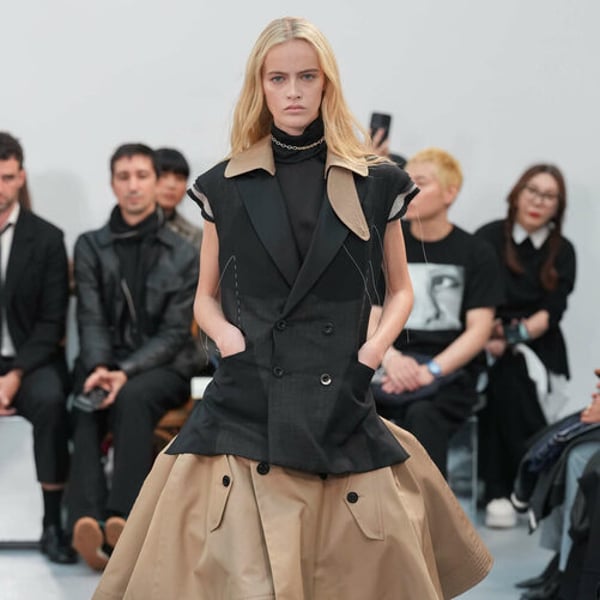
Unusual constructions, layering, and material blends. For her Spring-Summer 2026 collection, shown on Monday at the brand’s new headquarters—an old building with a vast glass roof, formerly occupied by Balenciaga on rue Cassette in the 6th arrondissement—Japanese designer Chitose Abe returns to her fundamentals, revisiting the key ingredients behind Sacai’s success.
Trench coats, denim, knitwear, outerwear, the white shirt, the little black dress and more. She surveyed the archetypes of the women’s wardrobe, blowing them apart before recomposing them into covetable hybrids. Black and white reappeared in voluminous silhouettes, finished with Oxford shoes sporting oversized tassels that lent an eighteenth-century air to the whole. The mood was epitomised by supermodel Naomi Campbell in a superb sleeveless tuxedo with a train.
Each piece was distinctive—almost unique in its construction, detailing or fusion of materials—yet appeared easy to wear, conveying a sense of freedom and movement. With Sacai, fashion is, more than ever, a game, and this season the house explored a new technique of “reversal”: the lower sections of classic garments flip up to fasten high on the body, creating unexpected forms.
For example, black trousers were hoisted up, anchored to the shoulders of a tuxedo jacket that becomes an oval cape. The same trick applied to the hem of a long white shirt, laced through eyelets at the shoulders, and to the panels of long canvas skirts, which rose to the waist to create peplums and ballooning shapes. Elsewhere, a trench morphed into a petticoat and a shirt, tuxedo and skirt become one.
Movement was omnipresent in undulating or godet-flared blouses and skirts. A shot of lime yellow enlivened a black-and-white patchwork maxi dress. Leather blousons and denim pieces were taken apart and recomposed into puzzle-like garments with rounded contours. Further on, mini dresses emerged from a mix-and-match of patterns (stripes, polka dots, flowers), while waterproof canvas fused with tuxedo satin. Tweed dresses unravelled into cascades of fringing, rounding off a breathtaking collection brimming with energy and invention.

Absent from the catwalks since 2019, Agnès b., real name Agnès Troublé, made her triumphant return on Monday at Paris Fashion Week with a grand manifesto show charting her half-century in fashion. The occasion also marked her return to fragrance, with a new scent authored by the designer and perfumer Isaac Sinclair. “Agnès b. Paris Le Parfum” will be launched on October 14. Made in France, it embodies “discretion, timeless elegance and the freedom to be oneself”.
Nearly 90 models, including 15 men, traversed the long runway installed at the Collège des Bernardins, accompanied by a live concerto. Principal dancer Hugo Marchand opened the show to an aria from Rameau’s “Les Indes Galantes”, played on piano by Martin Beau. What followed was a seemingly endless parade of the creations that have marked the brand’s history, with numerous archive pieces, reworked models and new releases.
The first part was devoted to her ultra-light dresses in fine cotton, including butter muslin—very airy and washed “so it shrinks a little”—as well as light linen. There were petticoats, including the reworked “tango” model, dungarees and mechanic’s coveralls, apron dresses and crepe tailoring. Not forgetting artists’ T-shirts, Elvis straight-leg trousers, button-front dresses with Peter Pan collars, the harpsichord shirt (without buttons). Not forgetting, of course, polka dots, gingham fabric, denim, unisex leather jackets, satin used to cut cargo trousers and an eighteenth-century-style linen frock coat, from the designer’s favourite era.
At 83, Agnès can still deliver lessons in dressmaking, with her precision in cut and construction—not to mention her meticulous attention to armholes. The secret of her success? She has always remained true to her style since her debut in 1975, without ever renouncing it. Comprising informal, easy-to-wear pieces alongside more elaborate ones, each imbued with quintessential Parisian chic, the Agnès b. wardrobe covers every daily need, from morning to night, addressing everyone, men and women of all ages, with a timeless yet characterful style that has continued to captivate for five decades.

Pastel décor, the cries of seagulls, the soft waft of the brand’s next in-store fragrance, Zimmermann set a decidedly summery tone, immersing us this season in the bohemian, arty atmosphere of Lavender Bay in the seventies. At the time, this industrial corner of Sydney Harbour—with its disused warehouses wedged between a Luna Park and the railway—sprang to life, attracting an exuberant artistic community.
It’s this carefree effervescence that Australian designer Nicky Zimmermann translated with brio in her collection, while modernising the theme. A fresh, joyful spirit pervaded the show, which made much of vibrant colours (emerald green, petrol blue, orange, and pink), soft-focus floral prints à la David Hamilton and a nonchalant allure.
Blouses and maxi dresses were by turns ethereal in billows of ruffles, or demure in white cotton lace. Trousers were worn baggy or very flared. Front-zipped jumpsuits, worn unzipped, gave the models—in dark sunglasses, sandals or clogs—a touch of house painter. Chic pleated trousers sat low on the waist, revealing a high-cut swimsuit. Long dresses glided sinuously along the body. The women oscillated between a headscarf and sparkling gold jewellery.
A collection that should prove successful, like the previous ones, Zimmermann being one of the few brands to continue to post growth in today’s market with its accessible luxury, which appeals well beyond its native Australia.

The treasures of the Louvre served as the starting point for Ungaro’s collection, in particular Ingres’s “L’Odalisque”. “In this collection, there’s Orientalism, with a mix of cultures, but also a ‘cabinet of curiosities’ side. I wanted to celebrate femininity and freedom, imagining these women going from the Louvre to the flea market, mixing all sorts of influences,” explained artistic director, Kobi Halperin.
The result was a collection both rich and delicate, all about lightness via silky fabrics with floral prints, gauzy gypsy dresses, more sensual versions in fluid satin and clouds of ostrich feathers, which lent an airy touch to the ensemble. Several pieces in lace and guipure (dresses, as well as jackets, skirts, shorts and trousers) let the air circulate in a fresh, boudoir spirit.
The wardrobe is conceived to be versatile, with interchangeable pieces to mix and match from day to evening. Take your pick from beautiful shirt dresses, weightless summer dresses in chiffon or cotton, monochrome or printed, little tweed jackets to pair with leopard shorts, and the classic suit with its elegant double-breasted jacket, in white or a precious brocade.
This article is an automatic translation.
Click here to read the original article.
Copyright © 2025 FashionNetwork.com All rights reserved.








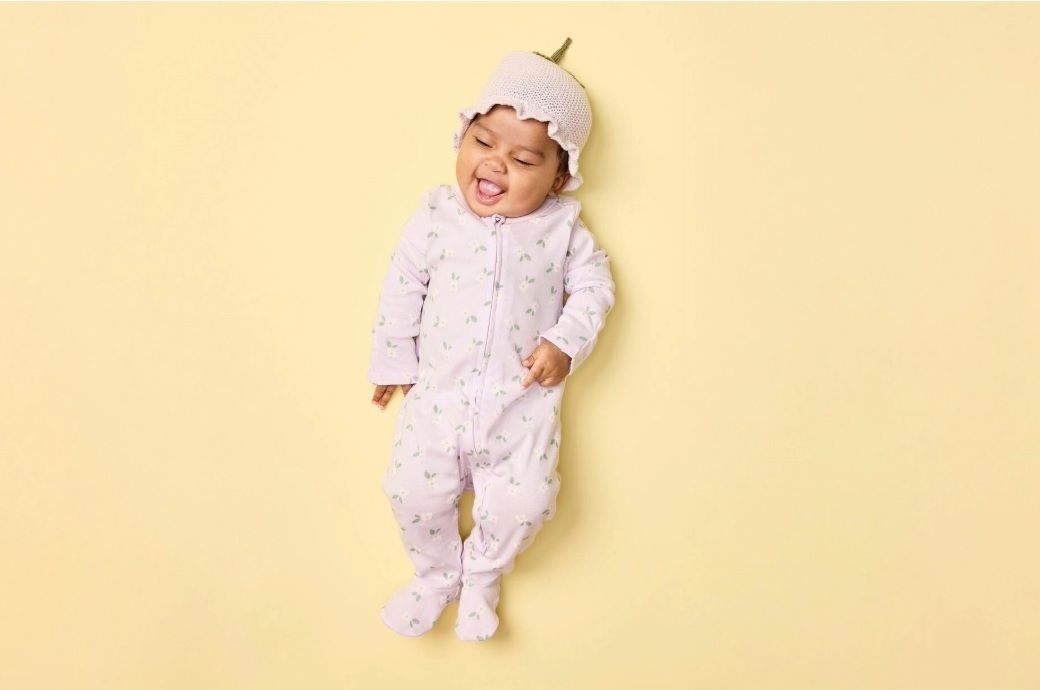
“We designed this collection with parents in mind. Shopping for a newborn, as a gift or for your own, should feel joyful and easy. Everything is intended to be mixed together and matched — it’s fun, it’s emotional, and the value is incredible.”. – Sarah Holme, Head of Design & Product Development for Old Navy.
Old Navy has introduced Little Navy, a new collection of newborn essentials designed to simplify early-stage shopping and gifting.
The range includes layettes, hats, booties and mix-and-match basics in soft, seasonless colours and cosy fabrics.
Sized for babies up to 24 months, the line focuses on comfort, versatility, emotional appeal and strong value for modern parents.
Little Navy goes beyond onesies, offering layettes, hats, booties, and more, all in one convenient collection and no extra searching required. It features a soft, seasonless color palette, cozy fabrics, and versatile styles made for newborns and babies up to 24 months, with sizing that allows Little Navy to grow with baby.
Note: The headline, insights, and image of this press release may have been refined by the Fibre2Fashion staff; the rest of the content remains unchanged.
Fibre2Fashion News Desk (RM)
They said bank audit procedures have stalled numerous applications. Around Tk 57 billion in incentives for the textile and apparel sector remain unsettled in fiscal 2025-26, creating acute liquidity pressure and affecting exports.
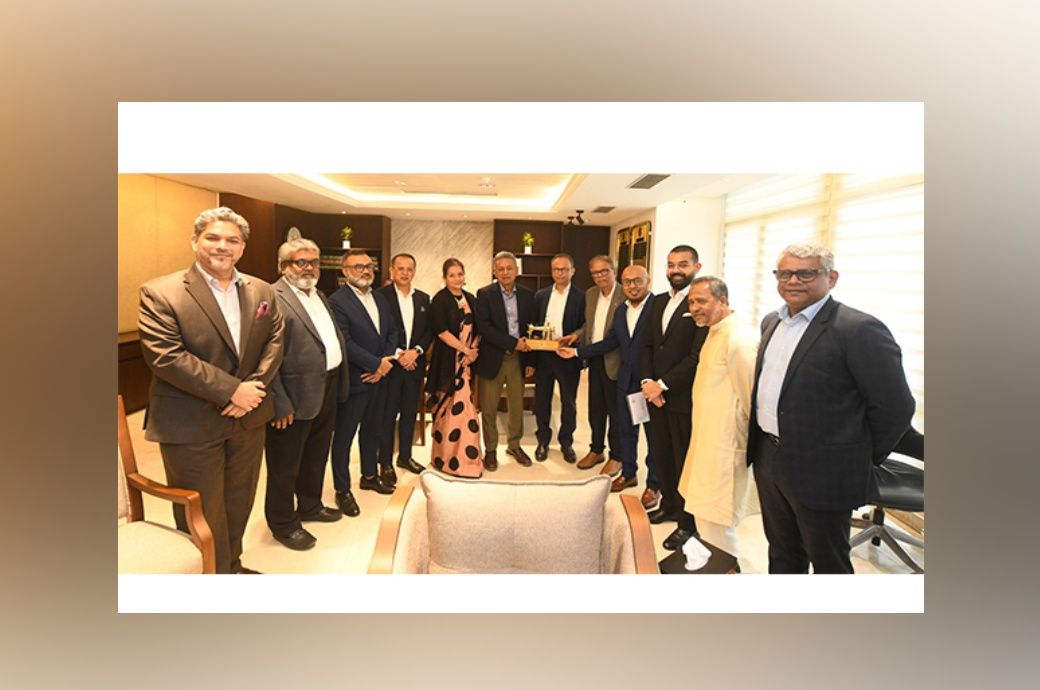
Bangladesh trade body BGMEA representatives recently met Finance Minister Amir Khasru Mahmud Chowdhury and urged him to release pending cash incentives without waiting for quarterly release schedules and simplify the disbursement process.
They said bank audit procedures have stalled numerous applications.
They also raised concerns over loan rescheduling and working capital.
The authorities were requested to disburse incentives upon application submission instead of waiting for quarterly release schedules, according to a release from the trade body.
BGMEA vice president Mohammad Shihab Uddoja Chowdhury raised concerns over loan rescheduling and working capital. He said banks often reschedule loans to maintain non-performing loan ratios, but fail to provide the working capital factories need to resume operations.
He proposed that banks pair rescheduling with working capital support to create a win-win outcome, allowing factories to operate and repay loans. The finance minister agreed with the proposal.
BGMEA leaders also called for business facilitation and lower operational costs to help Bangladesh remain competitive in the global market. They sought policy support to remove obstacles in customs, ports and other administrative layers and to ensure an investment-friendly environment.
Fibre2Fashion News Desk (DS)

Bangladesh think tank Centre for Policy Dialogue has called for major reforms in business environment, tax collection, trade deals and FDI management, cautioning that the country’s post-election economic transition may be at risk without evidence-based decisions and strong accountability.
A CPD study identified ‘leaking revenue’ as the weakest area across all decision-making indicators.
Source link


Billie Eilish crawls into her past with Justin Bieber

Attacks on GPS Spike Amid US and Israeli War on Iran

Most vs. least predictable men’s conference tournaments

-

 Politics1 week ago
Pakistan carries out precision strikes on seven militant hideouts in Afghanistan
-

 Tech1 week ago
These Cheap Noise-Cancelling Sony Headphones Are Even Cheaper Right Now
-
 Business6 days ago
Households set for lower energy bills amid price cap shake-up
-

 Entertainment1 week ago
Talking minerals and megawatts
-
 Business6 days ago
Lucid widely misses earnings expectations, forecasts continued EV growth in 2026
-

 Sports1 week ago
South Africa thrash India by 76 runs in T20 World Cup Super 8 – SUCH TV
-
 Business1 week ago
Haryana Govt bars IDFC First Bank, AU Small Finance Bank over alleged Rs 590 crore fraud
-

 Sports7 days ago
Top 50 USMNT players of 2026, ranked by club form: USMNT Player Performance Index returns