

Politics
Super-rich pay up to $350,000 for private jet evacuations as Middle East conflict escalates

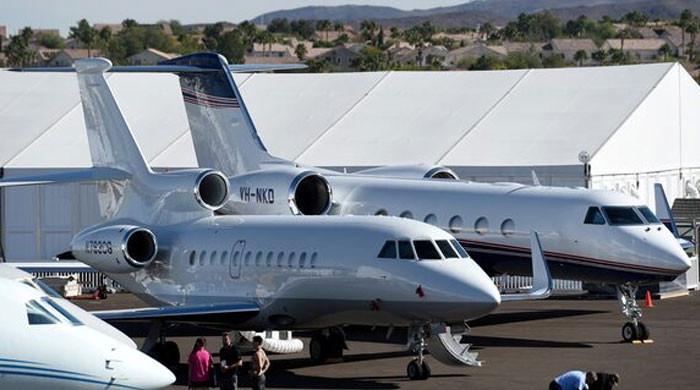
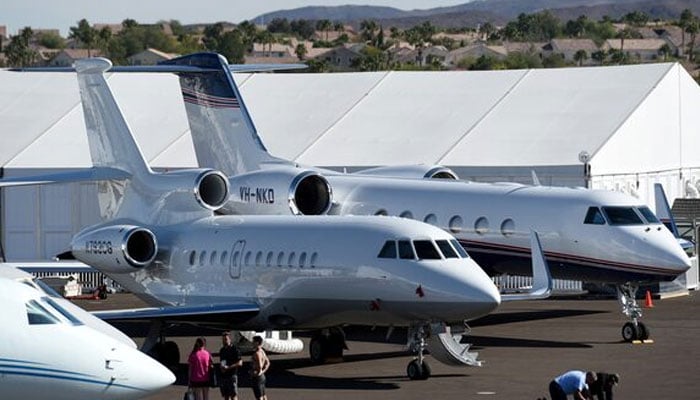
- Sharp rise in demand pushing private jet prices higher.
- Wealthy elites are fleeing to Saudi Arabia from Gulf countries.
- Riyadh eases visa rules amid ongoing Middle East crisis.
Private jet prices to evacuate Gulf countries are soaring after Middle East conflict escalates following the assassination of Iran’s Supreme Leader Ayatollah Ali Khamenei in the joint strikes launched by the US and Israel.
The Middle East conflict expanded with no end in sight, with Israel attacking Iran and Tehran firing missiles and drones at the “US interests and bases” across the Gulf states.
Global airlines cancelled flights across the Middle East after the US and Israel launched strikes on Iran, driving private jet rental prices to record highs amid the travel chaos.
In view of the prevailing situation, wealthy elites are fleeing to Saudi Arabia to evacuate the Gulf, as Iranian missiles and drones rained over Abu Dhabi, Dubai, Qatar, and Bahrain —previously perceived to be safe countries.
Riyadh is becoming a key exit route for those looking for a safe route out of the Middle East, as the airport in the Saudi Arabia capital is one of few still operating.
Private security companies are reportedly booking fleets of SUVs to transport people on the 10-hour drive to Riyadh from Dubai and then are chartering private planes.
Among those being evacuated are senior executives at global finance firms and high-net-worth individuals who were holidaying in the region or were there on a business trip.
The sharp rise in demand for an emergency exit is pushing prices for SUVs and private jets up, as it has been reported that private jets from Riyadh to Europe now cost up to $350,000 (£260,000), The Daily Mail reported.
Saudi Arabia is seemingly the safest country to currently get out of the Middle East, after routes out of Oman were closed following Iran’s strike on the port and an oil tanker in the country on Sunday.
Riyadh hosts one major international airport – the King Khalid International Airport, about 35km from the city centre. The airport has five passenger terminals and usually flies to Europe, America, Asia, the Middle East and Africa.
Visa rules have also loosened in Saudi Arabia, meaning many nationalities can get a visa upon arrival rather than in advance, making it appealing as an emergency exit route for many.
Saudi’s defence ministry confirmed two drones were intercepted and destroyed earlier today.
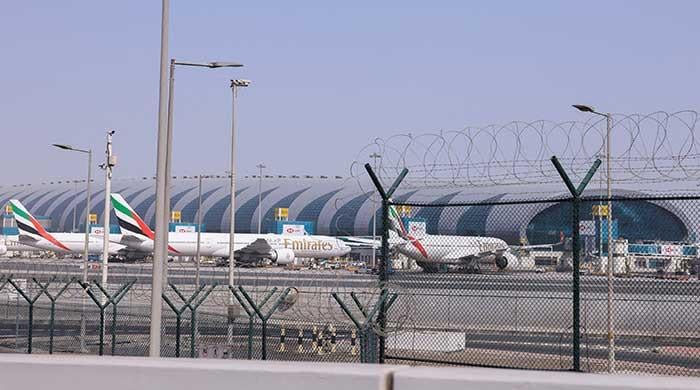
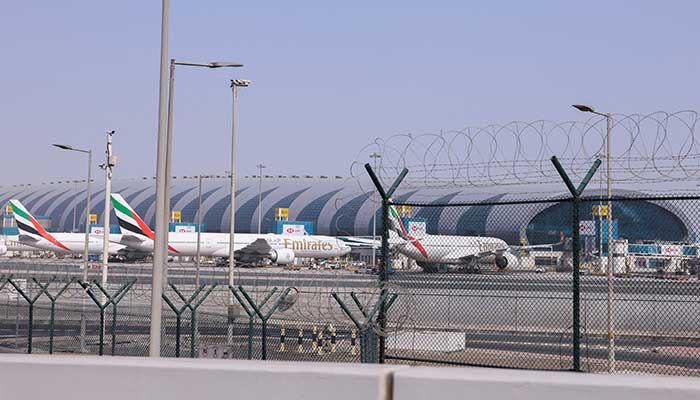
- Emirates, flydubai to restart limited flights from today.
- Etihad Airways announces resuming flights on Tuesday.
- Iran strikes targeted Gulf airports, airspace remains restricted.
Dubai Airports said “limited” flights would resume on Monday evening, three days after they were cancelled as Iran began striking targets in the Gulf, including Dubai and Abu Dhabi airports.
Global air travel remained in severe disarray since Sunday as sustained air strikes forced the closure of major Middle Eastern airports, including Dubai — the world’s busiest international transit hub — in one of the most significant aviation disruptions in recent years.
Transit gateways such as Dubai and Abu Dhabi in the United Arab Emirates, as well as Doha in Qatar, were either shut down or operating under heavy restrictions, with large sections of regional airspace closed.
The disruption followed US and Israeli strikes that reportedly killed Iranian Supreme Leader Ayatollah Ali Khamenei on Saturday, plunging the Gulf into heightened uncertainty.
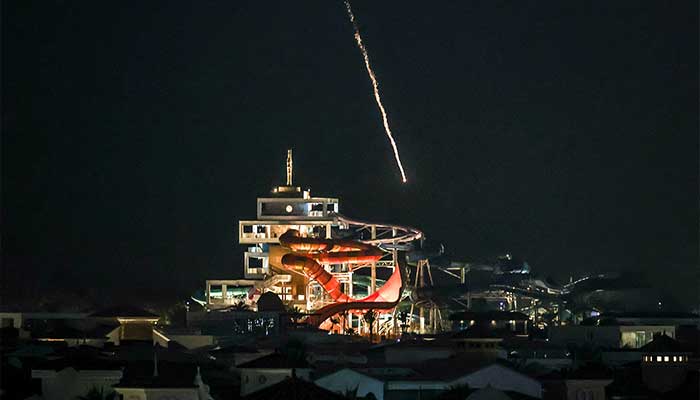
A fresh wave of attacks extended into a third consecutive day, deepening concerns over regional stability and prolonging the paralysis of air traffic.
“Dubai Airports announces a limited resumption of flights from Dubai International Airport (DXB) and Dubai World Central – Al Maktoum International Airport (DWC) starting this evening, Monday, March 2, 2026,” it said in a statement.
Emirates and low-cost carrier flydubai both said they would resume some flights on Monday evening.
In a post on X, Emirates, one of the UAE’s flag carriers, said it would prioritise passengers with existing bookings. Travellers rebooked on the limited services will be contacted directly by Emirates.
All other flights remain suspended until further notice, the airline said, urging passengers not to travel to the airport unless formally notified. It added that operations will be adjusted in line with developments on the ground.
Eihad Airways, which operates flights from Abu Dhabi, said it would resume flights on Tuesday.
Iran’s unprecedented bombardment in the Gulf states has hit military bases but also civilian infrastructure such as residential buildings, hotels, airports and sea ports, rattling a region long seen as a refuge from Middle East conflict.
Since Iran launched its campaign on Saturday, Dubai, Abu Dhabi, Kuwait and Manama airports were targeted.
Authorities reported one death in the Emirati capital Abu Dhabi in the “incident” at the facility.
On Saturday, the UAE announced it had closed its airspace “temporarily and partially” as an exceptional precautionary measure.
Dubai’s main airport (DXB) ranks as the second-busiest worldwide, behind Atlanta in the United States, according to Airports Council International.
The airspace closures hit a vital sector for the city, with Dubai’s air industry accounting for about a third of the emirate’s economy.
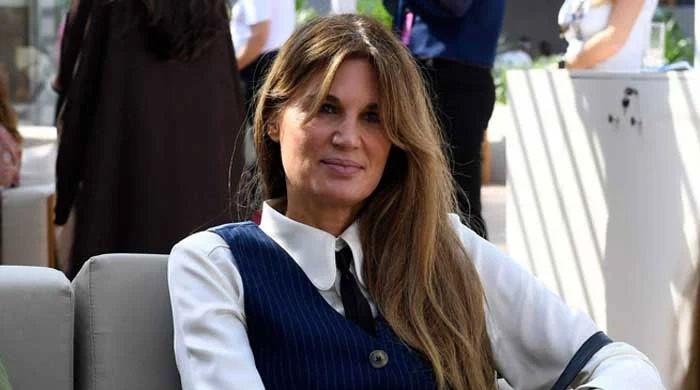
LONDON: TV producer and journalist Jemima Goldsmith blamed her builders as she was convicted and fined £1,000 over a run-in with the Metropolitan Police over a case related to breaking the speed limit.
The 52-year-old, the former wife of PTI founder and leader Imran Khan, failed to respond to police letters after a Mini Clubman vehicle registered in her name was caught breaking the speed limit in north London.
Jemima Goldsmith eventually offered up the name of the guilty driver who had been using her car, but by then she had missed the deadline to respond to avoid court proceedings.
Explaining the blunder, Goldsmith blamed major renovation work on her £10 million Kensington home.
“Due to ongoing construction works at the property where my car is registered, which made access tricky, the original letter was mislaid by builders and I was unaware of its existence until October,” she wrote, in a note to Westminster Magistrates’ Court.
“As soon as it was received, I completed and returned the form immediately.”
Court papers show Goldsmith named a man called Anthony Reilly, who lives in Switzerland, as the person who had been driving the Mini when it was caught doing 46mph on a 40mph stretch of the A1 in Hampstead on August 28 last year.
But her response was dated November 4 – six days after the final police deadline and two months after the first notification of a speeding ticket.
In a letter to the court, Goldsmith also referenced the death of her mother, Lady Annabel Goldsmith, in October last year at the age of 91.
“My PA, who collects the post, had been on annual leave in October and my mother died on the 18th that month, so I was less on top of things than I am normally. I am very sorry for the delay and inconvenience caused. I fully accept that a fine is due.”
Goldsmith was convicted by magistrate Gladys Famoriyo of failing to give information relating to the identification of the driver of a vehicle when required.
The magistrate imposed a £1,000 fine, six penalty points for her licence, and also ordered Goldsmith to pay £130 in costs and a £400 victim surcharge.
Goldsmith, who is known professionally as Jemima Khan, is the founder of a TV production company and has worked as a screenwriter and magazine editor.
She married former cricketer Imran Khan in 1995, and they have two children together.
Documents filed with Kensington and Chelsea Council show Goldsmith successfully applied last year for permission to carry out major renovations on her home, including the demolition and “grand” rebuild of one of the wings of the luxury property.
She was prosecuted over her failure to identify the speeding driver in the Single Justice Procedure, a fast-track court process which spares defendants the need to come to court and allows magistrates to make decisions on convictions and sentences in closed-door hearings.
Goldsmith was among 1,905 defendants who were convicted and sentenced last week for failing to identify the driver of a vehicle when contacted by police.
More than 330 of those defendants lost their licence as a result of the conviction.
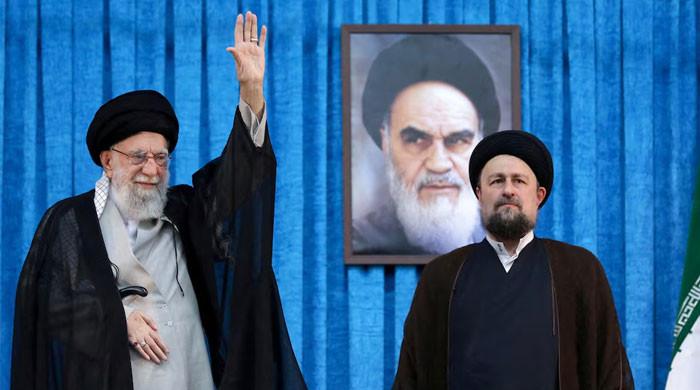
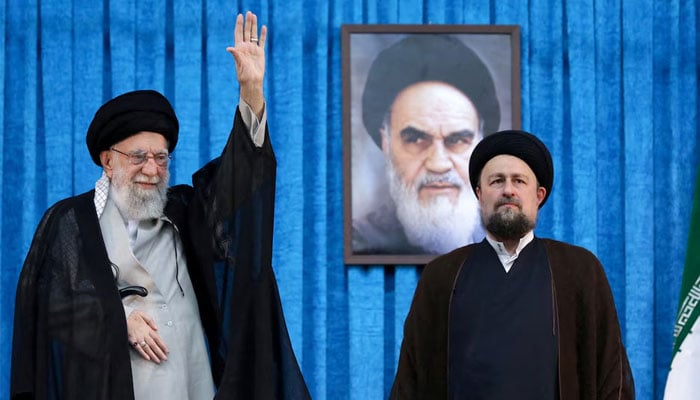
A grandson of Ayatollah Ruhollah Khomeini, the late founder of the Islamic Republic of Iran, is likely to figure prominently in the deliberations of the clerics who will determine who replaces Ayatollah Ali Khamenei as Supreme Leader.
The martyrdom of Khamenei, 86, in a US-Israeli attack has brought new urgency to the question of who will be the next Supreme Leader, a long-simmering issue over which there had been no clarity despite his age.
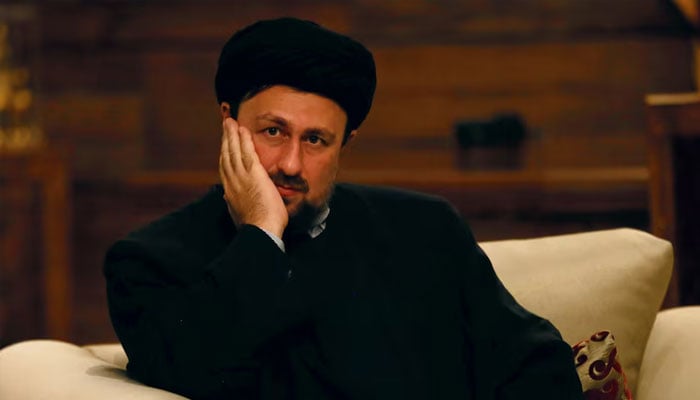
Hassan Khomeini is the most visible of the late Ayatollah’s 15 grandchildren and is seen as a relative moderate within Iran’s clerical establishment. He enjoys close ties to reformists including former presidents Mohammed Khatami and Hassan Rouhani, who both pursued policies of engagement with the West when in office.
Khomeini, 53, holds a symbolically important role in public life as custodian of his grandfather’s mausoleum in southern Tehran. He has never served in government.
Some politicians inside Iran have seen him as a rival to hardliners who gained sway under Khamenei, notably his son, Mojtaba.
The case for installing a moderate successor to Khamenei gained momentum among some Iranian politicians in the wake of unrest that swept Iran in January as a means of shoring up the Islamic Republic in the face of widening dissent.
Khomeini demanded accountability for Amini’s death
While loyal to the Islamic Republic established after the Shah was toppled in 1979, Khomeini has a track record of urging reform and has occasionally voiced dissent against authorities.
In 2021, he criticised the Guardian Council – the branch of Iran’s theocracy responsible for vetting presidential candidates – after it barred reformists from running.
The council’s move paved the way for the victory of hardliner Ebrahim Raisi, who died in a helicopter crash in 2024.
“You can’t pick someone for me and tell me to vote for them!” Khomeini said at the time.
He also demanded accountability after Mahsa Amini, a young Iranian woman, died in 2022 after being taken into custody by morality police, accused of violating conservative dress codes – an incident that ignited countrywide protests.
Authorities “must transparently and precisely account for what has happened to this 22-year-old girl under the pretext of ‘guidance and education’,” he said.
But, reflecting his loyalty to the system, the mid-ranking cleric also criticised protesters who chanted against Khamenei.
During the unrest that swept Iran in December and January — the deadliest since the 1979 revolution — he rallied behind the establishment, accusing rioters of serving Israel, taking part in a pro-government march, and likening some of the violence to the actions of Islamic State.
In a condolence letter, Khomeini said Khamenei would forever “be the hero of the people of Iran and Muslims”, adding: “The noble people of Iran will once again walk the path of the Imam (Khomeini) by overcoming this incident.”
‘Progressive Theologian’
A close friend of Khomeini’s, speaking to Reuters in 2015, described him as a progressive theologian, especially when it comes to music, women’s rights, and social freedom. He follows trends on social media and is interested in Western philosophy as much as Islamic thought.
His wife, Sayyeda Fatima, is the daughter of an Ayatollah, and they have four children.
Some reformists urged him to run for the presidency in 2012, but he declined.
Khomeini supported the Rouhani government that negotiated the 2015 nuclear agreement, which eased sanctions in return for limits on the nuclear programme – until US President Donald Trump tore it up in 2018.
He has spoken openly about economic hardships endured by Iranians during years of sanctions imposed over the nuclear programme.
A decade ago, Khomeini sought to run in an election for the Assembly of Experts, the body responsible for picking the Supreme Leader.
He secured an initial nod of approval for his candidacy from Khamenei, who reportedly gave his blessing while also cautioning Khomeini against doing any harm to his grandfather’s name. But he was later disqualified by the Guardian Council.
Though his religious credentials were cited for the disqualification – Khomeini holds the clerical rank of Hojatoleslam, one notch below Ayatollah – the move was seen as intended to head off a potential challenge by the reformist camp.
In 2008, he was widely regarded as criticising Iran’s powerful Islamic Revolutionary Guards Corps (IRGC) when he said in an interview that those claiming loyalty to his grandfather’s legacy should follow his order that the military must stay out of politics. He nevertheless enjoys close ties to the Guards, an elite force tasked with safeguarding the Islamic Revolution.
During the 12-day air war between Israel and Iran last year, Khomeini wrote to Khamenei praising his leadership and saying Iranian missiles had become a nightmare for Israel and a source of satisfaction for the Iranian nation, according to Jamaran, an Iranian news website dedicated to Khomeini’s memory.
Khomeini has described Israel as the “evil Zionist regime” and “a cancerous tumour” backed by the West, and has said the Muslim world should make itself strong to confront Zionism, according to statements reported by Jamaran.
He is fluent in Arabic and English, according to the biography, and was a keen footballer until the age of 21, when his grandfather insisted he go to the city of Qom to study Islamic theology.


Billie Eilish crawls into her past with Justin Bieber

Attacks on GPS Spike Amid US and Israeli War on Iran

Most vs. least predictable men’s conference tournaments

-
 Politics1 week ago
Pakistan carries out precision strikes on seven militant hideouts in Afghanistan
-

 Tech1 week ago
These Cheap Noise-Cancelling Sony Headphones Are Even Cheaper Right Now
-
 Business6 days ago
Households set for lower energy bills amid price cap shake-up
-
 Entertainment1 week ago
Talking minerals and megawatts
-
 Business6 days ago
Lucid widely misses earnings expectations, forecasts continued EV growth in 2026
-
 Sports1 week ago
South Africa thrash India by 76 runs in T20 World Cup Super 8 – SUCH TV
-
 Business1 week ago
Haryana Govt bars IDFC First Bank, AU Small Finance Bank over alleged Rs 590 crore fraud
-

 Sports7 days ago
Top 50 USMNT players of 2026, ranked by club form: USMNT Player Performance Index returns