

Business
The factory-built future of British construction


The introduction of the industrial production line in car manufacturing, pioneered by Henry Ford in the early 20th century, revolutionised the automotive industry and global manufacturing practices. But there is one sector that has—remarkably—failed to embrace the full potential of industrialised models of production: construction. Just look at housebuilding—while advanced manufacturing is now utilising robots and AI, in many ways homes are still being built as they were 100 years ago: with contractors laying bricks in muddy fields.
But technologies to modernise construction do exist. At Reds10 we have been pioneering them for more than a decade now, developing highly sustainable, innovative, high-quality modular buildings offsite in our dedicated factories in Driffield, East Yorkshire, for the public sector. These include amazing homes for the military, school buildings and facilities for the Ministry of Justice and the NHS.
However, in the UK this process, known as Modern Methods of Construction or MMC, has yet to enter the mainstream. This is at least in part due to the nature of our housebuilding market, dominated as it is by a small number of large housebuilders, who have a near monopoly over the market and therefore little incentive to drive forward innovation.
In the UK modular construction has also suffered from a perception problem — a hangover from poorly constructed post-war prefabricated buildings. This perception is grossly outdated: a bit like comparing a Morris Marina with a Tesla. Take, for example, our award-winning Imjin Barracks project, a highly sustainable three-storey building that provides the UK’s defence personnel with modern, comfortable and technologically advanced accommodation. Built offsite through our advanced construction techniques, Imjin Barracks, like all the projects Reds10 delivers, is unrecognisable from the much-maligned ‘prefabs’ of yesteryear and is indistinguishable from buildings built through traditional construction techniques.
But it is not just residential developments that can benefit from industrialised construction techniques. Reds10 has been working with the government’s multibillion-pound New Hospital Programme (NHP) to develop a prototype for the new in-patient bedroom that will be delivered in the first wave of state-of-the-art hospitals that will be built over the next five years. The full-scale model room, complete with ensuite and corridor, is now undergoing an incredibly rigorous process of clinical review and testing to ensure it is fully optimised for clinical use —and crucially—before designs are locked and replicated thousands of times (the bedroom alone will be replicated over 3,000 times in just the first wave of hospitals). This means any technical issues can be resolved now, before 11 new hospitals are built simultaneously, ensuring the late‑stage rework that has plagued complex healthcare builds and driven up costs can be avoided.
The advantages of industrialising construction in this way are myriad. Our factory production process is optimised for efficiency using repeatable processes and components, modern manufacturing tools, and advanced technologies that would be impractical on a construction site. The efficiency of factory construction means project delivery timescales can be drastically reduced by up to 50%.
Industrialised construction also greatly improves quality, with fewer post-construction snagging issues. Buildings are more airtight, providing greater energy efficiency without additional cost. And with around 90% of the construction completed in the factory, there is also far less disruption to local communities from works on site.

The efficiency of MMC also means that we can build projects with less labour. Across our pipeline we use around 30% less labour than would be required by traditional construction techniques, which is a real plus given the severe skills shortage that has long afflicted the industry. If construction as a whole industrialised in this way, the skills gap would be bridged.
In our factory settings we also employ our own workforce, investing in their skills and career development and supporting young people into apprenticeships and training opportunities. By other industry standards this may seem unremarkable, but in construction employing your own workforce (rather than managing an ever-growing chain of smaller sub-contractors) is increasingly rare.
Ultimately, MMC and the benefits it brings has huge potential to transform the construction industry, providing better quality, more efficiency, greater cost reductions, higher productivity, and improved sustainability. Industrialising construction in the way Reds10 is pioneering would bring the industry into the 21st century and help deliver the modern homes and infrastructure the country needs.
Learn more about how Reds10 is transforming construction here.
To learn more about E2E and the E2E 100, visit E2E’s official website.
For more information on the E2E Profit 100, and to see the full list of winners click here.

A Nike logo is displayed at a Nike store in Austin, Texas, Feb. 5, 2026.
Brandon Bell | Getty Images
Shares of Nike fell in extended trading Tuesday after the retailer warned sales will fall for the rest of the calendar year, led by an expected 20% decline in its key China market during the current quarter.
Chief Financial Officer Matt Friend said during the company’s earnings call that Nike expects sales for its current fiscal fourth quarter to drop between 2% and 4%, compared with Wall Street estimates of a 1.9% increase, according to LSEG.
For the duration of the calendar year, Friend said, the company expects sales to fall by a low single-digit percentage, led by growth in North America and offset by declines in China. That outlook wasn’t comparable to estimates.
Nike beat expectations across the business on both the top and bottom lines for its fiscal third quarter, but its guidance left investors with more questions about how long its turnaround will take. Friend also cautioned that Nike’s guidance was based off of where the global economic picture stands today — and it could change given recent geopolitical volatility.
“We also recognize that the environment around us has become increasingly dynamic, and we could experience unplanned volatility due to the disruption in the Middle East, rising oil prices and other factors that could impact either input costs or consumer behavior,” said Friend. “We are focused on what we can control.”
Shares fell more than 8% in extended trading.
Here’s how the world’s largest sneaker company did for its fiscal third quarter, compared with estimates from analysts polled by LSEG:
- Earnings per share: 35 cents vs. 28 cents expected
- Revenue: $11.28 billion vs. $11.24 billion expected
The company’s reported net income for the three-month period that ended Feb. 28 was $520 million, or 35 cents per share. That’s a 35% decline from $794 million, or 54 cents per share, a year earlier. That plunge came as Nike’s gross profit margin slid 1.3 percentage points to 40.2%, “primarily due to higher tariffs in North America,” the company said.
Sales were flat at $11.28 billion, compared to $11.27 billion last year.
While Nike beat expectations on the top and bottom lines, it posted a mixed picture regionally. Nike’s largest market of North America continued to show steady growth, as revenue climbed 3% to $5.03 billion, but that was just shy of Wall Street’s expectations of $5.04 billion, according to StreetAccount.
Meanwhile, Nike’s Greater China market continued to shrink, with revenue down 7% to $1.62 billion during the quarter. Still, that total beat analyst estimates of $1.50 billion, according to StreetAccount.
Nike is continuing to work through a colossal turnaround under CEO Elliott Hill. About a year and a half into his tenure, Hill has made strides in repairing parts of the business, but has been clear that it’ll take time for the entire company to improve given the retailer’s scale and complexity.
He reiterated that expectation on Tuesday, saying in a news release that “the pace of progress is different across the portfolio.”
“The areas we prioritized first continue to drive momentum,” Hill said. “The work is not finished, but the direction is clear, our teams are moving with focus and urgency, and our foundation is getting even stronger to build the future of NIKE.”
Friend said Nike’s turnaround efforts “will continue to impact results over the balance of the calendar year.”
Nike’s recovery was already coming at a tough time as a global trade war dented its efforts to improve profitability and drive sales from inflation-weary shoppers. But now the athletic company will have to contend with a new war in the Middle East that’s already led to rising gas prices and is expected to send consumer prices even higher, which could push shoppers to cut back on nice-to-haves like new clothes and shoes to save money elsewhere.
“We continue to be encouraged by the momentum in North America. We’ve got a strong order book for summer,” Friend said. “We’re seeing positive signs and sell through. We’re not seeing a consumer reaction to what’s going on in the Middle East at this point in time, in North America.”
Hill has focused in part on revitalizing Nike’s business with wholesale partners as opposed to direct sales on its website and in stores. Wholesale revenue climbed 5% to $6.5 billion.
Meanwhile, direct sales slid 4% to $4.5 billion.

It is thought that thousands of people may have lost their jobs at Oracle, one of the world’s largest tech companies.
Source link
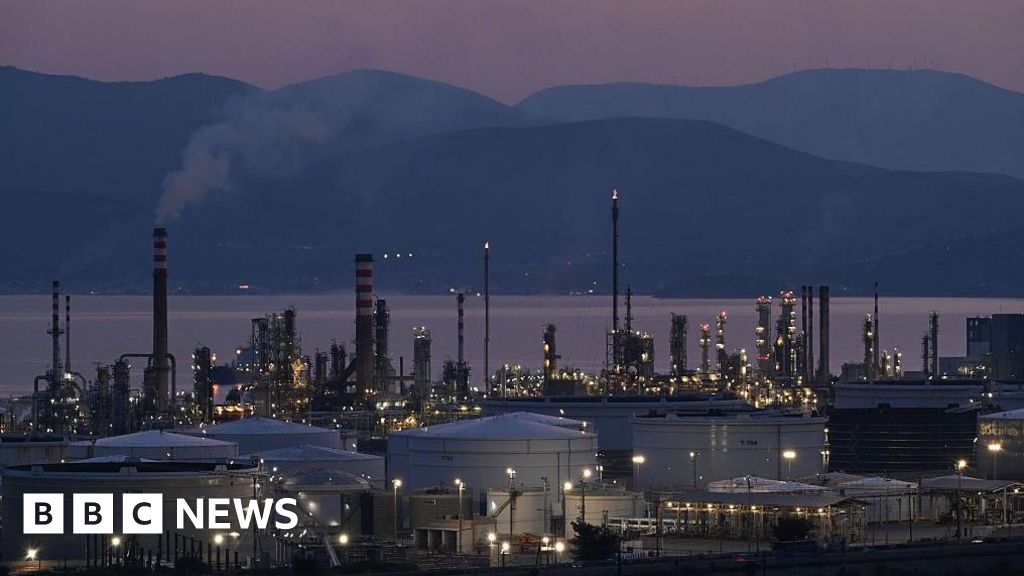
The US-Israel Iran war has halted almost all traffic in a key waterway and the price Brent crude has surged.
Source link

Nike shares fall 9% on weak outlook, expected 20% sales decline in China

Prince Harry surprises crowd by calling attendees his source of hope

Wrigley Field to host Big Ten/SEC volleyball doubleheader

-

 Politics1 week ago
Afghanistan announces release of detained US citizen
-

 Sports1 week ago
Broadcast industry CEO says consolidation is ‘essential’ to compete for NFL soaring media rights prices
-

 Tech1 week ago
Can a Home Appliance Fix the Problem of Soft-Plastic Waste?
-

 Entertainment1 week ago
UN warns migratory freshwater fish numbers are spiralling
-
 Business1 week ago
Property Play: Home flippers see smallest profits since the Great Recession, real estate data firm says
-
 Business1 week ago
Gold prices soar in Pakistan – SUCH TV
-

 Fashion1 week ago
ICE cotton slips on weaker crude, profit booking
-
 Business1 week ago
More women are entering wealth management, but few are in advisory roles, study finds