

Business
The government shutdown is over. The air traffic controller shortage is not


Planes line up on the tarmac at LaGuardia Airport on November 10, 2025 in New York City.
Spencer Platt | Getty Images News | Getty Images
The U.S. has been scrambling to hire more air traffic controllers for years. The longest-ever federal government shutdown might have made that even harder.
“We need more of them to come into the profession, and this shutdown is going to make that more difficult for us to accomplish that goal,” Transportation Secretary Sean Duffy said at a press conference at Chicago O’Hare International Airport on Tuesday, a day before Congress signed a bill to fund the federal government through January, ending the shutdown.
Air traffic controllers were required to work without receiving regular paychecks during the shutdown. They were paid in part on Friday, according to people familiar with the matter, but during the shutdown some had taken second jobs to make ends meet, while the lack of regular pay added to their stress, union and government officials and lawmakers have said.
The Federal Aviation Administration reported low-staffing thresholds were hit that that slowed aircraft around the country during the final days of the shutdown. President Donald Trump earlier this week threatened to dock air traffic controllers’ pay if they didn’t go to work. On Friday, staffing levels were relatively strong around the U.S. and disruptions eased.
“It can’t make it look like this is a great job because you’re going to have to deal with this all the time,” said Tim Kiefer, who teaches air traffic management at Embry-Riddle Aeronautical University in Prescott, Ariz.
Kiefer was an air traffic controller for more than two decades before he retired. He said shutdowns or the threat of them were common during his career. “You may see people decide to do other things and say, ‘They didn’t get paid; they were stuck in the middle of a partisan dispute,'” he said.
5 million passengers
The shortage of air traffic controllers delayed or canceled thousands flights during the shutdown, affecting the travel plans of more than 5 million people, according to Airlines for America, an industry group that includes American Airlines, United Airlines, Delta Air Lines, Southwest Airlines and others.
But even with partial pay hitting bank accounts, the staffing crisis that regularly upends travel is set to continue.
A government tally last year showed the U.S. was short 3,903 fully certified air traffic controllers of a goal of 14,633. Shortages have been particularly severe at busy facilities like those where controllers guide planes in and out of airports in the congested New York area, adding to flight disruptions and frustrating airline executives and customers.
Meanwhile, retirements picked up in the shutdown, with 15 to 20 people retiring per day, down from a usual rate of four a day, Duffy said Tuesday. Controllers are required to retire at age 56 but can do so earlier with benefits depending on years on the job.
Staffing was already thin before the shutdown began on Oct. 1, and many controllers were working six-day workweeks. By mid-November, as air traffic controllers missed two full paychecks and the shutdown passed the one-month mark, it approached crisis levels.
More than 10% of U.S. departures were canceled last Sunday as bad weather combined with air traffic controller shortfalls at facilities across the country. That was the highest rate since July 19, 2024, during the CrowdStrike outage, which had an outsize impact on Delta Air Lines, leading to thousands of canceled flights and causing travel headaches, according to aviation-data firm Cirium.
Hours after those cancellations spiked on Sunday, the Senate advanced a preliminary deal that led to the vote ending the shutdown this week.
The Federal Aviation Administration in early November ordered airlines to cut 4% of flights from their domestic schedules at 40 major airports, blaming safety risks they found because of an increased strain on air traffic controllers. Cuts were set to ramp up to 10% on Friday, if the shutdown didn’t end. Cancellations, however, improved dramatically during the week and on Friday morning, just 2% of U.S. departures were canceled, according to Cirium.
The FAA brought its mandated cuts down from 6% to 3% starting on Saturday, saying it will monitor system performance throughout the weekend.
The disruptions were similar to those on days with severe storms, but were more widespread across the U.S.
Millions in lost revenue
The last-minute cuts were a headache for the industry, where airlines from top-moneymaker Delta to struggling carrier Spirt had already lowered their outlooks for the year after an oversupply of flights and weaker-than-expected demand earlier this year. Airlines haven’t yet quantified the damage from the shutdown, but Bank of America estimated a $150 million to $200 million operating income hit for big network airlines and less than $100 million for other carriers.
Travelers walk through the terminal at Ronald Reagan Washington National Airport, more than a month into the ongoing U.S. government shutdown, in Arlington, Virginia, U.S., Nov. 11, 2025.
Annabelle Gordon | Reuters
Airline executives, exasperated by the recent disruptions, are now pushing Congress to make sure controllers are paid in the next shutdown.
“In the past week, we saw a crescendo effect as air traffic control staffing shortages led to massive and unpredictable amounts of delays and cancellations across the industry — and that was on top of a series of FAA-mandated schedule reductions,” American Airlines CEO Robert Isom and the carrier’s chief operating officer, David Seymour, said in a note to employees on Thursday, a day after the House approved a short-term funding bill. “While we both have been in this industry for a long time, only a few other events come to mind when we think about this level of disruption.”
It could have been worse. This part of the fall travel demand is relatively light, but Thanksgiving was fast approaching when Congress ended the shutdown, concerning airline executives.
“This shutdown put tremendous strain on our aviation system and caused severe inconvenience for the millions of Americans who depend on it,” United said in a statement. “It should be obvious to everyone that policy debates, however urgent, should never put air travel at risk, and we urge Congress to ensure that the FAA and [Transportation Security Administration’s] funding is protected in the event of any future lapse in federal appropriations.”
‘Political football’
It wasn’t the first time a government closure has put the aviation industry under strain. The 2018-2019 shutdown, then the longest in U.S. history, ended just hours after controller shortages snarled travel in the New York City area.
Some airline executives told CNBC that they were frustrated by this most recent shutdown and last-minute schedule changes, which ended up being greater than anticipated. One, who spoke on the condition of anonymity because he wasn’t authorized to speak to the press, said “we were the pawns” in the shutdown.

Delta CEO Ed Bastian told CNBC’s “Squawk on the Street” on Wednesday that “the thing we don’t like is being a political football” and said it was unacceptable that air traffic controllers and TSA officers were forced to work without regular paychecks.
The best way to prevent such disruptions is “to ensure those workers, the next time this happens because it will happen, get paid,” Bastian said. “Who could disagree with that?”
The airline industry is urging Congress for legislation that could make use of funds generated by airplane ticket taxes to ensure air traffic controllers and other essential industry workers like airport screeners and Customs agents are paid.
“You don’t hold the American public hostage over a political fight like that,” Airlines for America CEO Chris Sununu, the former governor of New Hampshire, said in a virtual press conference Wednesday, shortly before the House passed the funding bill.
Travelers check their flight status at Dulles International airport as the nation’s air travel system begins to return to normal, as the U.S. government opens back up following the longest shutdown in U.S. history, in Dulles, Virginia, U.S. Nov. 13, 2025.
Evelyn Hockstein | Reuters
Next Wednesday, Sen. Jerry Moran, R-Kan., who chairs the Commerce Subcommittee on Aviation, Space and Innovation, will hold a hearing on the shutdown’s impact on aviation. Moran this year pushed for legislation that would let the FAA use the Airport and Airway Trust Fund, which is funded by taxes on airplane tickets and fuel, to cover expenses if the government shuts down.
“The government shutdown has severely impacted our already fragile aviation industry, and recovering from its effects will take time,” he said in a release this week. “It’s critical that we address the damage done and look at the long-term effects of the shutdown.”
Lawmakers earlier this year approved $12.5 billion to improve air traffic control, though the industry said it needs billions more to modernize the system in the U.S.
The fatal collision of an American Airlines regional jet and an Army Black Hawk helicopter in Washington, D.C., in January also made hiring controllers more urgent, especially at congested facilities.
About a month after the crash, Duffy announced the country’s air traffic controller academy would raise pay for students, and he authorized more universities to teach a similar curriculum to help ease the shortage. The academy in Oklahoma City also stayed open, a different tactic than in the 2018-2019 shutdown.
But those aren’t immediate fixes. It takes years for controllers to be fully trained to work at some of the more complex facilities, and applicants to the academy can be no older than 30.





Business
‘India solidly through global shocks’: EAM Jaishankar calls for ‘hedge, de-risk, diversify’ strategy amid Iran war – The Times of India
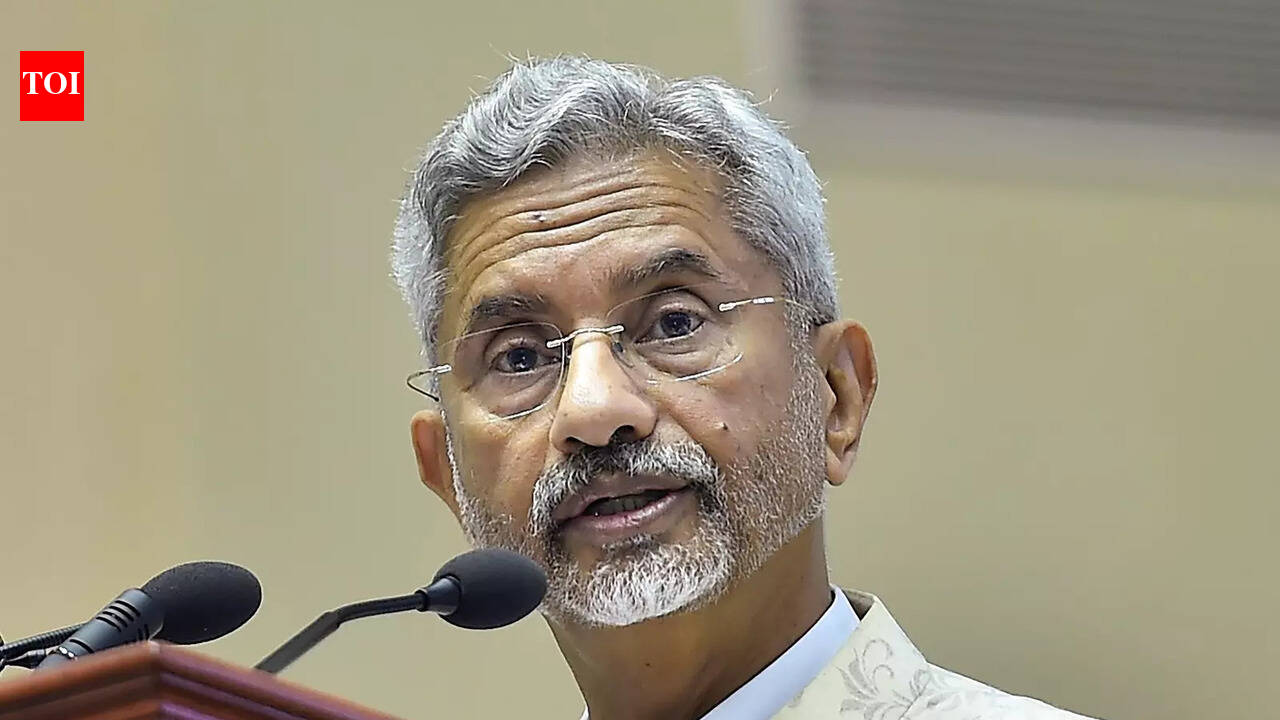
External affairs minister S Jaishankar on Saturday said that India has “solidly come through” a the ongoing turbulent geopolitical situation amid the Middle East conflict and the Russia-Ukraine war, adding that the country has been “managing domestic and external challenges successfully.”Speaking at the 15th Annual Convocation Ceremony of IIM Raipur, he said countries today must focus on “hedging, de-risking and diversifying” as the global order changes rapidly.
He said the world is going through a “structural” shift, adding, “The global order is changing before our very eyes with visible shifts in the relative power and influence of countries. The politics of some societies find it difficult to come to terms with these changes.”Jaishankar also said, “New developments in technology, in energy, military capabilities, in connectivity and in resources have encouraged risk-taking in an increasingly competitive environment. Everything today is being leveraged, if not actually weaponised. The world is then confronted with the prospect of securing itself in an increasingly volatile and unpredictable environment. This has necessitated the need to hedge, de-risk and diversify.”He said India has reasons for optimism compared to many other countries. “There is an optimism in our society that is lacking in many other parts of the world,” he said, adding that India is now among the top five economies and has handled recent global shocks well.He further stated, “No one can dispute that the multiple global shocks that have recently tested our resilience, and that India has come through that solidly. We have managed both domestic and external challenges fairly successfully.”The minister said building national capabilities is key for India’s goal of Viksit Bharat 2047. He also praised “inclusive growth, representative politics, and decisive leadership.”He said, “Building national capabilities has become more critical in the light of the global trends that I have mentioned… We must endeavour to build and secure within our control as many capacities as we can.”On foreign policy, Jaishankar said India is focusing on expanding market access, securing resources and technology, and supporting Indians abroad, while promoting “Brand India.”“Our foreign policy is today focused on expanding market access for Indian producers. It is also focused on helping to secure resources, technologies and essential goods. It looks after Indians… And it promotes Brand India,” he said.These remarks come at a time when the Middle East tensions that began on February 28 with US-Israel strikes on Iran have stretched beyond the 1 month mark. The crisis has since intensified with Iran’s chokehold over the strategically crucial Strait of Hormuz, sending ripples to oil baskets across the globe.
Business
Govt assures IMF of timely power tariff hikes, agrees to subsidy cap under $7bn EFF – SUCH TV

Pakistan has assured the International Monetary Fund (IMF) of implementing timely electricity tariff adjustments and capping power subsidies at Rs830 billion in the upcoming budget to sustain energy sector viability amid global market shocks.
The new baseline tariff will be implemented from January 15, 2027, under the structural benchmark agreed with the IMF under the $7 billion Extended Fund Facility (EFF).
The privatisation of power distribution companies — including Iesco, Gepco and Fesco — has been delayed once again and is expected to be finalised by early 2027.
The government is working closely with the Privatisation Commission to assess the viability of privatising two targeted Gencos (Nandipur and Guddu).
The government is committed to the IMF to apply the recently adopted net billing regulation to new consumers to better balance solar and grid demand, in line with international practice. These steps will help prevent the recurrence of the monster of the circular debt.
“It has been anticipated that with allocated subsidy and the timely tariff adjustments, it will minimise Circular Debt (CD) flow target of Rs300 billion and remain committed to reducing gross CD flow to zero by FY31,” top official sources confirmed to The News here on Friday.
Pakistan, according to the official, assured the IMF of achieving energy sector viability to maintain macroeconomic stability.
For this purpose, the government shared with the IMF in writing for timely tariff increases that recover costs and the re-emergence of circular debt.
The execution of timely adjustments in tariffs is necessary in the context of recent shocks to global energy markets to ensure the sector’s viability and broader macroeconomic stability.
The government has established the Integrated Energy Plan (IEP) targeted for completion by April 2027 in a bid to make better-informed decisions on supply and demand across the energy sector value chain.
According to the government’s strategy, it is aimed at incorporating the CD Management Plan to be adopted by the cabinet by the end of July 2026.
This upcoming CDMP will ensure timely electricity tariff adjustments consistent with cost recovery that remain progressive, and increases are introduced, balanced across consumer categories.
This includes Nepra’s continued timely notifications of quarterly tariff adjustments (QTAs) and automatic monthly fuel charge adjustments (FCAs), as well as the full implementation of the January 2027 annual rebasing by January 15, 2027.
Following the implementation of the CD stock reduction operation in FY26 and recognising ongoing improvements in operational efficiency and performance, the FY27 budget will include a subsidy limited to Rs830 billion.
The subsidy will cover (i) the projected tariff differential for Discos and KE; (ii) current and arrears payments of Fata; (iii) agricultural tubewells; and (iv) CD stock payments to counterbalance anticipated CD flow, which continues to be targeted at a lower level following the CD stock operation.
The settlement with several IPPs, with whom penalty payments on arrears were to be waived as part of the broader CD stock reduction operation, remains incomplete, with CD continuing to accumulate as a result. The government will finalise arrangements with all IPPs by the end of June 2026.
The government will try to resolve a dispute with KE, currently under litigation, which has resulted in significant nonpayment and arrears by the end of December 2026.
The government will continue to move forward with its fundamental cost-reducing power sector reforms, including private sector participation in Disco management to improve performance, efficiency, and governance, and address power sector CD drivers, helping to mitigate the need for higher tariffs.
The government is moving forward with the private sector participation process for second batch of Discos, i.e. Hesco and Sepco, for which conditions precedent – in line with World Bank recommendations and including outstanding subsidy claims; outstanding balances with the government, other Discos, and other entities; and other balance sheet issues – will be completed by the end of December 2026 as structural benchmark under the IMF programme.
For improving the transmission system, the appointment of a CEO to the Independent System and Market Operator is underway, as are efforts to finalise staffing arrangements.
The incorporation and legal formation of the Energy Infrastructure and Development Management Company (EIDMC) have been completed, and its leadership selection process has also been initiated.
The National Grid Company (NGC) is operational and is undergoing a review of its processes in the context of its new role.
If privatisation does not prove feasible, work to bring relevant companies under one entity to reduce redundancies will be done, make necessary improvements, and enhance operations.
The Nepra issued wheeling auction framework guidelines in January 2026; this will enable auctions under the auspices of the Competitive Trading and Bilateral Contract Market (CTBCM).
The first wheeling auction, for 200MW, will take place by the end of June 2026.

At current prices, the looted gold is worth around $70 million. PHOTO: PIXABAY
Prices of gold and silver remained stable in domestic and international markets on Saturday.
In the local market, the price of gold per tola held steady at Rs490,362, while 10 grams of gold remained at Rs420,406.
On the global market, gold prices per ounce were stable at $4,676.
Silver prices also remained firm, with one tola trading at Rs7,794 and 10 grams at Rs6,682. Globally, the price of silver per ounce held steady at $73.10.
Read: SBP injects Rs13.68tr into market
Yesterday, gold prices in Pakistan rose, tracking an upward trend in the international market. In the domestic market, the price of gold per tola climbed by Rs3,400 to settle at Rs490,362.
Likewise, the price of 10 grams of gold increased by Rs2,915, reaching Rs420,406, according to figures released by the All-Pakistan Gems and Jewellers Sarafa Association (APGJSA).
A day earlier, on Thursday, gold prices had declined, with the per tola rate falling by Rs7,100 to Rs486,962.
In the global market, gold prices gained $34, reaching $4,676 per ounce, including a $20 premium.
Moreover, silver prices also moved higher, rising by Rs160 to Rs7,794 per tola.
Meanwhile, on Friday, the Pakistani rupee posted a slight gain against the US dollar in the interbank market.
By the close of trading, the local currency stood at 279.10, appreciating by Rs0.01 against the greenback. On Thursday, it had settled at 279.11.
In global markets, China’s yuan strengthened against the US dollar as the latter steadied, with investor attention shifting to the release of US payroll data later in the day.
The dollar had surged a day earlier on safe-haven demand after US President Donald Trump signalled that the Iran conflict could persist.
The spot yuan opened at 6.8930 per dollar on Friday and was last trading 37 pips higher than its previous close.


How UConn-Illinois, Arizona-Michigan will be decided in men’s Final Four

Prince Harry gives up UK dream: What happened?
[CinePlex360] Please moderate: “Gold Loan Tips:

-

 Entertainment1 week ago
Lee Sang-bo dies at 45: Funeral details revealed
-
 Business1 week ago
How do you spot a fake online review?
-

 Sports1 week ago
Illinois defense gets tough, ousts Houston to reach Elite Eight
-

 Sports7 days ago
USMNT handed reality check by Doku, Belgium ahead of World Cup
-

 Sports7 days ago
2026 NCAA men’s hockey tournament: Schedule, results
-

 Fashion1 week ago
China rolls out tariff cuts on Congo imports from April 1
-

 Fashion1 week ago
EU apparel imports slump 15.48% YoY in Jan; Bangladesh hardest hit
-

 Sports7 days ago
Man City show why they are worthy WSL title winners as tired United wilt