

Tech
The Rare Earth Metal Driving Tensions Between the US and China

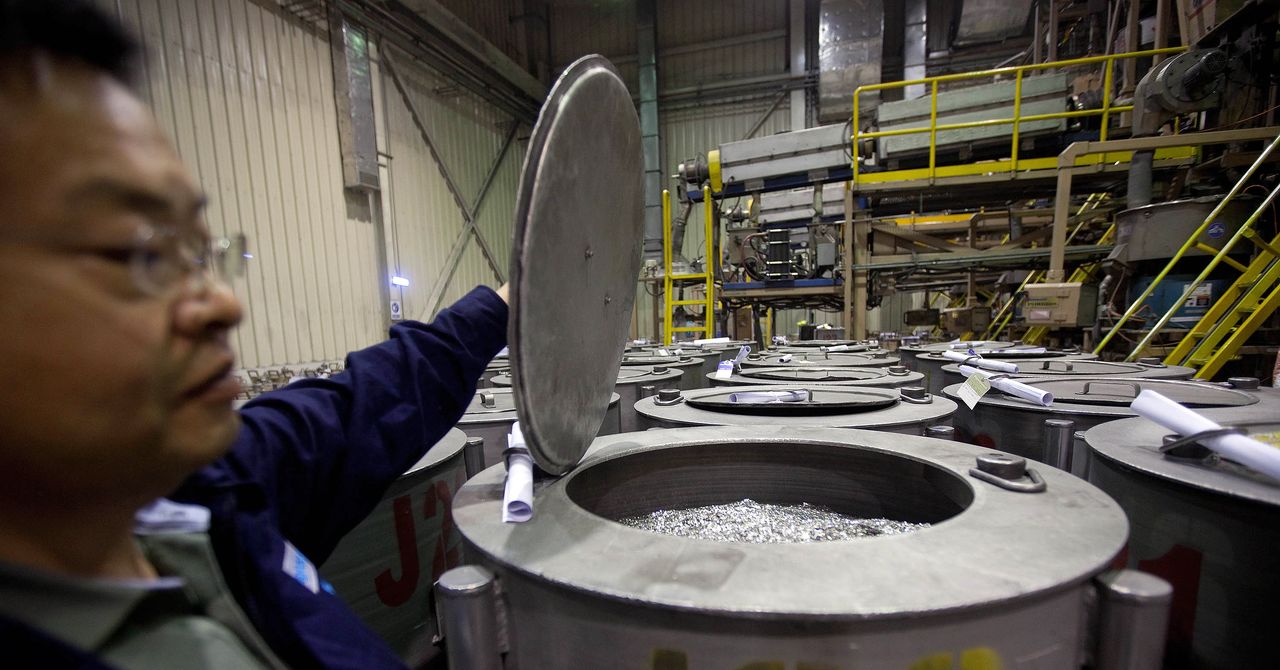
The alarm hasn’t yet reached the general public, but tension is beginning to build in the corridors of the aerospace industry, in microchip laboratories, and in government offices. For months, an element almost invisible to the world—yttrium—has become the silent center of a new global dispute. Supplies are thinning, prices are skyrocketing, deliveries are stalling. And while China and the United States have promised a truce over rare earth minerals, the wheels of advanced technology are beginning to slow.
Although a late-October meeting in South Korea between Chinese president Xi Jinping and his US counterpart Donald Trump raised hopes for a détente, the Chinese export restrictions introduced last April remain substantially in place. Beijing granted a one-year reprieve on the mandatory government licensing system for shipments of rare earths and products containing related materials (including those made abroad with at least 0.1 percent Chinese resources), in exchange for a similar suspension of the White House’s latest restrictions on technology supply chains.
A Crucial Element in a Market Under Pressure
But other measures introduced before the latest escalation remain in place. The result is a tightening of the international supply chain that threatens to slow advanced technological production, raise costs, and challenge entire industrial sectors. Yttrium plays a crucial role in the functioning of contemporary technologies. Without yttrium, the production of aircraft engines, high-efficiency turbines, advanced energy systems, and semiconductors would immediately slow down.
Yttrium’s value lies in its ability to impart thermal and mechanical strength to materials subjected to extreme temperatures. Jet engines blades, for example, must withstand prolonged overheating and intense vibration; yttrium is what allows them to maintain structural integrity and efficiency. The same is true for industrial chip manufacturing, where yttrium-based coatings protect machinery from chemical wear and ensure precision in plasma etching. Its indispensable nature has made it a key element of modern technology and the military.
China’s Role
The problem is that, as with several other resources, China controls almost the entire global yttrium supply chain. Not only does it produce most of it, but it also has the know-how and infrastructure to refine and separate it from other rare earth minerals, a complex and technologically advanced process. According to US data, the United States imports 100 percent of its yttrium needs, 93 percent of which comes directly from China. Such stark dependence creates enormous geopolitical vulnerability.
When Beijing decided to introduce export restrictions as a response to US tariffs, the entire international supply structure began to falter. Companies reported delays, difficulties in obtaining licenses, and uncertainty about delivery times. In the rare earths trade, lack of predictability is often more damaging than reduced volumes: An industry accustomed to just-in-time deliveries can be thrown into crisis by even a few weeks of delay.
The effects were immediate. In Europe, yttrium oxide prices have soared, reaching a 4,400 percent increase since the beginning of the year. Aerospace companies, which rely heavily on this material, have expressed alarm and demanded urgent measures from the US government to expand domestic production. The semiconductor industry is no less concerned: Some companies have called the situation a “serious” threat, predicting impacts on costs, efficiency, and production timelines. Gas-fired power plants, which use yttrium in the protective coatings of turbines, are also monitoring Chinese developments with increasing attention, although they maintain that they have not yet experienced disruptions.











Initially, Gorham used his brain-computer interface for single clicks, Oxley says. Then he moved on to multi-clicks and eventually sliding control, which is akin to turning up a volume knob. Now he can move a computer cursor, an example of 2D control—horizontal and vertical movements within a two-dimensional plane.
Over the years, Gorham has gotten to try out different devices using his implant. Zafar Faraz, a field clinical engineer for Synchron, says Gorham directly contributed to the development of Switch Control, a new accessibility feature Apple announced last year that allows brain-computer interface users the ability to control iPhones, iPads, and the Vision Pro with their thoughts.
In a video demonstration shown at an Nvidia conference last year in San Jose, California, Gorham demonstrates using his implant to play music from a smart speaker, turn on a fan, adjust his lights, activate an automatic pet feeder, and run a robotic vacuum in his home in Melbourne, Australia.
“Rodney has been pushing the boundaries of what is possible,” Faraz says.
As a field clinical engineer, Faraz visits Gorham in his home twice a week to lead sessions on his brain-computer interface. It’s Faraz’s job to monitor the performance of the device, troubleshoot problems, and also learn the range of things that Gorham can and can’t do with it. Synchron relies on this data to improve the reliability and user-friendliness of its system.
In the years he’s been working with Gorham, the two have done a lot of experimenting to see what’s possible with the implant. Once, Faraz says, he had Gorham using two iPads side by side, switching between playing a game on one and listening to music on the other. Another time, Gorham played a computer game in which he had to grab blocks on a shelf. The game was tied to an actual robotic arm at the University of Melbourne, about six miles from Gorham’s home, that remotely moved real blocks in a lab.
Gorham, who was an IBM software salesman before he was diagnosed with ALS in 2016, has relished being such a key part of the development of the technology, his wife Caroline says.
“It fits Rodney’s set of life skills,” she says. “He spent 30 years in IT, talking to customers, finding out what they needed from their software, and then going back to the techos to actually develop what the customer needed. Now it’s sort of flipped around the other way.” After a session with Faraz, Gorham will often be smiling ear to ear.
Through field visits, the Synchron team realized it needed to change the setup of its system. Currently, a wire cable with a paddle on one end needs to sit on top of the user’s chest. The paddle collects the brain signals that are beamed through the chest and transmits them via the wire to an external unit that translates those signals into commands. In its second generation system, Synchron is removing that wire.
“If you have a wearable component where there’s a delicate communication layer, we learned that that’s a problem,” Oxley says. “With a paralyzed population, you have to depend on someone to come and modify the wearable components and make sure the link is working. That was a huge learning piece for us.”

Expect datacentre spending to increase tenfold. That was among the claims Nvidia CEO Jensen Huang made during the company’s latest quarterly earnings call. He forecast that capital expenditure (CapEx) on datacentres would increase from the $300-400bn mark today to $3-4tn by 2030.
Huang’s remarks at the end of February came a few days after Microsoft’s AI Tour London event, when CEO Satya Nadella effectively called for enterprise software developers to use the capabilities now built into Microsoft 365 to create agentic AI workflows for streamlining business processes.
Nadella discussed the need to have an efficient token factory, where phrases or tokens can be streamed into AI engines that interpret natural language for querying large language models (LLMs). The Microsoft vision of enterprise AI is built on the M365 foundation, which acts as a knowledge store on which a new category of knowledge-based software can be built.
During his keynote presentation, Nadella spoke about the intelligence that exists in the various IT systems used across the business. He said that businesses should be able to harness the intelligence that already exists enterprise-wide, starting with what he described as the “data underneath Microsoft 365”, which, according to Nadella, represents the people in the business, their relationship to coworkers, and work artefacts such as projects, calendars and communications data. “This is massive information,” he said, which can be used to bootstrap agentic AI projects.
“Our goal is to have all of the innovation and the systems available in the token factory,” said Nadella. “That way you can build software which has the ability to use all of the capability [we provide] to train models and deliver models for inference.”
In effect, he sees the Windows software developer ecosystem evolving to where it is now a Microsoft 365 ecosystem, where enterprise data is stored in AI-enabled office productivity tools such as Word, Excel, PowerPoint, Teams and Outlook, and these can be used as the foundation for a new generation of applications that can draw on these AI knowledge sources.
It is this idea that all software will need to be knowledge-aware, which Huang spoke about during the company’s earnings call. “Token generation is at the centre of almost everything that relates to software in the future and relates to computing,” he said. “If you look at the way we use computing in the past, however, the amount of computation demand for software in the past is a tiny fraction of what is necessary in the future.”
According to Huang, the amount of computation necessary to run AI is 1,000 times higher than the computing power needed to run non-AI software. “The computing demand is just a lot higher,” he said. “And so, if we continue to believe there’s value in it, then the world will invest to produce that token.”
When asked whether Nvidia is confident that its customers will continue to have the ability to spend more on AI infrastructure, which could impact Nvidia’s ability to grow, Huang spoke about the opportunity in enterprises to make use of agentic AI and its widespread usefulness across organisations.
“We have now seen the inflection of agentic AI, and the usefulness of agents across the world and enterprises everywhere,” he said. “You’re seeing incredible compute demand because of it. In this new world of AI, compute is revenues. Without compute, there’s no way to generate tokens. Without tokens, there’s no way to grow revenues.”
At least, that is how he positioned AI for the investment bank analysts on the earnings call. The company posted fourth quarter revenue of $68bn, up 73% year-over-year. Datacentre revenue increased by 75% to $62bn, which Nvidia said was being driven by demand for its Blackwell architecture and AI inference deployments. It also reported networking revenue of $1bn, up 3.5x year-over-year, fuelled by adoption of NVLink, Spectrum X and other Nvidia ethernet technologies.
Last year, during his keynote presentation at the GTC conference in the US, Huang claimed that the lowest cost per token was being achieved using the most expensive GPU – which at the time was the Grace Blackwell NVLink 72.
Nvidia describes the GB200 Grace Blackwell as a “superchip”, which connects two high-performance Nvidia Blackwell Tensor Core GPUs and the Nvidia Grace CPU with the NVLink-Chip-to-Chip (C2C) interface, capable of delivering 900 GBytes/s of bidirectional bandwidth.
Significantly, the architecture means that applications have coherent access to a unified memory space. According to Nvidia, this simplifies programming and supports the larger memory needs of trillion-parameter LLMs, transformer models for multimodal tasks, models for large-scale simulations, and generative models for 3D data.
‘Huang’s Law’
Some industry observers have coined the term “Huang’s Law” to describe his perspective of how each new generation of GPU delivers a 10x increase in performance, compared with Moore’s Law’s doubling of performance every 18 months.
Nadella and Huang both spoke about how newer hardware is more energy-efficient at running AI workloads. During the Microsoft AI tour, Nadella noted that today’s system supports an entirely different memory hierarchy, which he said means “there’s now no latency with AI inference”.
The messaging from both the Microsoft and Nvidia chiefs is that the best efficiency is achieved by taking advantage of the capabilities available in these new systems. “There’s an unbelievable renaissance happening with these systems and workloads, whether they’re training workloads or inference workloads, they are unlike anything we’ve seen in the past,” said Nadella.
The tech sector is dead set on getting enterprises to adopt more and more AI. It is being built into knowledge-aware enterprise software likely to draw on the capabilities available in the newest generation of AI acceleration hardware.
Clearly, the business models of Microsoft and Nvidia are tied to increased demand for AI. But it is also apparent that the cost of deploying advanced AI systems is not going to get any cheaper. If anything, capital expenditure on datacentres will continue to increase at a phenomenal rate, fuelled by demand for these new AI systems and the AI acceleration hardware they need.
As my fellow pet parents will know, it’s amazing how quickly even the tiniest of dogs can demolish their toys and treat stash. We love and spoil them nonetheless. When you subscribe to BarkBox a fresh batch of cleverly themed treats and toys arrives at your doorstep. The costs of pet ownership can stack up quickly, especially if you’re buying your pooch a random gift box that goes well beyond the essentials. That’s why we have Barkbox promo codes and discount options ready to go for you.
Barkbox Promo: Enjoy a Free Toy for a Year at Barkbox
When your monthly Barkbox arrives, it’s like Christmas morning for your dogs. I watch as my two dogs, Rosi and Randy, shake their little Chihuahua mix bodies with barely restrained excitement. They’re never gentle on their toys but the stimulation that comes from textures and chewing is good for their little brains. With Barkbox you get a steady supply of two unique toys and two bags of all-natural treats every month. If you want to see how your dogs react, this Barkbox coupon is good for new Barkbox subscription customers and adds an additional toy in your box every month for a year.
Save 50% on Your First Barkbox Food Subscription With a Barkbox Coupon Code
Another reason why Barkbox is the best dog subscription box is how easy the company makes it to keep your pantry stocked with your dog’s food. Use this Barkbox coupon to save 50% off your first Barkbox food subscription, so you won’t have to end up running out to the grocery store in the middle of the night when your scooper scrapes across the bottom of an empty kibble bin.
Fly Travel Stress-Free With Your Dog and Get $300 Off BARK Air Flights
If you live in a Barkbox flight hub destination, please know I am insanely jealous of you. It’s no secret that flying is stressful and can be very dangerous for pets, especially if they have to ride in a cargo hold. Barkbox makes them the VIP with BARK Air, letting them ride in the cabin with you and get doted on, so things are a lot less scary. This is another perk of having a BarkBox subscription, with the opportunity to save $300 off BARK Air Flights.
Support Your Dog’s Dental Health and Get $10 Off With a Barkbox Coupon
Dental health is crucial for dogs, as it can prevent disease not just in their mouths, but their vital organs. Don’t forget to schedule your yearly cleaning with your vet, but in the meantime, use this BarkBox discount code to get $10 off a special BarkBox Dental kit.
Get an Extra Premium Toy in Every BarkBox With the Extra Toy Club
For having such tiny mouths, my dogs can gnaw through toys with surprising speed. If you’re also buried in a pile of shredded fluff and squeakers from disemboweled toys, the Extra Toy Club can help. This subscription includes dog toys for aggressive chewers of all ages, breeds, and sizes, offering extra durable toys meant to last longer. So far, so good at my house. To upgrade to this subscription box, it’s an extra $9 per month.
Get Exclusive BarkBox Discounts: Join the Email List
If you assume that the punchy branding and witty lingo extend to Barkbox’s email subscribers and not just the box subscription, you’d be correct. As a bonus, you can get exclusive BarkBox discount codes when you sign up to receive these emails. Who also doesn’t love a furry face and reminder of their pet in between work subject lines and bill payment reminders, too?


Miami (Ohio) improves to 30-0 as Cinderella run gets more magical

From ‘Freaky Friday’ to ‘Cruella’: Andrew Gunn’s blockbuster legacy

Dubai warns of jail, hefty fine for spreading rumours

India Us Trade Deal: Fresh look at India-US trade deal? May be ‘rebalanced’ if circumstances change, says Piyush Goyal – The Times of India

Households set for lower energy bills amid price cap shake-up

What are Iran’s ballistic missile capabilities?

-
Business5 days ago
India Us Trade Deal: Fresh look at India-US trade deal? May be ‘rebalanced’ if circumstances change, says Piyush Goyal – The Times of India
-
Business1 week ago
Households set for lower energy bills amid price cap shake-up
-
 Politics6 days ago
What are Iran’s ballistic missile capabilities?
-

 Politics6 days ago
US arrests ex-Air Force pilot for ‘training’ Chinese military
-
 Business6 days ago
Attock Cement’s acquisition approved | The Express Tribune
-

 Fashion6 days ago
Policy easing drives Argentina’s garment import surge in 2025
-

 Sports1 week ago
Top 50 USMNT players of 2026, ranked by club form: USMNT Player Performance Index returns
-

 Sports6 days ago
Sri Lanka’s Shanaka says constant criticism has affected players’ mental health