

Politics
Thousands march in central London to protest Trump’s second state visit

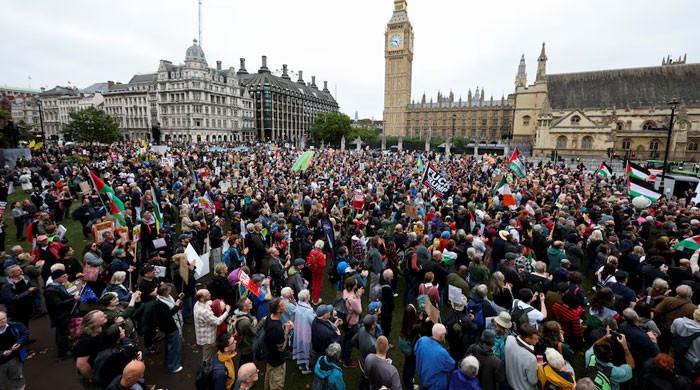

LONDON: Armed with signs and shouting slogans, thousands of anti-Donald Trump protesters descended on central London on Wednesday to decry the US president’s unprecedented second state visit to the UK.
London’s Metropolitan Police estimated that there were around 5,000 people at the protest, which culminated in a rally in front of parliament.
With Trump receiving the red-carpet treatment at Windsor Castle, around 22 miles (35 kilometres) west of London, demonstrators marched in the heart of the British capital to display their disdain on the first full day of the trip.
“We’re protesting, I suppose, about everything about Donald Trump. You don’t know what placard to carry, really, there’s so many things” to dislike, former teacher Dave Lockett, 67, told AFP.
“He’s sowing destruction and disorder throughout the whole Earth… If Trump’s ideas get into this society, then what we’re talking about is fascism in Britain,” he added.
Left-wing lawmakers, including new Green Party leader Zack Polanski, were among those to address the crowds in Parliament Square at the rally hosted by well-known comedian Nish Kumar.
“We are gathered here united to say this is not in our name,” Polanski said of Trump’s invitation from the ruling centre-left Labour government.
“This is the moment to challenge everything Donald Trump stands for. This is the moment to reject the politics of hate and division.”
‘Hiding’
Protesters had first massed early afternoon near the BBC’s headquarters, holding aloft an array of banners, flags and signs, covering everything from support for the Palestinians to rejecting fascism.
Amid a cacophony of drumming, some demonstrators had recreated smaller versions of the giant balloon depicting Trump wearing a nappy, which was famously flown during his first state visit in 2019.
Yashi Sriram, a doctor originally from India, turned out with a placard reading: “End the genocide. Stop Trump.”
“I just wanted to show support for the people of Palestine, really, more than anything else,” said the 32-year-old.
A group called the Stop Trump Coalition organised the demonstration, with a broad alliance of organisations sponsoring it, including Amnesty International UK, Black Lives Matter UK, the Palestine Solidarity Campaign, and Greenpeace.
The coalition questioned why Trump would spend so little time in London during the visit.
“Because he knows we’re protesting against him,” the group said in a statement ahead of the march.
“Instead, he’ll be hiding and having a sad little carriage ride all by himself in Windsor with a parade that no one will even see. This is because of the power of our protest.”
Those at the evening rally repeatedly chanted: “Say it loud, say it clear: Donald Trump is not welcome here,” as various speakers railed against him.
Trump unpopular
London’s Metropolitan Police deployed more than 1,600 officers — including 500 brought in from other forces — to ensure the event passed off without incident.
A purported counter-demonstration failed to muster, and there were no reports of disorder or arrests.
A lone protester, surrounded by police, displayed a sign reading: “We Love Trump,” sparking boos as anti-Trump campaigners marched past him.
Trump remains deeply unpopular in Britain, with new polling on Wednesday showing almost half of respondents thought it was wrong to invite him for a second state visit.
Only a quarter believed it would improve UK-US relations, according to the YouGov/Sky survey.
London mayor Sadiq Khan, who allowed the unflattering Trump baby blimp to fly during the American president’s first-term visits, has been a persistent critic amid a years-long feud.
Khan wrote Tuesday in The Guardian: “Trump and his coterie have perhaps done the most to fan the flames of divisive, far-right politics around the world in recent years.”
An estimated 150,000 people attended a weekend rally in London organised by far-right activist Tommy Robinson, with 26 police officers injured in clashes on the event’s fringes.
In the article, Khan — the first Muslim mayor of a Western capital when he was first elected in 2016 — accused Trump of “scapegoating minorities, illegally deporting US citizens, deploying the military to the streets of diverse cities”.
“These actions aren’t just inconsistent with western values — they’re straight out of the autocrat’s playbook,” he wrote.
- Cairo “studying” request for Sisi to join board, says FM.
- Canadian PM intends to accept Trump’s invitation: aide.
- Argentine president says it will be an ‘honour’ to join initiative.
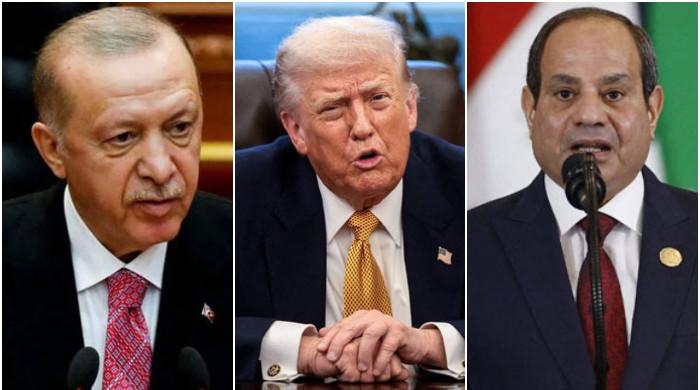
WASHINGTON: US President Donald Trump’s so-called “Board of Peace” for postwar Gaza began to take shape Saturday, with the leaders of Egypt, Turkey, Argentina and Canada asked to join.
The announcements from those leaders came after the US president named his Secretary of State Marco Rubio, former British prime minister Tony Blair, and senior negotiators Jared Kushner and Steve Witkoff to the panel.
Trump had already declared himself the chair of the body, as he promotes a controversial vision of economic development in the Palestinian territory, which lies in rubble after two-plus years of relentless Israeli bombardment.
The moves came after a Palestinian committee of technocrats meant to govern Gaza held its first meeting in Cairo which was attended by Kushner, Trump’s son-in-law who has partnered with Witkoff for months on the issue.
In Canada, a senior aide to Prime Minister Mark Carney said he intended to accept Trump’s invitation, while in Turkey, a spokesman for President Recep Tayyip Erdogan said he had been asked to become a “founding member” of the board.
Egypt’s Foreign Minister Badr Abdelatty said Cairo was “studying” a request for President Abdel Fattah al-Sisi to join.
Sharing an image of the invitation letter, Argentine President Javier Milei wrote on X that it would be “an honour” to participate in the initiative.
In a statement sent to AFP, Blair said: “I thank President Trump for his leadership in establishing the Board of Peace and am honoured to be appointed to its Executive Board.”
Blair is a controversial figure in the Middle East because of his role in the 2003 invasion of Iraq. Trump himself said last year that he wanted to make sure Blair was an “acceptable choice to everybody.”
Blair spent years focused on the Israeli-Palestinian issue as representative of the “Middle East Quartet” – the United Nations, European Union, United States and Russia – after leaving Downing Street in 2007.
The White House said the Board of Peace will take on issues such as “governance capacity-building, regional relations, reconstruction, investment attraction, large-scale funding and capital mobilisation.”
The other members of the board so far are World Bank President Ajay Banga, an Indian-born American businessman; billionaire US financier Marc Rowan; and Robert Gabriel, a loyal Trump aide who serves on the US National Security Council.
Trump has created a second “Gaza executive board” that appears designed to have a more advisory role.
It was not immediately clear which world leaders were asked to be on each board.
The White House, which said Friday that additional members would be named to both entities, did not immediately reply to a request for comment.
Israel strikes
Washington has said the Gaza plan had gone on to a second phase – from implementing the ceasefire to disarming Hamas, whose October 2023 attack on Israel prompted the massive Israeli offensive.
On Friday, Trump named US Major General Jasper Jeffers to head the International Stabilization Force, which will be tasked with providing security in Gaza and training a new police force to succeed Hamas.
Jeffers, from special operations in US Central Command, in late 2024 was put in charge of monitoring a ceasefire between Lebanon and Israel, which has continued periodic strikes aimed at Hezbollah.
Gaza native and former Palestinian Authority deputy minister Ali Shaath was earlier tapped to head the governing committee.
Trump, a real estate developer, has previously mused about turning devastated Gaza into a Riviera-style area of resorts, although he has backed away from calls to forcibly displace the population.
- Private carrier admits misjudgement, planning gaps.
- Regulator orders IndiGo to relieve senior office bearers.
- Operational meltdown linked to new policy of pilot rest.
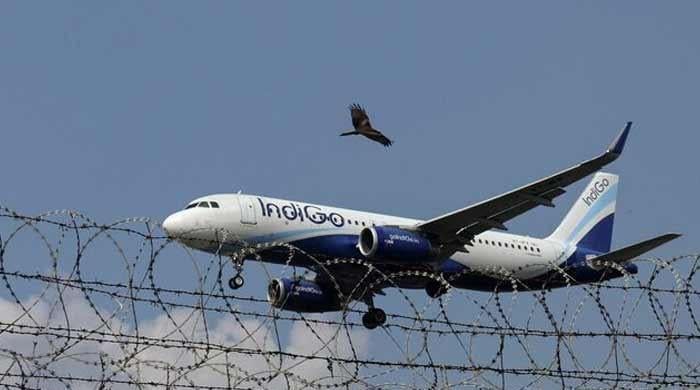
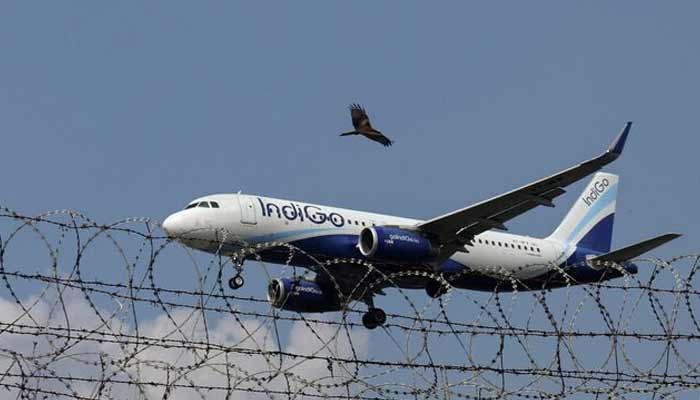
India’s civil aviation regulator on Saturday imposed a fine of $2.45 million on IndiGo, the country’s biggest airline, for poor roster planning that led to large-scale flight cancellations in December.
Airports across India were thrown into disarray late last year, with the private carrier admitting “misjudgement and planning gaps” in adapting to a new policy of pilot rest.
Over 4,000 mostly domestic flights were either cancelled or delayed for over a week across the country, stranding hundreds of thousands of passengers.
The operational meltdown came even though IndiGo had two years to prepare for the new rules aimed at giving pilots more rest periods in between flights to enhance passenger safety.
The Directorate General of Civil Aviation (DGCA) said it was levying the penalty for several lapses, including “failure to strike (a) balance between commercial imperatives and crew members’ ability to work effectively”.
The regulator ordered IndiGo to relieve its senior vice president of its operations control centre of his responsibilities, according to a statement released on Saturday.
It also issued warnings to senior officials at the company, including CEO Pieter Elbers “for inadequate overall oversight of flight operations and crisis management”.
There was no immediate response from IndiGo to the fine.
IndiGo, which commands 60% of India’s domestic market, operates more than 2,000 flights a day.
The crisis was one of the biggest challenges faced by the no-frills airline that has built its reputation on punctuality.
India is one of the world’s fastest growing aviation markets. In November 2024, IndiGo reached a daily level of 500,000 passengers for the first time.
- Protesters chant, “Greenland is not for sale.”
- Over “20,000 people” attend protest in Copenhagen.
- Trump says Greenland vital to US security.
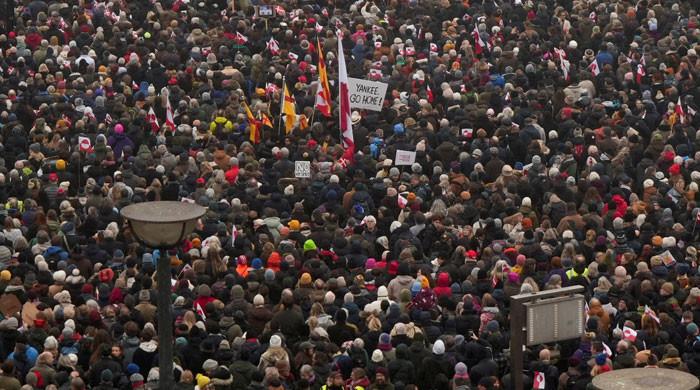
COPENHAGEN: Protesters in Denmark and Greenland demonstrated on Saturday against President Donald Trump’s demand that the Arctic island be ceded to the US and called for it to be left to determine its own future.
Trump says Greenland is vital to US security because of its strategic location and large mineraldeposits, and has not ruled out using force to take it. European nations this week sent military personnel to the island at Denmark’s request.
In Copenhagen, demonstrators chanted “Greenland is not for sale” and held up slogans such as “No means No” and “Hands off Greenland” alongside the territory’s red-and-white flag as they marched to the US embassy.
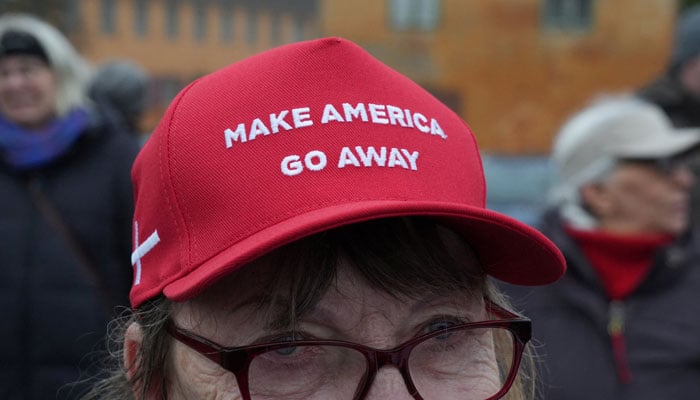
Some wore red baseball caps resembling the “Make America Great Again” caps of Trump supporters, but with the slogan “Make America Go Away”.
In Greenland’s capital Nuuk, hundreds of protesters led by Prime Minister Jens-Frederik Nielsen carried flags and similar banners as they headed for the US consulate.
They passed a newly built block where Washington plans to move its consulate – currently a red wooden building with four staff.
Organisers estimated over 20,000 people attended the protest in Copenhagen – akin to the entire population of Nuuk – though police did not provide an official figure. Other protests were held across Denmark.
“I am very grateful for the huge support we as Greenlanders receive … we are also sending a message to the world that you all must wake up,” said Julie Rademacher, chair of Uagut, an organisation for Greenlanders in Denmark.
Trump triggers diplomatic rift
Trump’s repeated statements about the island have triggered a diplomatic crisis between the US and Denmark, both founding members of the NATO military alliance, and have been widely condemned in Europe.
The territory of 57,000 people, governed for centuries from Copenhagen, has carved out significant autonomy since 1979 but remains part of Denmark, which controls defence and foreign policy, and funds much of the administration.
Some 17,000 Greenlanders live in Denmark, according to Danish authorities.
All five parties elected to Greenland’s parliament ultimately favour independence, but they disagree on the timing and have recently said they would rather remain part of Denmark than join the US
Only 17% of Americans approve of Trump’s efforts to acquire Greenland, and large majorities of Democrats and Republicans oppose using military force to annex it, a Reuters/Ipsos poll found. Trump called the poll “fake”.


Arne Slot ‘understands’ Liverpool fans’ boos after Burnley draw

Trump declares legal war against US largest bank

Hailee Steinfeld reveals how she supports husband Josh Allen from afar

-

 Tech5 days ago
New Proposed Legislation Would Let Self-Driving Cars Operate in New York State
-

 Sports7 days ago
Clock is ticking for Frank at Spurs, with dwindling evidence he deserves extra time
-
Sports1 week ago
Commanders go young, promote David Blough to be offensive coordinator
-

 Entertainment4 days ago
X (formerly Twitter) recovers after brief global outage affects thousands
-

 Fashion7 days ago
South India cotton yarn gains but market unease over US tariff fears
-
 Fashion7 days ago
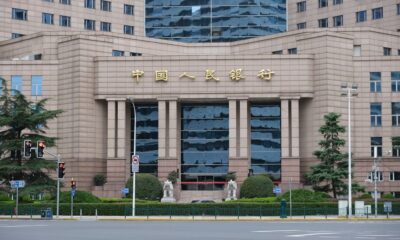
China’s central bank conducts $157-bn outright reverse repo operation
-
 Business1 week ago
SoftBank reduces Ola Electric stake to 13.5% from 15.6% – The Times of India
-

 Sports7 days ago
US figure skating power couple makes history with record breaking seventh national championship