

Business
Thousands more university jobs cut as financial crisis deepens


Hayley ClarkeEducation reporter and
Emily Doughty
 PA Media
Universities have collectively announced more than 12,000 job cuts in the last year, new analysis from the University and College Union (UCU) suggests.
Additional cost savings announced in the same period are equivalent to a further 3,000 jobs, the union says, but universities have not confirmed whether these savings will be made by cutting staff.
UCU members will vote on potential UK-wide strike action later this month over a 1.4% pay offer made over the summer.
Employers say that offer “clearly does not reflect the true value employers place on staff”, but that it is the “only prudent option” given the scale of the financial challenge facing the higher education sector.
Four in 10 English universities are now believed to be in financial deficit, according to the Office for Students.
Raj Jethwa, chief executive of the Universities and Colleges Employers Association (UCEA), says difficult decisions like redundancies and restructures are having to be “carefully considered” by all institutions, but that they were striving to do so in an “open and fair way”.
But Jo Grady, UCU general secretary, described the cuts as “brutal”, adding that staff had become “demoralised, exhausted and furious” and that “undervalued and poorly served” students were feeling the impact too.
She told the Today programme there was “no replacement for stable funding from government” to address the financial challenges and that the current model was “destroying higher education”.
The government said it had taken the “tough but necessary decision” to increase tuition fees last year to boost income for universities, and would soon set out further plans for reforms in new legislation.
‘I will have to live with my mum in my forties’

 Zak Hughes
Dr Zak Hughes, a chemistry lecturer at the University of Bradford, is at risk of redundancy.
“There are a lot of stressed and upset people who are struggling to deal with it, both within the school but also more widely within the institution,” he says.
Zak, who has worked at the university since 2018, says he now faces the prospect of having to move back home to live with his mum if he loses his job.
“I won’t be able to pay my rent, I will be in my forties and living back at home,” he says.
Even if the 44-year-old retains his job, the chemistry course at the university is being phased out, with similar closures happening across the country.
Zak says this limits the opportunities for him and his colleagues.
“People could, even if they lost their job, get a job at another institution. That’s not happening now,” he says.
“They’re probably looking not only at the end of the a job, but really the end of their career in academia.”
Sanskrity Baraili, sabbatical officer at the students’ union in Bradford, says she has already seen the impact of cuts on students, especially in support services such as cleaning teams and disability services.
While she believes the cuts come from a wider issue within higher education, she says “students are worried about what’s going to happen next”.
 Sanskrity Baraili
A spokesperson for the university said: “Like many other universities, we are having to make cost-savings to protect the student experience and ensure we deliver meaningful outcomes for graduates.”
They said they had expanded the support services available to students, adding that “our priority remains putting students first and widening access to higher education.”
They said the university had a responsibility to ensure it remained financially stable, including regularly reviewing courses with “persistently low intake such as chemistry”.
They called on the government to take “swift and decisive action” to tackle the challenges faced by the sector.
‘I’d have had second thoughts about uni if I knew’
The University of Edinburgh has announced it plans to make £140m in cuts, equivalent to about 1,800 jobs, according to the UCU.
Caspar Cubitt, who is studying theology, says the uncertainty has “put all of us on edge”.
“There’s a lot of gossip which swirls around you,” he says.
“It’s when you write back to your mum and dad and they ask how uni is going, you say, ‘Well, my degree is in trouble.'”
While the 22-year-old says he is still receiving the same level of support from his department, he has found that access to study spaces and module choices has been affected.
 Caspar Cubitt
With two years left at university, he is now worried what further cuts may mean.
“I would have had second thoughts [about going to Edinburgh] if I knew that this is how they handle budget crisis and this is how they run finances,” he says.
Professor Sir Peter Mathieson, principal and vice chancellor of the University of Edinburgh, said the university had been “fully transparent about the necessary steps we need to take to safeguard the future of our university”.
“We remain firmly committed to ongoing dialogue as we take the necessary steps to enable us to deliver excellence and continue to be a bold, imaginative and world-leading university.”

Get our flagship newsletter with all the headlines you need to start the day. Sign up here.

The firm was unable to cope during high demand, Ofwat says, leading to “immense stress” for customers.
Source link
Business
Middle East heat may ripple across India’s energy supply chain, flags Goldman Sachs – The Times of India

As tensions continue to heat up in the Middle East, concerns are raising about disruptions to one of the world’s most critical energy shipping routes, the Strait of Hormuz. Any disruption could significantly affect major oil-importing countries such as India, as the narrow Strait of Hormuz is central to global energy trade. The strait sees almost 20 million barrels of oil passing through each day, or about a fifth of the world’s consumption, pass through the route. The waterway also carries roughly 19% of global liquefied natural gas (LNG) shipments, making it a crucial corridor for energy-importing economies.A recent report by Goldman Sachs has flagged early signs of stress in the region. The report warned that tanker traffic through the Strait of Hormuz has already begun showing signs of disruption, with shipping firms, oil producers and insurers adopting a cautious approach following reports of damaged vessels in nearby waters.According to the firm, financial markets have already begun factoring in the geopolitical risk. Oil prices currently carry an estimated risk premium of $18-per-barrel, reflecting the potential market impact if energy flows through the Strait of Hormuz were disrupted for about a month.
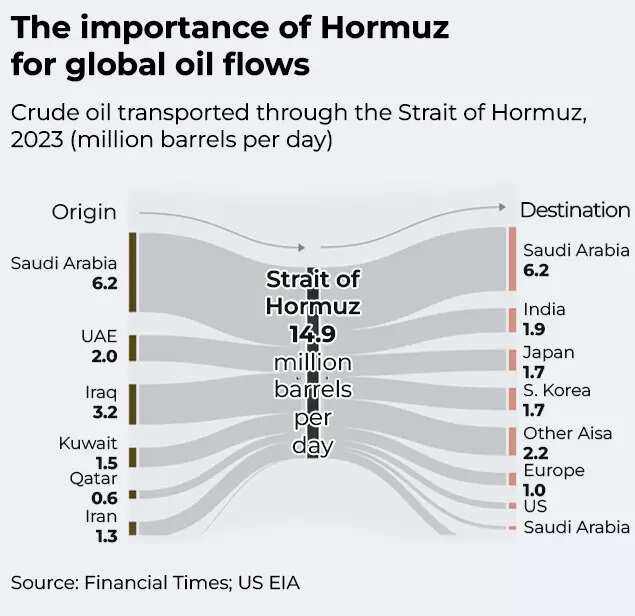
Even is the oil facilities are not directly damaged, a shutdown of the shipping route could expose a significant portion of global supply. The report estimates that in an event of full closure, about 16 million barrels per day of oil flows could be affected, despite the availability of some pipeline routes designed to bypass the strait.And the risks are not limited to crude oil shipments with almost 80 million tonnes of LNG exports annually, much of it from Qatar, moving through the passage. Any prolonged disruption could tighten gas supply globally and potentially drive European benchmark gas prices back to levels seen during the 2022 energy crisis.
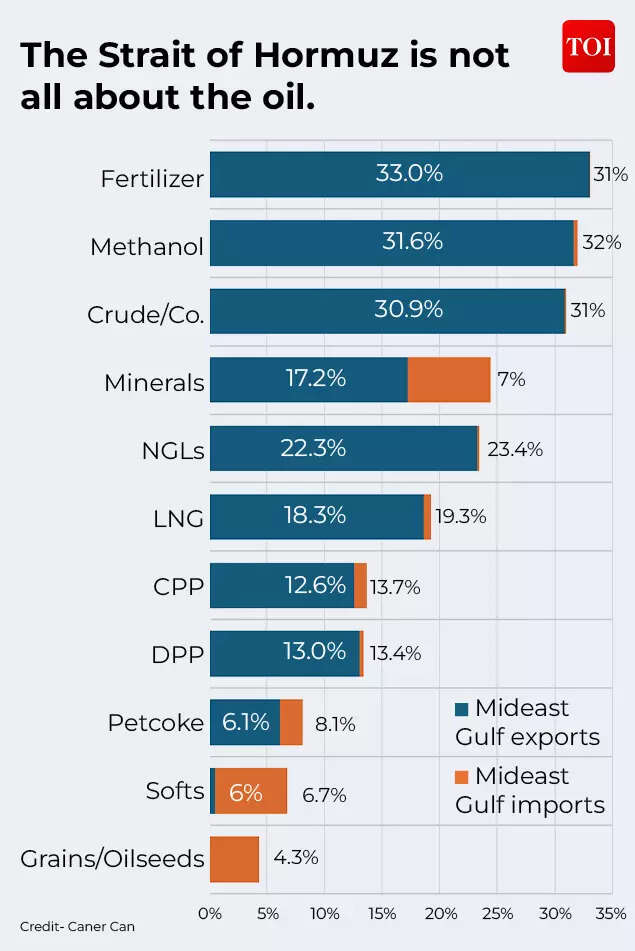
Asian economies stand among the most exposed to such disruptions. Major importers such as China, India, Japan and South Korea depend heavily on oil and LNG shipments that transit through the strategic corridor.While global oil inventories and spare production capacity could help cushion short-term shocks, the report warned that sustained disruption to Gulf shipping routes could trigger sharp volatility in global energy markets and push prices higher across oil, gas and refined fuel products.Market participants and governments are closely watching tanker traffic in the Strait of Hormuz, along with diplomatic and military developments involving the United States, Iran and Gulf nations, to assess whether the current disruptions remain temporary or escalate into a broader energy supply shock.

KARACHI: The Pakistan Stock Exchange rallied on Thursday after Saudi Arabia assured Pakistan of facilitating crude oil shipments through the Red Sea port of Yanbu Port, easing concerns over potential fuel supply disruptions.
The benchmark KSE-100 Index climbed sharply during the trading session, rising 4,439.93 points (2.85%) to reach an intraday high of 160,217.14 points.
Market Recovery
Analysts attributed the market rebound to renewed institutional buying and improving investor sentiment after Saudi assurances on oil supplies.
Market expert Ahsan Mehanti, CEO of Arif Habib Commodities, said easing fuel supply concerns played a key role in the recovery.
He added that rising global crude prices, expectations of a new International Monetary Fund loan tranche for Pakistan, and positive economic indicators also boosted investor confidence.
Alternative Oil Route
Pakistan sought an alternative supply route after Iran announced the closure of the Strait of Hormuz, a crucial global oil transit corridor.
Federal Petroleum Minister Ali Pervaiz Malik held talks with Nawaf bin Said Al-Malki, requesting Saudi support for uninterrupted energy supplies.
Saudi authorities reportedly assured Pakistan that oil shipments could be routed through Yanbu, and one crude vessel has already been prepared for dispatch.
Global Oil Market Impact
Oil prices continued to rise amid tensions in the Middle East conflict involving Iran, Israel and the United States.
Brent crude: up 3.26% to $83.99 per barrel
West Texas Intermediate (WTI): up 3.70% to $77.42 per barrel
Energy markets remain volatile as shipping disruptions threaten supply through the Strait of Hormuz, a route that handles nearly 20% of global oil trade.
Analysts say the Saudi assurance helped calm fears about Pakistan’s energy supply chain, contributing to the strong recovery at the PSX.


Need One Pair for Hiking, Traveling, and Working Out? Try Gravel Running Shoes

Aaron Rodgers tears into ex-girlfriends: ‘I got myself into crazy town’

Switzerland’s Calida narrows sales decline, lifts profit in 2025

India Us Trade Deal: Fresh look at India-US trade deal? May be ‘rebalanced’ if circumstances change, says Piyush Goyal – The Times of India

What are Iran’s ballistic missile capabilities?

Attock Cement’s acquisition approved | The Express Tribune

-
Business6 days ago
India Us Trade Deal: Fresh look at India-US trade deal? May be ‘rebalanced’ if circumstances change, says Piyush Goyal – The Times of India
-
 Politics1 week ago
What are Iran’s ballistic missile capabilities?
-
Business7 days ago
Attock Cement’s acquisition approved | The Express Tribune
-
 Business1 week ago
Households set for lower energy bills amid price cap shake-up
-

 Politics1 week ago
US arrests ex-Air Force pilot for ‘training’ Chinese military
-

 Fashion7 days ago
Policy easing drives Argentina’s garment import surge in 2025
-

 Sports6 days ago
LPGA legend shares her feelings about US women’s Olympic wins: ‘Gets me really emotional’
-

 Fashion6 days ago
Texwin Spinning showcasing premium cotton yarn range at VIATT 2026