

Business
Thousands more university jobs cut as financial crisis deepens


Hayley ClarkeEducation reporter and
Emily Doughty
 PA Media
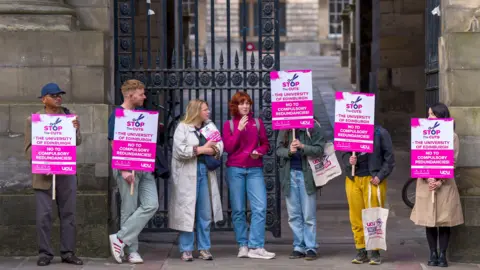
Universities have collectively announced more than 12,000 job cuts in the last year, new analysis from the University and College Union (UCU) suggests.
Additional cost savings announced in the same period are equivalent to a further 3,000 jobs, the union says, but universities have not confirmed whether these savings will be made by cutting staff.
UCU members will vote on potential UK-wide strike action later this month over a 1.4% pay offer made over the summer.
Employers say that offer “clearly does not reflect the true value employers place on staff”, but that it is the “only prudent option” given the scale of the financial challenge facing the higher education sector.
Four in 10 English universities are now believed to be in financial deficit, according to the Office for Students.
Raj Jethwa, chief executive of the Universities and Colleges Employers Association (UCEA), says difficult decisions like redundancies and restructures are having to be “carefully considered” by all institutions, but that they were striving to do so in an “open and fair way”.
But Jo Grady, UCU general secretary, described the cuts as “brutal”, adding that staff had become “demoralised, exhausted and furious” and that “undervalued and poorly served” students were feeling the impact too.
She told the Today programme there was “no replacement for stable funding from government” to address the financial challenges and that the current model was “destroying higher education”.
The government said it had taken the “tough but necessary decision” to increase tuition fees last year to boost income for universities, and would soon set out further plans for reforms in new legislation.
‘I will have to live with my mum in my forties’

 Zak Hughes
Dr Zak Hughes, a chemistry lecturer at the University of Bradford, is at risk of redundancy.
“There are a lot of stressed and upset people who are struggling to deal with it, both within the school but also more widely within the institution,” he says.
Zak, who has worked at the university since 2018, says he now faces the prospect of having to move back home to live with his mum if he loses his job.
“I won’t be able to pay my rent, I will be in my forties and living back at home,” he says.
Even if the 44-year-old retains his job, the chemistry course at the university is being phased out, with similar closures happening across the country.
Zak says this limits the opportunities for him and his colleagues.
“People could, even if they lost their job, get a job at another institution. That’s not happening now,” he says.
“They’re probably looking not only at the end of the a job, but really the end of their career in academia.”
Sanskrity Baraili, sabbatical officer at the students’ union in Bradford, says she has already seen the impact of cuts on students, especially in support services such as cleaning teams and disability services.
While she believes the cuts come from a wider issue within higher education, she says “students are worried about what’s going to happen next”.
 Sanskrity Baraili
A spokesperson for the university said: “Like many other universities, we are having to make cost-savings to protect the student experience and ensure we deliver meaningful outcomes for graduates.”
They said they had expanded the support services available to students, adding that “our priority remains putting students first and widening access to higher education.”
They said the university had a responsibility to ensure it remained financially stable, including regularly reviewing courses with “persistently low intake such as chemistry”.
They called on the government to take “swift and decisive action” to tackle the challenges faced by the sector.
‘I’d have had second thoughts about uni if I knew’
The University of Edinburgh has announced it plans to make £140m in cuts, equivalent to about 1,800 jobs, according to the UCU.
Caspar Cubitt, who is studying theology, says the uncertainty has “put all of us on edge”.
“There’s a lot of gossip which swirls around you,” he says.
“It’s when you write back to your mum and dad and they ask how uni is going, you say, ‘Well, my degree is in trouble.'”
While the 22-year-old says he is still receiving the same level of support from his department, he has found that access to study spaces and module choices has been affected.
 Caspar Cubitt
With two years left at university, he is now worried what further cuts may mean.
“I would have had second thoughts [about going to Edinburgh] if I knew that this is how they handle budget crisis and this is how they run finances,” he says.
Professor Sir Peter Mathieson, principal and vice chancellor of the University of Edinburgh, said the university had been “fully transparent about the necessary steps we need to take to safeguard the future of our university”.
“We remain firmly committed to ongoing dialogue as we take the necessary steps to enable us to deliver excellence and continue to be a bold, imaginative and world-leading university.”

Get our flagship newsletter with all the headlines you need to start the day. Sign up here.

The federal government announced a Rs26.77 per litre hike in the price of petrol and high-speed diesel each on Friday, according to a notification issued by the Petroleum Division.
The new prices will be effective from April 25, 2026 for a week, the notification stated.
Following the increase, the price of HSD has jumped from Rs353.42 to Rs380.19, while the petrol price now stands at Rs393.35.
The government has been reviewing petroleum prices every Friday night following the now-paused US-Israel war on Iran, which began on February 28.
In the previous weekly review, the prime minister announced a reduction of Rs32.12 per litre in the price of high-speed diesel, while the petrol price remained unchanged.
The government jacked up petrol and diesel prices despite oil prices falling globally on Friday after it appeared a second round of Middle East talks was back on, bolstering prospects for an end to a war that has crippled energy shipments from the Gulf.
Oil prices had been climbing earlier as investors worried about a lack of progress in ending the Middle East crisis, with Tehran keeping the Strait of Hormuz closed and the US maintaining a blockade of Iranian ports.
But they dropped on reports that Iran’s Foreign Minister Abbas Araghchi was to arrive in Islamabad on Friday night.
Brent crude, the international benchmark contract, fell back below $100 a barrel.
facebook twitter
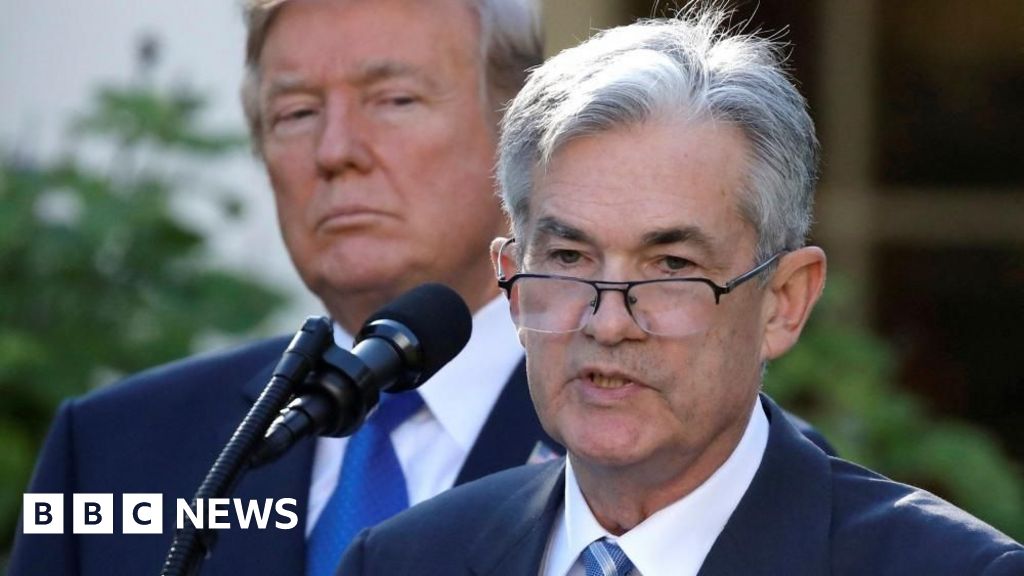
Powell’s term is nearing its end and the US Senate is considering Trump’s nominee for his replacement, Kevin Warsh. A key Republican, Thom Tillis, has withheld his support for Warsh unless the Trump administration would drop its investigation into Powell.
Business
Intel bags big gains! Chipmaker’s shares jump 26% on blockbuster results; how Trump admin benefits – The Times of India
Intel share price soared sharply on Friday after the chipmaker delivered a first-quarter performance that exceeded market expectations. And the win was not just for the chipmaker, but also the whole of US!The stock climbed 26.7% during trading on Friday, marking what could be its strongest single-day gain since 1987. Momentum continued after the closing bell, with shares rising a further 20% in after-hours trading as investors reacted to signs of a sustained turnaround driven by artificial intelligence.Intel reported revenue of $13.58 billion (€11.6bn) for the quarter, ahead of the $12.3 billion (€10.5 bn) forecast and up 7.2% from a year earlier. Adjusted earnings per share came in at $0.29, far exceeding expectations of $0.01.A key contributor to this performance was the company’s Data Centre and AI (DCAI) division, which delivered revenue of $5.05 billion (€4.2bn), up 22.4% year-on-year and well above analyst estimates of $4.41 billion (€3.77bn). The results indicate strong demand for Intel’s Xeon 6 processors and Gaudi 3 AI accelerators, particularly among enterprise clients and cloud service providers.Chief executive Lip-Bu Tan pointed to a broader shift in artificial intelligence usage as a major factor behind the growth. He said, “the next wave of AI will bring intelligence closer to the end user, moving from foundational models to inference to agentic.” He added, “This shift is significantly increasing the need for Intel’s CPUs and wafer and advanced packaging offerings.”The company also issued an upbeat outlook for the second quarter, forecasting revenue in the range of $13.8 billion (€11.8billion) to $14.8 billion (€12.6billion), surpassing investor expectations of $13 billion (€11.1billion).
But how is Washington winning?
The rally has had a direct impact on the US administration’s investment in Intel. In 2025, during a period of severe financial strain for the company, the administration of Donald Trump acquired a 9.9% stake in a move aimed at stabilising the business. The government invested $8.9 billion (€7.8bn) at a share price of $20.47 (€18.01), with $5.7 billion (€5bn) of that amount coming from previously approved but unpaid grants, according to the Euro News.At the time, Intel was facing multi-billion dollar losses and operational challenges, prompting concerns over its viability. As part of the intervention, the company cancelled planned factory projects in Germany and Poland, redirected focus towards US-based manufacturing, and reduced its global workforce by 25%, cutting around 25,000 jobs.Following the latest jump, Intel’s shares are now trading at $81.3 (€71.5), representing an increase of nearly 300% since the government first took its stake. The sharp rise highlights how the company’s improved financial performance has translated into substantial gains for the US administration.


Extended interview: Don Cheadle – CBS News

Charlie Sheen updates on relationship with old pal Jon Cryer

Iranian FM Abbas Araghchi lands in Pakistan ahead of renewed US talks

-

 Fashion1 week ago
France’s LVMH Q1 revenue falls 6%, shows resilience amid Iran war
-

 Tech1 week ago
CYBERUK ’26: UK lagging on legal protections for cyber pros | Computer Weekly
-

 Sports5 days ago
WWE WrestleMania 42 Night 2: Live match results and analysis
-

 Sports1 week ago
Faheem Ashraf backs Islamabad United’s push, calls league a ‘career-changing platform’
-
 Business1 week ago
PepsiCo earnings beat estimates as North American food business improves
-

 Sports5 days ago
NCAA men’s gymnastics championship: All-time winners list
-

 Tech1 week ago
Anthropic Plots Major London Expansion
-

 Entertainment4 days ago
Lee Anderson, Zarah Sultana kicked out of UK Parliament for calling PM ‘liar’