Connect with us

Business

Time taken to bring shoplifters to justice is ‘unacceptable’, retailers tell BBC

Published

on

Time taken to bring shoplifters to justice is ‘unacceptable’, retailers tell BBC

Cherry Wilson and Jim ConnollyBBC News Investigations
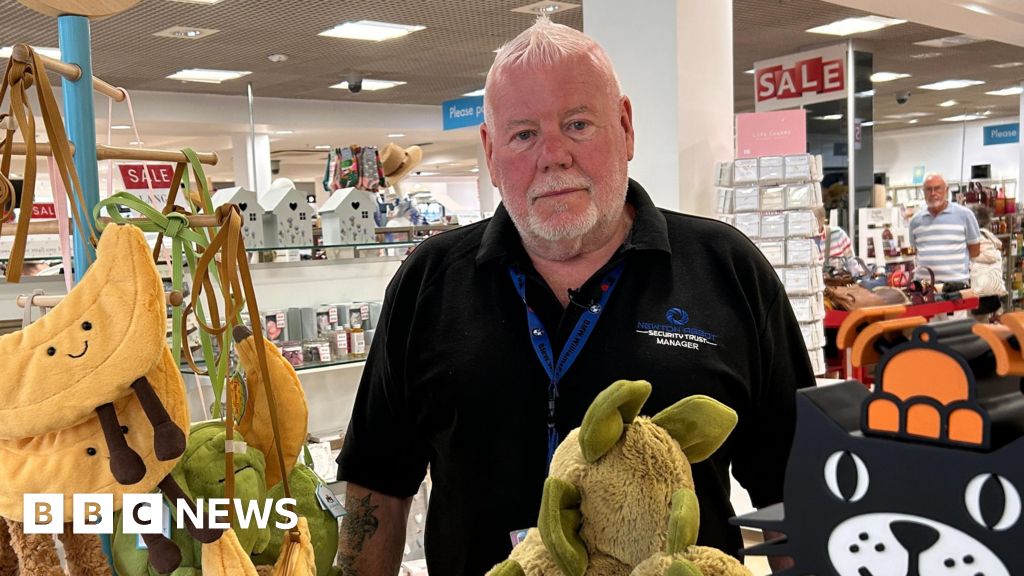
BBC A man wearing a polo shirt and a lanyard with branding for his company on stands infront of a shop display where he works as head of security BBC

Head of security Tom Hirst said the criminal justice system is “too easy” on shoplifters

The time it takes to bring shoplifters to justice is “unacceptable” with retailers waiting longer for criminals to face punishment compared with a decade ago, the BBC has learned.

In one case, stores targeted by a thief waited up to 10 months for a shoplifter to be sentenced, despite retail workers piecing together her identity without help from the police.

Chelsea Strange, 33, went on a three-week crime spree stealing £2,000 worth of Jellycat soft toys from four different stores across the south west of England and one in Wales – which she later sold on Vinted.

Figures obtained by the BBC show the average time it takes for a shoplifting case to be dealt with from offence to completion in a magistrates’ court in England and Wales has risen by more than 80% in the last 10 years – from 32 days in 2014 to 59 days in 2024.

Trade bodies representing retailers have said many stores have been left frustrated with the way shoplifters are dealt with. They say the time taken reduces shopkeepers’ faith in the justice system – making them feel there’s no point in reporting crimes.

“The delays in bringing perpetrators to court really does add insult to injury,” said Andrew Goodacre, chief executive of the British Independent Retailers Association.

“It is no surprise many small shop owners simply do not bother reporting the crime in the first place. In their minds it makes no difference.”

The BBC has looked at a series of shoplifting cases which highlight how shops have been left waiting months for thieves to be brought to justice.

We followed the Jellycat shoplifting case since December 2024, when we reported how a garden centre owner in Bridport, Dorset, had managed to piece together the thief’s identity by scouring resale websites, deciphering her car’s personalised number plate, and finding her Facebook profile.

Austins department store in Newton Abbot, Devon, was also targeted by Strange on three separate occasions – and staff said they too were able to figure out who she was.


Austins Department Store CCTV imagery of a blonde woman pushing a pram and holding a Jellycat plush toy in a shop surrounded by shelves with Jellycat teddies on Austins Department Store

Strange was caught on CCTV stealing Jellycat plush toys

Head of security Tom Hirst described the time taken to deal with shoplifters as “unacceptable” and said the criminal justice system is “too easy on them”.

“You’re better off shoplifting than going to work, that’s my honest view,” he added.

“Every time someone comes in and steals something, that cost gets passed on… it puts the price up so we’re all paying.”

In July, Strange, from Felton, Bristol, was sentenced to a 12-month community order at Newton Abbot Magistrates Court after admitting stealing from five shops across Devon, Somerset, Dorset and South Wales in September and October last year.

She was also ordered to pay nearly £1,800 in compensation.

Strange’s defence team said the offences were out of character and would not have taken place if it had not been for her poor mental health.
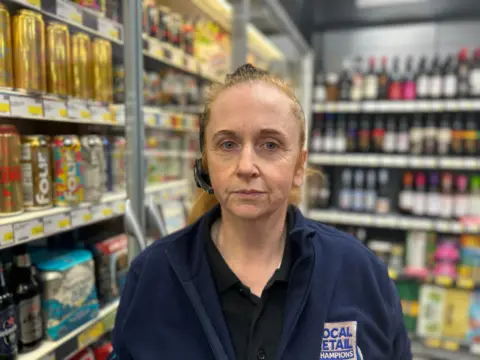
A woman wearing a work uniform and a headset stands in the aisle of the shop that she works in. She is standing in front of a fridge with drinks inside.

Fiona Malone caught a thief red-handed but still had to wait five months for them to be sentenced

​​Fiona Malone, who runs a Post Office in Tenby, Pembrokeshire, also told the BBC she had to wait five months for a shoplifter who stole from her store to face sentencing – despite catching the thief red-handed.

The shopkeeper confronted Natalie Lintern after security cameras captured her stealing pre-mixed vodka cans, sandwiches and cake from the store in August last year.

Mrs Malone chased the 36-year-old down the street and got the stolen items back before reporting it to the police.

“The whole criminal justice system is too slow, it’s bureaucratic,” she told the BBC.

“We need to deal with these people and deal with them quickly and think about alternative punishments to stop them doing it in the first place.”

In January, Lintern, from Pembroke, Pembrokeshire, was given a 12-month community order after pleading guilty to stealing from Tenby Post Office and four other stores between April and September 2024.

But the sentence did not stop her from shoplifting again.

Six months later, she was back in court again where she admitted stealing from a service station in May.

She was given six weeks in jail, suspended for 12 months.

Tenby Stores and Post Office a woman in a jelly crop top is seen with her hands full, carrying pre-mixed vodka drinks she has just taken from a fridge in a storeTenby Stores and Post Office

Lintern was seen on security cameras stealing pre-mixed vodka cans, sandwiches and cake

“What we’re doing as a society, it’s not working,” said Mrs Malone.

“It’s like whatever punishment she got it was almost like ‘Oh never mind I’ll just go out and do it again’.”

The most serious shop thefts can end up being heard at crown court where figures show the average time from the offence to cases being completed has increased from 111 days in 2016 to 128 days in 2024.

Shoplifter Bianca Mirica appeared in crown court after stealing more than £105,000 worth of goods from high street chain Boots between December 2023 and May 2024.

The 20-year-old, from Tottenham, London, was part of a shoplifting gang and would clear shelves of cosmetics and perfumes while another member of her team acted as look-out, according to police.

It took 14 months from her last theft before she was sentenced to 32 months in a young offenders’ institution, after pleading guilty to 18 charges of theft.

Met Police A woman with dark hair in a low bun is standing in her hallway, wearing a black jumper with white flowers on. She looks shocked.Met Police

Mirica was part of a shoplifting gang who would clear shelves of cosmetics and perfumes

Shoplifting has increased by 13% in the last year with 529,994 shoplifting offences recorded by police in England and Wales up to June 2025, according to the Office for National Statistics (ONS).

However, the ONS said there are signs that increasing rates of shops thefts being reported are now slowing.

The crime adds an estimated £133 onto the cost of an average UK household’s shopping bill each year, according to the Centre for Retail Research.

The government told the BBC it understood the “devastating impact” of shop theft on retailers and it was clear many cases were taking too long to be resolved, adding: “Justice delayed is justice denied.”

It said it is backing the courts with record funding and considering recommendations for long term structural reform of the system.

The National Police Chiefs Council said it had strengthened its relationship with retailers and improved information sharing in the last two years – which had resulted in a number of offenders being brought to justice.

Assistant Chief Constable Alex Goss said it planned to bring together police, shops and the security industry to make best use of their resources and “turn the tide on the volume of offending blighting our communities”.



Source link

Continue Reading
Click to comment

Leave a Reply

Your email address will not be published. Required fields are marked *

Business

Budget 2026: Punjab, Telangana flag higher fiscal burden under VB-G RAM G; seek more central funds – The Times of India

Published

on

Budget 2026: Punjab, Telangana flag higher fiscal burden under VB-G RAM G; seek more central funds – The Times of India


Opposition-ruled states Punjab and Telangana on Saturday sought additional fiscal support from the Centre in the Union Budget 2026-27, arguing that the proposed Viksit Bharat Guarantee for Rozgar and Ajeevika Mission (Gramin) (VB-G RAM G) will place a heavier financial burden on states due to its revised cost-sharing formula, PTI reported.The demands were raised at the pre-Budget meeting chaired by Union Finance Minister Nirmala Sitharaman, which was attended by finance ministers of states and Union Territories, along with Union Minister of State for Finance Pankaj Chaudhary. The meeting also saw participation from the Governor of Manipur, chief ministers of Delhi, Goa, Haryana, Jammu and Kashmir, Meghalaya and Sikkim, and deputy chief ministers of several states, including Telangana.Opposition-ruled states said the changes to the rural employment framework weaken the employment guarantee and go against the spirit of cooperative federalism.Parliament last month passed the VB-G RAM G Bill, replacing the two-decade-old Mahatma Gandhi National Rural Employment Guarantee Act (MGNREGA). Under the new scheme, the Centre will bear 60 per cent of the cost and states 40 per cent, compared with the 90:10 funding pattern under MGNREGA.Punjab Finance Minister Harpal Singh Cheema strongly opposed the proposed changes, saying the new framework dilutes the employment guarantee while shifting a significant financial burden to states.“Proposed MGNREGA changes weaken employment guarantee and burden states,” Cheema said at the meeting, calling for the restoration of the original demand-driven structure and funding pattern of the scheme.Telangana Finance Minister Mallu Bhatti Vikramarka said the Union government had replaced MGNREGA with VB-G RAM G without consulting states. He noted that the shift from a 90:10 to 60:40 funding ratio would further strain state finances.He also pointed out that any additional man-days beyond the normative allocation would now have to be borne by states, which would create a serious obstacle in providing demand-based work to job seekers.“This is entirely against the spirit of cooperative federalism and starving them of funds for capital outlay, which is essential for maintaining growth momentum,” Vikramarka said.The Telangana finance minister also suggested that surcharges on income tax and corporation tax be credited to a non-lapsable infrastructure fund, from which states could receive grants for infrastructure development. Alternatively, he said, surcharges should be merged with basic tax rates to expand the divisible pool of central taxes.On GST reforms, Vikramarka said GST 2.0 may boost demand but questioned its sustainability, warning that states’ revenues could fall due to rate reductions. He called for a suitable mechanism to compensate states for any revenue loss.Punjab also sought a special fiscal package, citing the “double whammy” of border tensions and floods in 2025. On GST, Cheema said Punjab is facing an annual revenue loss of nearly Rs 6,000 crore following GST 2.0 and pressed for a predictable GST stabilisation or compensation mechanism for states.


Source link

Continue Reading

Business

Export credit boost: Banks clear Rs 3,362 crore under CGSE in first month; 774 exporters covered – The Times of India

Published

on

Export credit boost: Banks clear Rs 3,362 crore under CGSE in first month; 774 exporters covered – The Times of India


Lenders have sanctioned Rs 3,361.83 crore to 774 applicants under the Rs 20,000-crore Credit Guarantee Scheme for Exporters (CGSE) within a month of its rollout, as the government steps up support for exporters facing headwinds from steep US tariffs, official data showed as reported PTI.The scheme, approved by the Union Cabinet on November 12 and made operational from December 1, 2025, provides 100 per cent credit guarantee cover by the National Credit Guarantee Trustee Company Ltd (NCGTC) to member lending institutions (MLIs) for extending additional credit facilities of up to Rs 20,000 crore to eligible exporters, including MSMEs.“Applications worth Rs 8,764.81 crore (1,840 applications) received, out of which Rs 3,361.83 crore (774 applications) sanctioned by the lenders” till January 2, 2026, the Department of Financial Services (DFS) under the finance ministry said in a statement.Implemented by the DFS, the CGSE aims to enable banks and financial institutions to extend additional financial assistance to Indian exporters during a period of external trade uncertainties, helping them diversify markets and enhance global competitiveness. The scheme will remain valid till March 31, 2026, or until guarantees worth Rs 20,000 crore are issued, whichever is earlier.The DFS also highlighted progress under the Mutual Credit Guarantee Scheme for MSMEs (MCGS-MSME), which offers credit guarantees to incentivise MLIs to provide additional credit facilities of up to Rs 100 crore to MSME borrowers for the purchase of plant, machinery and equipment. As of December 2025, banks have sanctioned Rs 16,836 crore against 8.96 lakh applications under the scheme.Sharing broader banking sector performance, the DFS said scheduled commercial banks (SCBs) recorded their highest-ever aggregate net profit of Rs 4.01 lakh crore. Public sector banks (PSBs) posted a record aggregate net profit of Rs 1.78 lakh crore in 2024-25, while their net profit stood at Rs 0.94 lakh crore in the first half of 2025-26.Global deposits and advances of PSBs rose to Rs 146.27 lakh crore and Rs 114.85 lakh crore, respectively, in September 2025, compared with Rs 71.95 lakh crore and Rs 56.16 lakh crore in March 2015.The gross non-performing assets (GNPA) ratio of PSBs declined to 2.30 per cent (Rs 2.65 lakh crore) in September 2025, down from 4.97 per cent (Rs 2.79 lakh crore) in March 2015 and a peak of 14.58 per cent (Rs 8.96 lakh crore) in March 2018. The capital adequacy ratio of PSBs improved by 451 basis points to 15.96 per cent in September 2025 from 11.45 per cent in March 2015.


Source link

Continue Reading

Business

Gen Z and social media are helping men’s makeup go mainstream. The beauty industry is trying to capitalize

Published

on

Gen Z and social media are helping men’s makeup go mainstream. The beauty industry is trying to capitalize


Pixdeluxe | E+ | Getty Images

It often starts small.

A dab of concealer. A tinted moisturizer. Maybe a brow gel that goes from borrowed to bought. For many men, like Daniel Rankin, makeup has transformed from something taboo into a tool to make them look less tired and more put together.

“I remember thinking, ‘Am I really doing this?'” Rankin, a 24-year-old advertising agent from New York who likes to shop at Sephora, told CNBC. “But once I tried it, it just became normal.”

In front of bathroom mirrors and in gym locker rooms, more men are now adding cosmetics to their routines, industry experts told CNBC. The men’s makeup market is now one of the most lucrative — and largely untapped — growth opportunities left in beauty, and specialty retailers like Ulta Beauty and Sephora along with big-box companies like Target and Walmart all see opportunity.

“Men’s beauty is one of the last categories left where brands can likely still see easy double-digit growth potential simply by showing up,” said Delphine Horvath, professor of cosmetics and fragrance marketing at the Fashion Institute of Technology.

Men’s grooming sales in the United States topped $7.1 billion in 2025, up 6.9% year over year, according to market research firm NielsenIQ. The global market was valued at $61.6 billion in 2024 and projected to surpass $85 billion by 2032, with the biggest growth driven by the skin-care sector, according to Fortune Business Insights.

Much of the momentum is coming from Gen Z.

In the U.S., 68% of Gen Z men ages 18 to 27 used facial skin-care products in 2024, a sharp jump from 42% just two years earlier, according to data from market intelligence firm Mintel.

“This is no longer niche,” said Linda Dang, CEO of Canada-based Asian beauty retailer Sukoshi. “Men are forming routines, that usually starts at skin care and then expands further, they are no longer just buying random products. That’s what makes this market so valuable.”

Bloomberg | Bloomberg | Getty Images

Unlike one-off grooming purchases, makeup encourages repeat use and experimentation. A man who starts with concealer often adds primer, setting powder or tinted SPF over time, said Farah Jemai, global marketing associate lead at beauty brand Unleashia.

“When men discover makeup that works, they don’t use once and never again,” Jemai told CNBC. “They restock.”

Market researchers estimate that in 2022, about 15% of U.S. heterosexual men ages 18 to 65 were already using cosmetics and makeup, while another 17% said they would consider it, according to Ipsos. Industry experts say those figures are likely higher in 2026.

Openness to cosmetics has grown, as the share of U.S. men who say they never wear makeup has fallen from more than 90% in 2019 to about 75% in 2024, Statista survey data show.

Retailers cater to men

Beauty conglomerates and startups alike are responding to the growth in men’s beauty.

Ulta Beauty and and Sephora have begun integrating men’s complexion products into gender-neutral, skin care-first displays rather than having “Men’s” aisles. Those gender-specific displays can feel intimidating or stigmatizing to some men, Horvath said.

Big-box retailers like Walmart and Target have also expanded their men’s cosmetics or grooming offerings.

For example, in 2025, Target partnered with online streaming collective AMP, Any Means Possible, to launch TONE. The men‑forward personal care brand debuted in Target stores nationwide in July, leveraging AMP’s massive Gen Z male following across YouTube and Twitch.

Online — where much of the growth and discovery is happening — many beauty brands are pouring money into influencer partnerships to increase engagement and sales on TikTok Shop and Amazon.

“So many brands are now putting most of their marketing budget into influencer marketing to meet people where they already are online and make it easier to click ‘buy,'” said Janet Kim, a vice president at K-beauty brand Neogen.

Others are leaning into digital education to teach men what different items do.

The brand War Paint sells makeup products like concealer pens, tinted moisturizers and anti-shine powders that feature QR codes on the packaging. Scanning them launches video tutorials explaining what each product does — without forcing customers to ask questions in a store.

“The biggest barrier isn’t price, it’s uncertainty,” Dang said. “Men want to know what a product does and how to use it without feeling awkward.”

But the path to mass adoption isn’t guaranteed.

Industry analysts warn that social stigma remains high and inflation threatens to curb spending on experimental, nonessential goods. Retailers also face a steep learning curve: It is difficult to scale a market when the core customer doesn’t know how to use the product.

Target’s SoHo store has an eye-catching “Beauty Bar” that shows off fragrances, makeup items and more.

Courtesy of Target

The emergence of men’s makeup

While men have worn makeup for centuries, from ancient Egypt to Elizabethan England, the modern commercial men’s makeup movement traces its roots to the mid-2010s.

In 2016, CoverGirl made history by appointing then 17-year-old YouTuber James Charles as its first-ever “CoverBoy,” placing a male face on a mass-market cosmetics brand for the first time.

Still, beauty conglomerates largely focused on women until recently, Sukoshi’s Dang said. Now, a broader cultural reset around masculinity is taking place and companies are racing to monetize it, FIT’s Horvath said.

Social media has been the single biggest accelerant, Dang said.

On TikTok and Instagram, male creators post step-by-step makeup routines, product breakdowns and before-and-after results that often emphasize subtle changes rather than dramatic looks. Hashtags tied to men’s grooming and makeup have amassed billions of views, with #mensgrooming alone surpassing 26 billion views on TikTok.

“TikTok democratized the ‘how-to,'” said Dang. “You don’t have to ask your sister or guess anymore. You just scroll, see a guy who looks like you fixing his acne in 30 seconds, and click ‘buy.’ It removed the gatekeepers.”

Gen Z men are also more comfortable rejecting rigid gender categories and more skeptical of marketing that frames products as inherently masculine or feminine, Horvath said.

At the same time, makeup has increasingly been folded into a broader wellness and optimization culture — sometimes referred to as “looksmaxxing” — that includes fitness tracking, supplements, hair-loss prevention and longevity routines.

“Many men have started framing grooming and, for some, makeup as maintenance, not vanity,” Horvath said. “That reframing removes stigma and unlocks spending.”

Celebrity influence has further accelerated adoption, with stars like Harry Styles, Brad Pitt and Dwayne “The Rock” Johnson launching their own skin care and makeup brands, mirroring the trend of celebrity saturation largely seen in spirits.

Johnson’s brand Papatui, which launched at Target in 2024 and spans skin, hair, body and tattoo care, was created in response to ongoing questions about his grooming regimen. It now competes directly with legacy names like Clinique, L’Oréal and Kiehl’s.

CoverGirl James Charles

Source: COVERGIRL

Moving ahead

As the market matures, a debate is forming: Do men want “men’s makeup,” or do they just want makeup?

Horvath said there is a “bifurcation” in how companies are marketing their products.

Brands like War Paint and Stryx argue that men need products designed for their thicker, oilier skin, and packaged in masculine, tool-like containers that feel at home in a gym bag.

But Gen Z consumers are increasingly gravitating toward gender-neutral brands like LVMH co-owned Fenty Beauty, The Ordinary and Haus Labs. For them, labels that say “For Men” can feel outdated or even patronizing, Horvath said.

“In ten years, I don’t think we’ll be talking about ‘men’s makeup’ anymore,” Horvath said. “We will just be talking about makeup. The gender binary in beauty is dissolving, and the sales data is finally catching up to the culture.”


Source link

Continue Reading

Trending