

Business
Time taken to bring shoplifters to justice is ‘unacceptable’, retailers tell BBC


Cherry Wilson and Jim ConnollyBBC News Investigations
 BBC
BBCThe time it takes to bring shoplifters to justice is “unacceptable” with retailers waiting longer for criminals to face punishment compared with a decade ago, the BBC has learned.
In one case, stores targeted by a thief waited up to 10 months for a shoplifter to be sentenced, despite retail workers piecing together her identity without help from the police.
Chelsea Strange, 33, went on a three-week crime spree stealing £2,000 worth of Jellycat soft toys from four different stores across the south west of England and one in Wales – which she later sold on Vinted.
Figures obtained by the BBC show the average time it takes for a shoplifting case to be dealt with from offence to completion in a magistrates’ court in England and Wales has risen by more than 80% in the last 10 years – from 32 days in 2014 to 59 days in 2024.
Trade bodies representing retailers have said many stores have been left frustrated with the way shoplifters are dealt with. They say the time taken reduces shopkeepers’ faith in the justice system – making them feel there’s no point in reporting crimes.
“The delays in bringing perpetrators to court really does add insult to injury,” said Andrew Goodacre, chief executive of the British Independent Retailers Association.
“It is no surprise many small shop owners simply do not bother reporting the crime in the first place. In their minds it makes no difference.”
The BBC has looked at a series of shoplifting cases which highlight how shops have been left waiting months for thieves to be brought to justice.
We followed the Jellycat shoplifting case since December 2024, when we reported how a garden centre owner in Bridport, Dorset, had managed to piece together the thief’s identity by scouring resale websites, deciphering her car’s personalised number plate, and finding her Facebook profile.
Austins department store in Newton Abbot, Devon, was also targeted by Strange on three separate occasions – and staff said they too were able to figure out who she was.

 Austins Department Store
Head of security Tom Hirst described the time taken to deal with shoplifters as “unacceptable” and said the criminal justice system is “too easy on them”.
“You’re better off shoplifting than going to work, that’s my honest view,” he added.
“Every time someone comes in and steals something, that cost gets passed on… it puts the price up so we’re all paying.”
In July, Strange, from Felton, Bristol, was sentenced to a 12-month community order at Newton Abbot Magistrates Court after admitting stealing from five shops across Devon, Somerset, Dorset and South Wales in September and October last year.
She was also ordered to pay nearly £1,800 in compensation.
Strange’s defence team said the offences were out of character and would not have taken place if it had not been for her poor mental health.

Fiona Malone, who runs a Post Office in Tenby, Pembrokeshire, also told the BBC she had to wait five months for a shoplifter who stole from her store to face sentencing – despite catching the thief red-handed.
The shopkeeper confronted Natalie Lintern after security cameras captured her stealing pre-mixed vodka cans, sandwiches and cake from the store in August last year.
Mrs Malone chased the 36-year-old down the street and got the stolen items back before reporting it to the police.
“The whole criminal justice system is too slow, it’s bureaucratic,” she told the BBC.
“We need to deal with these people and deal with them quickly and think about alternative punishments to stop them doing it in the first place.”
In January, Lintern, from Pembroke, Pembrokeshire, was given a 12-month community order after pleading guilty to stealing from Tenby Post Office and four other stores between April and September 2024.
But the sentence did not stop her from shoplifting again.
Six months later, she was back in court again where she admitted stealing from a service station in May.
She was given six weeks in jail, suspended for 12 months.
 Tenby Stores and Post Office
“What we’re doing as a society, it’s not working,” said Mrs Malone.
“It’s like whatever punishment she got it was almost like ‘Oh never mind I’ll just go out and do it again’.”
The most serious shop thefts can end up being heard at crown court where figures show the average time from the offence to cases being completed has increased from 111 days in 2016 to 128 days in 2024.
Shoplifter Bianca Mirica appeared in crown court after stealing more than £105,000 worth of goods from high street chain Boots between December 2023 and May 2024.
The 20-year-old, from Tottenham, London, was part of a shoplifting gang and would clear shelves of cosmetics and perfumes while another member of her team acted as look-out, according to police.
It took 14 months from her last theft before she was sentenced to 32 months in a young offenders’ institution, after pleading guilty to 18 charges of theft.
 Met Police
Shoplifting has increased by 13% in the last year with 529,994 shoplifting offences recorded by police in England and Wales up to June 2025, according to the Office for National Statistics (ONS).
However, the ONS said there are signs that increasing rates of shops thefts being reported are now slowing.
The crime adds an estimated £133 onto the cost of an average UK household’s shopping bill each year, according to the Centre for Retail Research.
The government told the BBC it understood the “devastating impact” of shop theft on retailers and it was clear many cases were taking too long to be resolved, adding: “Justice delayed is justice denied.”
It said it is backing the courts with record funding and considering recommendations for long term structural reform of the system.
The National Police Chiefs Council said it had strengthened its relationship with retailers and improved information sharing in the last two years – which had resulted in a number of offenders being brought to justice.
Assistant Chief Constable Alex Goss said it planned to bring together police, shops and the security industry to make best use of their resources and “turn the tide on the volume of offending blighting our communities”.
Business
NaBFID signs pact with PDCOR to expand advisory support for state projects – The Times of India

The National Bank for Financing Infrastructure and Development (NaBFID) has signed a Memorandum of Agreement with Projects Development Company of Rajasthan Limited (PDCOR) to strengthen advisory services for state and city-level infrastructure projects.The agreement will also allow both institutions to jointly explore financing and transaction advisory opportunities, including transaction structuring, commercial and technical due diligence, and support for financial closure of projects undertaken by state governments and urban local bodies across India, according to PTI.“This collaboration seeks to enhance access to long-term institutional finance for State Governments and Urban Local Bodies, while strengthening the infrastructure advisory and financing ecosystem,” Rajkiran Rai G., Managing Director of NaBFID, said.He added that the partnership would help both institutions jointly pursue project advisory opportunities, develop replicable financing frameworks, accelerate financial closures and mobilise capital across the infrastructure value chain.Monika Kalia, DMD-CFO, NaBFID, said the tie-up would leverage the strengths of both organisations to provide much-needed advisory support to states and urban local bodies for impactful urban infrastructure projects.Dileep Chingapurath, Chief Executive Officer, PDCOR, said the agreement would address the long-felt need for end-to-end professional support to structure and mobilise sustainable financing solutions, particularly for state governments and their agencies.“Through this collaboration, both institutions aim to enhance the quality of project preparation, mobilise institutional capital more effectively and accelerate the implementation of sustainable infrastructure projects across states and municipalities,” he said.NaBFID is a Development Financial Institution focused on long-term infrastructure financing, while PDCOR is an undertaking of the Government of Rajasthan.
Business
Explained: On way to 4th largest, how India slipped to 6th rank & what it means for 3rd largest economy dream – The Times of India
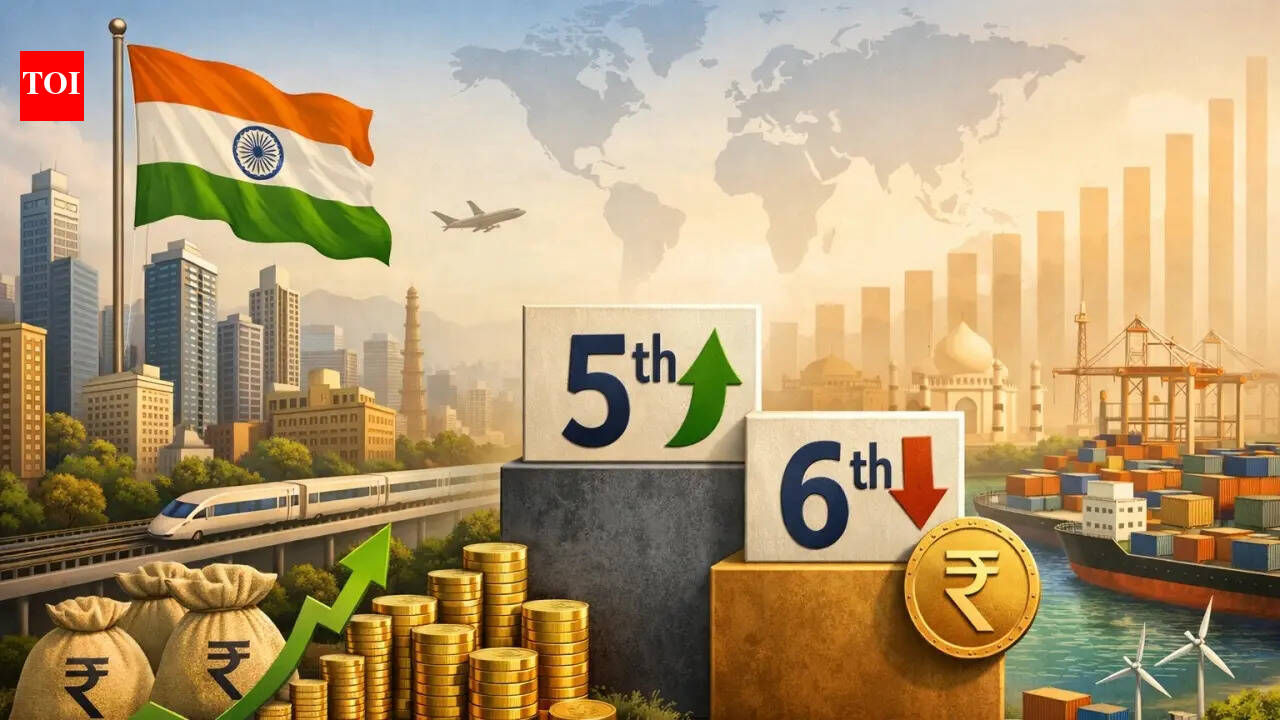
In April 2025 when the International Monetary Fund (IMF) released its World Economic Outlook, India was seen overtaking Japan to become the world’s fourth largest economy by the end of 2025-26. One year later, India has slipped to the sixth position on the largest economies rankings, with the United Kingdom reclaiming its spot as the fifth largest economy.In fact, IMF’s latest World Economic Outlook (April 2026) sees India sitting at the sixth spot this financial year too. This projection comes even as India has grown better than expected in FY26 and is seen retaining its tag of being the world’s fastest growing major economy.What has led to the sudden fall? Why has India dropped to the sixth position, falling behind the UK, instead of overtaking Japan to become the fourth largest economy? And what does this setback mean for its dream of becoming the third largest economy by the end of this decade? We decode:
Data drive: India projected as 4th largest, but fell to 6th spot
First let’s look at some IMF data to see which way the Indian economy was headed in April 2025, and what the April 2026 outlook data suggestsAs per April 2025 estimates of IMF, India’s economy would have been at $4601.225 billion at the end of FY 2025-26, overtaking Japan which was estimated at $4373.091 billion. The UK at the 6th spot was projected to have a nominal GDP of $4040.844 billion.However, as per the April 2026 estimates, India’s economy had a nominal GDP of $4,153 billion at the end of FY 2025-26, with the UK overtaking it with $4,265 billion GDP. Japan’s GDP is seen at $4,379 billion.As the above estimates show, India’s GDP estimates have seen a drop over one year, while UK’s nominal GDP has grown better than expected. Japan has been steady.So, what went wrong? Blame the rupee and GDP data itself!
Rupee Depreciation Blow & New GDP Series
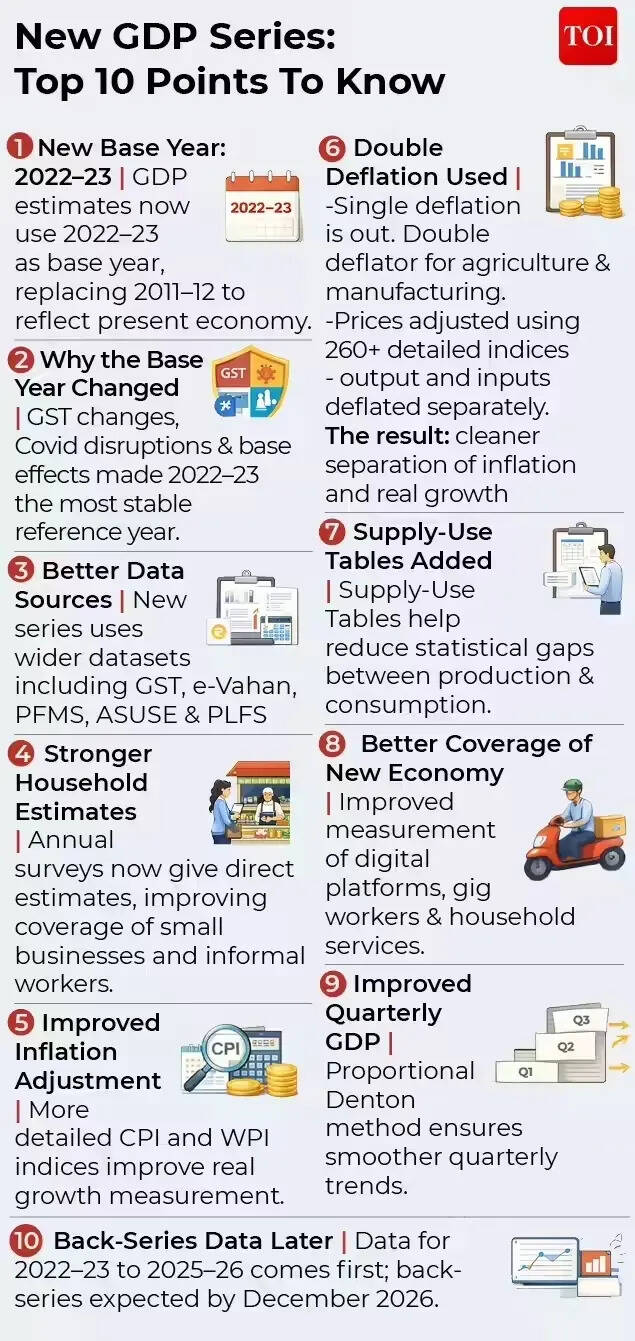
The first thing to understand is that IMF’s data on the size of a country’s nominal GDP is in dollar terms. Hence, with global rankings based on dollar‑denominated GDP, they are highly sensitive to exchange rate movements. The biggest party pooper for India’s dream of becoming the fourth largest has been the rupee’s slide. The Indian currency has depreciated more than expected over the last year, dropping from 84.57 versus the US dollar in 2024 to 88.48 in 2025, as per IMF data. The IMF estimates see it at 92.59 this year.Several factors have contributed to the rupee’s decline, including capital outflows, uncertainty related to India-US trade deal up until February, and the recent Middle East conflict which has raised crude oil prices and India’s import bill. Also, the RBI while actively managing volatility in the forex market, is not targeting any particular level of the rupee.Arun Singh, Chief Economist, Dun & Bradstreet India says that India’s recent slip to sixth place in global GDP rankings does not reflect a weakening of the economy, but is largely the result of currency conversion effects and a one‑time statistical revision.The rupee’s depreciation from 2024 to 2026, has mechanically compressed India’s GDP in dollar terms, effectively halving apparent growth despite strong domestic expansion, says Arun Singh.According to Ranen Banerjee, Partner and Leader, Economic Advisory Services, PwC India, GDP in US dollar terms would shave off with rupee depreciation. “We have had almost 7-8% depreciation over the last few months owing to the conflict and portfolio outflows. Thus, in effect in US dollar terms, it is close to shaving out almost a year’s nominal GDP,” he tells TOI.And it’s not just about the Indian economy. The United Kingdom which has overtaken India to bag the 5th spot again also has economic factors working in its favour. UK’s GDP growth at 0.5% has recently beaten forecasts of 0.1% by a wide margin. Not only that, its currency – pound – has actually appreciated against the US dollar.The second factor that has impacted the rankings is India’s adoption of a new base year for its latest GDP series. As per the new data, which also makes use of a more refined methodology, the size of India’s nominal GDP in rupee terms has gone down. Sample this: As per the older base year of 2011-12, India’s GDP at the end of 2025-26 would have been Rs 35,713,886 crore. But under the new series, it is estimated to be Rs 34,547,157 crore. The new calculation methodology and base year revision presents a more accurate picture of the size of the Indian economy.Hence the currency effect has been compounded by a one‑time downward revision following India’s shift to a new GDP base year, which has lowered reported nominal levels without affecting real activity.
Does India’s drop to 6th indicate fundamental weakness?
Experts are confident that India’s growth story is intact and fundamentally strong, a fact that is reflected in projections of it continuing to be the world’s fastest growing major economy. They see technical factors behind the current slip, rather than any deterioration in economic fundamentals.It’s also interesting to note that while India will be the sixth largest economy in FY27, in the upcoming financial year, it is likely to overtake both the UK, and Japan to bag the fourth spot.Arun Singh of Dun & Bradstreet India explains this resilience with numbers:IMF World Economic Outlook (April 2026) data show that India’s GDP at current prices in domestic currency rose strongly from ₹318 trillion in 2024 to ₹346.5 trillion in 2025 and further to ₹384.5 trillion in 2026, translating into robust nominal growth of about 8.9% in 2024–25 and nearly 11% in 2025–26, among the fastest globally. In contrast, other large economies recorded more moderate domestic nominal growth – around 5% in the US, roughly 4% in China, 3–5% in the UK, 3–3.5% in Germany, and lower or volatile growth in Japan – underscoring India’s strong underlying momentum. In times of global economic turmoil, while GDP growth is expected to take some hit, most agencies and experts have pegged India’s growth to be strong. Incidentally, the IMF has even marginally raised its GDP growth forecast for FY27 to 6.5% despite the ongoing Middle East conflict.
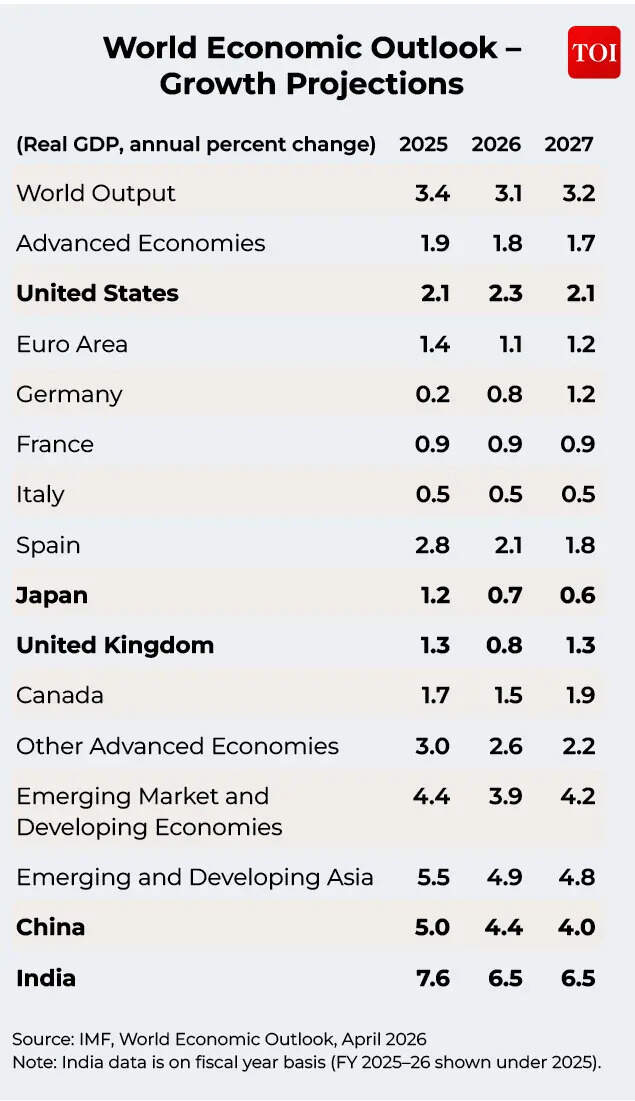
“In India, growth for 2025 is revised upward by 1.0 percentage point relative to October, to 7.6 percent, reflecting the better-than-expected outturn in the second and third quarters of the fiscal year and sustained strong momentum in the fourth quarter,” IMF said in its latest outlook. “For 2026, growth is revised upward moderately by 0.3 percentage point (0.1 percentage point relative to January) to 6.5 percent, led by positive contributions from the carryover of the strong 2025 outturn and the decline in additional US tariffs on Indian goods from 50 to 10 percent, which outweigh the adverse impact of the Middle East conflict. Growth is projected to stay at 6.5 percent in 2027,” it added.
Will India become 3rd largest anytime soon?
The rupee depreciation and the nominal GDP revision has also pushed back India’s dream of becoming the third largest economy by the end of this decade. In the October 2025 estimates, IMF had said that India will overtake Germany to become third largest by FY30. However, the April 2026 projections see it reaching the third rank only by FY 2030-31.Experts point to the rupee’s depreciation versus the dollar to note that the road ahead is likely to be uncertain. Madan Sabnavis, Chief economist, Bank of Baroda is confident that India will continue to do well in the coming years.“We will definitely improve in terms of GDP growth which will be higher than that of other countries especially UK and Japan which are just above us. However, the rupee value will finally determine how India gets placed on the global scale,” he told TOI.Ranen Banerjee of PwC India sees rupee beginning to get support with the conflict containment, relatively lower oil prices and portfolio flow reversals with valuations getting attractive in recent times. “Thus, we should not be experiencing any further sharp depreciation of the rupee in the immediate term provided the conflict does not escalate and oil prices relatively softening from their highs and come down to a range of $85-90 a barrel,” he says.For Arun Singh of Dun & Bradstreet, looking ahead, India’s relative position in US dollar‑based GDP rankings will remain highly sensitive to currency movements rather than domestic growth dynamics. “Continued global dollar strength or capital‑flow volatility may cause periodic slippage in rankings despite robust fundamentals. Sustaining external macro stability and limiting undue rupee volatility will be crucial for India’s strong growth performance to translate more fully into higher global economic rankings,” Arun Singh told TOI.The Indian economy, largely driven by domestic fundamentals, is not immune to external shocks. High US tariffs of 50% from August 2025 to early February, and the ongoing US-Iran war have spelt back-to-back shocks for the economy. Even as experts stress on the resilience of the growth story, the vulnerability to higher crude oil prices, and other global supply chain disruptions is a reality. In such a scenario, India may well have to contend with fluctuating world rankings, while banking on its strong GDP growth to tide over disruptions.

new video loaded: Why Your Paycheck Feels Smaller
By Ben Casselman, Nour Idriss, Sutton Raphael and Stephanie Swart
April 18, 2026


Ariana Grande teases new era after ‘Eternal Sunshine’ with cryptic video

I don’t regret gifting Nobel prize to Trump: Venezuela’s Machado
NaBFID signs pact with PDCOR to expand advisory support for state projects – The Times of India

-

 Politics1 week ago
Indian airlines hit hardest after Dubai limits foreign flights until May 31
-

 Entertainment6 days ago
Palace left in shock as Prince William cancels grand ceremony
-

 Sports5 days ago
The case for Man United’s Fernandes as Premier League’s best
-

 Politics1 week ago
Chinese, Taiwanese will unite, Xi tells Taiwan opposition leader
-
 Business5 days ago
UK could adopt EU single market rules under new legislation
-

 Entertainment1 week ago
Dua Lipa hits major career high ahead of wedding with Callum Turner
-
 Business1 week ago
The FAA wants gamers to apply for air traffic control jobs
-

 Sports1 week ago
Lamar Jackson hits back at critics with faithful message on social media