

Business
Topshop returns to the high street, but can it get its cool back?


 Karwai Tang/WireImage)
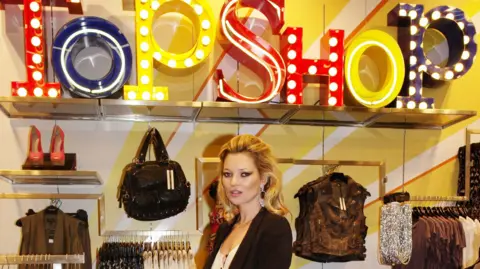
For teenage girls like me in the 2000s and 2010s, going into a Topshop store was like being transported into a fantasy world.
There was music! Makeup! And fashion! All under one roof – with Topshop clothes often found on the pages of Vogue alongside high-end couture.
But somewhere along the way, things went wrong.
“Topshop lost its cool,” said fashion journalist Amber Graafland.
“And when that happens, it’s hard. Fashion is a fickle beast, people move on quickly.”
Then in 2020, its owner, Sir Philip Green’s Arcadia group, collapsed. All of Topshop’s physical stores shut soon after.
But Topshop is now launching a major comeback.
Standalone stores are returning to the High Street, Michelle Wilson, managing director of Topshop and Topman, confirmed to BBC News.
And on Saturday, Topshop is hosting its first catwalk show for seven years in Trafalgar Square. We’ve been told long-time brand muse model Cara Delevingne will be there.
It seems absence (and nostalgia) makes the heart grow fonder. As rumours of Topshop’s imminent return have been met by a wave of affection on social media, particularly among millennials and Gen-Z.
But industry experts say it will take more than nostalgia to make Topshop 2.0 a success.
‘They need to entice younger girls’

 Shutterstock
One of the challenges that Topshop will face is attracting a new wave of shoppers through the doors.
Its previous core following are now women in their late 20s and 30s, but it can’t just rely on them, says Graafland.
“They will need to work hard to entice younger girls in,” she said.
What might help, though, is the nostalgia trend that has taken over social media feeds and High Streets in recent months (Joni jeans, anyone?)
Topshop’s team, for their part, think they can attract both older and newer groups.
“We want to deliver for those that are nostalgic for a brand that they felt like they lost,” Wilson said.
“But we absolutely want to appeal to a new demographic as well.”
Then, there’s the fashion. For me, shopping in Topshop as a teenager made me feel like the ‘it girl’.
On Saturdays, you’d breeze through racks to find the one item that justified taking money out of your barely-there bank balance.
When you bought it, you’d act nonchalant. “Oh this old thing? It’s from Topshop,” you’d tell your school friends, as if you could afford it all the time.
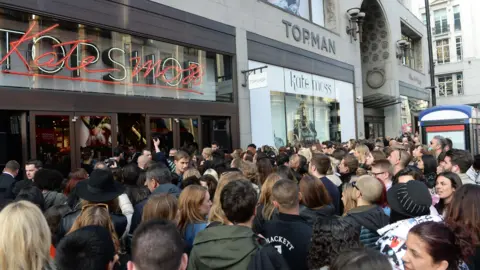
And I wasn’t the only one. Huge crowds would throng to the London landmark store to witness the launch of new ranges from A-listers like Beyoncé and Kate Moss.
 Getty Images
In the 90s and 00s, designers “used to laugh at High Street fashion”, said Wayne Hemingway, a designer and co-founder of Red or Dead.
“They couldn’t keep up with the trends. Topshop was the only one that did.”
Hemingway, who worked with Topshop through its heyday, said a large part of its success was down to the team behind it, including Jane Shepherdson, its hugely influential brand director.
“They brought in second hand clothes for example, that’s normal now, but back then it was seen as absolutely radical to have a shopping department store doing that,” he said.
“You had the collaborations, the London Fashion Walk catwalk, all this design and excitement at High Street prices. It was so fresh, everyone wanted to be part of it.”
But over time, what people were looking for changed – and Topshop didn’t always keep up, said Graafland.
“They offered that unique London look. Then the girls who shopped there grew up, and they didn’t want that look anymore,” she said.
“You cannot afford to take your finger off pulse for one minute in fashion.”
She added that Topshop 2.0 would benefit from the fact its core aesthetic – the London girl look – is back in style, and that not many other retailers are offering it.
“If you look at the High Street now, there’s a strong Spanish presence, with the likes of Zara, and also a Swedish presence with H&M. When Arcadia collapsed, we lost that Britishness,” she said.
She added that a lot of the High Street is “playing it safe right now”, and that could also work in Topshop’s favour if can “get that cool edge back”.
Topshop’s team is confident that it can still win over shoppers with its trademark London-based swagger.
“We still think there’s a huge gap in the market for that,” Wilson said.
“The most important thing that we won’t forget, and maybe got forgotten about towards the end of the previous era, is that product is everything.
“It has to be the best quality product, the most fashionable product for our customer base, and bringing that at good value.”
And then there are the prices
 Getty Images
Topshop’s popularity peaked in the heady years before the cost of living crisis. Its team are aware of the stiff competition it now faces.
A pair of Topshop jeans will easily set you back about £50. Chinese fast fashion giant Shein offers them for about £17.
“If we’re just comparing Shein, then yes, I think most brands on the planet are at a higher price point than Shein,” Wilson said.
But she added: “We know that when we offer great fashion and great value for money then the product does sell very well, so absolutely no concerns about that to be honest.”
While Topshop might not churn out new pieces at the breakneck speed of its online-only rivals, in the past, it’s still faced questions over its environmental record.
For younger shoppers, this can be an important factor in deciding where to go.
Wilson, however, indicates the higher prices reflect a more sustainable model.
The firm’s focus, she said, is very much “on the livelihoods of people within the supply chain that we partner with and also the environmental impacts of the brand”.
‘There’s got to be a buzz around it’
 PA Media
After Sir Green’s retail empire collapsed, the Topshop brand was bought by Asos.
You can still buy the items online on their website – but now, in-store shopping is coming back.
Topshop’s return to the High Street starts this month, with products set to be available to buy in certain stores.
But of course, the real interest is in the standalone stores which Wilson said are “definitely” coming back.
She wouldn’t give a date for their return, but said the aim was to open stores across the nation.
Topshop is choosing to relaunch at a time when the High Street continues to struggle. Just days ago, fashion accessories chain Claire’s collapsed into administration.
But Wilson said lessons have been learnt after what happened to Topshop 1.0.
“We’re just making sure we do it in the right way so that we don’t over-expand ourselves,” she said.
As for the stores themselves, it remains to be seen if they’ll have the same vibe as before.
For me, it was where I met friends after school, tried on eye shadow for the first time, and listened to DJs pumping out dance music.
In some stores you were able to order skinny caramel lattes, get your hair and nails done, and maybe even get a piercing or two if your mum wasn’t watching.
“Fashion is only part of the story. It’s about selling a lifestyle and an experience,” Graafland said. “There’s got to be that buzz around it.”
Topshop’s team say they won’t necessarily be replicating what it used to do, but rather, “finding ways to bring that into 2025 and do interesting things”.
Overall, the hopes are high.
“They will get the girls to the stores, I don’t doubt it,” Graafland said.
“The question is whether they can keep them there.”
Business
FPI May trade: Foreign portfolio investiors withdrew Rs 14,231 crore from Indian equities – The Times of India
Foreign portfolio investors have extended their retreat from Indian equities in May, taking their total withdrawal from the market in 2026 beyond Rs 2 lakh crore as global economic concerns continue to drag down sentiment. Data from NSDL showed FPIs have pulled out Rs 14,231 crore so far this month, adding to a year marked by persistent selling pressure. The cumulative outflow this year has now surpassed the Rs 1.66 lakh crore foreign investors withdrew during the whole of 2025. The pattern through 2026 has largely remained negative, with February standing out as the lone exception. January opened with FPIs selling equities worth Rs 35,962 crore. In February, however, foreign investors briefly reversed course, bringing in Rs 22,615 crore, their biggest monthly investment in 17 months. That momentum did not last. March recorded the sharpest reversal, with a record Rs 1.17 lakh crore exiting Indian equities. April followed with another steep outflow of Rs 60,847 crore, while May has continued the same trajectory. “The selling was largely driven by persistent global macroeconomic uncertainties, particularly concerns around inflation, interest rates and geopolitical risks, which continued to weigh on sentiment toward emerging markets,” Himanshu Srivastava, Principal, Manager Research at Morningstar Investment Research India, said. According to Srivastava, uncertainty over how global interest rates will move remains central to foreign investor behaviour. High crude oil prices and unresolved geopolitical tensions, particularly in the Middle East, have kept inflation concerns elevated worldwide, forcing investors to reassess hopes of near-term rate cuts by major central banks. This backdrop has supported firm global bond yields, increasing the appeal of developed-market debt instruments while weakening investor appetite for emerging market equities such as India. He also said intermittent weakness in the Indian rupee has affected returns for overseas investors when measured in dollar terms. Even amid sustained selling, foreign investors have not completely stepped away from Indian markets. V K Vijayakumar, Chief Investment Strategist at Geojit Investments, said FPIs have shown selective interest in segments such as power, construction and capital goods. He noted that mid-cap and certain small-cap stocks with strong earnings and growth potential are also drawing investor attention. Vijayakumar said currency depreciation and concerns around India’s earnings growth have played a significant role in shaping FPI outflows this year. He added that markets like South Korea and Taiwan are currently seeing stronger FPI interest, supported by expectations of better earnings growth linked to the artificial intelligence boom.

Campaigners are calling for a ban on the use of the weedkiller over health concerns.
Source link
Business
Assam ships 20 tons of honey consignment to US, farmers get export market boost – The Times of India

In a major push to India’s agricultural exports and the government’s One District One Product (ODOP) initiative, APEDA has facilitated the first-ever export of 20 metric tonnes of honey from Assam’s Baksa district to the United States, ANI reported.According to the Commerce and Industry Ministry, the consignment was flagged off on May 9 and exported by APEDA-registered exporter M/s Salt Range Foods Pvt Ltd.“In a major boost to the diversification of India’s agricultural exports and furthering the One District One Product (ODOP) initiative, the first-ever export consignment of ODOP honey from Baksa, an Aspirational District in Assam, to the USA was flagged off on 09 May 2026 through the initiative of APEDA,” the ministry said in a release.The ministry said the 20-metric-tonne consignment was sourced from Baksa district, which has been identified under the ODOP programme for its strong honey production and export potential.“Sourced from eco-friendly and pesticide-free environments, honey from Baksa district is known for its high quality and near-organic characteristics, reflecting the region’s rich biodiversity and sustainable agricultural practices,” the release stated.The ministry noted that honey collection has traditionally been practised by indigenous communities such as the Karbi, Mishing and Bodo tribes, where honey has long been used for food, medicinal and cultural purposes.As per National Horticulture Board data cited in the release, Assam produced around 1,650 metric tonnes of honey during FY24. Major honey-producing districts in the state include Baksa, Kokrajhar, Chirang, Udalguri and Tamulpur in the Bodoland Territorial Region.The government said the export initiative is expected to significantly improve earnings for local beekeepers and farmers.“The initiative is expected to significantly benefit local beekeepers and farmers, with producers receiving nearly 43 per cent higher price realisation compared to prevailing local farm gate prices, thereby enhancing income opportunities and strengthening rural livelihoods in the region,” the ministry said.According to the release, APEDA supported the export process by facilitating infrastructure development and providing testing and laboratory equipment at the processing facility to ensure compliance with global food safety and quality standards.“The export initiative marks a significant milestone in integrating farmers from Aspirational Districts into global value chains, ensuring better price realisation and sustained market access,” the ministry added.The ODOP initiative seeks to promote district-specific products, strengthen local economies, encourage value addition and create employment opportunities by linking regional products with international markets.


Misse Beqiri reacts as Ryan Thomas pays tribute to late TOWIE star Jake Hall

‘Reservation Hijacking’ Scams Target Travelers. Here’s How to Stay Safe

Missiles and drones locked on US targets: ‘Awaiting firing order,’ IRGC commander warns

-

 Politics7 days ago
Iran weighs US reply delivered via Pakistan as Trump signals opposition to deal terms
-
 Fashion1 week ago
Canada’s Lululemon appoints Esi Eggleston Bracey to board of directors
-

 Fashion1 week ago
US’ J.Jill, Inc. appoints Kimberly Wallengren as CMO
-

 Fashion1 week ago
US’ Gap partners with Victoria Beckham on timeless wardrobe essentials
-

 Fashion1 week ago
US cotton export sales show strong recovery, Upland rise 36%
-
 Business1 week ago
Apollo Sports Capital and Tom Dundon make landmark $225 million investment in pickleball
-

 Fashion1 week ago
AAFA pushes for swift US House passage of key anti-counterfeiting law
-

 Sports1 week ago
Sajid Ali Sadpara summits world’s fifth-highest peak