

Fashion
Trade deals, fiscal policy back India’s credit fundamentals: CareEdge


These developments could enhance the diversification and scale of India’s exports and support medium-term growth prospects, it noted in a release.
At the same time, the budget signals a steady and calibrated approach to fiscal consolidation, anchored in maintaining deficit target with continued emphasis on capital investment, it said.
CareEdge Global Ratings believes India’s recent trade deals along with its fiscal policy path uphold the BBB+/stable credit profile.
These could enhance the diversification and scale of exports and back medium-term growth.
While India’s public debt levels and interest burden are high, resilient domestic demand, diversified growth drivers and comfortable external buffers may back macroeconomic stability.
From a credit perspective, the improved tariff setting supports near-term growth prospects and enhances the predictability of export-linked revenues.
By placing India on a more competitive footing relative to other emerging market exporters, these agreements could support export momentum amid a fragmented global trade environment, remarked CareEdge Global.
While India’s public debt levels and interest burden remain elevated, resilient domestic demand, diversified growth drivers and comfortable external buffers are expected to support macroeconomic stability over the near to medium term, it said.
Sustained progress on revenue mobilisation, delivery on disinvestment targets and effective debt management will be critical to maintaining fiscal credibility and supporting India’s credit profile over the medium term, it added.
Fibre2Fashion News Desk (DS)






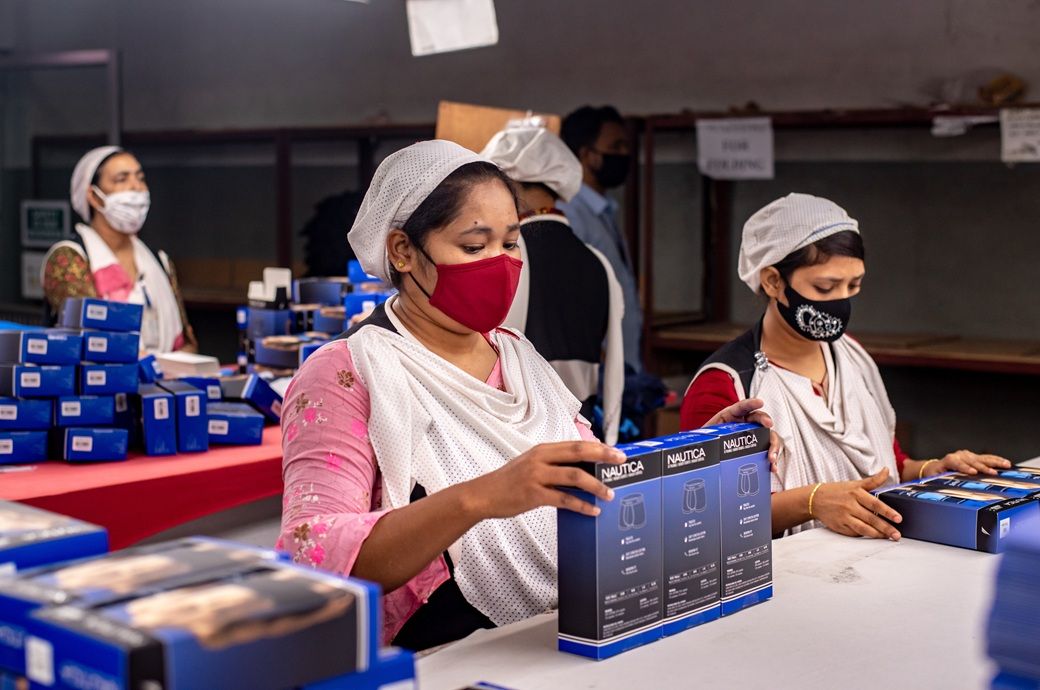
“The revised definition of workers and employees in the Bangladesh Labour Ordinance 2025 has created confusion and does not align with the recommendations of the tripartite consultative committee (TCC),” BKMEA president Mohammed Hatem told a press conference.
Bangladesh trade body BKMEA has urged the government to review provisions of the recently-amended labour law, including the definition of workers and employees, collective bargaining agents and the formation of provident funds.
The new ordinance defines employees as workers, he noted.
He called for a unified facility for provident funds and the universal pension scheme as maintaining both is impractical.
The new ordinance defines employees as workers, he noted. Previously, those engaged in administrative, supervisory or managerial roles were not classified as workers.
Hatem noted that at the TCC meeting, representatives of owners, workers and the government had agreed that employees under a specific labour law provision would not be treated as workers. The amendment, however, is ambiguous and may lead to pressure from international buyers to extend equal benefits to employees as workers, he was cited as saying by domestic media outlets.
The BKMEA president said employees’ benefits are determined by their appointment letters, and including them within the definition of workers would blur the distinction between management and labour, complicating decision-making and factory operations.
Such a move could weaken management structures, disrupt responsibilities and ultimately affect productivity, he added.
He also called for revisions to provisions relating to workers’ provident funds and the universal pension scheme, arguing that maintaining both would be impractical. He urged the government to introduce a single unified facility.
Fibre2Fashion News Desk (DS)
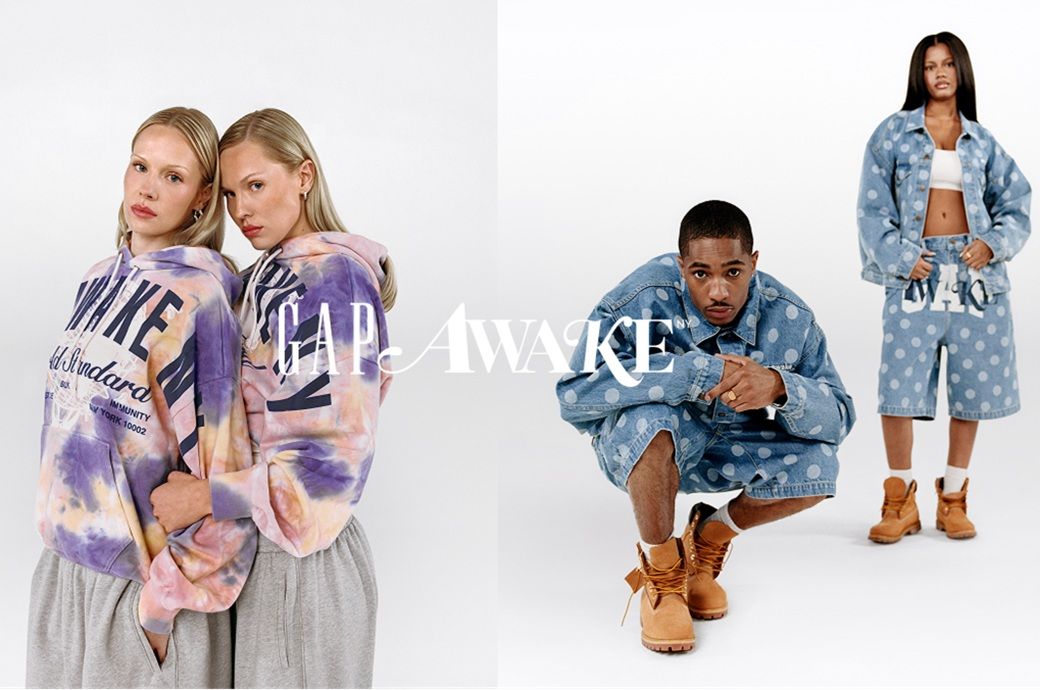
The collaboration reimagines everyday streetwear staples — sweats, utility wear, tees, denim, and accessories — with a bold, graphic-driven sensibility that is unmistakably New York. Brought to life through Awake NY’s distinct style, the collection and campaign reflect the rich diversity that has defined the city’s cultural landscape, reimagining Gap’s most-loved essentials through Awake NY’s contemporary lens.
Gap is partnering with Awake NY on a cross-generational streetwear collection for adults and kids, set to launch on March 27, 2026.
Inspired by Gap’s archives and 1990s New York City culture, the collection reinterprets classic staples with bold graphics.
It celebrates diversity, family and the city’s creative communities through a campaign featuring local artists and founders.
“Gap has always stood for self-expression and modern American style,” said Mark Breitbard, President and CEO, Gap brand. “Partnering with AWAKE is one of the ways we’re bringing our heritage into today’s cultural conversation. By blending their New York perspective with our iconic roots, we’re celebrating individuality and continuing to show up in unexpected places.”
The Gap × Awake NY campaign, shot by Elissa Salas and HIDJI WORLD, celebrates the cross-generational ties of families of all kinds — from those we’re born into to the ones we create. The campaign features an ensemble of New York creatives, including Angelo Baque and his family, the team behind Frenchette, Potluck Club co-owner Cory NG, artists Planta Industrial, and other local creators who embody the self-expression and storytelling at the heart of the collaboration.
“Growing up in Queens in the ’90s, Gap was part of the everyday uniform — democratic, effortless, and for everyone,” said Angelo Baque, Founder and Creative Director of Awake NY. “This collaboration is about honoring that era of New York — the creativity, the diversity, the families and communities that shaped how we dressed and expressed ourselves. Partnering with Gap, and its global scale and reach, allows us to bring that New York energy to audiences everywhere. Reinterpreting Gap’s icons through the lens of Awake NY brings it full circle.”
The collection brings Awake NY’s signature graphic treatments and statement-making design perspective to nostalgic Gap essentials — spanning logo and heavyweight GapSweats fleece, reimagined denim, and cargo silhouettes. Pops of color, bold polka dots and colorful plaids energize the assortment, alongside an athletic-inspired jersey, a limited-edition ‘47 Brand Gap × Awake NY New York Mets hat, and an exclusive co-branded blanket. Prices range from $18–268.
The Gap × Awake NY collection launches Friday, March 27 at 12 p.m. ET / 9 a.m. PT on gap.com and at select Gap stores, including:
- The Grove at Farmers Market – Los Angeles
- Garden State Plaza – Paramus, NJ
- 2 Folsom Street – San Francisco
- Times Square – New York
- Flatiron – New York
- Limited styles available at Awake NY’s flagship store
Note: The headline, insights, and image of this press release may have been refined by the Fibre2Fashion staff; the rest of the content remains unchanged.
Fibre2Fashion News Desk (RM)
Sarbananda Sonowal, Union Minister of Ports, Shipping and Waterways, said, “The record cargo handling of over 915 million tonnes by our major ports is a testament to the government’s unwavering commitment to strengthening India’s maritime sector. We are building world-class port infrastructure, improving efficiency, and enabling seamless logistics to support India’s growing economy.”
Among the ports, Deendayal Port Authority led with 160.11 MT, followed by Paradip Port Authority at 156.45 MT and Jawaharlal Nehru Port Authority (JNPA) at 102.01 MT. Other major contributors included Visakhapatnam, Mumbai, Chennai, and New Mangalore ports. In terms of growth, Mormugao Port Authority recorded the highest increase at 15.91 per cent, followed by Kolkata Dock System at 14.28 per cent and JNPA at 10.74 per cent, the ministry said in a press release.
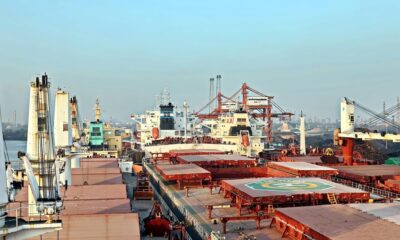
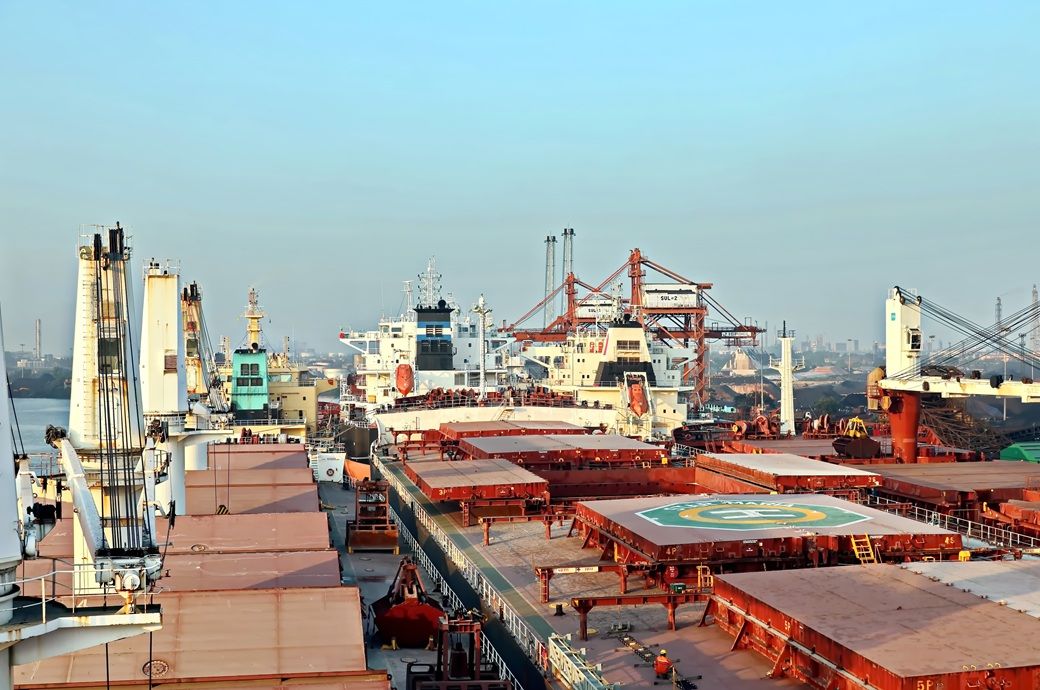
India’s major ports handled a record 915.17 MT of cargo in FY 2025-26, exceeding the 904 MT target and growing 7.06 per cent YoY, according to the Ministry of Ports, Shipping and Waterways.
The rise was driven by infrastructure upgrades, digitalisation, and improved logistics, with Deendayal, Paradip and JNPA leading volumes.
Strong gains were seen in Mormugao and Kolkata ports.
The growth has been supported by capacity expansion, enhanced multimodal connectivity, digitalisation initiatives, and increased handling of commodities such as coal, crude oil, containers, fertilisers, and petroleum, oil, and lubricants (POL). Improved turnaround time and ease of doing business have also contributed to higher cargo volumes.
The ministry continues to focus on port-led development, logistics integration, and sustainability under the Maritime Amrit Kaal Vision 2047, aiming to strengthen India’s position in global trade.
Fibre2Fashion News Desk (JP)


Middle East tensions hit Dubai imports, drive up computer prices

BKMEA urges Bangladesh govt to change amended labour law

Duchess Sophie health suffers after learning secrets amid Edward-Andrew bond

-
Uncategorized1 week ago
[CinePlex360] Please moderate: “Further tariff
-
Uncategorized5 days ago
[CinePlex360] Please moderate: “Trump signals p
-

 Tech4 days ago
Our Favorite iPad Is $50 Off
-

 Entertainment4 days ago
Joe Jonas shares candid glimpse into parenthood with Sophie Turner
-
 Fashion6 days ago
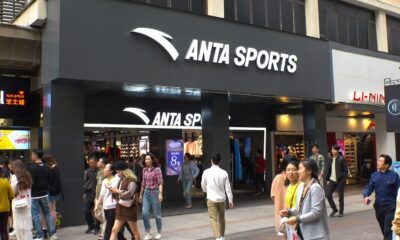
China’s Anta Sports posts record $11.62 bn revenue in 2025
-
 Business6 days ago
UPI transactions hit record Rs 29.53 lakh crore in March; volumes cross 22.6 billion – The Times of India
-
 Politics1 week ago
Trump considers asking Arab allies to help to pay for Iran war
-

 Politics4 days ago
Iran can sustain Strait of Hormuz closure for years, will cut US military logistics: Official