

Business
Translating military success into lasting economic resurgence | The Express Tribune

Defence partnerships worth $13–15bn are a generational opening, only disciplined statecraft can make them gains
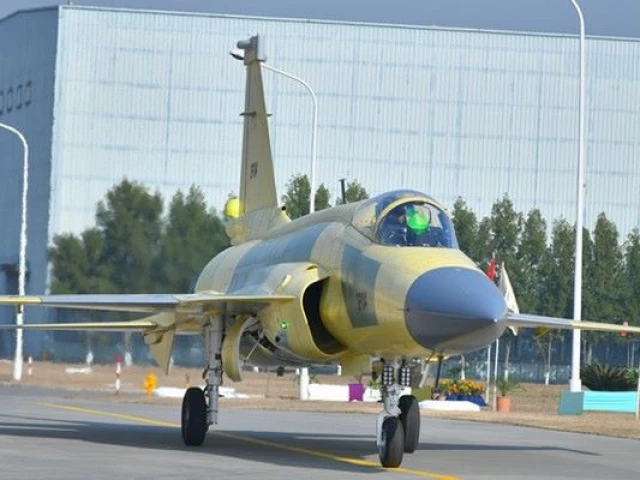
JF-17 Thunder is an advanced, light-weight, all weather, day / night multi-role fighter aircraft; developed as a joint venture between Pakistan Aeronautical Complex (PAC), Kamra and Chengdu Aircraft Industry Corporation (CAC) of China. PHOTO: Pakistan Aeronautical Complex website
KARACHI:
Over the past few weeks, the dominant conversation across Pakistan, and increasingly across the region, has revolved around the country’s potential $13-15 billion defence export and military partnerships pipeline. These discussions are no longer confined to rumours; they are being actively debated and evaluated by both domestic and international media.
The reported deals go far beyond the sale of flagship platforms such as the JF-17 fighter aircraft. They encompass comprehensive defence partnerships, including training, maintenance, upgrades, logistics, and long-term military support, effectively positioning Pakistan as a full-spectrum defence solutions provider rather than a mere arms exporter. This raises a fundamental question: has Pakistan’s military success in May 2025 created the conditions for a long-term economic resurgence, or will it remain a tactical achievement without strategic economic payoff?
Defence exports: opportunity of a generation
Pakistan’s reported defence engagement with Saudi Arabia, potentially expanding into a trilateral framework involving Turkey and Qatar, could alone eclipse headline figures attached to other contracts. Defence partnerships of this nature are rarely capped by nominal deal values; nations spend whatever is required to secure strategic capability, reliability, and deterrence.
Similarly, the reported $4 billion comprehensive defence package with the Libyan National Army, a $1.5 billion deal with Sudan, and ongoing negotiations with Iraq, Indonesia, Bangladesh, Qatar, Egypt and others could cumulatively push Pakistan’s defence partnerships into the $20-25 billion range over the medium term (remember the SIFC’s claim of $100 billion?).
If executed well, this would position Pakistan as a preferred defence supplier for several developing and Muslim-majority nations. This is undeniably positive news, but only if Pakistan treats it as a strategic inflection point, not a short-term windfall.
Rethinking the nation-building blueprint
First, Pakistan must deepen coordination with China to further scale defence manufacturing capacity, ensure technology transfer, and strengthen backward integration. Military self-reliance is not achieved merely by exporting platforms; it requires indigenous production ecosystems, resilient supply chains, and continuous innovation to protect both national security and export credibility.
Second, defence contracts should act as anchors for broader economic partnerships. Countries such as Saudi Arabia, Qatar, Egypt, Indonesia, Turkey, Azerbaijan, and Nigeria should not only be defence buyers but long-term trade, investment, and industrial partners, creating a regional economic corridor (Pakistan Military & Economic Allies (PEMAs). A regional economic corridor, built around energy, logistics, manufacturing, food security, and technology, would lock in geopolitical goodwill for decades rather than years.
Third, proceeds from defence exports must be used with extreme fiscal discipline. The priority should be to build a genuine war-chest by expanding foreign exchange reserves from the targeted $17.8 billion by June 2026 to $50 billion by June 2030, keeping current account balanced, reducing debt-to-GDP ratio by 1-2% every year, expanding tax-to-GDP ratio by 1% through widening the tax net and capturing the grey market, demonetisation of Rs5,000 notes, digitisation of transactions, ending corruption and bribery among institutions, documenting all gold transactions, thereby aligning economic resilience with military strength. Reverting to consumption-led growth, pre-election stimulus, or renewed current-account imbalances would squander this rare opportunity.
Institutionalising economic security
Fourth, the management of these hard-earned dollars must fall under a high-powered Economic Security Council, analogous to the National Security Council. Its mandate should include reinvestment into next-generation capabilities – advanced aircraft, missiles, naval systems, drones, AI-enabled warfare, and cyber defence – ensuring Pakistan remains a reliable long-term partner for defence buyers.
Critically, these inflows should not be wasted on artificial currency stability or prematurely slashing interest rates back to 6-8%. A 10% policy rate should be treated as a floor, not a temporary inconvenience. Instead, resources must be channelled into dams, railways, energy infrastructure, and retiring costly bilateral debt.
The bigger reform agenda
None of this will succeed if Pakistan neglects core structural reforms. If the country genuinely aspires to become a sovereign leadership by its centenary in 2047, it must confront long-standing distortions:
Reforming the NFC Award; bringing untaxed traders, agriculture, real estate, and services into the net; supporting FBR’s push to raise the tax-to-GDP ratio to 17-20% within five years; restoring export competitiveness through rational energy pricing, liquidity access, and predictable policy; re-engaging the West for technology transfer in AI, machine learning, and robotics; and investing aggressively in globally marketable skills for Pakistan’s youth.
Civil-military alignment
Finally, civil-military coordination must extend beyond security into economic statecraft. The upcoming budgets must reflect seriousness – privatising inefficient DISCOs (not only profitable ones), rebuilding the Roosevelt Hotel using Pakistani capital, reducing excessive taxation on the formal and salaried class, catalysing IT exports, lowering power tariffs for export industries, educating every Pakistani with global skills, creating 100 universities of global standards and investing in dams and canals to secure food security.
Pakistan must demonstrate that it is not only capable in the skies, but equally credible at economic policy tables. Investors – foreign and domestic – must see a country where decision-makers rise above vested interests, dismantle lobbies, curb nepotism, and wage a determined war against poverty, dependence, and the low-growth trap. Military success can open doors. Only disciplined economic strategy can keep them open.
The writer is an independent economic analyst







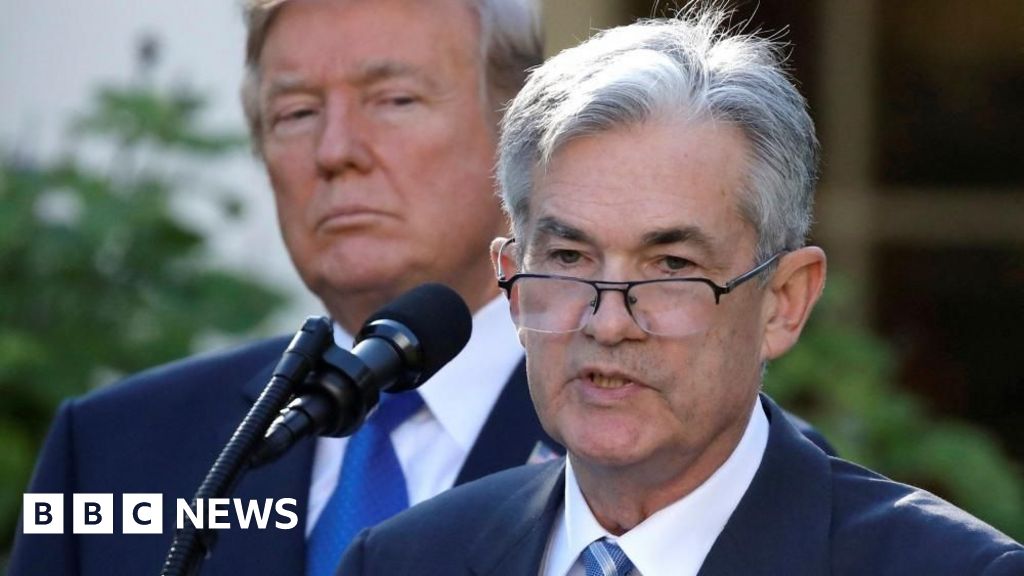
Powell’s term is nearing its end and the US Senate is considering Trump’s nominee for his replacement, Kevin Warsh. A key Republican, Thom Tillis, has withheld his support for Warsh unless the Trump administration would drop its investigation into Powell.
Business
Intel bags big gains! Chipmaker’s shares jump 26% on blockbuster results; how Trump admin benefits – The Times of India
Intel share price soared sharply on Friday after the chipmaker delivered a first-quarter performance that exceeded market expectations. And the win was not just for the chipmaker, but also the whole of US!The stock climbed 26.7% during trading on Friday, marking what could be its strongest single-day gain since 1987. Momentum continued after the closing bell, with shares rising a further 20% in after-hours trading as investors reacted to signs of a sustained turnaround driven by artificial intelligence.Intel reported revenue of $13.58 billion (€11.6bn) for the quarter, ahead of the $12.3 billion (€10.5 bn) forecast and up 7.2% from a year earlier. Adjusted earnings per share came in at $0.29, far exceeding expectations of $0.01.A key contributor to this performance was the company’s Data Centre and AI (DCAI) division, which delivered revenue of $5.05 billion (€4.2bn), up 22.4% year-on-year and well above analyst estimates of $4.41 billion (€3.77bn). The results indicate strong demand for Intel’s Xeon 6 processors and Gaudi 3 AI accelerators, particularly among enterprise clients and cloud service providers.Chief executive Lip-Bu Tan pointed to a broader shift in artificial intelligence usage as a major factor behind the growth. He said, “the next wave of AI will bring intelligence closer to the end user, moving from foundational models to inference to agentic.” He added, “This shift is significantly increasing the need for Intel’s CPUs and wafer and advanced packaging offerings.”The company also issued an upbeat outlook for the second quarter, forecasting revenue in the range of $13.8 billion (€11.8billion) to $14.8 billion (€12.6billion), surpassing investor expectations of $13 billion (€11.1billion).
But how is Washington winning?
The rally has had a direct impact on the US administration’s investment in Intel. In 2025, during a period of severe financial strain for the company, the administration of Donald Trump acquired a 9.9% stake in a move aimed at stabilising the business. The government invested $8.9 billion (€7.8bn) at a share price of $20.47 (€18.01), with $5.7 billion (€5bn) of that amount coming from previously approved but unpaid grants, according to the Euro News.At the time, Intel was facing multi-billion dollar losses and operational challenges, prompting concerns over its viability. As part of the intervention, the company cancelled planned factory projects in Germany and Poland, redirected focus towards US-based manufacturing, and reduced its global workforce by 25%, cutting around 25,000 jobs.Following the latest jump, Intel’s shares are now trading at $81.3 (€71.5), representing an increase of nearly 300% since the government first took its stake. The sharp rise highlights how the company’s improved financial performance has translated into substantial gains for the US administration.

Statistics Jersey says there have been “sharp increases” in some energy prices.
Source link


Iranian FM Abbas Araghchi lands in Pakistan ahead of renewed US talks

Mom’s Microwaved Coffee Won’t Stand a Chance With This Ember Smart Mug Deal

Giants legend Lawrence Taylor, 67, hospitalized after medical emergency: report

-

 Fashion1 week ago
France’s LVMH Q1 revenue falls 6%, shows resilience amid Iran war
-

 Tech1 week ago
CYBERUK ’26: UK lagging on legal protections for cyber pros | Computer Weekly
-

 Sports5 days ago
WWE WrestleMania 42 Night 2: Live match results and analysis
-

 Sports1 week ago
Faheem Ashraf backs Islamabad United’s push, calls league a ‘career-changing platform’
-

 Sports5 days ago
NCAA men’s gymnastics championship: All-time winners list
-
 Business1 week ago
PepsiCo earnings beat estimates as North American food business improves
-

 Tech1 week ago
Anthropic Plots Major London Expansion
-
 Business1 week ago
Oil prices fall again amid Middle East ceasefire hopes