

Politics
Trump Hails ‘Golden Age’ in High-Stakes State of the Union Address

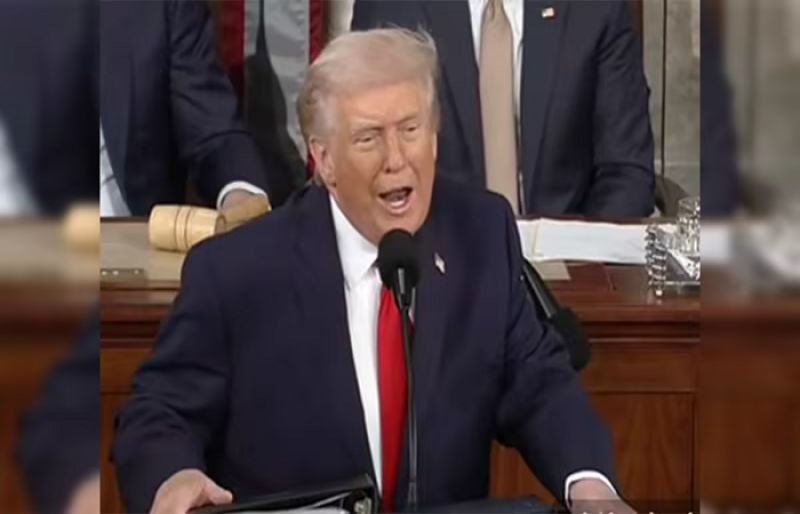
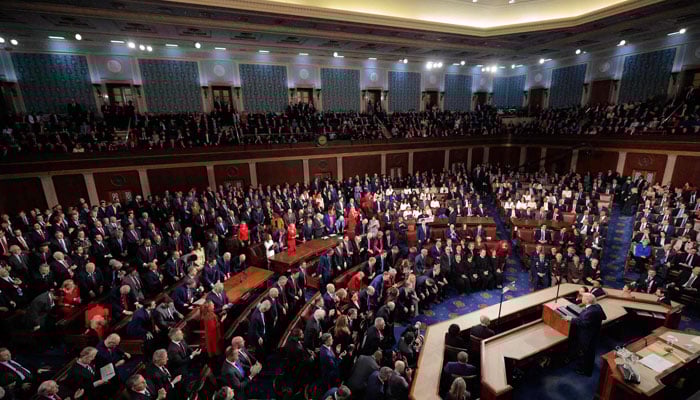
US President Donald Trump defended his economic record and declared the start of a new “golden age” during his State of the Union address on Tuesday, as he sought to project confidence amid slipping approval ratings and mounting political challenges.
Speaking before a joint session of Congress, Trump devoted much of the first hour of his speech to the economy, highlighting lower inflation, record stock market gains, sweeping tax cuts, and reduced drug prices.
“Our nation is back — bigger, better, richer and stronger than ever before,” Trump said to loud applause from Republican lawmakers, while Democrats largely remained silent.
Economic Claims Under Scrutiny
Despite the president’s optimism, recent data showed the US economy slowed more than expected last quarter while inflation accelerated.
A Reuters/Ipsos poll found only 36% of Americans approve of his handling of the economy.
Trump acknowledged last week’s ruling by the Supreme Court of the United States, which struck down his tariff regime, calling the decision “unfortunate” but avoiding the harsh criticism he had previously directed at the justices.
With midterm elections approaching in November — when all 435 House seats and about a third of Senate seats are up for grabs — both parties see the address as politically significant.
Heated Exchanges Over Immigration
Tensions rose when Trump shifted to immigration, defending his administration’s crackdown and accusing Democrats of undermining border security efforts.
“You should be ashamed,” he told Democratic lawmakers, blaming them for refusing to fully fund the Department of Homeland Security without curbs on enforcement tactics.
Democratic Representative Ilhan Omar interrupted the speech, accusing the administration of harming Americans, while Representative Al Green was removed from the chamber after holding up a protest sign.
Several Democratic lawmakers skipped the address entirely, opting to attend anti-Trump rallies outside the Capitol.
Others staged symbolic protests, including wearing clothing highlighting issues such as affordability and healthcare.
Political Stakes Remain High
Trump also repeated his longstanding claims about voter fraud, pushing for voter identification requirements — a move Democrats argue could suppress turnout.
The speech underscored deep partisan divisions at a moment when the president faces economic pressures, foreign policy anxieties involving Iran, and voter frustration over the cost of living.
As the midterms draw closer, the address served both as a celebration of Trump’s policy agenda and a preview of the contentious political battles ahead.
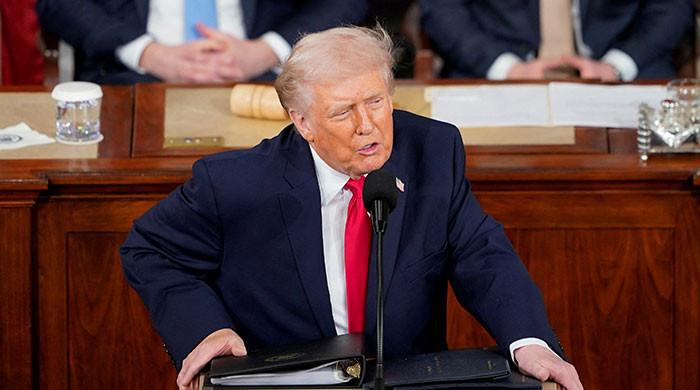
WASHINGTON President Donald Trump delivered his State of the Union address to a joint session of Congress on Wednesday, a potentially pivotal moment as the White House seeks to firm up support among Republican voters ahead of November’s midterm election.
Trump spoke against a backdrop of rising tensions with Iran and voter frustration with the high cost of living.
Here are some takeaways from Trump’s address:
Economy
Trump put dollars and cents at the heart of his speech, suggesting his aides, who have been pushing him for weeks to speak more about the economy, have prevailed for now.
He offered a broad-based sweep of kitchen-table economic issues — housing, healthcare, utility bills, crime, retirement — but he again stopped short of acknowledging that many Americans are still struggling with the high cost of living, including food and house prices.
Trump promised that his healthcare proposals to reduce drug prices and make federal payments directly to people would be cost-saving. He insisted that the tariffs struck down by the Supreme Court were generating revenue and were being restored under different legal authority.
Some party strategists have warned that without a more emphatic message on inflation, Trump’s Republican Party is at risk of losing control of Congress in the November midterm election.
In Trump’s telling, inflation, mortgage rates and gas prices are falling, while the stock market, oil production and foreign direct investment are booming along with construction and factory jobs.
But government data shows inflation ticked up last year, while the economy lost factory jobs and overall job creation was anemic. And while prices of some items — like eggs — have dropped since Trump’s return to the White House, food and other prices more broadly have increased.
Voters tell pollsters they are anxious about the economy and are dissatisfied with Trump’s handling of the issue. Some 56% disapprove of his handling of the economy, Reuters/Ipsos polling shows, while 36% approve.
Politics
Despite an uncharacteristically disciplined performance, Trump peppered his State of the Union address with made-for-TV flourishes designed to illustrate his case to voters. He doled out medals, introduced surprise guests and clashed with Democrats.
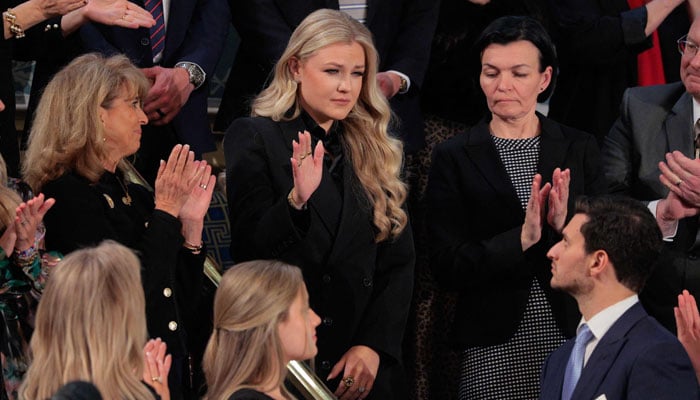
Awards for Korean War Navy pilot E. Royce Williams and Team US hockey goaltender Connor Hellebuyck — and the public name-checking of invited guests, including slain conservative activist Charlie Kirk’s widow Erika — punctuated the speech.
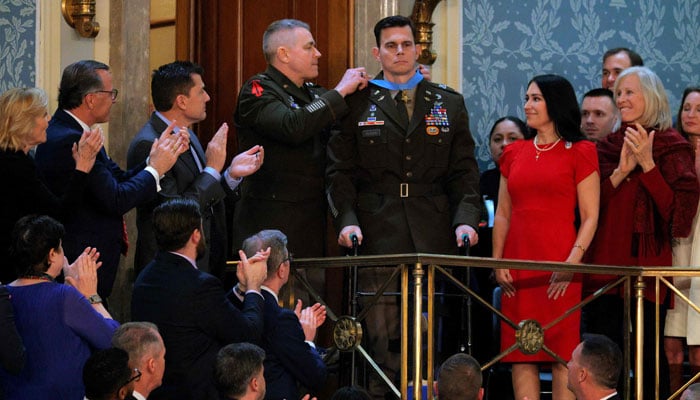
Trump gave Army Chief Warrant Officer Eric Slover, a helicopter pilot injured during the operation to capture then-Venezuelan President Nicolas Maduro, a Medal of Honour.
Each gesture underscored how the addresses have become political theatre over the years, as much about the optics as about the policies.
Trump, ever the showman, has used flashy displays of patriotism to advance his political goals. He staged a military parade on his 79th birthday and has regularly delivered sharply partisan speeches to active-duty service members.
On Tuesday, Trump’s efforts to reinforce narratives he wants voters to internalise were unmistakable. Members of the US men’s ice hockey team, fresh off an Olympic gold medal, were presented as proof that America is “winning” again under Trump’s leadership.
Other guests were introduced as cautionary tales: Dalilah Coleman, a seven‑year‑old injured in a car accident, was cited as evidence of the dangers Trump associates with immigration, while Liberty University student Sage Blair was held up as an example in his critique of schools and transgender policies.
Iran war
One of the most-asked questions going into Trump’s speech was whether he would finally make a detailed case for war against Iran, elaborating on the reason for the major US military buildup in the Middle East.
But the president did not mention Iran until well over an hour into his speech. And when he did, he fell back on his standard talking points, saying it was imperative to keep a bomb out of Tehran’s hands. He accused Iran of sowing terror via regional proxy groups and again said the leadership in Tehran had killed tens of thousands of people during recent protests.
He did not articulate why military action was urgent now, nor did he say precisely what he hoped to achieve. He gave little hint about which way he was leaning on using the military — a preoccupation at home and abroad.
During the first 75 minutes, he made only a glancing reference to Venezuela, while Russia and Ukraine were barely mentioned at all. His fixation on acquiring Greenland — a dispute that has strained transatlantic relations — did not come up.
While he spent a good chunk of time later discussing conflicts that his administration has been trying to resolve, the lack of national security and foreign policy talk up front was conspicuous, given how much time and political capital he has been spending on diplomacy.
He has in recent weeks dispatched his closest aides to far-flung capitals to try to settle the war in Ukraine and negotiate with Iran. Last month, his administration deposed the leader of Venezuela, and much of the administration’s time and energy has been focused on managing relations with the South American country.
Immigration
Trump used the speech to try to reclaim the narrative on immigration. While that issue was once a key political strength, it has morphed into a weakness in recent months amid a backlash against the high-profile killings of two US citizens by immigration agents and a mass deportation drive that has proven more popular in theory than in practice.
He never mentioned the work of the Border Patrol and US Immigration and Customs Enforcement — agencies whose masked agents have been the public face of his crackdown in American cities.
He did, however, highlight crimes carried out by immigrants in graphic terms. And he argued that Democrats could not be trusted to secure the country’s borders and keep Americans safe.
In a sense, it was a return to form for Trump. The president dedicated much of his time on the campaign trail in 2024 to describing the dangers posed by immigrants, a message that resonated with voters. Stripped from his speech was any mention of his own administration’s enforcement tactics.
Overall, Trump sought to steer attention away from the most controversial elements of his immigration enforcement push while highlighting the elements of his message that have resonated in the past.
Shift in priorities
Trump’s speech offered a window into his administration’s changing priorities from almost a year ago, the last time he spoke to a joint session of Congress.
What’s gone: A host of foreign policy subjects treated in depth. These include plans to reclaim the Panama Canal and annex Greenland. China, which merited six mentions last year, received none this year. Trump has relaxed policy toward China ahead of his planned state visit in five weeks, and he has backed off for now on his Greenland threats.
Also cut from this year’s remarks was praise for Elon Musk and his Department of Government Efficiency. Trump’s affection for both projects has dimmed. Trump did say he would launch a program focused on fraud and chaired by Vice President JD Vance.
What’s in: In addition to a bucket of deliverables on the economy, Trump added a fresh push for election law changes ahead of the November midterms, including voter ID and limits on mail ballots.
Jibe at Democrats
Trump argued that Republicans deserved two more years of control of Congress because of their handling of the economy, immigration and public safety. But beyond those policy issues, he made a far more visceral appeal to voters to back Republicans.
“These people are crazy,” he said of Democratic lawmakers in the chamber who have voted against most of his legislative proposals and who view his presidency as one that has weakened democratic institutions. “Democrats are destroying this country, but we’ve stopped it just in the nick of time,” he said.
On a number of occasions, Trump took aim at Democrats as anti-American and acting against the best interests of the country, highlighting the increasingly partisan tone of the annual speech.
Democrats stayed in their seats, visibly irritating Trump, while Republicans leapt to their feet to applaud the president on issues ranging from gender politics to illegal migration and crime.
Some, like Representatives Al Green, Ilhan Omar and Rashida Tlaib, shouted at Trump. For those Democrats, Trump’s views on those issues are divisive and problematic — and upset large parts of their base.
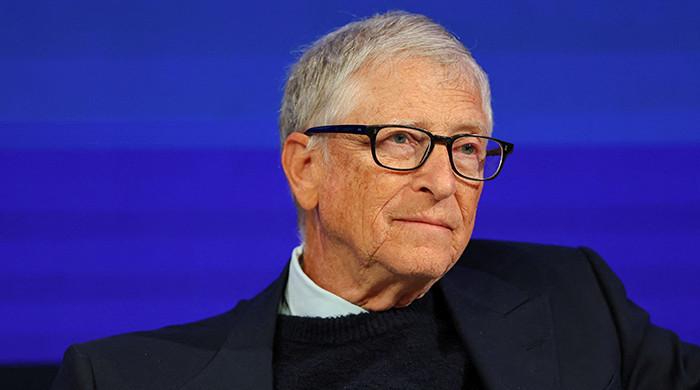
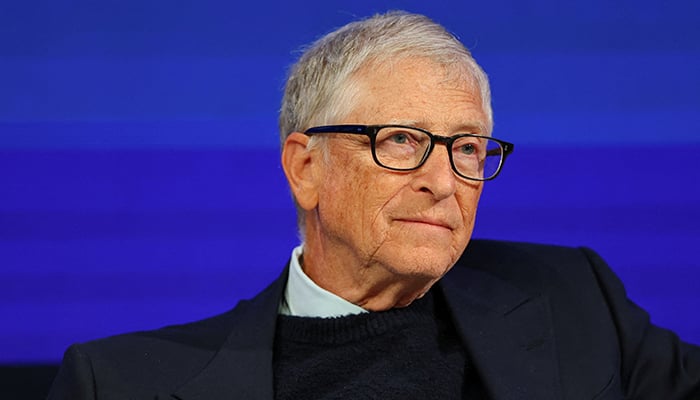
- Gates met employees and answered questions on several issues.
- Tech billionaire says he was not involved with Epstein’s victims.
- Gates acknowledges affairs with two Russian women.
Bill Gates “took responsibility for his actions” over ties to late financier and sex offender Jeffrey Epstein in a town hall meeting with employees of the Gates Foundation, a spokesperson for the philanthropic group told Reuters in a written statement.
The spokesperson’s comments came in response to a Wall Street Journal report, which said that Gates had apologised to staff during the town hall over his ties with Epstein.
Documents released by the US Department of Justice (DOJ) have indicated that Gates and Epstein met repeatedly after Epstein’s prison term to discuss expanding the Microsoft founder’s philanthropic efforts.
According to the Journal report, Gates told staff that it was a huge mistake to spend time with Epstein and bring Gates Foundation executives into meetings with the sex offender. The report cited a recording of the comments Gates made in the town hall.
“I apologise to other people who are drawn into this because of the mistake that I made,” he said, according to the newspaper.
The Journal added that Gates also acknowledged that he had two affairs with Russian women that Epstein later discovered, but that they did not involve Epstein’s victims.
“I did nothing illicit. I saw nothing illicit,” Gates told the staff, according to the report.
Documents released by the DOJ also included pictures of the Microsoft founder posing with women whose faces are redacted. Gates has previously said the relationship with Epstein was confined to philanthropy-related discussions and has said it was a mistake to meet with him.
According to the Journal, Gates told the foundation’s staff that the images were pictures that Epstein asked him to take with Epstein’s assistants after their meetings.
“To be clear I never spent any time with victims, the women around him,” Gates added, according to the report.
A spokesperson for the Gates Foundation told Reuters that Gates held a scheduled town hall with the employees and answered questions on a range of issues, including the release of the Epstein files.
“In the town hall, Bill spoke candidly, addressing several questions in detail, and took responsibility for his actions.”
The spokesperson also said the Gates Foundation statement acknowledged what was shared by the billionaire during the town hall, and the statement is all that the foundation would say about the report.
Earlier this month, the Gates Foundation said it did not make any financial payments to Epstein or employ him at any time.
The billionaire also pulled out of India’s AI Impact Summit hours before his scheduled keynote last week.
The Gates Foundation, chaired by Bill Gates and started by him and his then-wife in 2000, is one of the world’s biggest funders of global health initiatives.
- Iran’s deputy FM says ready to reach agreement as soon as possible.
- We will do whatever it takes to make this happen: Takht-Ravanchi
- Talks between Iran and US set to take place on Thursday in Geneva.
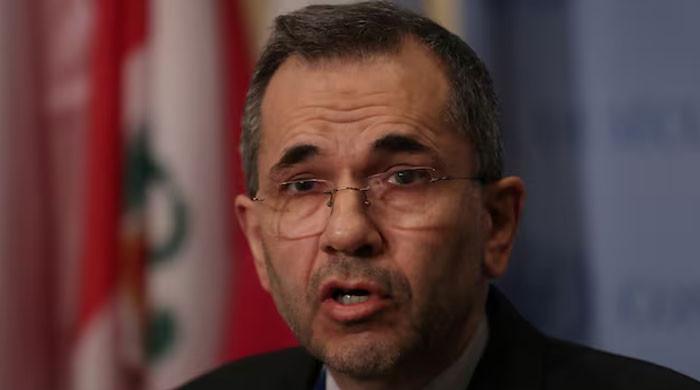
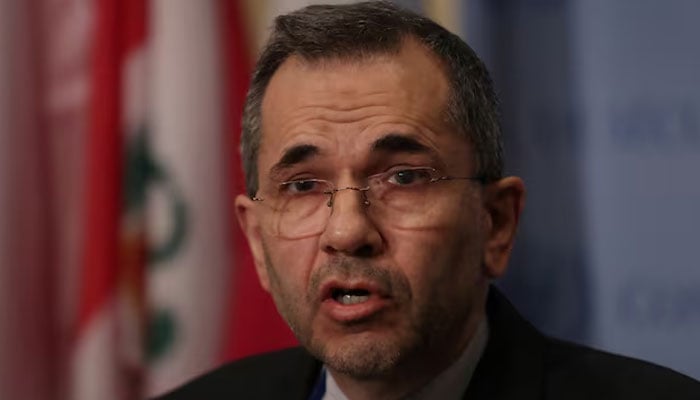
DUBAI: Iran is ready to take any necessary steps to reach a deal with the United States, Iranian Deputy Foreign Minister Majid Takht-Ravanchi said on Tuesday, as the two countries prepare for a fresh round of talks.
The talks are set to take place on Thursday in Geneva, a senior US official said on Monday, with US envoys Steve Witkoff and Jared Kushner slated to meet with an Iranian delegation for the negotiations.
The two countries resumed negotiations earlier this month as the US builds up its military capability in the Middle East. Iran has threatened to strike US bases in the region if it is attacked.
“We are ready to reach an agreement as soon as possible. We will do whatever it takes to make this happen. We will enter the negotiating room in Geneva with complete honesty and good faith,” Takht-Ravanchi said in comments carried by state media.
White House Press Secretary Karoline Leavitt said on Tuesday that US President Donald Trump’s first option was always diplomacy but that he was willing to use lethal force if necessary.
A senior Iranian official told Reuters on Sunday that Tehran would seriously consider a combination of sending half of its most highly enriched uranium abroad, diluting the rest and taking part in creating a regional enrichment consortium – an idea periodically raised during years of Iran-linked diplomacy.
Iran would do this in return for US recognition of Iran’s right to “peaceful nuclear enrichment” under a deal that would also include lifting economic sanctions, the official said.
“If there is an attack or aggression against Iran, we will respond according to our defence plans… A US attack on Iran is a real gamble,” Takht-Ravanchi added.
Indirect talks between the two sides last year brought no agreement, primarily due to friction over a US demand that Iran forgo uranium enrichment on its soil, which Washington views as a pathway to a nuclear bomb.
Iran has always denied seeking such weapons.
The US joined Israel in hitting Iranian nuclear sites last June, effectively curtailing Iran’s uranium enrichment, with Trump saying its key nuclear sites were “obliterated”. But Iran is still believed to possess stockpiles enriched previously, which Washington wants it to relinquish.


Energy bills to fall in April in price cap change and charges shake-up

Mid-market emerges as fashion’s new growth engine: Lectra study

Benny Blanco trends for all the wrong reasons after show launch

-

 Entertainment1 week ago
Queen Camilla reveals her sister’s connection to Princess Diana
-

 Tech1 week ago
Rakuten Mobile proposal selected for Jaxa space strategy | Computer Weekly
-

 Politics1 week ago
Ramadan moon sighted in Saudi Arabia, other Gulf countries
-

 Entertainment1 week ago
Robert Duvall, known for his roles in "The Godfather" and "Apocalypse Now," dies at 95
-
 Politics1 week ago
Tarique Rahman Takes Oath as Bangladesh’s Prime Minister Following Decisive BNP Triumph
-
 Business1 week ago
Tax Saving FD: This Simple Investment Can Help You Earn And Save More
-

 Tech1 week ago
Businesses may be caught by government proposals to restrict VPN use | Computer Weekly
-

 Fashion1 week ago
Australia’s GDP projected to grow 2.1% in 2026: IMF