

Politics
Trump praises Japan’s ‘great’ female leader in talks on trade, critical minerals

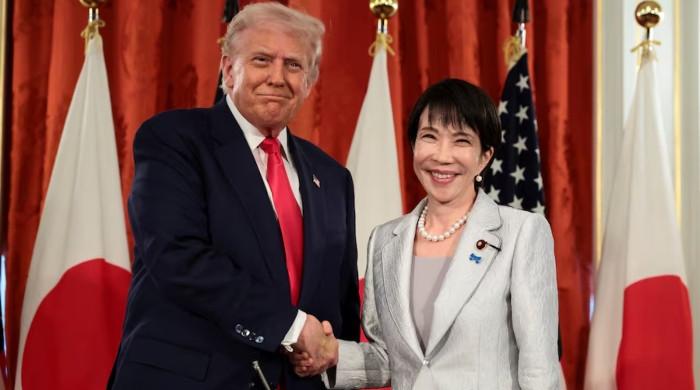
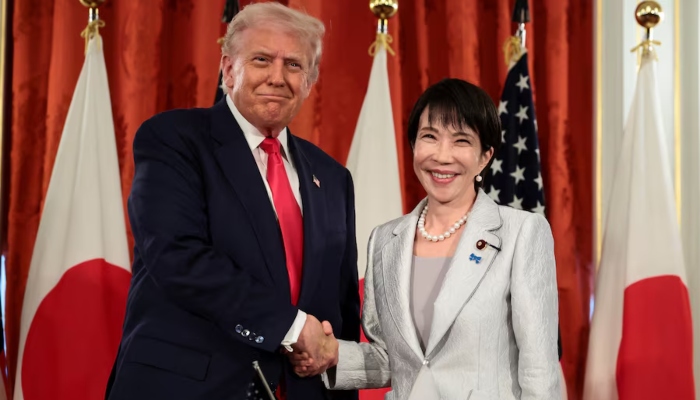
- Leaders meet in Tokyo, set to visit US naval base.
- Shipbuilding, soybeans, gas are on the agenda, sources say.
- Trump eyes trade deal with China after Japan visit.
TOKYO: US President Donald Trump lavished praise on Japan’s first female leader Sanae Takaichi in Tokyo on Tuesday, welcoming her pledge to accelerate a military buildup and signing deals on trade and critical minerals.
Takaichi, a close ally of Trump’s friend and golfing partner late Japanese Prime Minister Shinzo Abe, said she would nominate Trump for the Nobel Peace Prize, White House spokeswoman Karoline Leavitt told reporters.
She is also expected to offer a package of US investments under a $550-billion deal agreed this year, including shipbuilding, and increased purchases of US soybeans, natural gas and pickup trucks, sources familiar with the talks said.
Those gestures may temper any Trump demands for Tokyo to spend more on defending islands from an increasingly assertive China, which Takaichi sought to head off by pledging last week to fast-track plans to increase defence spending to 2% of GDP.
“It’s a very strong handshake,” Trump said, as the pair posed for photos at the Akasaka Palace in downtown Tokyo.
“Everything I know from Shinzo and others, you will be one of the great prime ministers. I’d also like to congratulate you on being the first woman prime minister. It’s a big deal,” Trump told Takaichi as the pair sat down for discussions with their delegations.
Takaichi gifted Trump Abe’s putter, a golf bag signed by Japanese major winner Hideki Matsuyama and a gold leaf golf ball, according to photos posted on X by Trump’s assistant Margo Martin.
Deal on critical minerals signed
Trump also praised Japan’s efforts to purchase more US defence equipment, while Takaichi said Trump’s role in securing ceasefires between Cambodia and Thailand, and Israel and Palestinian militants, were “unprecedented” achievements.
Takaichi followed other world leaders to recommended Trump for the Peace Prize he has long said he is worthy of.
The leaders then signed an agreement to support the supply of critical minerals and rare earths, as the countries seek to wean reliance off China’s chokehold on the materials crucial for a wide range of products from smartphones to fighter jets.
The deal aims to jointly identify projects of interest in areas such as magnets and batteries over the next six months and work together to develop stockpiles of key minerals among other measures.
Trump was last at the palace, an ornate residence built in a European style, in 2019 for talks with Abe, who was assassinated in 2022.
The US leader received a royal welcome shortly after his arrival on Monday, meeting with Japanese Emperor Naruhito at the Imperial Palace.
Visit US naval base
Takaichi’s gifts to Trump and repeated references to Abe are aimed at evoking memories of a close bond forged over hours the pair spent golfing together during Trump’s first term. Abe was assassinated in 2022, with the trial of his assailant coincidentally beginning in the western city of Nara on Tuesday.
A similar close relationship with the leader of Japan’s key security and trade partner could help Takaichi bolster her weak political position at home.
Though she has seen a surge in public support since becoming prime minister, her coalition government is two votes shy of a majority in parliament’s lower house.
Trump and Takaichi will later visit the US naval base in Yokosuka near Tokyo, which is home to the aircraft carrier USS George Washington, part of the US military’s powerful presence in the region.
Trump will then meet business leaders in Tokyo, before travelling on Wednesday to South Korea. In talks there with Chinese President Xi Jinping, Trump said he hopes to seal a trade war truce between the world’s two biggest economies.
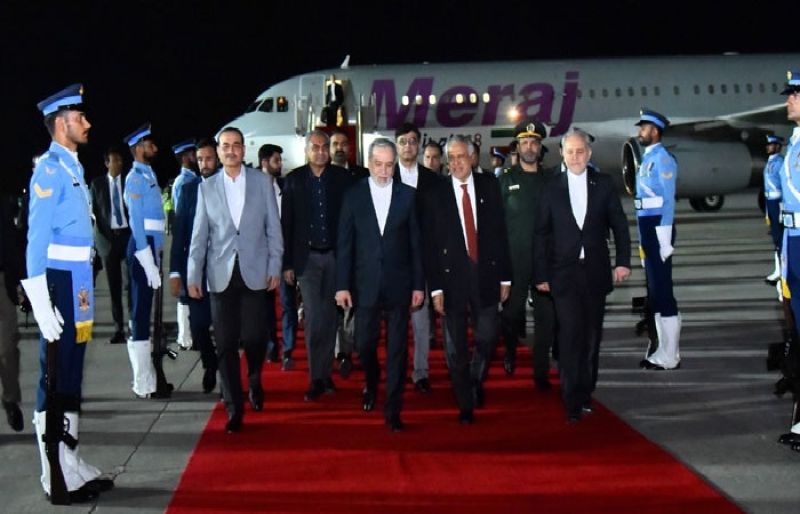
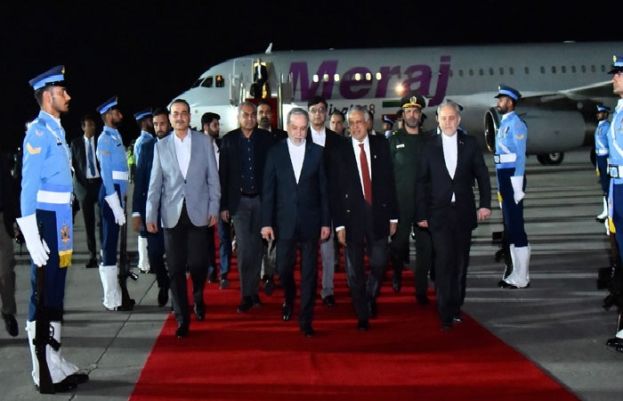
Iranian Foreign Minister Abbas Araghchi touched down in Islamabad on Friday night amid expectations of renewed engagement between Iran and the United States to end the Middle East conflict.
FM Araghchi will hold meetings with Prime Minister Shehbaz Sharif and Deputy Prime Minister and Foreign Minister Senator Ishaq Dar during the visit.
The Iranian delegation was received by Deputy Prime Minister and Foreign Minister Senator Mohammad Ishaq Dar, Chief of Defence Forces (CDF) and Chief of Army Staff (COAS) Field Marshal Asim Munir, along with other senior officials upon arrival in Islamabad, the Ministry of Foreign Affairs said in a statement.
During the visit, the Iranian FM will hold meetings with Pakistan’s senior leadership to discuss the latest regional developments as well as ongoing efforts for regional peace and stability, it added.
Earlier today, Iranian state media reported that Araghchi will depart on Friday (today) for a tri-nation tour that includes visits to Islamabad, Muscat and Moscow.
“The purpose of this visit is to hold bilateral consultations and discuss current developments in the region, as well as the latest situation in the war imposed by the United States and the Israeli regime against Iran,” the state news agency IRNA said.
Meanwhile, US envoys Steve Witkoff and Jared Kushner will head to Pakistan on Saturday for a new round of talks with Iran on ending the war, the White House said.
“I can confirm Special Envoy Witkoff and Jared Kushner will be off to Pakistan again tomorrow morning to engage in talks,” White House Press Secretary Karoline Leavitt told Fox News on Friday.
Leavitt said that Vance remained ready to fly to Pakistan but will not for now. “Everyone will be on standby to fly to Pakistan if necessary,” she said.
A US logistics and security team is already present in the federal capital ahead of the potential second round of peace talks, sources said.
They said that the development was the result of pivotal conversations conducted by Pakistan’s mediation team.
The talks would come more than two weeks after Vice President JD Vance held the first round of talks with Iranian representatives in Pakistan.
The development emerged shortly after Deputy Prime Minister and Foreign Minister Ishaq Dar urged continued dialogue and engagement to resolve disputes between the US and Iran, saying the diplomatic process was essential for advancing regional peace and stability.
DPM Dar made the remarks during a phone call with Araghchi, in which they also discussed the ongoing US-Iran ceasefire, according to a statement issued by the Foreign Office.
DPM Dar and Araghchi also exchanged views on the ongoing diplomatic efforts being pursued by Islamabad in the context of US-Iran engagement.
The Iranian FM lauded Pakistan’s consistent and constructive role in facilitating peace talks between the US and Iran.
A second round of talks between Tehran and Washington faced ambiguity after both sides failed to agree on their respective measures in and around the Strait of Hormuz.
Tehran blocked the waterway after the US and Israel launched attacks across Iran on February 28. Apart from closing Hormuz, Tehran also launched strikes against Israel and US bases across the Middle East.
Prime Minister Shehbaz Sharif mediated a two-week ceasefire between the two sides on April 8 and then facilitated the first round of talks in Islamabad on April 11.
However, the talks concluded without a deal on a permanent end to the conflict.
Following an inconclusive first round of talks, US President Donald Trump announced a US naval blockade of Iranian ports.
Iran declared Hormuz open on April 17, citing a ceasefire agreement between Lebanon and Israel. However, it closed the strait the following day due to the US blockade of Iranian maritime trade, a measure Tehran considers an act of war.
Despite the hostilities on both sides, Islamabad continued its diplomatic outreach to bring Tehran and Washington back to the table and extend the two-week ceasefire.
Hours before the expiry of the ceasefire on April 22, US President Donald Trump announced extending the truce until an Iranian proposal was submitted and discussions were concluded.
In a post on Truth Social, the US president said he was acting at the request of Pakistan to hold off attacks until Iranian leaders and representatives could come up with what he called a unified proposal.
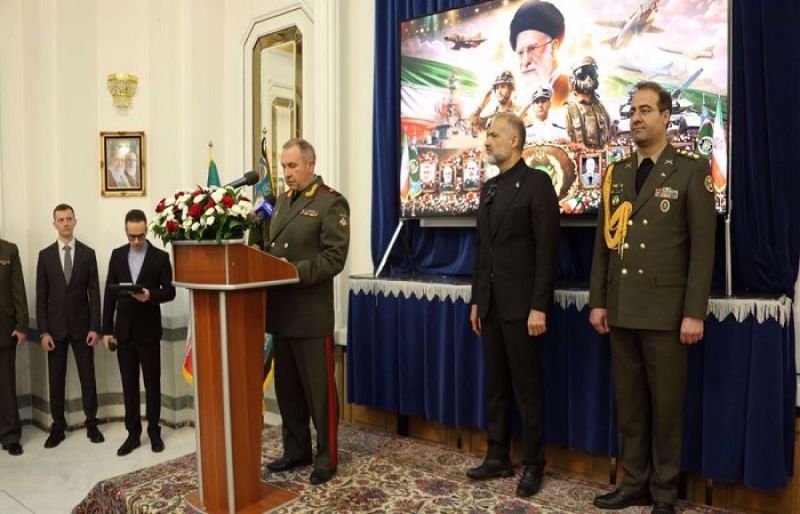
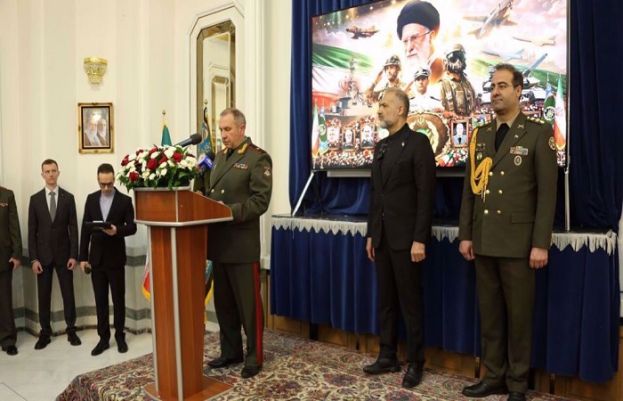
The first deputy head of the Main Directorate of International Military Cooperation of the Russian Defense Ministry says Iran demonstrated a “shining example” of defense during the recent illegal US-Israeli war of aggression.
“Iranian Armed Forces showed to the world a shining example of their firm resolve to defend their country’s interests,” Major-General Yevgeny Ilyin said during a ceremony in Moscow on Thursday, marking Iran’s National Army Day.
Iranian forces, he added, stand ready to deliver a proper and proportionate response to emerging challenges and threats.
The Russian military official said the Islamic Republic of Iran Army, with its steadfastness and courage, has protected the country’s defense and security and turned into a reliable guarantor for the nation’s independence and stability.
The unprovoked US-Israeli aggression on Iran began on February 28 with airstrikes that assassinated senior Iranian officials and commanders.
Iranian armed forces unleashed 100 waves of successful retaliatory strikes against sensitive and strategic American and Israeli targets throughout the region.
On April 8, forty days into the war, a Pakistan-brokered two-week ceasefire went into effect but the first round of Tehran-Washington negotiations failed to reach an agreement.
Referring to the strategic partnership pact signed between Iran and Russia, Ilyin said that both states have maintained their cooperation in many fields.
Iran-Russia defense relations are multifaceted, encompassing areas from the deep sea to space, he added.
The military official also reiterated Russia’s resolve to implement previous agreements with Iran and continue working on plans for bilateral military cooperation.
During the ceremony, Iran’s military attaché to Russia Sadeq Rezaei Moqaddam said Iranian Armed Forces have always been committed to moral principles and differentiated between military and civilian targets.
On the contrary, he said, the US and the Israeli regime perpetrated horrible war crimes by killing 170 students and teachers at an elementary school in the city of Minab, and targeting the Iranian Dena destroyer which was returning home from a naval drill in India.
The attacks on civilian infrastructure and educational centers represent the enemies’ strategic failure to deal a blow to the will of the Iranian nation, Rezaei Moqaddam asserted.
The perfect coordination of the Army units and other forces caused the aggressors to step back and thwarted their calculations, he said.
He further stressed that enhanced technical and military cooperation between the Iranian and Russian armed forces not only guarantees the national security of both nations, but is also the main pillar to safeguarding stability in Eurasia and countering unilateralism and organized international crimes.
- Netanyahu does not disclose when treatment occurred.
- Delayed release of medical report by two months: Israeli PM.
- Move aimed at preventing Iran from spreading “propaganda”.
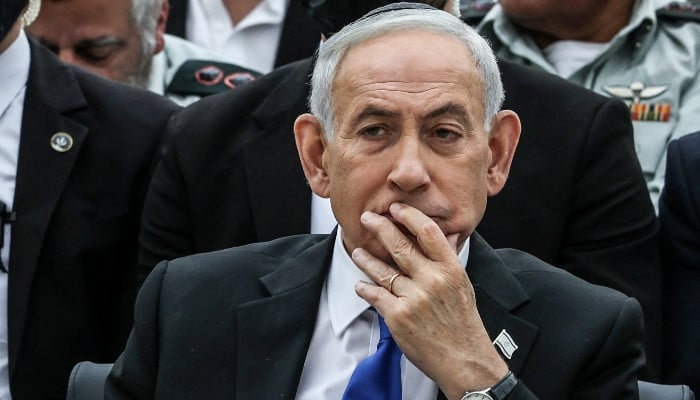
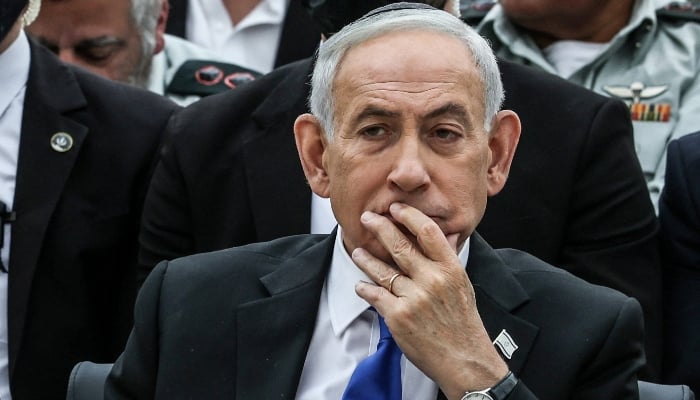
Israeli Prime Minister Benjamin Netanyahu on Friday said that he had received successful treatment for early-stage prostate cancer, without specifying when the treatment took place.
In a statement on social media, as his annual medical report was released, Netanyahu, 76, said an early stage malignant tumor had been discovered during a routine checkup. He said “targeted treatment” had removed “the problem” and left no trace of it.
According to the medical report, which otherwise said the prime minister was in good health, Netanyahu was treated with radiation therapy for early-stage prostate cancer.
Neither the medical report nor Netanyahu said when the treatment occurred.
Israel’s longest-serving prime minister said that he had delayed the release of the medical report by two months to prevent Iran from spreading “false propaganda against Israel”.
In March, during the fighting with Iran, rumors that circulated on social media and aired on Iranian state media claimed that Netanyahu had died.
The Israeli leader recorded a video of himself visiting a Jerusalem cafe in March to refute the claims.
Netanyahu underwent surgery on his prostate in 2024 after he was diagnosed with a urinary tract infection resulting from a benign prostate enlargement. In 2023, he was fitted with a pacemaker. Elections are due to be held in Israel by October.


Charlie Sheen updates on relationship with old pal Jon Cryer

Iranian FM Abbas Araghchi lands in Pakistan ahead of renewed US talks

Mom’s Microwaved Coffee Won’t Stand a Chance With This Ember Smart Mug Deal

-

 Fashion1 week ago
France’s LVMH Q1 revenue falls 6%, shows resilience amid Iran war
-

 Tech1 week ago
CYBERUK ’26: UK lagging on legal protections for cyber pros | Computer Weekly
-

 Sports5 days ago
WWE WrestleMania 42 Night 2: Live match results and analysis
-

 Sports1 week ago
Faheem Ashraf backs Islamabad United’s push, calls league a ‘career-changing platform’
-

 Sports5 days ago
NCAA men’s gymnastics championship: All-time winners list
-
 Business1 week ago
PepsiCo earnings beat estimates as North American food business improves
-

 Tech1 week ago
Anthropic Plots Major London Expansion
-
 Business1 week ago
Oil prices fall again amid Middle East ceasefire hopes