

Politics
Trump says Iran regime change could be ‘best thing’ as second carrier heads to Middle East

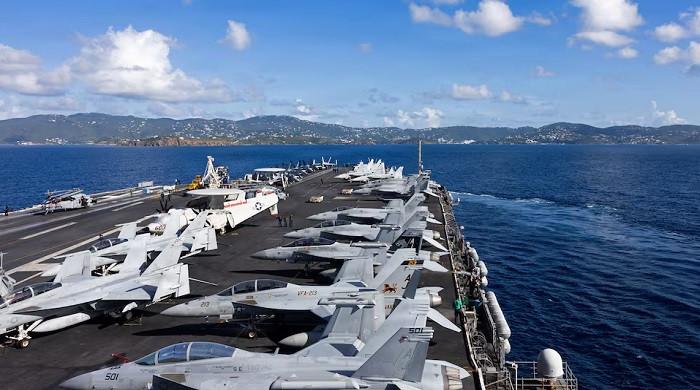
- Trump embraces potential regime change in Iran.
- Declines to share who he wants to lead Iran.
- Second US carrier sent to region.
US President Donald Trump on Friday embraced potential regime change in Iran and declared that “tremendous power” will soon be in the Middle East, as the Pentagon sent a second aircraft carrier to the region.
Trump’s military moves and tough talk come even as Washington and Tehran seek to revive diplomacy over Tehran’s long-running nuclear dispute with the West.
Asource briefed on the matter told Reuters that US envoys Steve Witkoff and Jared Kushner will hold negotiations with Iran on Tuesday in Geneva, with representatives from Oman acting as mediators.
The source said Witkoff and Kushner will also meet officials from Russia and Ukraine on Tuesday in Geneva in the US drive to bring an end to the war in Ukraine.
Asked if he wanted regime change in Iran, Trump responded that it “seems like that would be the best thing that could happen.” He declined to share who he wanted to take over Iran, but said, “There are people.”
“For 47 years, they’ve been talking and talking and talking,” Trump said after a military event at Fort Bragg, North Carolina. “In the meantime, we’ve lost a lot of lives while they talk. Legs blown off, arms blown off, faces blown off. We’ve been going on for a long time.”
Washington wants nuclear talks with Iran to also cover the country’s ballistic missiles, support for armed groups around the region and the treatment of the Iranian people. Iran has said it is prepared to discuss curbs on its nuclear program in exchange for lifting sanctions, but has ruled out linking the issue to missiles.
Trump has threatened strikes on Iran if no agreement is reached, while Tehran has vowed to retaliate, stoking fears of a wider war as the US amasses forces in the Middle East. The US targeted Iran’s nuclear facilities in strikes last year.
When asked what was left to be targeted at the nuclear sites, Trump said the “dust.” He added, “If we do it, that would be the least of the mission, but we probably grab whatever is left.”
Long deployments
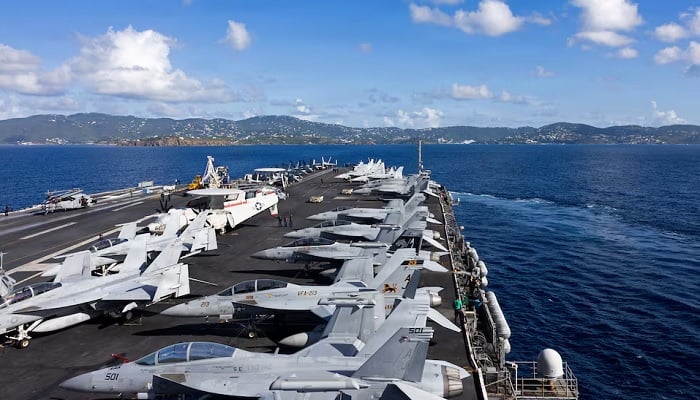
US officials described the complex process of moving military assets. The carrier Gerald R. Ford will join the carrier Abraham Lincoln, several guided-missile destroyers, fighter jets and surveillance aircraft that have been moved to the Middle East in recent weeks.
The Gerald R. Ford, the United States’ newest and the world’s largest carrier, has been operating in the Caribbean with its escort ships and took part in operations in Venezuela earlier this year.
Asked earlier on Friday why a second aircraft carrier was headed to the Middle East, Trump said: “In case we don’t make a deal, we’ll need it … if we need it, we’ll have it ready.”
One of the officials, who spoke on condition of anonymity, said the carrier would take at least a week to reach the Middle East.
The United States most recently had two aircraft carriers in the area last year, when it carried out strikes against Iranian nuclear sites in June.
With only 11 aircraft carriers in the US military’s arsenal, they are a scarce resource and their schedules are usually set well in advance.
In a statement, US Southern Command, which oversees US military operations in Latin America, said it would continue to stay focused on countering “illicit activities and malign actors in the Western Hemisphere.”
The Ford has essentially been at sea since June 2025. It was supposed to be operating in Europe before it was abruptly moved to the Caribbean in November.
While deployments for carriers usually last nine months, it is not uncommon for them to be extended during periods of increased US military activity.
Navy officials have long warned that long deployments at sea can damage morale on ships.
Officials said the administration had looked at sending a separate carrier, the Bush, to the Middle East, but it was undergoing certification and would take over a month to reach the Middle East.
The Ford, which has a nuclear reactor on board, can hold more than 75 military aircraft, including fighter aircraft like the F-18 Super Hornet jet and the E-2 Hawkeye, which can act as an early warning system.
The Ford also has sophisticated radar that can help control air traffic and navigation.
The supporting ships, such as the Ticonderoga-class guided missile cruiser Normandy, Arleigh Burke-class guided missile destroyers Thomas Hudner, Ramage, Carney, and Roosevelt, include surface-to-air, surface-to-surface and anti-submarine warfare capabilities.
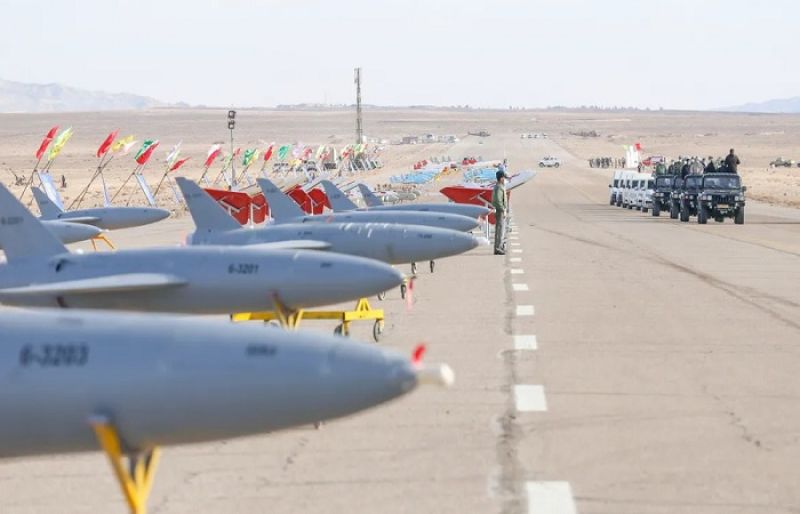
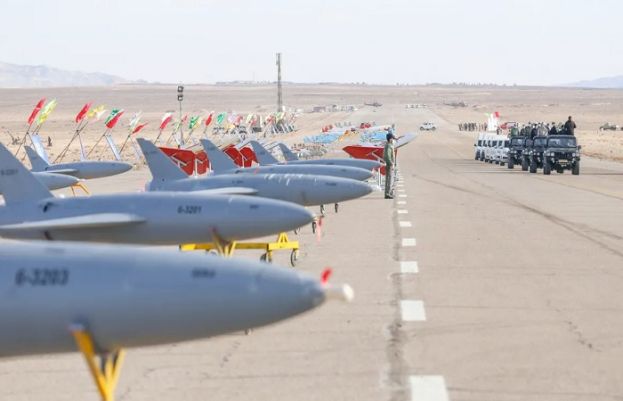
Iran’s Army launched large-scale drone operation early Tuesday on Israeli petrochemical infrastructure near Dimona, a US naval maintenance hub in the United Arab Emirates (UAE), and American radar and housing facilities in Kuwait.
“In response to the aggressions of the American-Zionist enemy against the Iranian petrochemical industries and other infrastructure, the power generation unit and fuel storage source of the petrochemical industry in the south of the occupied territories near Dimona, the US Navy maintenance center in Jebel Ali port in the UAE, and radar systems and housing buildings of American forces at the Ahmed Al Jaber Air Base in Kuwait have been targeted by heavy drone attacks,” the Army said in a statement.
The Dimona industrial zone is of high sensitivity to Israeli economy and security. It hosts the regime’s largest chemical complex in the Negev desert.
The power generation unit and fuel storage facility are located there, and the chemicals produced are used for certain military purposes, the Army said.
The US Navy maintenance center at Jebel Ali port in the UAE is one of the largest docking ports for American naval vessels in the region. It provides critical support and repair services to the US fleet.
The Ahmed Al Jaber Air Base in Kuwait hosts American military personnel. It houses radar systems and hangars capable of accommodating various military aircraft. The US Air Force’s 332nd unit is stationed there.
Iran’s Army dedicated the Tuesday operation to “anonymous soldiers, creative engineers, diligent workers, and all those involved in the Iranian oil, petrochemical and energy industries.”
“Pioneers who, during the war, with their steadfastness, expertise and exemplary sacrifice, prevented the halt of the production cycle, light and hope in this land”.
The United States and Israel imposed their illegal, unprovoked war on Iran on February 28. They assassinated Leader of Islamic Revolution Ayatollah Seyyed Ali Khamenei and targeted nuclear sites, schools and hospitals.
Nearly 100 waves of missile and drone strikes under Operation True Promise 4 have been pounding the Israeli-occupied territories and the United States’ assets in the region on a daily basis.
- Two police officers suffer light injuries during 10-minute shootout.
- Assailants arrive from Izmit; one linked to terrorist group: officials.
- Erdogan condemns attack, vows to maintain security environment.
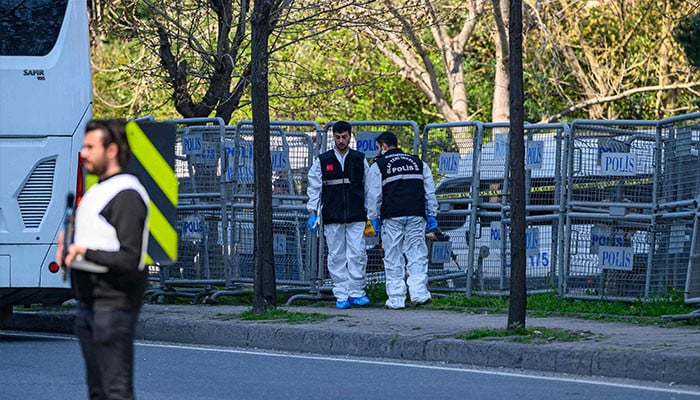
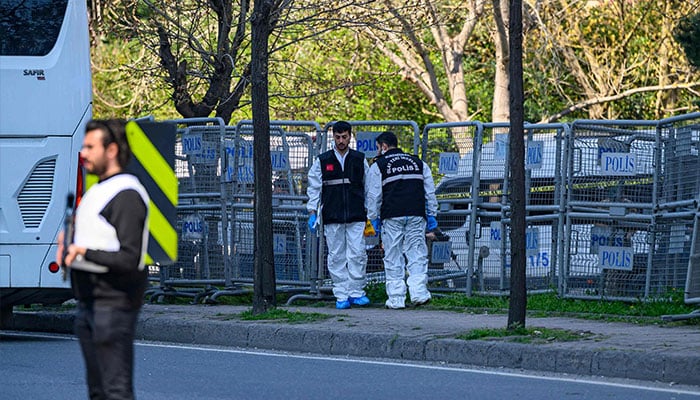
A gunman was killed and two others wounded in a shootout on Tuesday with police outside the Israeli consulate in Istanbul, Turkish officials said, adding that two officers were lightly wounded.
Governor Davut Gul confirmed the killing of one of the assailants during the attack that took place around 12:15pm (0915 GMT).
It was not immediately clear if the intended target was the Israeli consulate. No Israeli diplomats “are currently on Turkish soil”, a source familiar with the matter told AFP.
Israeli diplomatic missions had been evacuated “not only in Turkiye but throughout the region for security reasons” shortly after the October 7, 2023, attacks by the Palestinian resistance group Hamas on Israeli soil, according to the same source.
Israel said it would not be cowed down while Turkish President Recep Tayyip Erdogan condemned the “treacherous attack” and vowed to fight “all kinds of terrorism”.
“We will not allow … provocations to harm Turkiye’s climate of security,” Erdogan said in a televised speech.
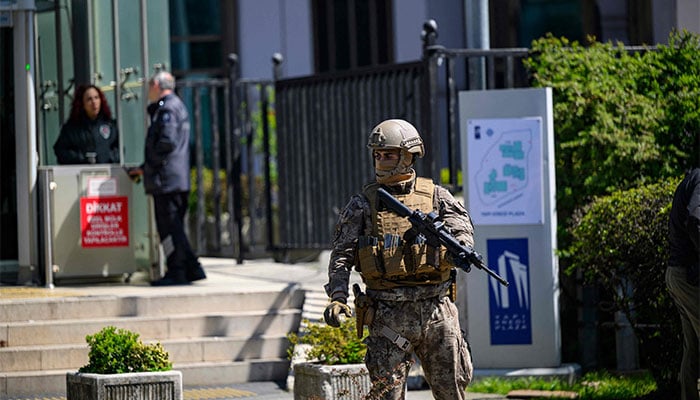
“We appreciate the Turkish security forces’ swift action in thwarting this attack. Israeli missions around the world have been subjected to countless threats and terrorist attacks. Terror will not deter us,” the Israeli foreign ministry posted on X.
Turkiye’s Interior Minister Mustafa Ciftci said the assailants came in a rented vehicle from Izmit, a city about 86 kilometres (50 miles) away and that one of them was linked to an “organisation that exploits the region”.
The ministry later clarified that the dead gunman “had connections with a terrorist group” and said two policemen were “slightly injured”.
The remaining two assailants were brothers and one has a drug record, it added.
Footage showed one attacker armed with an automatic rifle, dressed in beige cargo pants and black top and carrying a backpack.
“I saw gunfire suddenly break out … It went on for quite a while,” a witness who wished to remain anonymous told AFP.
‘People panicked’
“I saw a police officer collapse. People panicked,” he said.
Turkish officials would not immediately reveal the group but local media said it could be Daesh, whose members clashed with police in Yalova — which lies on the Sea of Marmara about 90 kilometres (55 miles) southeast of Istanbul.
Daesh militants opened fire on police in Yalova in December, killing three officers and wounding nine.
Turkish police have stepped up nationwide raids against Daesh militants, rounding up 125 suspects after that attack.
Television images on Tuesday showed police officers opening fire near a busy thoroughfare and an injured person being carried away on a stretcher.
Turkish media reported that the shootout lasted for about 10 minutes.
A large police presence was deployed in front of the consulate, located in the Levent business district on the European side of Istanbul, AFP journalists witnessed.
They also saw bloodstains on the ground in an adjacent parking lot.
The immediate vicinity of the consulate sees heightened security measures even under normal circumstances, as the area is cordoned off by police barriers.
Istanbul public prosecutor’s office has launched an investigation while the state-run TRT television reported that three suspects were detained.
“The United States condemns in the strongest terms today’s attack on the Israeli Consulate in Istanbul,” US Ambassador to Turkey Tom Barrack said on X.
“Attacks on diplomatic missions are attacks on the international order — and an assault on the principles that bind nations together,” he added, while commending Turkiye and Turkish security forces for “their swift and decisive response”.
Daesh has carried out deadly attacks in Turkey including one at a nightclub in Istanbul that killed 39 people in 2017.

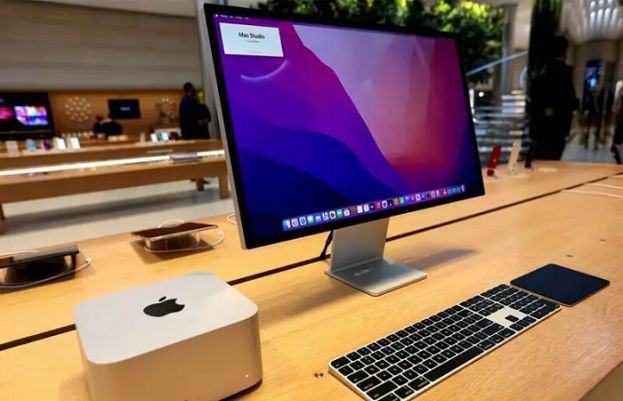
Tensions in the Middle East have disrupted the delivery of imported goods from Dubai, leading to an increase in prices of computers, laptops and related spare parts in local markets.
Supply delays have pushed up costs for consumers, while repair work has also become more expensive, affecting citizens relying on electronic devices.
Traders cited shipment disruptions as a key factor behind the rising prices.


McKennie equals career best with goal in Juve win; Napoli edge Milan

Queen’s trusted aide shares heartfelt truth after saying goodbye to Palace

Non-Vegetarian Thali Price March 2026: Home-cooked non-veg thali gets cheaper in March, veg meal cost stays flat: Report – The Times of India

-
Uncategorized5 days ago
[CinePlex360] Please moderate: “Trump signals p
-
Uncategorized1 week ago
[CinePlex360] Please moderate: “Further tariff
-

 Tech4 days ago
Our Favorite iPad Is $50 Off
-

 Entertainment4 days ago
Joe Jonas shares candid glimpse into parenthood with Sophie Turner
-

 Fashion6 days ago
China’s Anta Sports posts record $11.62 bn revenue in 2025
-

 Sports4 days ago
UConn Final Four run could trigger a $50M furniture giveaway for Massachusetts-based Jordan’s Furniture
-
 Business6 days ago
UPI transactions hit record Rs 29.53 lakh crore in March; volumes cross 22.6 billion – The Times of India
-
 Politics4 days ago
Iran can sustain Strait of Hormuz closure for years, will cut US military logistics: Official