

Politics
Trump vows Iran war will ‘end very soon’

- War sends stock markets slumping and oil prices soaring.
- If war starts up again, Iran will be hit even harder, says Trump.
- Trump tells lawmakers campaign would be “short-term excursion.”
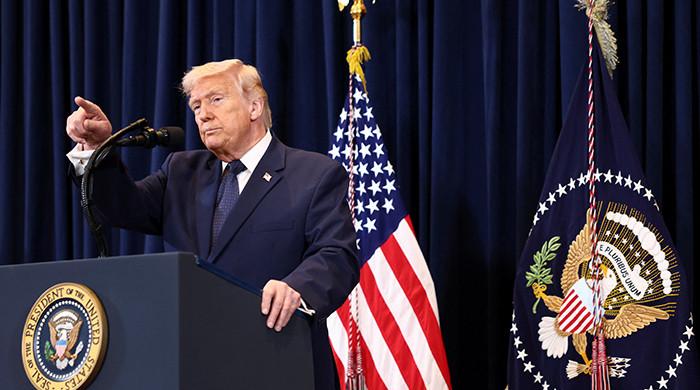
President Donald Trump on Monday said that US military operations in Iran would be ending soon, reassuring markets that have been thrust into chaos by a war still reverberating across the Middle East.
The war had sent stock markets slumping and oil prices soaring on Monday as Tehran, under new leader Mojtaba Khamenei, fired a fresh barrage of missiles at its Gulf neighbours and signalled that the strategic Strait of Hormuz would likely remain closed.
But Wall Street climbed into positive territory on Trump’s signals of a short war, with Tokyo and Seoul also opening Tuesday strongly, despite the president’s continued threats to expand the campaign if Iran did not fall in line.
Oil prices also reversed course, falling as much as 5% a day after benchmark crude rocketed past $100 a barrel — its highest level since Russia’s invasion of Ukraine in 2022.
“It’s going to be ended soon, and if it starts up again they’ll be hit even harder,” Trump told a news conference in Florida, after telling lawmakers that the campaign would be a “short-term excursion.”
Iran’s Revolutionary Guards replied Tuesday that they, not the Americans, would “determine the end of the war”.
Trump’s remarks came on the first day in power for the 56-year-old son of late leader Ali Khamenei, with Iranian forces launching a fresh wave of missile and drone attacks on Saudi Arabia, Bahrain, Qatar, the UAE and Israel.
Another missile was also fired at Nato member Turkiye, the second such incident in five days, with the alliance’s air defences intercepting it before it could reach its target.
Diplomatic efforts focused Monday on the highly strategic Strait of Hormuz, which has been blocked to nearly all oil tankers — sending shockwaves across the global economy.
French President Emmanuel Macron said his country and its allies were working on a “purely defensive” mission to reopen the strait, through which nearly 20% of the world’s crude oil usually transits.
The mission would aim to escort ships “after the end of the hottest phase of the conflict,” but experts say it would mean putting naval vessels at risk of fire from the nearby Iranian coast.
Kamal Kharazi, a foreign policy adviser to Iran’s supreme leader, told CNN that Tehran was calculating that economic pressure would eventually prompt other countries to intervene and end the war.
Rallies
Iran faced a fresh blitz of US and Israeli strikes after its Assembly of Experts, the top clerical body, appointed its first new supreme leader in 37 years.
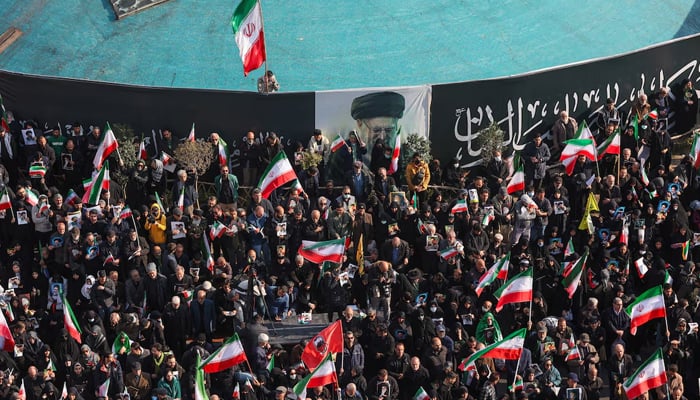
Iranian state media carried images of tens of thousands of people celebrating Mojtaba Khamenei’s selection in central Tehran, many carrying his picture.
Iran’s Houthi allies in Yemen and Hezbollah in Lebanon pledged allegiance, while Russian President Vladimir Putin on Monday promised “unwavering support”.
Trump told reporters he was “disappointed” about Khamenei’s appointment, but remained open to a replacement from inside the Islamic republic, citing the recent transition of power in Venezuela as “a formula that has been very good so far.”
Oil risks
Oil traders, policymakers and central bankers are all watching the Middle East for news about Gulf energy infrastructure, which is crucial for the world economy.
About 10 vessels in or near the Strait of Hormuz have come under attack since Iran blocked the waterway in retaliation for the US-Israeli strikes, shipping experts say.
Global shipping giant MSC announced it was formally halting some export shipments from the Gulf, meaning goods sitting on ships would be unloaded.
Following strikes on Bahrain’s Al Ma’ameer oil facility that ignited a fire, the country’s state-owned energy company Bapco joined its counterparts in Qatar and Kuwait in declaring “force majeure” — a warning that events beyond its control may lead it to miss export targets.
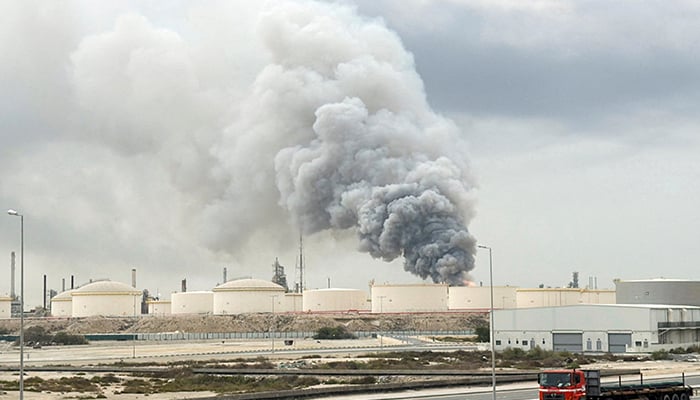
The Saudi defence ministry said Monday it had thwarted a drone attack targeting an oil field in the kingdom’s east, near the Emirati border.
‘Resistance’
In Bahrain, the interior ministry said early Tuesday an Iranian attack on a residential area in the capital Manama killed one person and injured others.
In Israel earlier, around 10 explosions were audible in Tel Aviv after the military announced it had detected missiles inbound from Iran.
At least one Israeli was killed when he was hit by shrapnel, emergency services said.
Israel said on Tuesday that it had struck an Iranian missile launcher shortly after a barrage fired from the Islamic republic triggered air raid warnings in several Israeli areas.
The multi-front war also intensified in Lebanon, where Israeli and Hezbollah exchanges of fire since March 2 have killed at least 486 people and wounded more than 1,300.
Lebanese President Joseph Aoun accused Hezbollah of working to “collapse” the state, while the head of the group’s parliamentary bloc said it had “no other option…than the option of resistance.”
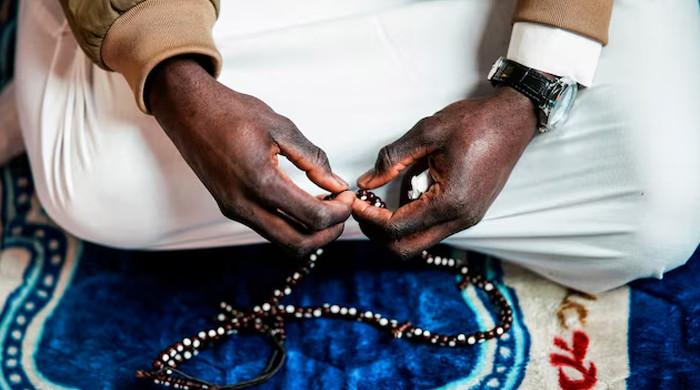
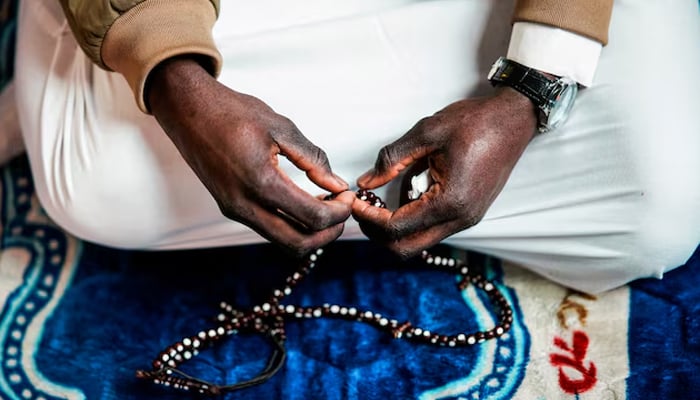
- CAIR says Islamophobia in 2025 in US reached record high.
- Most complaints were about employment discrimination (12.7%).
- Trump’s crackdown has raised free speech, due process concerns.
Record high Islamophobia in the US in 2025 was driven in part by President Donald Trump’s crackdown against pro-Palestinian protests and immigration, a Muslim advocacy group said on Tuesday.
The Council on American-Islamic Relations (CAIR) said it recorded 8,683 anti-Muslim and anti-Arab complaints in 2025, the highest since it began publishing data in 1996, compared to 8,658 in 2024.
Most complaints were about employment discrimination (12.7%), immigration and asylum (6.5%), hate incidents (6.4%), and travel discrimination like government watchlists and screenings (5.6%), CAIR’s report noted.
Over the years, advocates have attributed Islamophobia to the September 11, 2001 attacks; and more recently to anti-immigration sentiment, white supremacy and the fallout of Israel’s war in Gaza.
Immigration crackdown
Trump denies being discriminatory and says his administration aims to curb illegal immigration and improve domestic security. Advocates say the immigration crackdown is unsafe and violates due process.
CAIR noted Trump’s targeting of Somali Americans in Minnesota, a majority-Muslim community, who he accused of fraud and called “garbage.”
CAIR said the government used isolated cases for collective targeting and dismissed Trump’s ability to tackle fraud, citing pardonsto those with past fraud convictions.
CAIR’s Minnesota chapter reported 693 complaints, up from 353 in 2024.
CAIR also noted targeting of Afghan immigrants after two National Guard soldiers were shot in Washington in November, for which an Afghan was indicted.
Protest crackdown
Trump alleges pro-Palestinian protesters are antisemitic and sympathise with extremists.
His administration has attempted to deport foreign protesters, threatened to freeze funds for universities where protests were held, and ordered aggressive screening of immigrants’ online comments.
Protesters, including some Jewish groups, say he wrongly conflates criticising Israel’s assault on Gaza and occupation of Palestinian territories with antisemitism, and advocating for Palestinian rights with supporting extremism.
“The Trump administration framed anyone who holds pro-Palestinian views as inherently threatening,” CAIR said.
Notable deportation attempts were against Mahmoud Khalil, who was detained for months while his wife was pregnant, and Leqaa Kordia, who lost over 170 family members in Gaza and was briefly hospitalised following a seizure in detention.
CAIR raised free speech, due process and academic freedom concerns. Trump’s crackdown has faced judicial roadblocks.
Republican governors in Florida and Texas have signed orders designating CAIR as a “terrorist” group. CAIR sued over the designations. A judge has blocked Florida’s order.
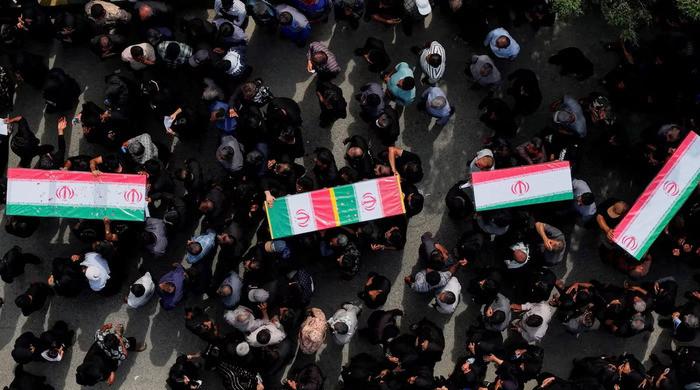
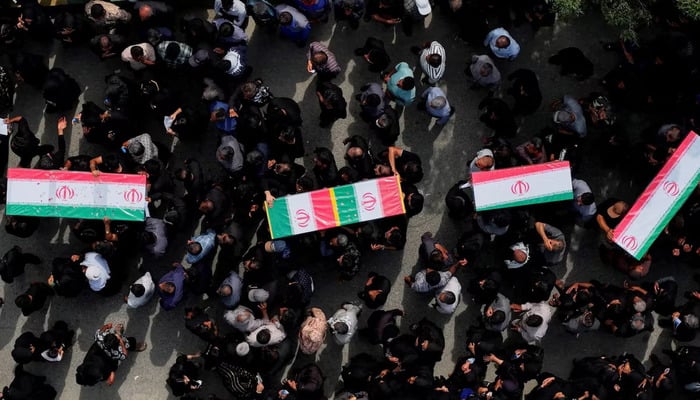
Scores of people have been killed across the Middle East since the US and Israel attacked Iran on February 28, with Gulf states that host US military bases and personnel as well as Lebanon quickly drawn into the conflict.
Here are the death tolls from the war as reported by countries as of March 9, more than a week after it began. Reuters has not independently verified these deaths.
Iran: At least 1,230 people have been killed, including 175 schoolgirls and staff killed in a missile strike on a primary school in Minab in the country’s south on the war’s first day, according to the non-profit humanitarian group Iranian Red Crescent Society. It was unclear if the overall death toll included Islamic Revolutionary Guard Corps military casualties.
The Iranian army has said that at least 104 people were killed after a US submarine sank an Iranian warship off Sri Lanka’s coast last week. Those deaths were not included in the toll given by the Red Crescent.
Israel: The military said two soldiers were killed in southern Lebanon, the first fatalities among its troops since hostilities with Hezbollah resumed last week after the group attacked Israel in support of Iran.
Eleven civilians have been killed, including nine people in an Iranian missile strike on Beit Shemesh near Jerusalem on March 1, according to Israel’s ambulance service Magen David Adom.
United States: Seven servicemembers have been killed in action during operations against Iran, the US military said.
Lebanon: At least 394 people have been killed in Israeli strikes, including 83 children, according to Lebanon’s health ministry.
Saudi Arabia: Two people were killed when a projectile fell on a residential location in Al-Kharj city, southeast of the capital Riyadh.
Bahrain: One person was killed after fire broke out in Bahrain’s Salman Industrial City following missile interception on March 2, according to the interior ministry.
Kuwait: One child has been killed in Iranian attacks on the country, according to Kuwait’s health and foreign ministries.
Two interior ministry officers and two army soldiers were also killed on duty, the army said.
Oman: One person was killed after a projectile hit the Marshall Islands-flagged product tanker MKD VYOM off the coast of Muscat.
United Arab Emirates: Four people have been killed, according to UAE’s defense ministry.
Syria: Four people were killed when an Iranian missile struck a building in the southern Syrian city of Sweida on February 28, state news agency SANA said.
Iraq: At least 15 people have been killed, according to Iraqi police and health officials.
One commander from Islamic Resistance in Iraq, an umbrella group of Iran-backed armed factions, was killed in an airstrike on his vehicle on March 5, police sources told Reuters.
LONDON: There is widespread and systemic anti-Muslim bias across British media in 2025, with a cluster of right-wing outlets responsible for the most severe and persistent harmful coverage, a new report from the Centre for Media Monitoring (CfMM) shows.
Analysing 40,913 articles published across 30 major news outlets, The State of British Media 2025: Reporting on Muslims and Islam is the largest of its kind in the UK – unveiled at a media event in the House of Commons on Monday night.
The speakers panel included Faisal Hanif, CfMM Media Analyst, Dominic Ponsford, Press Gazette, Kevin Maguire, The Mirror, Zahera Harb, Press Recognition Panel, and Professor Tahir Abbas, Aston University.
It finds that biased portrayals of Muslims and Islam are not isolated incidents but structural patterns embedded in significant sections of British journalism.
“As the largest study of its kind ever conducted in the UK, this report presents deeply concerning evidence of structural bias in how Muslims are portrayed in the UK press,” Rizwana Hamid, director of CfMM told Geo News.
“When nearly half of all articles referencing Muslims or Islam are biased, and almost 70% associate Muslims with negative aspects or behaviours, it points to a systemic problem within our media ecosystem. When entire communities are repeatedly framed through lenses of suspicion or threat, it inevitably shapes public attitudes, political debate and the everyday lives of British Muslims.”
Journalist and author Peter Oborne said: “Not all the findings in this report are unexpected. Who would have guessed that the Spectator is the most Islamophobic media outlet in Britain! But this authoritative and fair-minded study is a sobering and scrupulous reminder of the prejudice British Muslims have to endure. And it’s getting worse. Much worse.”
For Britain’s 4 million Muslims, reporting remains a primary source of information for the wider public, influencing social attitudes, policy debates and lived experiences. Unlike previous research based on limited sampling, CfMM’s study conducted a comprehensive quantitative review of all relevant articles published in 2025.
Each article was evaluated against five measurable indicators of bias: 1) negative associations with Muslims or Islam, 2) broad generalisations, 3) misrepresentation or distortion, 4) omission of context or diverse perspectives, and 5) problematic or sensational headlines.
Articles containing two or more indicators were classified as “biased”, while those containing four or five were deemed “very biased”.
The study found that nearly 50% of all articles published about Muslims in the UK (approx. 20,000 pieces) contained varying degrees of bias. With nearly half of all UK media articles about Muslims demonstrating measurable bias in 2025, audiences are routinely denied balanced and accurate information on matters of significant social importance.
Extensive research has shown correlations between negative portrayals of Muslims and rising hate crimes and support for restrictive policies.
Across all 40,913 articles analysed, 70% contain information that associates Muslims and/or Islam with negative aspects or behaviours. Although negative stories about Muslim and Islam are not inherently biased, this high figure of 70% suggests a widespread bias against the Muslim community.
The UK media is churning out negative portrayals of Muslims through the lens of conflict, threat, and controversy.
A distinct cluster of right-wing outlets consistently produced the most biased coverage of Muslims. The most harmful reporting was concentrated among a group of right-wing publications: The Spectator, GB News, The Telegraph, Jewish Chronicle, Daily Express, The Sun, Daily Mail and The Times. These outlets scored worst across all five bias categories, suggesting systematic editorial hostility rather than incidental failures.
The Spectator showed the highest concentration of severe bias against Muslims. Over one in four of the Spectator’s articles were classified as “very biased,” thereby representing the most extreme anti-Muslim framing in the UK media landscape, proportionally speaking.
The Telegraph and Daily Mail published the highest volume of very biased articles about Muslims. While some smaller outlets like the Spectator ranked worse, proportionally speaking, The Telegraph produced the largest number of severely biased articles – followed by the Daily Mail.
Generalisation about Muslims is overwhelmingly a right-wing editorial practice, the study found. The highest rates of sweeping generalisations were found almost exclusively in right-wing outlets: GB News (39%), The Telegraph (32%), Daily Express (24%), The Times (22%), The Sun (21%) and the Daily Mail (20%). By contrast, broadcasters and left-leaning outlets such as the BBC (6%), and The Guardian (11%) recorded substantially lower rates.
Contextual omission is the most widespread form of media failing when it comes to coverage of Muslims and Islam. Contextual omission was found in 44% of biased articles, making it the single most prevalent harmful practice across the dataset. Unlike other categories, this issue extends beyond right-wing media and reflects a broader structural weakness in UK journalism.
GB News has rapidly established itself as one of the most harmful outlets in terms of anti-Muslim bias. Despite its relatively recent launch, GB News ranked among the worst-performing outlets across all bias indicators. Hostile coverage of Muslims is a defining feature of its editorial identity.
The BBC consistently recorded the lowest rates of bias against Muslims. The BBC showed the strongest overall performance across metrics, demonstrating that scale does not require sacrificing editorial standards and that public service obligations provide meaningful constraints on harmful framing.


Vietnam’s CPI up 1.14% MoM in Feb; IIP up 10.4% YoY in Jan-Feb 2026

Watchdog urged to clamp down on heating oil prices after 1.7m hit by soaring bills

Bangladesh Brand Forum, BGMEA sign MoU to transform RMG sector

-
 Politics3 days ago
India let Iran warship dock the day US sank another off Sri Lanka, say officials
-

 Sports3 days ago
Pakistan set for FIH Pro League debut | The Express Tribune
-

 Entertainment3 days ago
Harry Styles kicks off new era with ‘One Night Only’ comeback show
-
 Business1 week ago
Labour parliamentarians urge UK Government to oppose Rosebank oil field
-
 Business3 days ago
Home heating oil: ‘Most of my pension has gone on home heating oil’
-
 Business3 days ago
Restaurant group changes name after bid to buys pubs across the UK
-
 Tech1 week ago
The 5 Big ‘Known Unknowns’ of Donald Trump’s New War With Iran
-

 Sports1 week ago
USA vs. Argentina (Mar 1, 2026) Live Score – ESPN