

Business
UK supermarket giants join up to warn business rates rise could push up costs

Britain’s major supermarkets are pressing the chancellor to exempt them from a new business rates surtax, warning consumers will ultimately face higher prices.
A letter from the British Retail Consortium (BRC) to Rachel Reeves argues that limiting the tax burden on grocers is vital for tackling food inflation. It has been signed by UK executives and directors from Tesco, Sainsbury’s, Aldi, Asda, Iceland, Lidl, Marks & Spencer, Morrisons, and Waitrose.
The BRC said it is concerned that large shops could see their business rates rise if they are included in the government’s new surtax for properties with a rateable value over £500,000.
This is expected to cover discounts for smaller high-street firms, which will be subject to reduced business rates under the government’s plans.
The plans are set to be confirmed in next month’s autumn Budget and would come into effect from next April.
In the letter, the supermarket bosses say that their “ability to absorb additional costs is diminishing”.
It reads: “If the industry faces higher taxes in the coming Budget – such as being included in the new surtax on business rates – our ability to deliver value for our customers will become even more challenging and it will be households who inevitably feel the impact.
“Given the costs currently falling on the industry, including from the last Budget, high food inflation is likely to persist into 2026.
“This is not something that we would want to see prolonged by any measure in the Budget.
“Large retail premises are a tiny proportion of all stores, yet account for a third of retail’s total business rates bill, meaning another significant rise could push food inflation even higher.”
The letter concludes by asking Ms Reeves to “address retail’s disproportionate tax burden”, which it said would “send a strong signal of support for the industry and of the government’s commitment to tackling food inflation”.
Helen Dickinson, the BRC’s chief executive, said: “Supermarkets are doing everything possible to keep food prices affordable, but it’s an uphill battle, with over £7bn in additional costs in 2025 alone.
“From higher national insurance contributions to new packaging taxes, the financial strain on the industry is immense.”
The Treasury has been contacted for comment.

new video loaded: How Kharg Island May Change the Trajectory of the Iran War
By Peter Eavis, Gilad Thaler, Edward Vega, Lauren Pruitt and Joey Sendaydiego
March 25, 2026
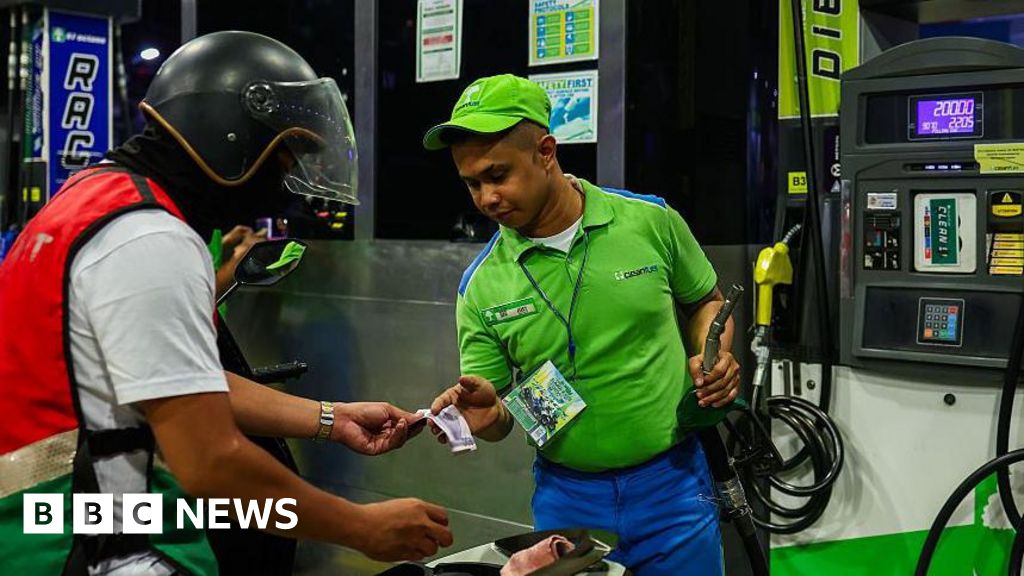
Crude rose back above $100 a barrel as the US and Iran clashed over bringing the conflict to an end.
Source link

Key Points
- JLL has a major footprint in the Middle East, managing and leasing properties in Dubai and Abu Dhabi in the United Arab Emirates and in Riyadh, Saudi Arabia.
- CEO Christian Ulbrich said the business impacts of the Iran war depend on how long the conflict lasts.
- “It’s a tragedy from a point that the region was on a really strong growth trajectory, and this is, at the moment at least, interrupted for the time being,” Ulbrich said.


Trump to visit China in May after Iran war delay
Video: How Kharg Island May Change the Trajectory of the Iran War
Oil prices volatile as Trump talks up Iran negotiations

Sales at US apparel, clothing accessories stores up 4% YoY in Jan 2026

Justice Department Says Anthropic Can’t Be Trusted With Warfighting Systems

March Madness 2026 – How to watch in SA, start time, schedule, TV channel for NCAA championship basketball tournament

-
 Fashion1 week ago
Sales at US apparel, clothing accessories stores up 4% YoY in Jan 2026
-
 Tech1 week ago
Justice Department Says Anthropic Can’t Be Trusted With Warfighting Systems
-
 Business1 week ago
Stocks and pound rise as US rate call approaches
-
 Sports1 week ago
March Madness 2026 – How to watch in SA, start time, schedule, TV channel for NCAA championship basketball tournament
-

 Entertainment1 week ago
Val Kilmer revived 1 year after death through AI
-
 Business1 week ago
Brits cashing in jewellery as gold price hits record high
-

 Sports1 week ago
WBC championship: USA-Venezuela preview, live updates, analysis
-

 Tech1 week ago
Meta Is Shutting Down Horizon Worlds on Meta Quest