

Business
UPI transaction in September slip below 2 billlion but daily average up – The Times of India


MUMBAI: UPI (Unified Payments Interface) transactions in September 2025 continued to show strong momentum, with growth evident in both daily transaction counts and values. While the total number of transactions for the month dipped slightly compared to August, the average daily data—adjusted for the shorter 30-day September—indicates a clear upward trend in activity on the platform.UPI processed 19.63 billion transactions in September, marginally lower than the 20.01 billion recorded in August. In value terms, the platform saw Rs 24.90 lakh crore transacted, almost flat compared to Rs 24.85 lakh crore in August. On a month-on-month basis, this translated into a 1.9% decline in volume but a 0.2% increase in value. The fall in aggregate numbers was largely due to September having one fewer day than August, making the daily averages more representative of underlying growth.On an average daily basis, UPI handled 654 million transactions worth Rs 83,000 crore each day in September. This marked a 1.37% increase in daily transaction count compared to August’s 645 million and a sharper 3.54% rise in daily value from Rs 80,160 crore. The stronger rise in value relative to volume indicates a growth in average ticket size, with users transacting higher amounts per payment in September. July’s daily averages were lower at 628 million transactions and Rs 80,900 crore, showing a clear three-month progression.The year-on-year picture remains more robust. September’s total transaction volume was 31% higher than the same month last year, while August had posted 34% growth. In value terms, both August and September registered 21% growth over their respective 2024 levels. These double-digit gains underscore the platform’s continued expansion and deepening integration into everyday payments.




Business
Donald Trump targets Fed chief Jerome Powell again, threatens to fire him if he is ‘not leaving on time’ – The Times of India
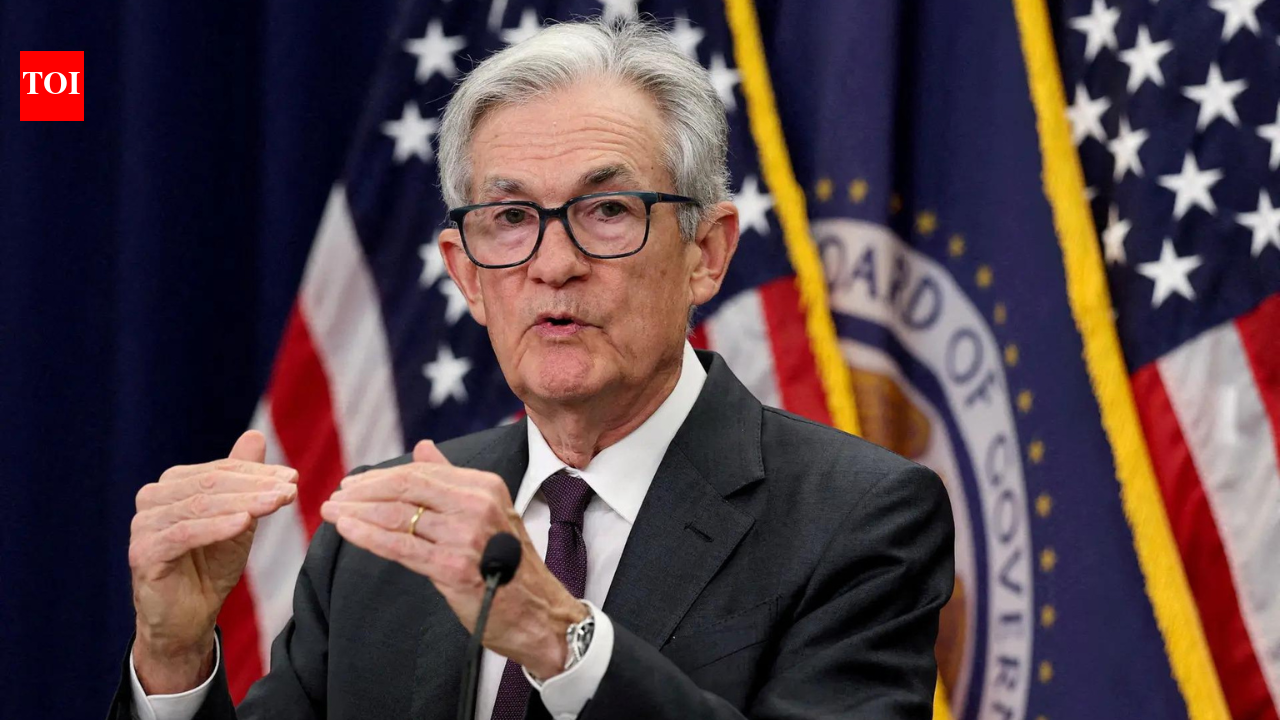
US President Donald Trump on Wednesday renewed his attack on Federal Reserve Chair Jerome Powell, saying he would fire him if he continues in the role beyond the end of his mandate.Powell’s term as Fed chair ends in mid-May, and Trump has repeatedly criticised him for not cutting interest rates more aggressively, AFP reported.
“I’ll have to fire him,” Trump told Fox Business, if Powell “is not leaving on time.”The president added: “I’ve wanted to fire him.”The remarks come as the Trump administration steps up pressure on the independent central bank, including initiating a Department of Justice probe into Powell over alleged renovation cost overruns and seeking to remove Fed governor Lisa Cook.Asked if he would drop the DOJ investigation, Trump said: “I’m not playing. I have to find out.”Trump has nominated former central banker Kevin Warsh to succeed Powell, but his appointment requires confirmation by the US Senate.Warsh is scheduled to appear before the Senate Banking Committee next Tuesday, though his confirmation faces resistance.Senator Thom Tillis, a Republican member of the committee, has said he would hold up the nomination while the probe into Powell remains unresolved.As long as the nomination process is delayed, Powell can legally continue as Fed chair.While uncommon, it is possible for a Fed chair to remain on the board even after their term as chief expires.Powell first became Fed chair in 2018 during Trump’s earlier presidency and was reappointed in 2022 under then president Joe Biden.

Morgan Stanley on Wednesday posted results that topped analyst estimates as the firm’s trading operations generated almost $1 billion more in revenue than expected.
Here’s what the company reported:
- Earnings: $3.43 a share vs. $3 LSEG estimate
- Revenue: $20.58 billion vs. $19.72 billion estimate
The bank said profit jumped 29% to $5.57 billion, or $3.43 a share. Revenue rose 16% to $20.58 billion, fueled by gains in the firm’s trading, investment banking and wealth management businesses.
Equities trading revenue jumped 25% to a record $5.15 billion, or about $450 million above the StreetAccount estimate. The firm cited strong volumes across its global equities franchise, especially in its prime brokerage business catering to hedge funds and its derivatives unit.
Fixed income revenue rose 29% to $3.36 billion, or about $540 million more than expected, helped by commodities trading that benefited from volatility in energy markets in the period.
Morgan Stanley, led by CEO Ted Pick since 2024, appears to have capably navigated the tumult of the first quarter, which saw rolling corrections in software stocks and the upheaval caused by the Iran war. Of note, the bank edged out rival Goldman Sachs in the key arena of fixed income trading, where Goldman posted an unusually large miss of $910 million versus the StreetAccount estimate.
Morgan Stanley’s investment banking revenue surged 36% to $2.12 billion, essentially matching the StreetAccount estimate, on rising fees from completed mergers, as well as stock and bond underwriting.
Wealth management revenue climbed 16% to a record $8.52 billion as the firm cited rising asset values and fee-generating transactions.
The firm’s smallest division, its investment management business, saw revenue drop 4.2% to $1.54 billion, or about $110 million below expectations. Morgan Stanley cited lower carried interest on private funds for the drop in performance.
Analysts will want to know what Pick has to say on the business outlook for the rest of the year as geopolitical tensions remain high.
This story is developing. Please check back for updates.

Bank of America, the nation’s second-largest lender, beat on the top and bottom lines during the first quarter, bolstered by equities sales and trading.
Here’s what the firm reported:
- Earnings per share: $1.11 per share vs. $1.01 LSEG estimate
- Revenue: $30.43 billion vs. $29.93 billion estimate
The bank said Wednesday that net income rose 17% to $8.6 billion, or $1.11 per share, Bank of America’s highest EPS in almost two decades.
Revenue rose 7.2% to $30.43 billion on rising net interest income, higher trading revenue, and fees from investment banking and asset management.
Tune in at 10:15 a.m. ET as Bank of America CEO Brian Moynihan joins CNBC TV to discuss the bank’s earnings report. Watch in real time on CNBC+ or the CNBC Pro stream.
Equities trading contributed to the beat, as the geopolitical environment roiled stock markets. Revenue in that business jumped 30% to $2.83 billion, topping the StreetAccount estimate by roughly $350 million and helping drive the bank’s trading operations to its best quarter in 15 years.
Investment banking also beat estimates and was up 21% to $1.8 billion, compared with StreetAccount consensus of $1.73 billion.
Net interest income, the profitability metric for loan-making, increased by 9% to $15.9 billion and beat expectations of $15.67 billion as well, according to StreetAccount. That was due to higher loan and deposit balances, fixed-rate asset repricing and markets activity.
In a sign that the bank’s borrowers weren’t deteriorating, the firm posted a $1.3 billion provision for credit losses in the quarter, lower than the $1.5 billion provision in the year earlier period and about $190 million below the estimate.
“We remain watchful of evolving risks. However, we saw healthy client activity, including solid consumer spending and stable asset quality, indicating a resilient American economy,” Bank of America CEO Brian Moynihan said in the release.
Still, like rival Goldman Sachs, the bank’s fixed income revenue came in below expectations. That business generated about $3.5 billion in revenue, missing the StreetAccount estimate by about $330 million.
The net-charge-off ratio, showing what proportion of total loans were deemed unable to be collected, improved 6 basis points during the quarter to 0.48%. The firm’s consumer banking and global wealth divisions each gained more than 20% in net income.
Return on tangible common equity, a measure of profitability, was 16%, a more than 200 basis point improvement.
— CNBC’s Hugh Son and Laya Neelakandan contributed to this report.
Correction: Bank of America previously guided to net interest income growth of between 5% and 7% this year. A previous version of this article misstated the range. And the firm’s consumer banking and global wealth divisions each gained more than 20% in net income. A previous version misstated the growth metric.


Breaking down the offseason for Michigan, Arizona, UConn, Illinois, Duke

MMA legend Ronda Rousey on her return and upcoming historic fight

Iran says to host Pakistani delegation as exchanges continue with US

-

 Fashion1 week ago
India’s exports face reset as EU links trade to carbon metrics: EY
-

 Entertainment1 week ago
Queen Elizabeth II emotional message for Archie, Lilibet sparks speculation
-

 Entertainment1 week ago
Lamar Odom shocking response to Khloé Kardashian account of his overdose
-

 Tech7 days ago
As the Strait of Hormuz Reopens, Global Shipping Will Take Months to Recover
-

 Tech1 week ago
Azure customers up in arms over ‘full’ UK South region | Computer Weekly
-

 Fashion1 week ago
CII submits 20-pt agenda to Indian govt to back firms hit by Iran war
-

 Tech6 days ago
This AI Button Wearable From Ex-Apple Engineers Looks Like an iPod Shuffle
-

 Tech1 week ago
A Single Strike Won’t Shut Off the Gulf’s Desalination System