

Business
US agrees deal to slash Swiss tariffs to 15% after golden charm offensive

 AP
APPaul KirbyEurope digital editor
Switzerland and the US have agreed to cut President Donald Trump’s steep 39% tariffs on Swiss exports to 15%, as part of a deal that involves a Swiss promise to invest $200bn (£150bn) in the US.
“It’s a great relief for our economy,” said Swiss Economics Minister Guy Parmelin, who said significant damage had been done since the additional tariffs had kicked in last August.
Parmelin said a move by Swiss business leaders to meet Trump in the White House last week had proved “decisive” in reaching a deal.
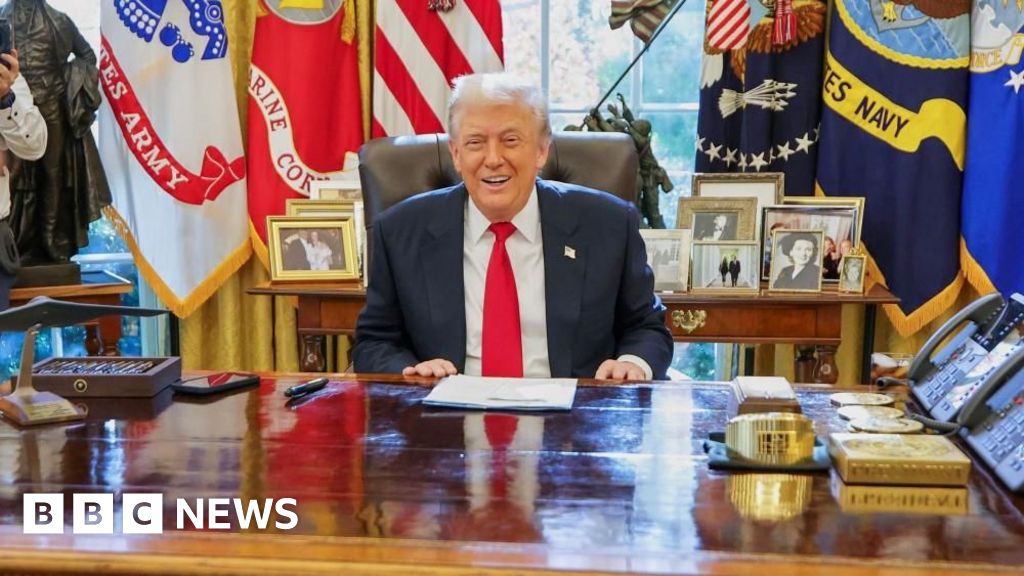
Industry chiefs visited the Oval Office, bearing gifts including a Rolex gold watch and a specially engraved gold bar from Swiss-based gold refining company MKS.
Initial attempts by Swiss President Karin Keller Sutter to change Trump’s mind had fallen on deaf ears. Trump said she “was a nice woman, but she did not want to listen”.
But after the 4 November encounter with Swiss business leaders, Trump revealed this week a deal was being worked on.
US Trade Representative Jamieson Greer confirmed an agreement had been reached, saying “President Trump’s unmatched dealmaking continues to deliver for the American people”.
The deal had involved very hard work, said chief trade negotiator Helene Budliger Artieda. Guy Parmelin said it would bring Switzerland into line with the 15% tariff rate negotiated with the US by its European Union neighbours.
The economics minister said it involved the Swiss economy investing $200bn directly in the US by 2028. A third of that Swiss money will be invested in the US in 2026 under the deal.
Switzerland has also agreed to axe tariffs on a quota of US meat exports including beef, bison and poultry.
Greer said the deal “tears down longstanding trade barriers” and Swiss investment would bring thousands of new jobs.
For Swiss industry, the deal could not come soon enough. Tech exports to the US are down 14.2% on the third quarter of last year, according to latest statistics – a dramatic fall since the tariff hike was imposed in August.
The role of Swiss industrialists appears to have been key, and some particularly those trading in luxury goods, gold, or commodities, already had contacts in Trump’s circle.
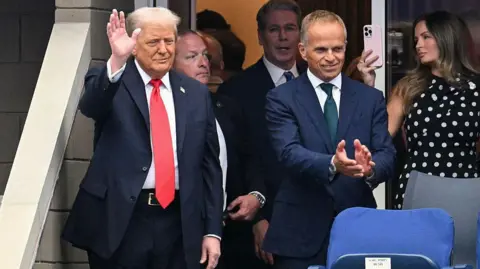
In September, Trump appeared at the US Open tennis final in the Rolex VIP box hosted by the Swiss watch company’s chief executive Jean Frédéric Dufour.

 MANDEL NGAN/AFP
The president even asked if the Rolex CEO would have been there if Trump had not slapped such steep tariffs on Switzerland.
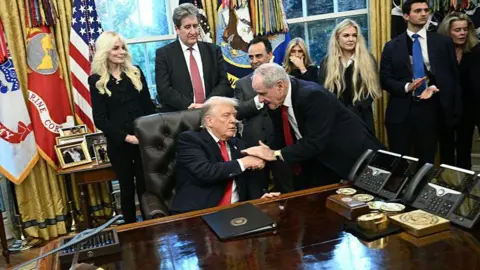
Last week Dufour met Trump again, this time in the Oval Office, along with fellow business leaders including Johann Rupert from luxury goods maker Richemont and Marwan Shakarchi from MKS.
Days after the meeting, Trump was pictured in the Oval Office with what looked very much like a Rolex “Datejust” desk clock, produced by the company as a collector’s item, and worth tens of thousands of dollars.
A White House official has confirmed to the BBC the two items were given to Trump.
It is quite normal nowadays for visitors to the Oval Office to come bearing a gift.
UK Prime Minister Sir Keir Starmer brought an invitation from King Charles for a lavish state visit. German Chancellor Friedrich Merz offered a framed copy of the birth certificate of Trump’s German grandfather.
 BRENDAN SMIALOWSKI/AFP
The US president receives thousands of gifts every year and they then become US property, deposited with the National Archives and filed annually by the state department.
They are eventually transferred to a presidential library. Some gifts can be kept but presidents have to pay federal taxes if they do not come from a close relative.
Swiss industry has been waiting for a deal with bated breath and a number of Swiss companies had warned they would have to furlough staff if nothing changed.
Yves Bugmann, who heads the Swiss Watch Industry Federation, welcomed the deal after months of uncertainty.
Asked what kind of investment the Swiss government might make in the US that would add up to $200bn, Helene Budliger Artieda said there was a detailed list that included pharmaceuticals, but she singled out plans for plane manufacturer Pilatus to build a big US plant and train-maker Stadler to expand its US operations in Utah.
Gold refining is also part of the plan.
“Currently, Switzerland is the primary location for gold storage, and New York is the primary location for trading,” said trade negotiator.
The chief trade negotiator said it would take a few days or even weeks for the changes to come into effect.
The agreement will only become binding when it receives approval from the Swiss parliament, and then it will be put to a referendum.

UK high streets and shopping destinations are showing signs of recovery as more than 13 retail stores opened each week over the past year, according to new figures.
However, England and Wales have still seen more than 6,000 retail premises vanish from local communities over the past five years.
Analysis of Valuation Office Agency data by tax firm Ryan, found that there were 507,810 retail premises across England and Wales at the end of 2025.
It said the figures showed that a recent contraction across the sector has appeared to stabilise, with a 723 net increase in the number of retail stores compared with a year earlier.
Property numbers increased across every region of England and Wales, with the exception of the North West, which saw a decline of 41.
It suggests that parts of the sector are now beginning to rebalance following significant structural contraction seen since the pandemic.
The creation of new retail units also comes as many retail real estate firms, such as Hammerson, have turned empty large units, often former department stores, into a greater number of smaller units.
Other retail groups, such as John Lewis, have moved away from ambitions to transform some retail property for other uses such as rental accommodation.
Nevertheless, the retail sector is still facing pressure from higher business rates for many firms, increased labour costs and concerns over consumer sentiment.
The data also shows that there has also been significant decline over the past few years, with a net reduction of 6,045 retail properties since the end of 2020.
London recorded the largest five-year regional reduction, with 1,266 retail premises disappearing over the period, followed by the South East (-1,191), North West (-719) and North East (-672).
The figures show retail premises which have permanently disappeared from communities altogether, having either been demolished or converted for alternative use.
The figures come as Ryan’s 2026 annual business rates review highlighted that the retail sector saw a 9.3% increase in rateable values at the 2026 business rates revaluation despite the major shift in the retail landscape since the pandemic.
Alex Probyn, practice leader for Europe and Asia-Pacific property tax at Ryan, said: “The pandemic accelerated structural changes that were already emerging across the retail sector, including changing consumer behaviour, hybrid working patterns and a reduced reliance on traditional retail floorspace in many locations.
“Many locations were arguably over-retailed before Covid and high streets have evolved towards more mixed-use environments, with retail space being rebalanced alongside growing demand for residential, leisure, hospitality and service-led uses.
“The revaluation outcome does suggest a large proportion of retail premises have seen bigger increases in their assessments than underlying market conditions and rental evidence would have led occupiers to expect.
“Retailers should therefore carefully review and, where appropriate, challenge their assessments.”

Indians sharply cut back on overseas travel spending in March, with remittances for foreign trips dropping by more than $212 million from the previous month, according to Reserve Bank of India data. The fall in outbound travel expenditure came amid rising oil prices linked to the Middle East conflict and persistent pressure on rupee, even as travel remained the single largest component of outward remittances under the Liberalised Remittance Scheme (LRS).In March, travel-related remittances fell to $1.09 billion from $1.3 billion in February and $1.65 billion in January. The decline came at a time when the West Asia conflict pushed oil prices higher and weakened rupee to record lows. Amid the situation, Prime Minister Narendra Modi urged citizens to cut down on foreign travel and adopt measures such as carpooling. Lower overseas travel spending could reduce foreign exchange outflows and help ease pressure on rupee.According to the RBI’s data on outward remittances by resident individuals, travel continued to account for the largest share of money sent abroad under the LRS in March. Total remittances during the month stood at $2.59 billion.The RBI tracks overseas spending across categories including travel, studies abroad, maintenance of close relatives, overseas investments, and property purchases. Under the LRS framework, resident individuals, including minors, can remit up to $250,000 in a financial year for permitted current or capital account transactions.Within the travel segment, the biggest component remained the ‘other travel’ category, which covers holiday spending and international credit card settlements. Indians spent $623.05 million under this category in March, accounting for nearly 57 per cent of total travel-related remittances during the month.Expenditure linked to education travel, including hostel and fee payments, stood at $450.16 million. Business travel, pilgrimage, and overseas medical treatment together accounted for $21.39 million.The data also showed a rise in remittances meant for the maintenance of close relatives abroad. Such transfers increased to $389.78 million in March from $266.18 million in February.At the same time, spending under the ‘studies abroad’ category declined. This category includes payments made for educational services accessed remotely without travelling overseas, such as correspondence courses. Remittances under this head stood at $151.71 million in March, compared to $175.68 million in February and $267.42 million in January.For the financial year 2024-25, Indians remitted a total of $29.56 billion under the LRS. Travel made up the largest portion of this amount at $16.96 billion.The RBI figures further showed that investments by Indians in overseas equity and debt instruments rose significantly to $440.22 million in March from $265.99 million in February.Meanwhile, outward remittances for the purchase of immovable property overseas declined to $38.68 million in March, down from $51.36 million a month earlier.

Gold and silver are expected to take cues from developments in the ongoing US-Iran talks this week, with analysts forecasting a largely steady trend for gold prices while silver may continue to outperform amid geopolitical tensions and elevated crude oil prices.Investors are also likely to track a series of economic indicators from the United States, including GDP data, housing numbers, consumer confidence figures and the Personal Consumption Expenditure (PCE) inflation print, as markets look for signals on the Federal Reserve’s next policy move.“Gold price momentum next week looks sideways, while silver still looks positive as focus will again be on the peace negotiations between the US and Iran to end the war,” said Pranav Mer, Vice President, EBG – Commodity & Currency Research, JM Financial Services Ltd.Trading activity in domestic commodity futures markets will be curtailed on Thursday morning due to Bakri Id.On the MCX, gold futures ended the previous week at Rs 1.58 lakh per 10 grams after posting marginal gains, while silver futures settled lower at Rs 2.71 lakh per kilogram.“Gold traded in a range-bound manner last week, posting marginal gains of around 0.40% on the MCX to close near Rs 1,58,670 per 10 grams,” said Jateen Trivedi, VP Research Analyst – Commodity and Currency, LKP Securities.He noted that crude oil prices witnessed heavy profit booking during the week and corrected nearly 7% from recent highs, easing concerns around inflationary pressure globally.“At the same time, the rupee recovered from weaker levels of 97 against the US dollar to strengthen near 95.70, which limited upside momentum in domestic gold prices despite stable international bullion trends,” Trivedi added.In international trade, Comex gold futures closed the week 1% lower at $4,523.2 per ounce. Silver futures also weakened, slipping nearly 2% to $76.20 per ounce.“Gold prices moved in a consolidative range over the past few sessions, but ended the week with a marginal loss. Prices were steady amid a lack of fresh direction in the market — be it on the economy front or the US-Iran war front,” Mer said.According to analysts, uncertainty surrounding the geopolitical situation has continued to keep markets on edge, particularly as statements from both Washington and Tehran have frequently shifted.On Sunday, US President Donald Trump said that an agreement between the US and Iran aimed at reducing tensions in the Gulf region and reopening the Strait of Hormuz was close to being finalised.Posting on Truth Social, Trump said the deal had been “largely negotiated” and that only final formalities remained.However, Iranian media disputed Trump’s remarks regarding the full reopening of the Strait of Hormuz, stating that Tehran would continue to maintain control over the key waterway.Analysts said the contrasting positions from both sides are likely to keep bullion prices sensitive to any fresh headlines emerging from the region.Meanwhile, market participants are also expected to monitor comments from Federal Reserve officials after Kevin Warsh formally succeeded Jerome Powell as head of the US central bank on Friday during a period of geopolitical tensions, market volatility and persistent inflation pressures.


Gordon Ramsay reveals ‘most important thing in life’
Shop numbers return to growth after years of decline, say experts

Drake sets new record at ‘Iceman,’ ‘Habibti’ and ‘Maid of Honour’

-

 Entertainment1 week ago
Where Pete Davidson, Elsie Hewitt stand after breakup: Details revealed
-

 Politics1 week ago
Rising diesel costs from Iran war strain US school budgets
-

 Tech1 week ago
Why Is Your Grill So Dumb? The Best Grills Set Temp Like an Oven
-

 Tech1 week ago
This Solar-Powered Smart Sprinkler Keeps My Lawn Watered Without Any Power Cables
-
 Fashion1 week ago
RMG trade bodies seek policy support from Bangladesh PM
-

 Fashion1 week ago
India calls for aligning standards, customs procedures with Africa
-

 Fashion6 days ago
Nigeria Kwara Garment Factory, KWS Garment Production Village ink pact
-

 Fashion7 days ago
India’s Pearl Global’s FY26 revenue crosses $521 mn milestone