

Politics
US backs security guarantees for Ukraine at summit of Kyiv’s allies in Paris

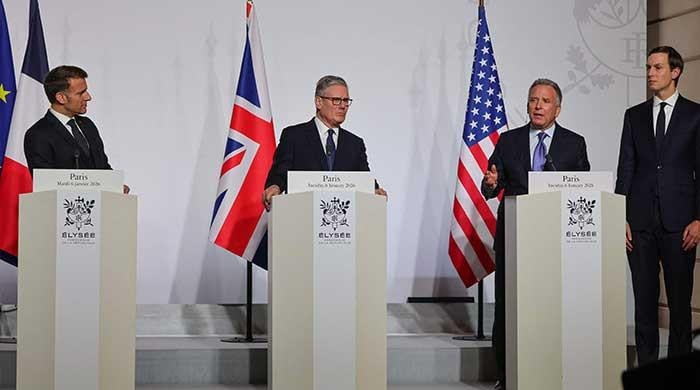
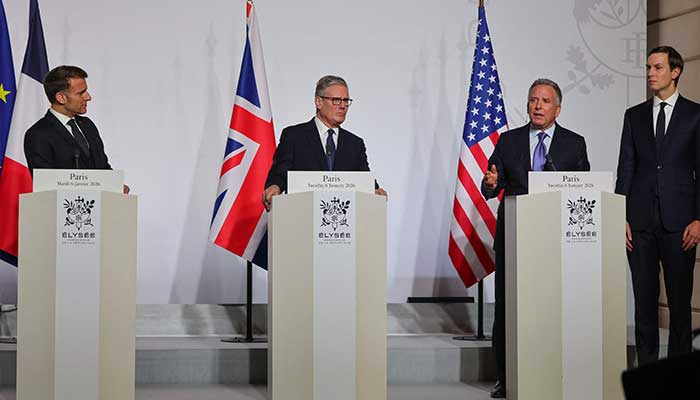
- Commitment comes at ‘coalition of willing’ gathering.
- Security protocols ‘as strong as anyone has ever seen’: Witkoff.
- Guarantees would enter into force after ceasefire.
The United States for the first time on Tuesday backed a broad coalition of Ukraine’s allies in vowing to provide security guarantees that leaders said would include binding commitments to support the country if Russia attacks again.
The pledge came at a summit in Paris of the “coalition of the willing” of mainly European nations to firm up guarantees to reassure Kyiv in the event of a ceasefire with Russia, which invaded its neighbour in 2014 and again at full scale in 2022.
Unlike previous coalition meetings, the summit was also attended by US envoys Steve Witkoff and Jared Kushner — President Donald Trump’s son-in-law — as well as America’s top general in Europe, Alexus Grynkewich, who a day earlier fleshed out details of security guarantees with European army chiefs.
Witkoff, who has led talks with Russia, said after the summit that Trump “strongly stands behind security protocols”.
“Those security protocols are meant to … deter any attacks, any further attacks in Ukraine, and … if there are any attacks, they’re meant to defend, and they will do both. They are as strong as anyone has ever seen,” he said at a joint news conference with the French, German, British and Ukrainian leaders.
Kushner said that if Ukrainians were to make a final deal “they have to know that after a deal they are secure, they have, obviously, a robust deterrence, and there’s real backstops to make sure that this will not happen again.”
Proposal for US to lead ceasefire monitoring
A statement by coalition leaders also said that allies will participate in a proposed US-led ceasefire monitoring and verification mechanism. Officials have said this would likely involve drones, sensors and satellites, not US troops.
The statement was not explicitly endorsed by the United States and details of a US role were watered down from an earlier draft, notably removing language that outlined the use of US capabilities to support a multinational force in Ukraine.
But European officials hailed the involvement of the US envoys and their strong comments as evidence Washington stood behind the security framework.
Talks to bring the almost four-year war to an end have accelerated since November. However, Moscow has yet to signal willingness to make concessions after Kyiv pushed for changes to a US proposal that initially backed Russia’s main demands.
Moscow has also given no public sign that it would accept a peace deal with the security guarantees envisaged by Ukraine’s allies. Russia has previously rejected any Nato members having troops inside Ukraine.
Focus on legally binding security guarantees
Until recently, much of the allies’ focus was on pledges of military aid for Ukraine’s forces and possible contributions to an international reassurance force.
But attention has now shifted to legally binding guarantees to come to Kyiv’s aid in the event of another attack by Moscow. The possibility of a military response is likely to trigger debate in many European countries, diplomats say.
“These commitments may include the use of military capabilities, intelligence and logistical support, diplomatic initiatives, adoption of additional sanctions,” the leaders’ statement said, adding that they would now “finalise binding commitments.”
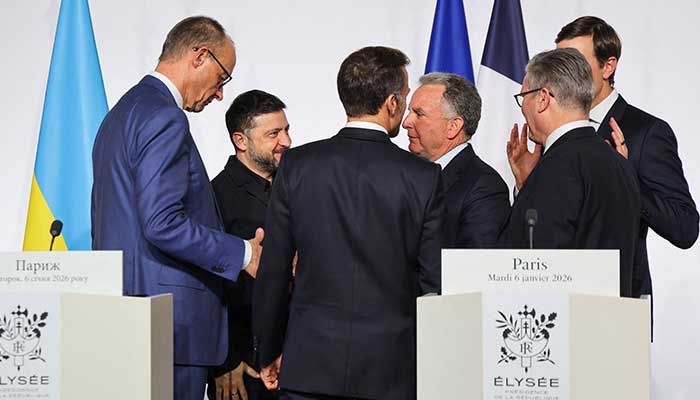
Ukrainian President Volodymyr Zelenskiy said the discussions had been substantive with the US delegation, but suggested more still needed to be done.
European leaders present at the meeting, including French President Emmanuel Macron, British Prime Minister Keir Starmer, Polish Prime Minister Donald Tusk and Italy’s Prime Minister Giorgia Meloni stressed that the statement showed renewed unity between Europe and the United States on helping Ukraine.
Macron and Starmer brushed aside questions about whether they could rely on commitments by Trump, particularly given his renewed claims that the US should take over Greenland, an autonomous part of Nato ally Denmark.
France, Britain ready to deploy troops after ceasefire
The leaders’ statement also pledged a European-led “Multinational Force for Ukraine … to support the rebuilding of Ukraine’s armed forces and support deterrence” with “the proposed support of the US”.
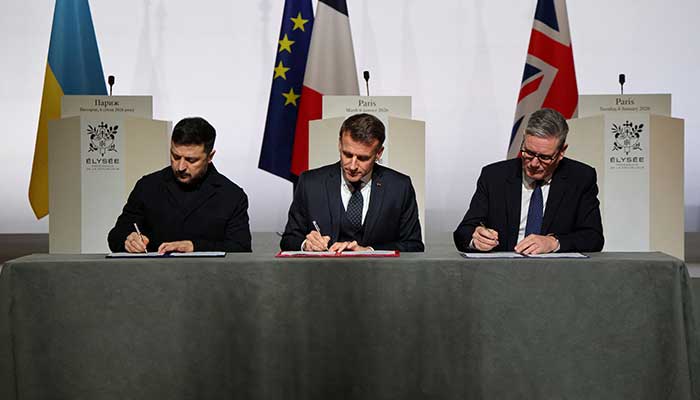
France and Britain signed a declaration of intent on the future deployment of multinational forces once a ceasefire is reached.
Macron said that could involve sending thousands of French troops.
“It paves the way for the legal framework under which British, French and partner forces could operate on Ukrainian soil, securing Ukraine’s skies and seas and regenerating Ukraine’s armed forces for the future,” Starmer said.
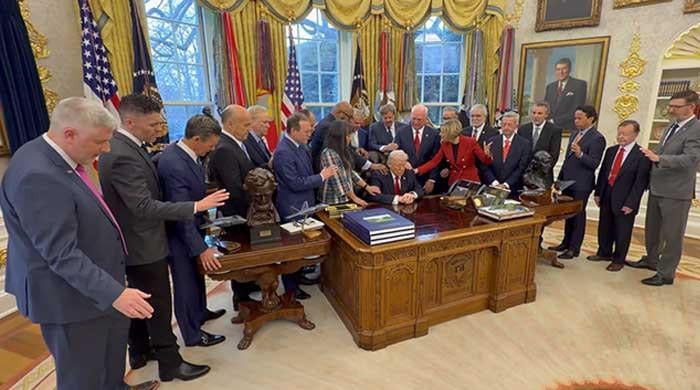
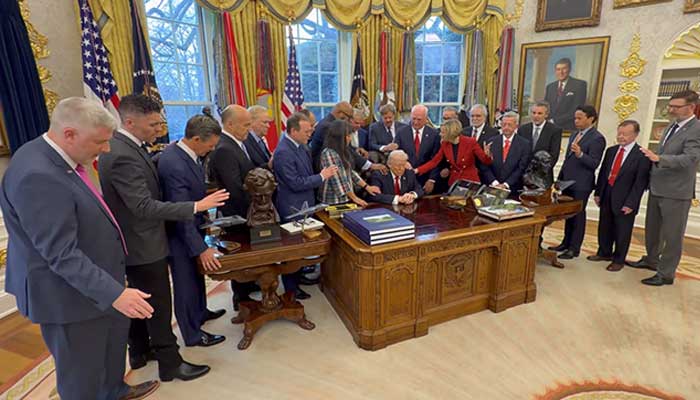
A video released by White House officials has gone viral showing US President Donald Trump surrounded by a group of pastors praying over him in the Oval Office, as US and Israeli military campaign against Iran enter its seventh day.
Critics warn that the offensive risks worsening humanitarian conditions and destabilising an already tense region.
The video, shared by White House Deputy Chief of Staff Dan Scavino, shows a prayer circle of prominent religious leaders from across the US. Trump sits behind his desk with eyes closed as Pastor Tom Mullins leads the ceremony.
Pastor Mullins said: “We are honoured to come before Your presence today, lifting up the arms of our president. We pray for Your continued blessing and favour to rest upon him. We pray for wisdom from heaven to flood his heart and mind and for Your guidance during these challenging times.”
He also prayed for the protection of US troops and for the president to lead the nation with strength and grace.
The strikes have escalated tensions across the Middle East, with analysts cautioning that continuous retaliation could prolong the cycle of conflict.
The US Department of Defence said Operation Epic Fury targets Iran’s missiles, production facilities, and naval assets.
After the death of its Supreme Leader Ayatollah Ali Khamenei in a joint US‑Israeli airstrike on Tehran, Iran has launched a series of retaliatory missile and drone attacks on Israel, Gulf states, including the United Arab Emirates and Qatar, claiming to target American facilities in response.
The US confirmed that six soldiers were killed when a drone struck a facility in Port Shuaiba, Kuwait. Critics say the human and infrastructural toll underlines the urgent need for diplomatic efforts to prevent further escalation.
- Qatar produces LNG about 20% of global supply.
- If war continue, it will impact world’s GPD: minister.
- Minister forecasts crude prices may hit $150 per barrel.
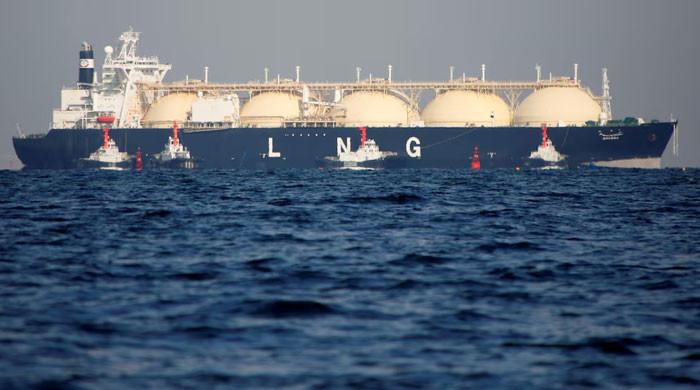
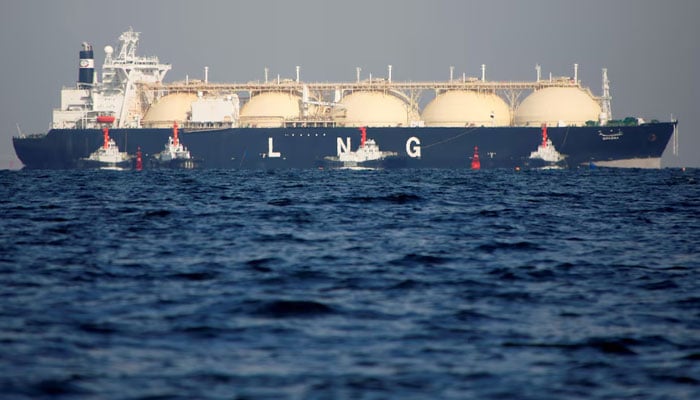
Qatar expects all Gulf energy producers to shut down exports within weeks if the Iran conflict continues and drives oil to $150 a barrel, the country’s Energy Minister Saad al-Kaabi told the Financial Times in an interview published on Friday.
Qatar halted its production of liquefied natural gas (LNG) on Monday, as Iran continued to strike Gulf countries in retaliation for Israeli and US attacks.
The country’s LNG production is equivalent to about 20% of global supply and plays a major role in balancing both Asian and European markets’ demand for the fuel.
“Everybody that has not called for force majeure we expect will do so in the next few days that this continues. All exporters in the Gulf region will have to call force majeure,” Kaabi told the FT.
“If this war continues for a few weeks, GDP growth around the world will be impacted,” he said.
“Everybody’s energy price is going to go higher. There will be shortages of some products and there will be a chain reaction of factories that cannot supply,” Kaabi said.
Kaabi said even if the war ended immediately it would take Qatar “weeks to months” to return to a normal cycle of deliveries.
Analysts and economists have highlighted the potential impact of the war on economies globally.
Kaabi, who is also the CEO of Qatar Energy, one of the world’s biggest liquefied natural gas producers, told FT that the company’s North Field expansion project would delay first production.
“It will delay all our expansion plans for sure,” Kaabi said. “If we come back in a week, perhaps the effect is minimal, if it’s a month or two, it is different.”
The project was scheduled to begin production in mid-2026.
He forecast that crude prices could hit $150 a barrel O/R in two to three weeks if ships and tankers were unable to pass through the Strait of Hormuz, which is the world’s most vital oil export route, connecting the biggest Gulf oil producers with the Gulf of Oman and the Arabian Sea.
Kaabi also expects gas prices to rise to $40 per million British thermal units.
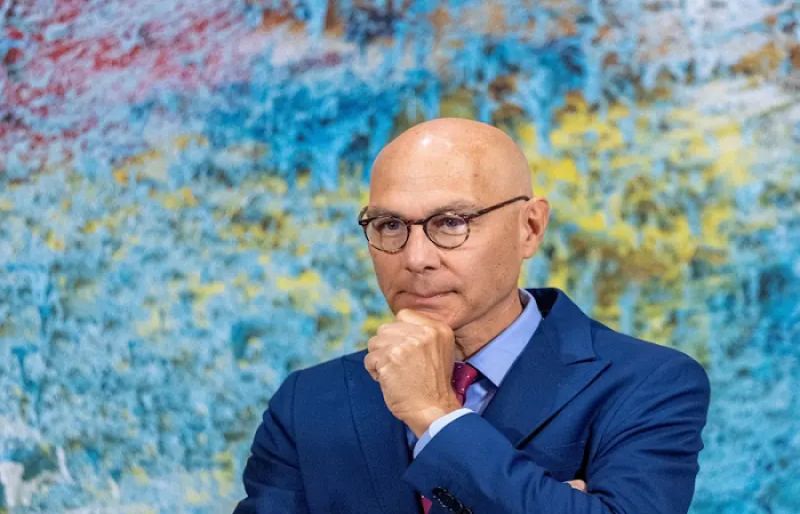

GENEVA: The United Nations High Commissioner for Human Rights Volker Turk has said that killings such as the reported death of Ali Khamenei raise serious concerns under international human rights law.
Speaking to reporters, Turk said that from a human rights perspective, any form of killing is unacceptable.
“From a human rights perspective, any killing of anyone is not in the interest of international human rights law,” he said.
Strike on Girls’ School Raises Concern
Turk also addressed reports of a strike on a girls’ school in Minab, a city in southern Iran, during the first day of US and Israeli attacks.
Iran’s ambassador to the UN in Geneva, Ali Bahreini, claimed that the attack killed around 150 students, although the figure has not been independently verified.
The UN rights chief stressed that schools are civilian institutions and should never be targeted during armed conflicts.
Call for Independent Investigation
Turk called for an impartial investigation into the incident to determine the circumstances surrounding the strike, including the type of weapon used and the timing of the attack.
He said responsibility now lies with those who carried out the strikes to ensure a transparent inquiry.
Meanwhile, US officials told media that military investigators are examining the possibility that American forces were responsible, though the investigation has not yet reached a final conclusion.
The incident has intensified international concern about civilian casualties and humanitarian law violations as the conflict in the region continues to escalate.


As West Asia conflict rages on, India’s pharma exports stare at Rs 5K crore potential losses – The Times of India

Pastors pray for Trump in Oval Office amid US-Israel war with Iran

Book excerpt: “Judge Stone” by Viola Davis & James Patterson

Attock Cement’s acquisition approved | The Express Tribune

India Us Trade Deal: Fresh look at India-US trade deal? May be ‘rebalanced’ if circumstances change, says Piyush Goyal – The Times of India

Policy easing drives Argentina’s garment import surge in 2025

-
Business1 week ago
Attock Cement’s acquisition approved | The Express Tribune
-
 Fashion1 week ago
Policy easing drives Argentina’s garment import surge in 2025
-
Business1 week ago
India Us Trade Deal: Fresh look at India-US trade deal? May be ‘rebalanced’ if circumstances change, says Piyush Goyal – The Times of India
-
 Politics1 week ago
What are Iran’s ballistic missile capabilities?
-
 Politics1 week ago
US arrests ex-Air Force pilot for ‘training’ Chinese military
-

 Sports1 week ago
LPGA legend shares her feelings about US women’s Olympic wins: ‘Gets me really emotional’
-

 Sports1 week ago
Sri Lanka’s Shanaka says constant criticism has affected players’ mental health
-
 Business1 week ago
Greggs to reveal trading amid pressure from cost of living and weight loss drugs