

Sports
Wetzel: How college basketball ended up signing NBA draft picks

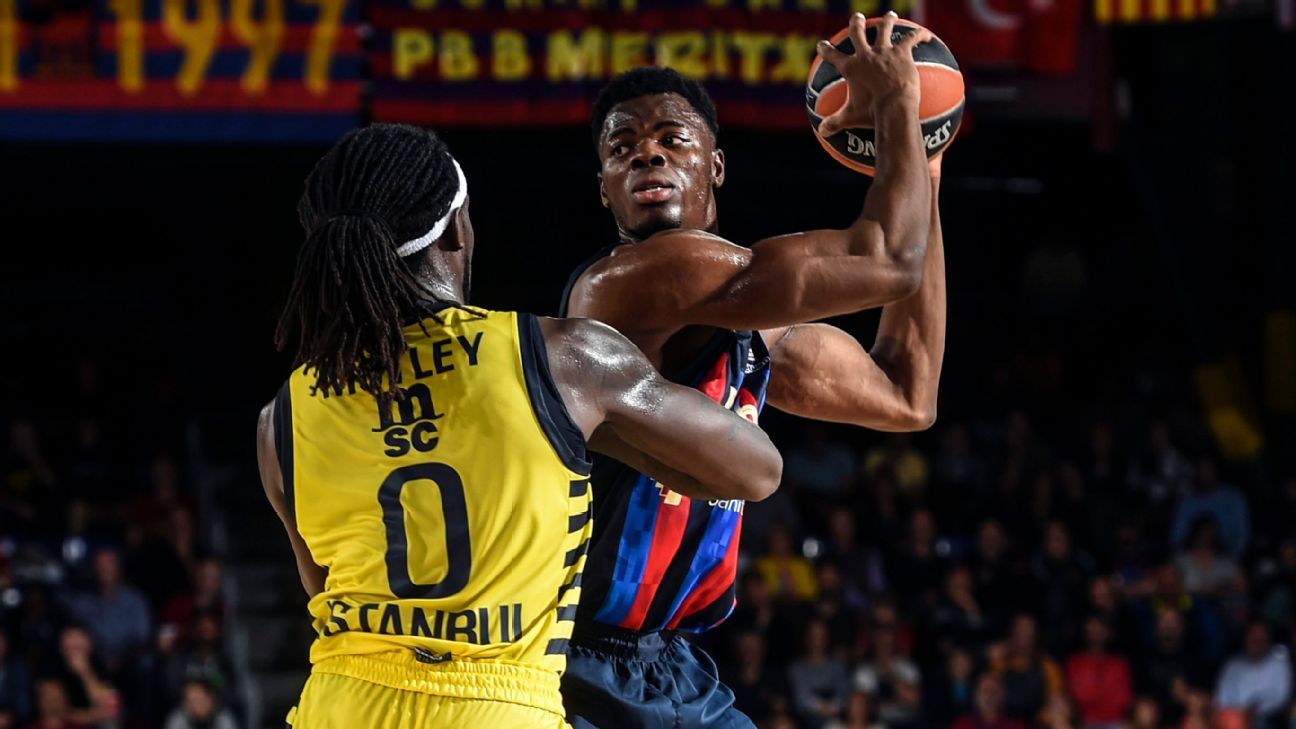
Ideally, college basketball would have organized itself so that teams weren’t adding dudes from European pro leagues in the middle of the season.
Your roster on, say, Nov. 1, is your roster. Is that too much to ask? They have trade deadlines and signing windows in the NBA and NFL, after all. How about this: If you enter the NBA draft, you can’t still play college ball.
Of course, ideally, the NCAA and college sports’ leadership — from conference commissioners to high powered athletic directors to famed coaches — would have, at least by the late 2010s, recognized that change was inevitable and begun planning for it.
Instead, they pouted, complained and in an enduring effort for control (especially of the money), clung to losing arguments, waged losing fights and let confusion engulf them.
That’s how Baylor got a stocking (and hoop) stuffer on Christmas Eve, when it announced it had signed James Nnaji, a 21-year-old, 7-foot center. You might remember him as the 31st selection of the 2023 NBA draft.
Detroit picked him that night. He was later traded to Charlotte and then the New York Knicks. Nnaji has never seen NBA minutes (other than in the summer league) but has been playing pro ball in Europe since 2020.
Somehow, Nnaji has four years of college eligibility remaining. Sure, why not? What’s LeBron’s status?
Nnaji is expected to join the Bears on the court next week in time for Big 12 play.
“Santa Claus is delivering mid season acquisitions,” Connecticut coach Dan Hurley quipped on social media.
“I just know they told us he can play, so I’m happy,” Baylor coach Scott Drew said.
Don’t blame Drew. He didn’t make the rules. It’s all perfectly legal. Drew has an obligation to his players, not to mention his school, to surround them with the best talent he can. So he did.
Besides, Baylor isn’t the only team bringing in pros from Europe, even at midseason. Oklahoma just signed a Russian center. Dayton, BYU and others, including Kansas State women’s hoops, have done similar.
It might be jarring, but the world is not ending. Nnaji, for all the attention, has averaged just 3.4 points a game as a pro. Set up with thought and structure, granting guys like him eligibility isn’t even an entirely bad idea — college hockey is packed with NHL draft picks.
Done this way though?
“This s— is crazy!!” Hurley wrote.
It certainly feels that way.
The fault falls to college sports’ “leadership,” which spent the past few decades trying to hold the line on amateurism, a dated concept that was almost assuredly doomed in the face of legal challenges.
The first came way back in 2009, when former UCLA men’s basketball player Ed O’Bannon sued to argue the NCAA was selling his name, image and likeness in a video game (which they were, as a judge ruled in 2014). The writing was on the wall. Public sentiment quickly shifted against the NCAA.
Yet instead of accepting the need for a new way of doing business, the NCAA just got more entrenched. Rather than share the revenue from the video game, the game was canceled.
College sports embraced a hard line, continuing to pour millions into ill-fated legal defenses and, later, Washington lobbyists who gladly cashed checks and sold the pipe dream that Congress would save them.
The NCAA, for example, argued in front of the United States Supreme Court that the Sherman Antitrust Act should not apply to college athletics because fans would tune out if an athlete was ever compensated for anything, even cash awards won via academic contests or legitimate endorsement opportunities.
Apparently Caitlin Clark’s State Farm commercial wasn’t a marketing boon for women’s basketball, but an existential threat.
“That argument is circular and unpersuasive,” Justice Brett Kavanaugh wrote in 2021, in a concurring opinion to a 9-0 decision against the NCAA. “… Nowhere else in America can businesses get away with agreeing not to pay their workers a fair market rate on the theory that their product is defined by not paying their workers a fair market rate.”
With the courts almost universally against them, the NCAA turned to Congress, seeking antitrust exemptions. Lobbyists were hired. Senators were courted. A few dog and pony show hearings were held.
No legislation ever came even close to passing. It was a completely predictable waste of time and money.
O’Bannon just wanted a fair cut, but being in opposition to the Sherman Antitrust Act (which has been around since 1890) has left the NCAA on the losing side of numerous eligibility fights, which has changed the way the games are actually played.
In the simplest of terms, the NCAA can’t stop someone from earning a living, which means it can rarely stop someone from playing for them and thus — earn a living.
That reality opened the floodgates to immediate eligibility for all transfers, caused junior college seasons to no longer count, flooded rosters with mid-20s grad students and, yes, even allowed for a once NBA-drafted, twice NBA-traded, European pro to join up in January.
Rather than pursuing outdated legal strategies and transparently one-sided legislation, the NCAA should have recognized the players as employees and then negotiated with what would almost assuredly be a weak union. If needed, it could have asked Congress for limited, common sense, antitrust carve-outs that might have stood a bipartisan chance of passing.
Then maybe compromises would’ve been reached on, say, the transfer portal or postdraft eligibility or whatever else comes up.
“To me, until we get to collective bargaining, there’s not going to be a solution,” Drew said.
He’s right, but that has also been obvious for years now.
The old guard of college sports just couldn’t accept it though. It was the old way, or no way.
So the lawyers and the lobbyists got paid.
And college basketball got midseason EuroLeague signings.
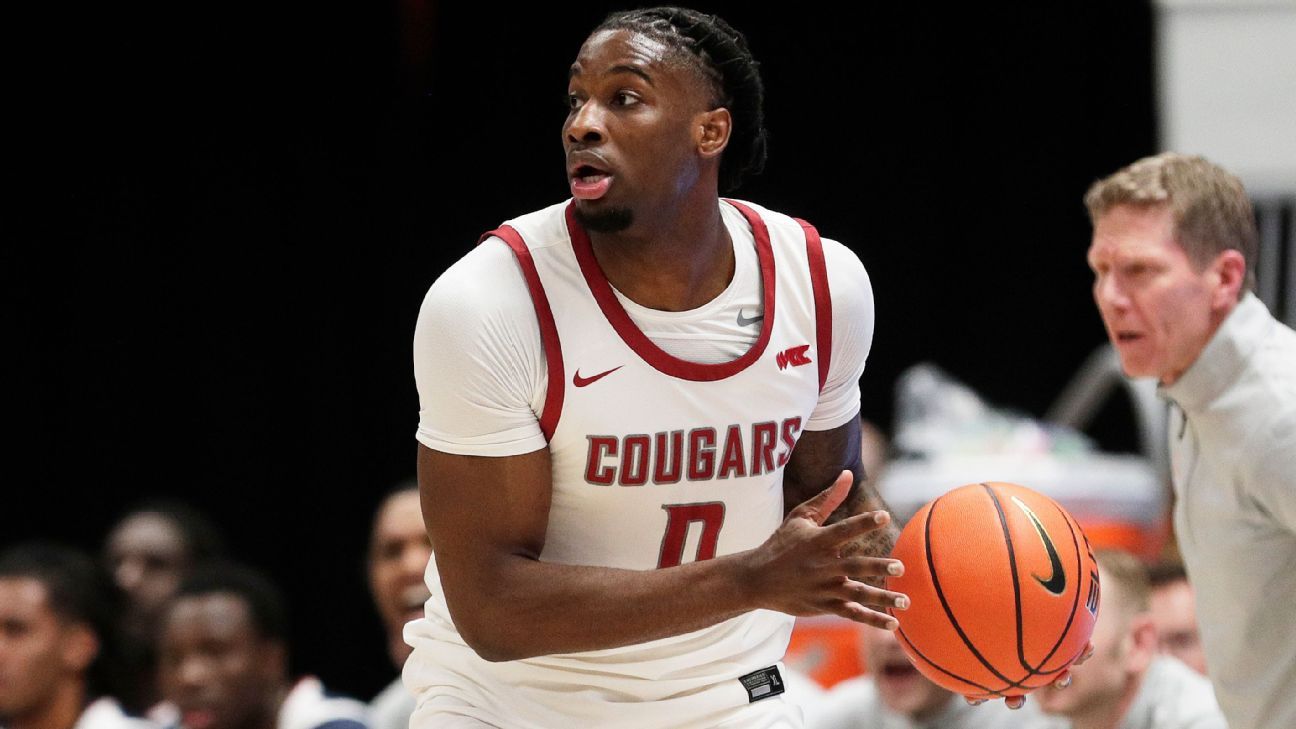
PULLMAN, Wash. — Washington State forward Emmanuel Ugbo, who is currently under a court order resulting from allegations of stalking and harassment, has been suspended for the remainder of the season.
Coach David Riley told reporters this week that Ugbo, who has neither played nor practiced for the Cougars since he was suspended on Jan. 28, will sit out the rest of the way.
“As an institution,” Riley told reporters, “we believe that’s the best course of action.”
Ugbo was accused by a Washington State women’s volleyball player of stalking and harassment after she ended their relationship. Last week, a Whitman County judge granted the woman a full protection order against Ugbo.
Ugbo’s suspension began with Washington State’s home game on Jan. 31, shortly after the woman filed for a temporary protection order. Ugbo averaged 6.7 points and 3.5 rebounds in 18 minutes this season. He previously played for Boise State.
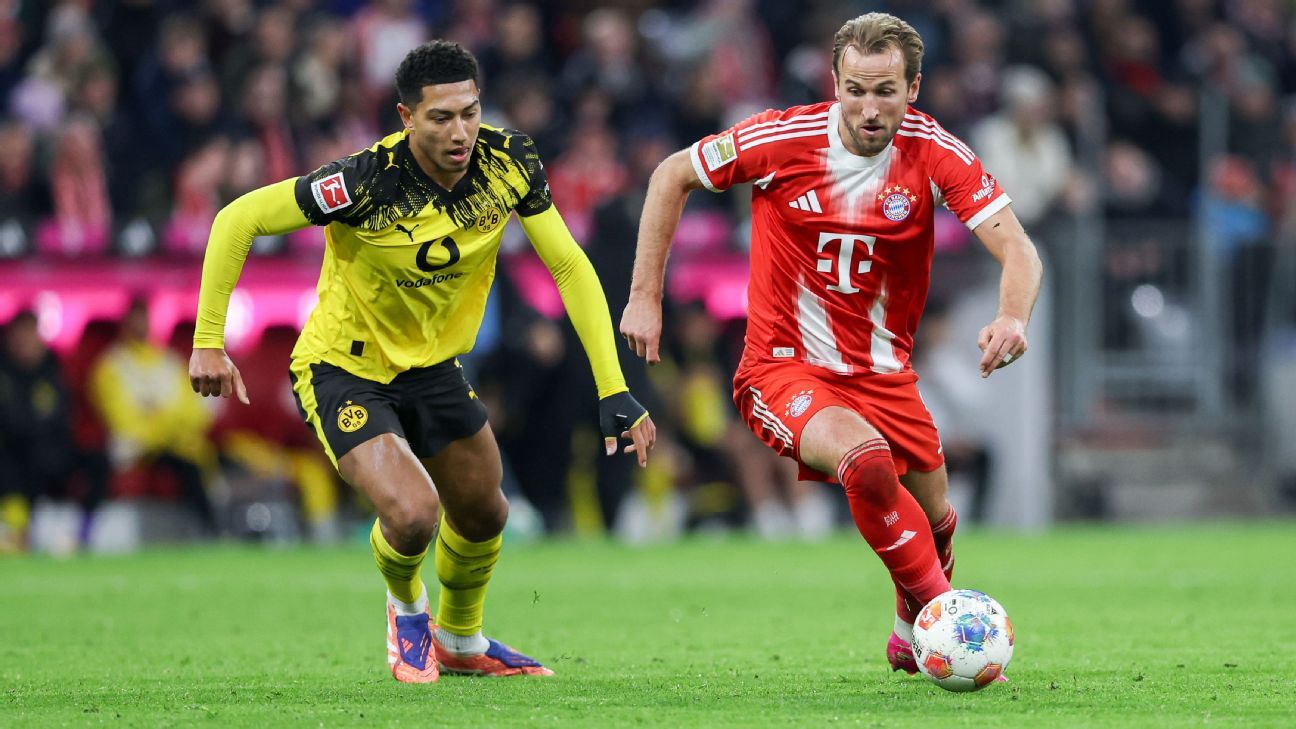
The German word of the week in the Bundesliga ahead of Saturday’s showdown (live at 12:30 p.m. ET, on ESPN+) is not the marketing invention der Klassiker but rather die Aufholjagd (literally, “the hunt to pursue”).
There are in all honesty, very few, even here in the bustling Ruhrpott this week, who believe Borussia Dortmund are likely to make up nine points on leaders Bayern Munich. With the goal difference equation stacked in favor of the Rekordmeister, that is the challenge facing BVB with only 11 games left. But a head-to-head Gipfeltreffen (summit meeting) offers a chance for a new perspective.
Dortmund have spent much of this season under Niko Kovac defying stereotypes: showing a more stable face, grinding out wins, pressing better, reemerging as clearly the second-best team in the Bundesrepublik.
– Why Stuttgart, Celtic’s Europa League opponents, are worth watching
– Meet Noahkai Banks, the outside pick to make USMNT’s World Cup squad
– Harry Kane scores 500th goal: Explaining stats behind red-hot form
But on Wednesday night in Bergamo, the old problems came back to haunt die Schwarz-Gelben, and the team collectively had to Lehrgeld zahlen (literally pay up as a result of being taught a painful lesson) after being eliminated by Atalanta in their knockout round playoff tie in the UEFA Champions League.
Whether Dortmund can translate those lessons — among them, don’t start a big match so passively and Gregor Kobel, don’t give the ball to the opposition with extra time looming — into something successful against a team of Bayern’s sheer quality, is another matter.
Bayern are almost certain to break the Bundesliga’s single-season goal-scoring record (they have 85 goals and need 17 more, a mere bagatelle surely?) Harry Kane requires 14 between now and mid-May to surpass Robert Lewandowski‘s 2020-21 benchmark of 41 league goals. The Englishman has registered a Doppelpack (double) in each of his past three league matches and if he stays fit, you would not bet against him becoming the most goal-rich winner of the Torjägerkanone award ever.
With Michael Olise scoring freely and more importantly, assisting others, and Luis Díaz posing significant problems for opposing sides, Bayern win most games by overwhelming and obliterating. Nobody does it better.
There is, however, a slight glass-jaw quality defensively, which has been evident since January, with only one Bundesliga clean sheet so far this calendar year.
Augsburg for example, have gone to the Allianz Arena and beaten them, Hoffenheim caused them bother even while down to 10 men, and last week Eintracht Frankfurt scored a couple of late goals that Bayern fans, anticipating an easy win, will have seen as nervig (irritating).
At the time of writing, it is unclear who will stand between the posts for the Rekordmeister. Manuel Neuer has been working all week in a bid to get back into the side after sustaining a calf muscle injury at the Weserstadion nearly two weeks ago.
However, Bayern have faith in 22-year-old understudy Jonas Urbig, who looks ever more like the future custodian. Urbig stumbled in the Augsburg game, but his performances have ranged mostly from good to excellent.
If there are any doubts about Neuer’s fitness, it would seem foolish — given the eight-point difference at the top and crunch Champions League matches ahead — to take a chance. Alphonso Davies is out for the foreseeable future with a muscle fiber injury, but with Konrad Laimer available again, Vincent Kompany has plenty of squad depth in the fullback positions with Josip Stanisic and Hiroki Ito.
It almost seems unfair to Dortmund, given the colossal task that they face on Saturday, that right wing back Julian Ryerson is suspended. The Norwegian, once viewed as an honest journeyman, has transformed himself into one of the most valuable players in Kovac’s squad.
Diligent in normal play, Ryerson’s deliveries from open or set play situations can be devilish and he recently crafted all four goals in the same game against Mainz. Yan Couto, more adventurous going forward but less secure defensively, must fulfill that role against Bayern.
At least Nico Schlotterbeck will return to anchor the Dreierkette (back three) in front of Kobel, whose 11 clean sheets top the Bundesliga goalkeeping charts. BVB will require energy and guile in abundance from Marcel Sabitzer and Felix Nmecha in midfield against the formidable duo of Joshua Kimmich and Aleksandar Pavlovic.
Saturday is due to be another day of Verkehrschaos in Dortmund and there have been a few recently. This one is due to industrial action by the trade union, Verdi, knocking out the Stadtbahn (city train/tram service) and bus lines. Fans have been urged to walk the 40 minutes from the Stadtzentrum (city center) to the Signal Iduna Park.
Thereafter, there’s a very real danger that in 90 minutes, Dortmund’s season could effectively disappear in a puff of smoke. Already out of the Champions League and the DFB-Pokal, defeat in the Klassiker would make an Aufholjagd unthinkable.
PARIS:
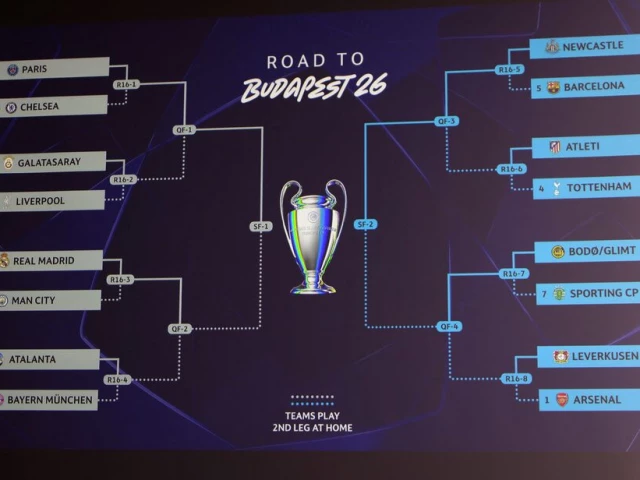
Real Madrid and Manchester City will face off in a Champions League knockout tie for the fifth season running after being drawn Friday to play each other in the last 16, while reigning champions Paris Saint-Germain will take on Chelsea.
The Spanish giants, record 15-time European champions, will host City in the first leg at the Santiago Bernabeu next month before travelling to England for the return the following week.
The clubs have already played each other this season, with Pep Guardiola’s City winning 2-1 in Madrid in December during the league phase, in which the Premier League club finished eighth and Real ninth.
That allowed City, Champions League winners in 2023, to advance straight to the last 16 while Madrid had to come through the knockout phase play-offs, in which they beat Benfica 3-1 on aggregate.
This is the eighth season in which the teams have played each other since 2012. Real beat City in the knockout phase play-offs last season, and in the quarter-finals on the way to winning the trophy in 2024. They also emerged victorious in the semi-finals in 2022 with City winning at the same stage the following year.
PSG will be at home to Chelsea in the first leg after qualifying for this stage with a 5-4 aggregate win over Ligue 1 rivals Monaco in the play-offs. Chelsea progressed straight to the last 16 after finishing sixth in the league phase.
The sides played each other in the knockout stages in three consecutive years from 2014 to 2016, with Chelsea winning the first of those confrontations in the quarter-finals and PSG triumphing in the last 16 in the following two.
Their last encounter came in July’s Club World Cup final in the United States, when Chelsea won 3-0 against last season’s European champions.
Chelsea have been coached since January by Liam Rosenior, who had previously come up against PSG in Ligue 1 as coach of Strasbourg.
Meanwhile, Newcastle United will take on Barcelona with the first leg at St James’ Park — the Spanish side won 2-1 there during the league phase in September.
There is a record total of six English clubs in the last 16. Liverpool will have a rematch against Galatasaray, the Turkish giants having defeated the Anfield club 1-0 in September in the league phase.
Arsenal will come up against Bayer Leverkusen and Tottenham Hotspur were drawn to play Atletico Madrid.
German champions Bayern Munich will play Atalanta, the sole Italian club left in the competition, while Norwegian upstarts Bodo/Glimt’s reward for knocking out Inter Milan is a last-16 tie against Sporting of Portugal.
The first legs will take place on March 10 and 11, with the second legs a week later. The teams who qualified directly for this stage after finishing in the top eight in the league phase will all be at home in the return matches.
This season’s Champions League final will take place at the Puskas Arena in Budapest on May 30.


Washington State’s Emmanuel Ugbo suspended for rest of season

Sri Lanka’s apparel exports down 2.6% in January 2026

The Aventon Soltera 3 Is the Most Bikey Ebike on the Market Right Now

-
 Tech1 week ago
A $10K Bounty Awaits Anyone Who Can Hack Ring Cameras to Stop Sharing Data With Amazon
-
 Business7 days ago
US Top Court Blocks Trump’s Tariff Orders: Does It Mean Zero Duties For Indian Goods?
-

 Fashion7 days ago
ICE cotton ticks higher on crude oil rally
-

 Entertainment7 days ago
The White Lotus” creator Mike White reflects on his time on “Survivor
-

 Tech1 week ago
Donald Trump Jr.’s Private DC Club Has Mysterious Ties to an Ex-Cop With a Controversial Past
-
 Sports7 days ago
Brett Favre blasts NFL for no longer appealing to ‘true’ fans: ‘There’s been a slight shift’
-
 Business6 days ago
Eye-popping rise in one year: Betting on just gold and silver for long-term wealth creation? Think again! – The Times of India
-

 Fashion1 week ago
India’s $28 bn reset: How 5 trade deals will reprice its T&A exports