Business
What are tariffs, how do they work and why is Trump using them?


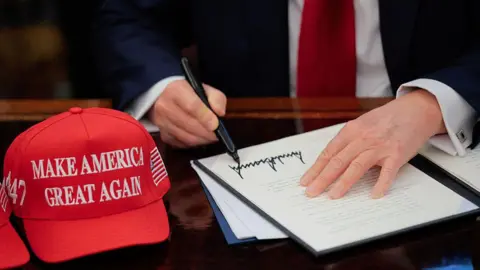
US President Donald Trump has threatened to impose further tariffs on eight European allies who oppose his demands for control of Greenland.
In 2025, he placed a number of taxes on goods reaching the US from countries around the world, arguing that the move would boost American manufacturing and create jobs.
Critics warned of higher prices and damage to the global economy, and the US Supreme Court is considering the legality of the tariffs Trump has brought in.
What are tariffs and how do they work?
Tariffs are taxes on imported goods.
Typically, the charge is a percentage of a good’s value.
For example, a 10% tariff on a $10 product would mean a $1 tax on top – taking the total cost to $11 (£8.17).
The tax is paid to the government by companies bringing in the foreign products.
These firms may pass some or all of the extra cost on to their customers, which in this case means ordinary Americans and other US businesses.
They may also decide to import fewer goods.
Why is Trump using tariffs?
Trump says tariffs increase the amount of tax raised by the government, encourage consumers to buy more American-made goods and boost investment in the US.
He wants to reduce the US trade deficit – the gap between the value of goods it buys from other countries and those it sells to them.
The president argues that the US has been exploited by “cheaters” and “pillaged” by foreigners.
He said that China, Mexico and Canada must do more to stop migrants and the illegal drug fentanyl reaching the US.
Trump has also used the threat of tariffs to encourage other countries to support the US on issues unrelated to trade – Russia’s invasion of Ukraine and Iran’s suppression of protests, as well as his demands on Greenland.
Many tariffs have been amended or delayed after being announced.
How will the new tariffs on eight European countries work?
On 17 January, Trump threatened to impose a further 10% tariff on eight European countries who have rejected his Greenland plans.
He said the rate would apply to goods from Denmark, Norway, Sweden, France, Germany, the UK, the Netherlands and Finland from 1 February, but could later rise to 25% – and would last until a deal was reached.
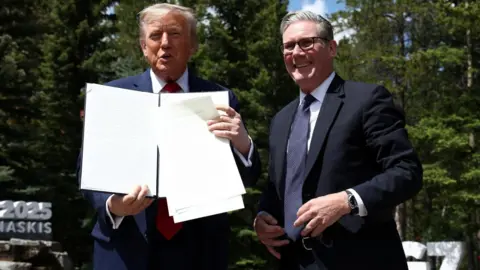
The move was widely condemned by European leaders, including UK Prime Minister Sir Keir Starmer and French President Emmanuel Macron, who said the EU could consider a series of retaliatory options including a so-called “trade bazooka”.
Officially known as the Anti-Coercion Instrument (ACI), this is a law that allows the EU to respond to economic blackmail from non-EU countries. It threatens very severe consequences.
In July 2025, European Commission President Ursula von der Leyen agreed the EU would pay 15% tariffs on its US exports.
After the agreement, Brussels suspended the tariffs it had planned to introduce on €93bn (£81bn; $109bn) worth of US goods sold to the EU, from livestock and aircraft parts to whiskey.
The European Parliament had been due to ratify the 15% deal shortly, but is now expected to suspend the agreement, sparking fears of a new trade war.
What are Trump’s tariffs on individual countries?
Negotiations continue with a number of countries, including America’s top three trading partners, China, Canada and Mexico, who have been threatened with particularly high tariffs:
What is the UK tariff deal?


Which goods are affected by Trump’s tariffs?
Some taxes announced by Trump are on particular products, wherever they are made.
These include:

In addition, Trump ended an exemption for imports valued at $800 (£592) or less.
It means low-cost goods are no longer duty-free – a move affecting millions of packages sent every day, including those from online retailers like Shein and Temu.
The companies shipping the parcels now have to pay duties based on the tariff rate which applies to the country the goods were sent from. Otherwise, for six months, they can choose to pay a fixed fee of between $80 and $200 per package.
On 2 January, the White House confirmed it had slashed proposed tariffs of almost 92% on some imported pasta after what it called constructive engagement from firms.
In November, Trump had signed an executive order exempting a range of other food products from tariffs, including avocados, bananas, beef and coffee because of domestic shortages.
Why has the Supreme Court been considering the legality of Trump’s tariffs?
Trump’s tariffs have faced numerous legal challenges.
The Trump administration brough in certain tariffs using the 1977 International Emergency Economic Powers Act. Declaring an emergency under the law meant Trump could bypass Congress.
In August 2025, a US appeals court ruled that most of the tariffs were illegal, but left them in place.
The White House asked the US Supreme Court to overturn that decision. A ruling is expected soon.
Trump posted on social media that it would be a “complete mess” if the Supreme Court struck down his tariffs, and warned of difficulties if businesses were told they could claim refunds.
“It would take many years to figure out what number we are talking about and even, who, when, and where, to pay,” he said.
Have prices gone up for US consumers?
Some products have become more expensive – including toys, appliances and furniture as well as certain foodstuffs.
US inflation was 2.7% in the 12 months to December, down from 3% in September, but up from 2.4% in April, before most tariffs started.
Many firms say they are passing on the cost of tariffs to US customers, including Target, Walmart and Adidas.
The cost of goods manufactured in the US using imported components is also expected to rise.
For example, car parts typically cross the US, Mexican and Canadian borders multiple times before a vehicle is completely assembled.
How are tariffs affecting the US and global economies?
Trump was accused of throwing the global economy into turmoil when he announced the first tariffs of his second presidential term.
Although financial markets have since largely recovered, in October 2025 the International Monetary Fund (IMF) said the overall picture remained volatile, and that US tariffs were having a negative effect.
It forecast global growth of 3.2% for 2025, and 3.1% in 2026. That was a slight increase from its July predictions, but still below the 3.3% it had projected for both years before Trump’s measures were announced.
It thinks the US economy will grow by 2% in 2025, and 2.1% in 2026. That’s down from the 2.8% growth recorded in 2024, but still the fastest among the world’s most advanced economies.
The most recent US figures show the economy picked up speed over the three months to September 2025, as consumer spending jumped and exports increased.
The economy grew at an annual rate of 4.3%, up from 3.8% in the previous quarter. That was better than expected, and marked the strongest growth in two years.
Imports – which count against growth – continued to decline during the period.