

Tech
What does the future hold for generative AI?


When OpenAI introduced ChatGPT to the world in 2022, it brought generative artificial intelligence into the mainstream and started a snowball effect that led to its rapid integration into industry, scientific research, health care, and the everyday lives of people who use the technology.
What comes next for this powerful but imperfect tool?
With that question in mind, hundreds of researchers, business leaders, educators, and students gathered at MIT’s Kresge Auditorium for the inaugural MIT Generative AI Impact Consortium (MGAIC) Symposium on Sept. 17 to share insights and discuss the potential future of generative AI.
“This is a pivotal moment — generative AI is moving fast. It is our job to make sure that, as the technology keeps advancing, our collective wisdom keeps pace,” said MIT Provost Anantha Chandrakasan to kick off this first symposium of the MGAIC, a consortium of industry leaders and MIT researchers launched in February to harness the power of generative AI for the good of society.
Underscoring the critical need for this collaborative effort, MIT President Sally Kornbluth said that the world is counting on faculty, researchers, and business leaders like those in MGAIC to tackle the technological and ethical challenges of generative AI as the technology advances.
“Part of MIT’s responsibility is to keep these advances coming for the world. … How can we manage the magic [of generative AI] so that all of us can confidently rely on it for critical applications in the real world?” Kornbluth said.
To keynote speaker Yann LeCun, chief AI scientist at Meta, the most exciting and significant advances in generative AI will most likely not come from continued improvements or expansions of large language models like Llama, GPT, and Claude. Through training, these enormous generative models learn patterns in huge datasets to produce new outputs.
Instead, LuCun and others are working on the development of “world models” that learn the same way an infant does — by seeing and interacting with the world around them through sensory input.
“A 4-year-old has seen as much data through vision as the largest LLM. … The world model is going to become the key component of future AI systems,” he said.
A robot with this type of world model could learn to complete a new task on its own with no training. LeCun sees world models as the best approach for companies to make robots smart enough to be generally useful in the real world.
But even if future generative AI systems do get smarter and more human-like through the incorporation of world models, LeCun doesn’t worry about robots escaping from human control.
Scientists and engineers will need to design guardrails to keep future AI systems on track, but as a society, we have already been doing this for millennia by designing rules to align human behavior with the common good, he said.
“We are going to have to design these guardrails, but by construction, the system will not be able to escape those guardrails,” LeCun said.
Keynote speaker Tye Brady, chief technologist at Amazon Robotics, also discussed how generative AI could impact the future of robotics.
For instance, Amazon has already incorporated generative AI technology into many of its warehouses to optimize how robots travel and move material to streamline order processing.
He expects many future innovations will focus on the use of generative AI in collaborative robotics by building machines that allow humans to become more efficient.
“GenAI is probably the most impactful technology I have witnessed throughout my whole robotics career,” he said.
Other presenters and panelists discussed the impacts of generative AI in businesses, from largescale enterprises like Coca-Cola and Analog Devices to startups like health care AI company Abridge.
Several MIT faculty members also spoke about their latest research projects, including the use of AI to reduce noise in ecological image data, designing new AI systems that mitigate bias and hallucinations, and enabling LLMs to learn more about the visual world.
After a day spent exploring new generative AI technology and discussing its implications for the future, MGAIC faculty co-lead Vivek Farias, the Patrick J. McGovern Professor at MIT Sloan School of Management, said he hoped attendees left with “a sense of possibility, and urgency to make that possibility real.”






The WIRED Reviews Team has been covering Amazon’s Big Spring Sale since it began at on Wednesday, and the overall deals have been … not great, honestly. So far, we’ve found decent markdowns on vacuums, smart bird feeders, and even an air fryer we love, but I just saw that Cadence Capsules, those colorful magnetic containers you may have seen on your social media pages, are 20 percent off. (For reference, the last time I saw them on sale, they were a measly 9 percent off.)
If you’re not familiar, they allow you to decant your full-sized personal care products you use at home—from shampoo and sunscreen to serums and pills—into a labeled, modular system of hexagonal containers that are leak-proof, dishwasher safe, and stick together magnetically in your bag or on a countertop. No more jumbled, travel-sized toiletries and leaky, mismatched bottles and tubes.

Cadence Capsules have garnered some grumbling online for being overly heavy or leaking, but I’ve been using them regularly for about a year—I discuss decanting your daily-use products in my guide to How to Pack Your Beauty Routine for Travel—and haven’t experienced any leaks. They do add weight if you’re trying to travel super-light, and because they’re magnetic, they will also stick to other metal items in your toiletry bag, like bobby pins or other hair accessories. This can be annoying, especially if you’re already feeling chaotic or in a hurry.
Otherwise, Capsules are modular, convenient, and make you feel supremely organized—magnetic, interchangeable inserts for the lids come with permanent labels like “shampoo,” “conditioner,” “cleanser,” and “moisturizer.” Maybe you love this; maybe you don’t. But at least if you buy on Amazon, you can choose which label genre you get (Haircare, Bodycare, Skincare, Daily Routine). If this just isn’t your jam, the Cadence website offers a set of seven that allows you to customize the color and lid label of each Capsule, but that set is not currently on sale.

This is the older Kindle Scribe, but the price and features are the best you’ll get, especially when it’s on sale like this. I still reach for this model even though I have the newer third generation, and keep in mind the second generation will also get some of the newer software and experiences over time. With the sale, it’s half the price of the newer model.
If you’re already a Kindle reader and looking to upgrade, it’s likely because you want a new feature like a color screen. While the Kobo above is the better buy, if you want to stay in the Kindle ecosystem but add some color to your books, both the Colorsoft and Colorsoft Signature are on sale.

Amazon
Kindle (2024, 11th Gen)
If you’re looking to spend as little as possible, the basic Kindle (11th generation) is still a great e-reader and is currently under $100. It can do almost everything the other Kindles can (except the Scribe) on a snappy black-and-white screen. It doesn’t have a warm front light either, but it’s still a great purchase for the price.
Power up with unlimited access to WIRED. Get best-in-class reporting and exclusive subscriber content that’s too important to ignore. Subscribe Today.
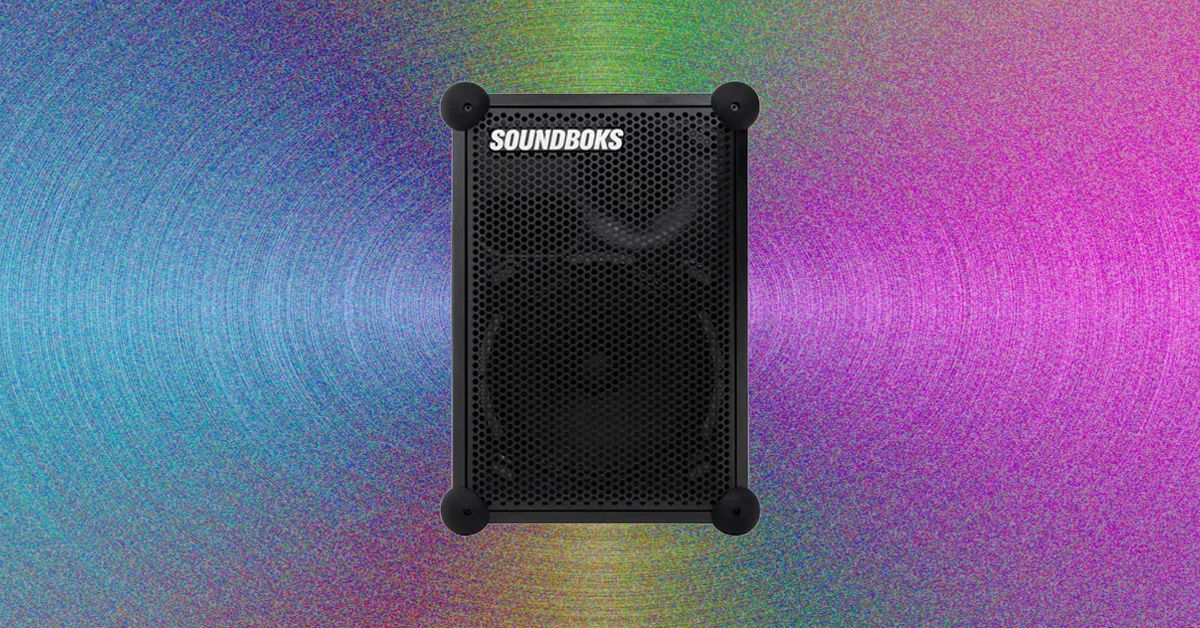
In addition to the rubber balls, there’s a nice physical interface on the side for adjusting volume and pairing multiple Mix speakers together if you have multiple on hand (I was only sent the single mono speaker). Setup involves installing the Soundboks app, pairing to the speaker via Bluetooth on your phone, and picking whatever you want to play. It’s all quick and painless, especially for my first-time pairing with a Samsung Galaxy S24 Ultra.
Otherwise, it’s all very pro audio. Everything reminds me very much of the Peavey PA system I have in my music rehearsal space. The top of the speaker features a built-in carrying handle and a place for a strap (an accessory you have to buy aftermarket, or you can fasten it with any strap you have that fits through the hole). There are also top-hat mounts for the speakers to slide onto traditional PA pole stands, if you wanted to use them in that way at a party or event.
The grill is replaceable, as is the massive internal battery, which means that these things are pretty much indestructible as long as the amp and speakers themselves still work—the battery is the weak point of most portable speakers in 2026.
I bounced it around my yard, dropped it off my patio, and generally beat the crap out of it during my two-week testing period, and the thing just needed a little wipe down and a charge when it ran out of juice. The claimed 40 hours of battery at reasonable volume is accurate, but you’ll get about eight hours at max volume (which is very good for the category). If you need to bring some walk-out music to your kid’s all-day Little League tournament, this a great way to go.
Big Sound
Photograph: Parker Hall
Soundboks calls this speaker midsize, but at 21.4 pounds and the size of a medium-size cooler, I’d still call it a large speaker. That said, the size doesn’t make it any less portable than competitors from JBL and others; you still need a car or cargo ebike to take one of these with you, so what’s a couple inches here or there? The fact that this is a rectangle actually makes it easier to strap down than many others, especially with the holes for the strap and the built-in handle to tie down through.


Amazon’s Spring Sale Is So-So, but Cadence Capsules Are a Bright Spot

The unexpected path that led Morgan and Frankie Price to Arkansas gymnastics

US-Iran mediation: Politicians castigate India’s Jaishankar for spiteful remarks on Pakistan

Sales at US apparel, clothing accessories stores up 4% YoY in Jan 2026

Justice Department Says Anthropic Can’t Be Trusted With Warfighting Systems

March Madness 2026 – How to watch in SA, start time, schedule, TV channel for NCAA championship basketball tournament

-
 Fashion1 week ago
Sales at US apparel, clothing accessories stores up 4% YoY in Jan 2026
-
 Tech1 week ago
Justice Department Says Anthropic Can’t Be Trusted With Warfighting Systems
-
 Sports1 week ago
March Madness 2026 – How to watch in SA, start time, schedule, TV channel for NCAA championship basketball tournament
-

 Fashion1 week ago
Spain’s Inditex FY25 sales rise 3.2% to $46.28 bn amid strong demand
-

 Politics1 week ago
Iran strikes Tel Aviv with cluster-warhead missiles in retaliation of Larijani’s martyrdom
-

 Entertainment1 week ago
Val Kilmer revived 1 year after death through AI
-

 Fashion1 week ago
US’ G-III Apparel’s FY26 sales fall 7% to $2.96 bn
-

 Entertainment1 week ago
With few new leads 45 days after Nancy Guthrie’s disappearance, investigation “becomes much harder,” expert says