

Sports
What it’s like to be Olivier Rioux — the tallest college basketball player ever

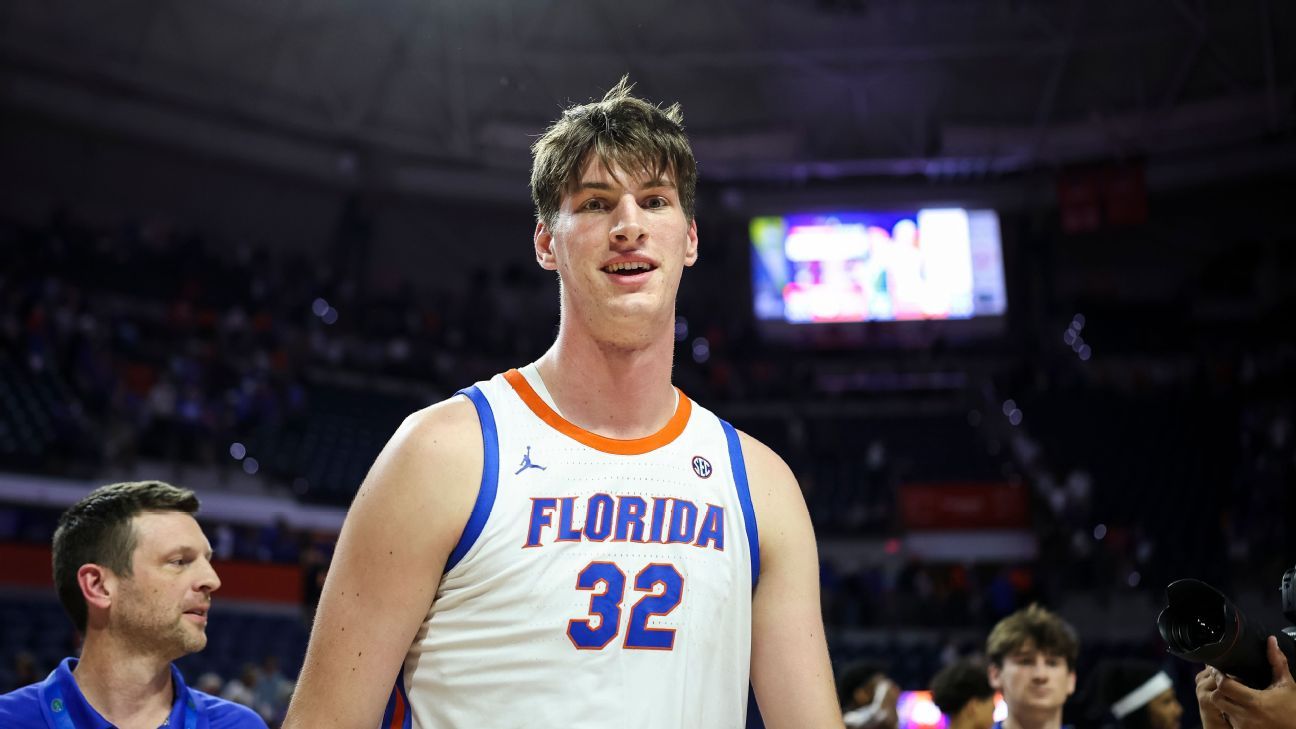
GAINESVILLE, Fla. — At an on-campus dining hall in September, a fork and knife looked like a toddler’s toy utensils in the massive hands of Olivier Rioux. Everything about Florida‘s 7-foot-9, 305-pound center, is supersized — just check the book of Guinness World Records, where he holds the official title for tallest teenager.
“I wear size 20 shoes,” Rioux told ESPN. “I eat 5,000 to 6,000 calories every day.”
It’s fuel for a body with proportions college basketball has never seen.
When he made his much-anticipated debut for the Gators in early November, Rioux (pronounced Ree-YOO) became the tallest player in college basketball history to check into a game. Two weeks after that, he became the tallest player to score a point after making a free throw. And in mid-December, he became the tallest player to record a field goal with a late-game dunk in a blowout win over Saint Francis.
Before he even entered that game — his third of five appearances so far this season — the crowd in Gainesville began to chant, “We want Ollie! We want Ollie!” The loudest cheers of the night erupted when he rose from his seat on the bench and walked to the scorer’s table to check in. Minutes later, that slam sent the fans into a frenzy. His teammates hopped on one another’s shoulders, his coaches high-fived and fans pointed to the ceiling and screamed.
“I knew it would be big, but I didn’t know it would be like that,” said Jean-Francois Rioux, Oliver’s father.
0:18
7-foot-9 Olivier Rioux scores first bucket
Olivier Rioux, the world’s tallest teenager, scores his first bucket for Florida vs. Saint Francis.
Oliver has created a buzz on and off the court since he was a young player in Montreal. As a child, he towered over his peers, then his teachers and, well, eventually most of the globe. He was nearly 7 feet tall in elementary school. With his unique size and stature, he’s a walking selfie opportunity for passersby.
The redshirt freshman’s main focus is to eventually earn more playing time and enjoy the typical life of a college student. Florida considers him a promising project, though at this stage, he’s a long way from filling up the stat sheet in the SEC. Still, he’s the most popular player on the roster, as evidenced by the incessant requests for photos and autographs when he’s out with the team. But while Rioux sometimes basks in the fame and attention of a rock star, he yearns to be acknowledged for his other attributes.
“Whenever I’m out with the guys or the team, I’m like, ‘I don’t want any pictures,'” he said. “When I’m walking to class, I’ll do selfies while I’m walking. I’ve learned that technique. It works a lot because you don’t get stopped by anybody. And then anything that involves kids asking for pictures, I’ll do it because I don’t want to feel bad.”
Long before he caused a stir everywhere he went, Rioux was just a tall kid in Canada.
As a child, he was just the growing young man who would walk into a local restaurant with his 6-8 father, 6-2 mother Anne Gariepy (6-2) and 6-9 older brother, Emile, to order a half-dozen pizzas for the family.
That started to change in 2016.
Joel Anthony, a 6-10 former NBA forward who won two NBA titles with LeBron James and the Miami Heat, returned to Montreal to attend a kids basketball camp in town. Having faced some of the biggest athletes in the world, he wasn’t easily impressed. Then, a friend of his introduced him to a 9-year-old Rioux.
“I was like, ‘Where is the kid?'” Anthony said. “And he’s like, ‘This is the kid I was talking about.'”
Anthony had assumed Rioux was a camp counselor. They were the same height.
2 years ago #Olivierrioux with Joel Anthony ! Times fly ! pic.twitter.com/zmWV1tS4HE
— Jean-Francois Rioux (@TWJFRIOUX) September 12, 2018
When a photo of Rioux and Anthony was posted on social media, it drew attention — including from Canada Basketball officials, who contacted Rioux’s family. Joining his country’s official basketball development system helped him gain the training resources to facilitate his growth. Free clothes and shoes, too. And the games against top opposition on the grassroots circuit taught him to play with an edge.
“A 6-foot-10 kid tried to dunk on him and he missed, and he was chirping at Rioux,” said Joey McKitterick, director of Brookwood Elite basketball program in Canada. “And then Rioux comes down and dunks on him, and then he pats the kid on the top of his head. And I was like, ‘He just patted a kid who is 6-foot-10 on his head like he was his child.'”
As the legendary stories about the tallest kid anyone had ever seen — he was 7 feet tall by age 12 — circulated throughout Canada and beyond, Rioux’s coaches had to call event organizers at youth basketball events to verify his age when they threatened to demand his birth certificate. The crowds at his games quickly grew. People wanted to see the boy who seemed like a myth. That attention wasn’t always easy to handle for Rioux, according to those who were around him then.
“It is a little difficult when you’re young and people don’t know how to stare,” Anthony said. “You have this growth spurt and now everyone’s just staring at you and it’s just constantly, everyone is staring at you.”
Rioux’s AAU coaches had to turn his teammates into “bodyguards” on road trips to keep those seeking autographs and pictures at bay. They would still snap selfies from afar and post them. A simple stroll through a mall, an airport or any place with throngs of people would present the possibility of hysteria for Rioux.
But in basketball, Rioux found a home and an identity. At Florida, he’s just one of the guys, another player on a roster chasing a dream.
“The fans at Florida are crazy,” he said. “The feeling of being supported by people, it just helps you a lot mentally and I feel like that’s what I needed and that’s what I’ve been provided with.”
Whenever he gets to his hotel room on the road with the Gators, Rioux goes through his routine.
First, he backs his body into the room like a semi-truck backs into a loading dock because it’s more efficient than trying to dip beneath a standard door frame (6-8) while facing forward. Then if the room has two beds — preferably doubles or queens — he’ll pull one toward the other to make a T-shape, then sleep diagonally.
When a room has only one bed, well, then he really has to get creative.
“I just have a technique where I just pull the mattress back, put some pillows and cushions near the top of the bedframe so that the bed is long enough,” he said. “I don’t need the extra space in the room.”
Just preparing his body for the wear and tear of a basketball season is a feat in and of itself. His training program involves a lot of work on his lower body to create and sustain the base he’ll need to play long stretches if he’s called upon.
“I can lose five pounds in a single day,” Rioux said of his daily workout regimen. “I have to regain it with water and it’s you can’t just hold water. You’ve got to drink progressively and be worried about when you drink, how you drink and when you pee and all of that. There is a whole process.”
At 7-9, the human body works harder. Much harder. But the energy Rioux expends at Florida to stay in shape — he added 10 pounds of muscle over the offseason — is not only in service of his basketball future, but his overall quality of life.
For now, Rioux hasn’t had much of an opportunity to showcase the work he has done to prepare his body for play.
Florida’s pecking order is set with a frontcourt of Alex Condon, NBA prospect Thomas Haugh and Rueben Chinyelu — all of whom starred in last season’s national title run. Rioux’s efforts now are really about fighting for a role next season. His height is an X factor no opponents can match at this level. But he’ll have to become quicker and more agile to play substantial minutes, according to those who have helped him develop over the years.
“It’s a guard’s game, so in order for a big guy like [Rioux] to really, really thrive, you’d have to slow the game down, walk the ball up the court, let him get in position and then throw it into him,” said Michael Meeks, an assistant with the Canadian national team who has known Rioux for more than a decade. “There are not a lot of teams that walk the ball up in the SEC, so his head is under the water and he’s going to have to really, really work to get it above it to impact the game.”
Florida head coach Todd Golden said he won’t make any definitive projections about Rioux’s future at Florida, but he is impressed by his determination and work ethic.
“I know he’s sitting over there probably like, ‘Damn man, I didn’t know all these guys were coming back,'” Golden said. “So it’s going to be a tough one this year to play. It really will be. But … I do think he has some really good basketball ahead of him, whether it’s here at Florida or somewhere else.”
That’s a challenge Rioux has embraced because he wants to play. That’s his ultimate goal; it’s how he wants to be remembered with the Gators and the world. Whether an opportunity to make that a reality comes will depend on what happens this offseason. Although Rioux has played limited minutes this season (2.2 per game), Florida could lose its entire frontcourt to the NBA or graduation. That could open a lane for him — and he’s determined to stay until it does.
“I think a lot of people don’t really know what I’m committed to doing,” he said. “Obviously, you see a highlight here and there, but you don’t see what the person is capable of doing. I want to push myself to be able to do that.”
Added his father: “We are confident that [Rioux] will have his place at Florida and that he will be able to play.”
0:22
Gators fans go wild for tallest player in CBB history checking into game
Florida fans are on their feet as 7-9 Olivier Rioux checks into the game against North Florida.
Rather than stuff himself into a car, Rioux prefers to ride around Florida’s campus on a bike. But it’s not an ordinary bike. The DirtySixer AllRoad Mark II retails at $5,000. When standing upright on its back wheel, the bike is almost as tall as Rioux. San Antonio Spurs star Victor Wembanyama is next on the company’s list to get one of the limited edition bikes. Shaquille O’Neal already has one.
“I haven’t figured out my driver’s license,” Rioux said. “I don’t fit into cars. I don’t fit into the driver’s seat. I would have to customize it and learn how to drive it. And that’s a lot. That’s a lot of money.”
Blending into a world made for the masses — the average Canadian man is 5-10 — but not a 7-9 man has always been the norm for Rioux. He has to “duckwalk” through the jet bridge at the airport and can sit only in exit rows unless he purchases extra seats for the legroom. And with his in-person classes in Gainesville, it’s rare that he ever finds a suitable seat.
“The auditoriums are not made for tall people, so I have to sit in the back where there is a seat,” he said. “You don’t really hear the teacher.”
The Florida athletic complex is one of the few places where he can relax without thinking about the next person to come up to him and ask him about his height or if he plays basketball or how tall he is. In the locker room, Rioux can be himself.
“He’s a great kid,” his teammate Boogie Fland said. “He’s just a cool dude to be around and he is always caring about us.”
Added Haugh: “People love him here. He loves it here, too. And he’s been grinding. He has been lifting a lot and getting better. I see him working out, working on ballhandling. And I think if he gets things rolling, gets a little quicker, he’s going to be good.”
Florida is where Rioux is attempting to mold himself into the player he wants to be — one with a future that will depend on how rapidly his skills develop and the way he conditions himself for the rigors of a season. In the meantime, the NIL and revenue sharing have helped him attain the 3XL gear — and the king-plus mattress — he needs. It also helps that clothing companies send him their stuff for free, hoping he can become their human billboard.
When he wants to turn it all off, though — the buzz, the selfie requests, the gawking, the questions — he connects with those who know him as “Ollie.”
Back home in Montreal, he challenges his dad to PC games, mostly “Civilization” and “Minecraft.” He enjoys reading manga and watching anime. He’s even an artist himself; his sketches are scattered around his family home.
When he wasn’t doodling as a kid, he was always close to a chessboard.
“He’s very good at chess,” his father said. “When he was young, he won the tournament at his school, but at some point, if you want to really be good at chess, you have to train, but basketball was taking too much of his time to do chess.”
He has a friend group that doesn’t care that he plays basketball or has a record-setting height. On a summer trip to New York City, they socialized at a food festival before they stopped at a club.
“We went downtown, we chilled. One of our friends is a DJ, so we went to support him,” Rioux said. “It was really nice. He was doing EDM. I am into that.”
He chooses to keep the names of those friends and their busy group chat private. For Rioux, cultivating a life outside basketball — and constant chatter about his height — has been a positive.
“It’s the freedom of not talking about basketball,” he said. “I feel like that helps me to just be more focused on basketball somehow. I don’t know the mentality behind it, but I have 100% in basketball and 100% with the liberty of recovery. I think that’s the balance.”
-
Dan Graziano
Close
Dan Graziano
senior NFL national reporter
- Dan Graziano is a senior NFL national reporter for ESPN, covering the entire league and breaking news. Dan also contributes to Get Up, NFL Live, SportsCenter, ESPN Radio, Sunday NFL Countdown and Fantasy Football Now. He is a New Jersey native who joined ESPN in 2011, and he is also the author of two published novels.
-
Jeremy Fowler
Close
Jeremy Fowler
senior NFL national reporter
- Jeremy Fowler is a senior national NFL writer for ESPN, covering the entire league including breaking news. Jeremy also contributes to SportsCenter both as a studio analyst and a sideline reporter covering for NFL games. He is an Orlando, Florida native who joined ESPN in 2014 after covering college football for CBSSports.com.
Multiple Authors
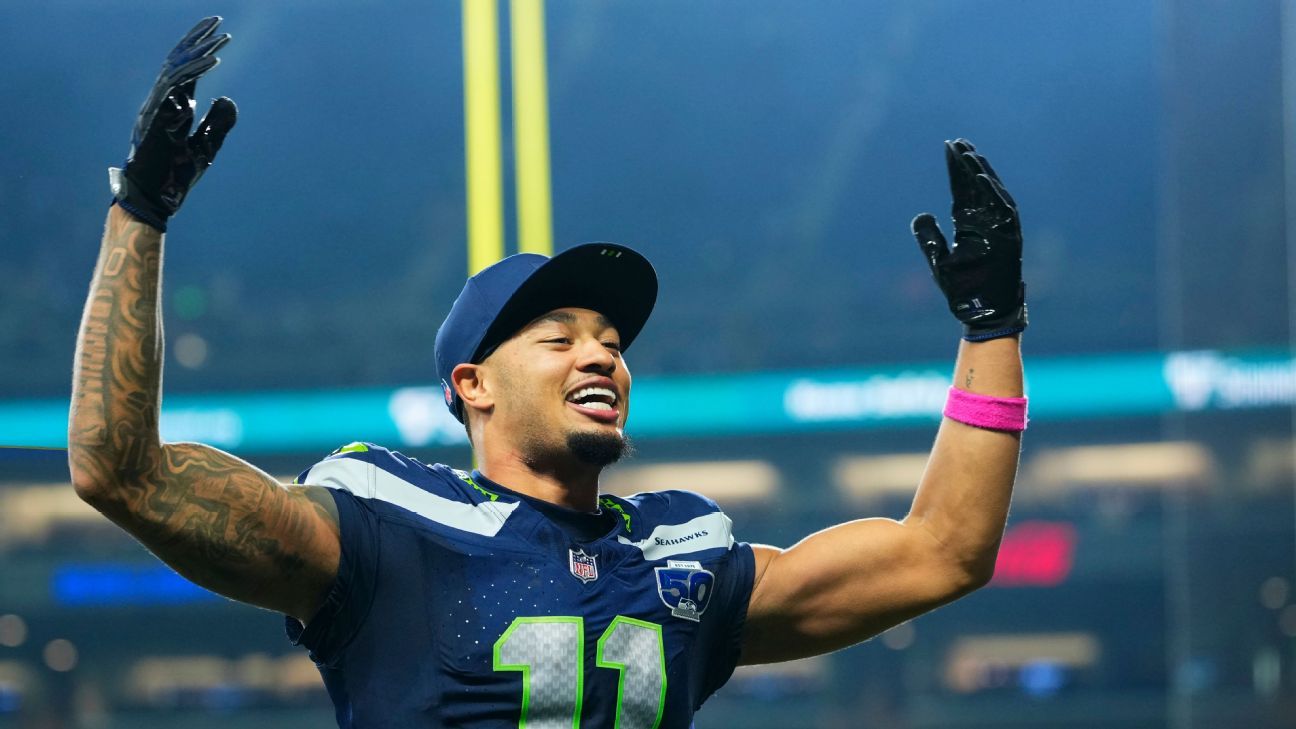
The Seattle Seahawks made Jaxon Smith-Njigba the NFL’s highest-paid receiver on Monday — and they did it without a whiff of the acrimony that came with other megadeals in their recent past.
The last time they made a nonspecialist the top-paid player at his position, it ended a monthslong contract dispute with safety Jamal Adams, who sat out the first three weeks of training camp in 2021.
In 2019, linebacker Bobby Wagner staged his own offseason hold-in while awaiting a top-of-the-market deal. It got done early in training camp, but with Wagner serving as his own agent, negotiations with one of the best players in franchise history got awkward.
Earlier that same year, quarterback Russell Wilson set an April 15 deadline for an extension, saying he’d play out the final year of his deal if a new one wasn’t secured by then. General manager John Schneider had to bounce between draft meetings and the negotiating table before an agreement was reached at the 11th hour to make Wilson the highest-paid player in the NFL.
There was no such drama between the Seahawks and Smith-Njigba, 24, as the two sides worked toward a deal that tops Wilson’s for the richest in team history. According to ESPN’s Adam Schefter, it’s a four-year, $168.6 million extension that includes over $120 million in guarantees.
Given the history, that a contract of this magnitude got done as quickly as it did might be surprising. At the same time, it makes sense given the player in question.
Smith-Njigba is an embodiment of the “Mission Over Bulls—“ mantra the Seahawks adopted last season during their run to Super Bowl LX. Those who know Smith-Njigba well say he’s genuinely more invested in the team’s success than his personal accomplishments.
After leading the NFL in receiving in 2025, making his second straight Pro Bowl and being named AP Offensive Player of the Year, Smith-Njigba helped the Seahawks claim the second Lombardi Trophy in the franchise’s history.
Now he has a record-setting contract to go with it.
NFL Nation Seahawks reporter Brady Henderson and senior NFL national reporters Jeremy Fowler and Dan Graziano break down what Smith-Njigba’s deal means for the Seahawks … and a rival West Coast receiver who is also waiting for an extension.

Why did the Seahawks extend JSN now, after exercising his fifth-year option last week?
The Seahawks always planned to pick up Smith-Njigba’s fifth-year option and negotiate an extension. The timing of this deal, though, is atypical for an organization that usually waits until later in the offseason to work out extensions, as was the case in recent years with players such as right tackle Abraham Lucas (2025), safety Julian Love (2024), outside linebacker Uchenna Nwosu (2023) and wide receiver DK Metcalf (2022).
Perhaps the Seahawks were motivated to get ahead of the wide receiver market, securing an extension for Smith-Njigba lest they wait and have to top whatever number Puka Nacua gets on his megadeal from the Los Angeles Rams. — Henderson
What does this mean for CB Devon Witherspoon and subsequent moves for Seattle?
With the Smith-Njigba deal done, expect the Seahawks to turn their attention to an extension for Witherspoon, a fellow 2023 first-round pick and a tone setter on the NFL’s top-ranked scoring defense. Seattle also picked up Witherspoon’s fifth-year option last week at a projected cost of around $21.12 million for 2027.
The Rams gave Trent McDuffie a four-year, $124 million extension after acquiring him in a trade with the Kansas City Chiefs — which complicates things for the Seahawks. The deal makes McDuffie the league’s top-paid corner at an average of $31 million per season, a number Witherspoon is now in position to top.
Witherspoon’s résumé is stronger than McDuffie’s, with an initial-ballot Pro Bowl berth in each of his first three seasons. Had it not been for running back Kenneth Walker III totaling 161 yards in Super Bowl LX, Witherspoon — with a sack and another hit that led to a pick-six — might have been the game’s MVP.
Seattle may have already been prepared to make Witherspoon the game’s top-paid corner, but McDuffie’s deal raised that benchmark.
That helps explain the restraint the Seahawks showed in free agency seemingly in preparation for these extensions. While they were never expected to make serious efforts to keep cornerback Riq Woolen or outside linebacker Boye Mafe, they also let Walker and safety Coby Bryant walk for deals they could have fit under their cap.
But it’s one thing to have enough cap space. Teams also need cash, and the Seahawks — assuming they extend Witherspoon — will be committing a ton of it up front in the form of signing bonuses for two top-of-the-market deals. — Henderson
Could QB Sam Darnold get a new deal, too?
Not until next year. Darnold certainly has a case for a raise. The $33.5 million average of the three-year, $100.5 million deal he signed as a free agent last March ranks 15th in terms of annual salaries for quarterbacks. It’s a bargain for a QB coming off a Pro Bowl season and a Super Bowl victory.
But the Seahawks do not extend contracts with more than one season remaining — a nonnegotiable team policy on which they’ve held firm over the years. That’s why it was a nonstarter when their previous quarterback, Geno Smith, wanted a new deal in 2024, as he was entering the second season of a three-year deal.
When asked at the NFL combine if Darnold could get an extension this offseason, Schneider stated, “Sam signed a three-year deal.”
Technically, Smith-Njigba had two years remaining on his rookie contract once his option was exercised, as does Witherspoon. But Schneider has clarified that option years don’t apply to the team’s rule. — Henderson
What does this mean for Rams’ discussions with Nacua?
The impact is immense. Smith-Njigba and Nacua are 2023 draft mates with similar production through three NFL seasons. (Smith-Njigba has the receptions edge and a slight win in receiving touchdowns, 20 to 19, but Nacua has more yards.)
There’s no question that Nacua and his agents will use Smith-Njigba’s benchmark as a suitable comp, but getting there might not be easy. The Rams aren’t afraid of tough negotiations. They made Aaron Donald hold out years ago in order to get his deal and dangled a trade for Matthew Stafford last offseason before eventually sweetening his deal.
Nacua and the Rams have plenty of time to execute a potential extension and there’s no real rush. But Smith-Njigba’s contract definitely helps Nacua — unless Los Angeles finds the ballooning receiver market, which is up about 280% over the past decade, untenable. The flip side: The Rams identified Nacua as a star very early in his career and knew this day was coming. — Fowler
Is JSN’s contract structured to limit the immediate payout with eventual new ownership in mind?
The structure is favorable for the team, but I don’t think it’s because the team is being sold. In talking to people with knowledge of this and other Seahawks negotiations this offseason, I’ve been told the pending new ownership change has no impact on the business the Seahawks are doing right now.
The Seahawks have very rigid principles when it comes to veteran contract negotiations. Specifically, they do not guarantee any money outside of the first year of the deal. In the case of Smith-Njigba, however, he already had $23.852 million fully guaranteed for 2027 because they’d picked up the fifth-year option on his rookie contract. This is why his 2027 money is guaranteed at signing in an apparent departure from the Seahawks’ self-imposed rules.
Seattle will pay Smith-Njigba $36.5 million in 2026 — a $35 million signing bonus, a $1.25 million base salary and a $250,000 workout bonus. They’ll pay him $32.63 million in 2027, including a $30 million option bonus, a $1.53 million salary, a $250,000 workout bonus and $850,000 in per-game roster bonuses (assuming he plays all 17 games in 2027). After that, the 2028 money is guaranteed for injury only and doesn’t become fully guaranteed until five days after Super Bowl 62, which is scheduled to be played in February 2028.
It’s also interesting to note how the Smith-Njigba structure fits into the Seahawks’ overall payroll picture. The extension they did for left tackle Charles Cross earlier this year included a $25 million signing bonus and a $15 million 2026 option bonus, plus an additional $8 million option bonus in 2028.
Smith-Njigba’s contract includes option bonuses in 2027 and 2029, staggering them on the odd years while Cross’ are in the even years, presumably to even out the year-to-year cash spend. Given the Seahawks appear to have adopted an every-other-year option bonus structure in these big-money deals, it’ll be interesting to see which years of the inevitable Witherspoon extension include big option bonuses.
That’s a long way of saying no but also illustrating the ways in which the Seahawks have structured this deal as part of an overall cap management and cash budgeting process that will help the current owners as well as the eventual new ones. — Graziano
Michigan made history in 1937 by winning the first official NCAA Division I men’s swimming and diving national championship. Coach Matt Mann led the Wolverines to the first five titles and another in 1948. Since then, Texas has been the most dominant program in the pool, winning a record 16 national championships. The Longhorns won their first title in 1981 and captured their 16th crown in 2025.
Stanford has won the most championships on the women’s side, with 11. But no program has been more successful of late than the Virginia women. In March 2026, the Cavaliers won their sixth straight NCAA women’s swimming and diving title.
Check out the all-time NCAA Division I men’s and women’s swimming and diving national championship winners below.
2026: Virginia (W)
2025: Texas (M), Virginia (W)
2024: Arizona State (M), Virginia (W)
2023: California (M), Virginia (W)
2022: California (M), Virginia (W)
2021: Texas (M), Virginia (W)
2020: Canceled due to COVID-19
2019: California (M), Stanford (W)
2018: Texas (M), Stanford (W)
2017: Texas (M), Stanford (W)
2016: Texas (M), Georgia (W)
2015: Texas (M), California (W)
2014: California (M), Georgia (W)
2013: Michigan (M), Georgia (W)
2012: California (M), California (W)
2011: California (M), California (W)
2010: Texas (M), Florida (W)
2009: Auburn (M), California (W)
2008: Arizona (M), Arizona (W)
2007: Auburn (M), Auburn (W)
2006: Auburn (M), Auburn (W)
2005: Auburn (M), Georgia (W)
2004: Auburn (M), Auburn (W)
2003: Auburn (M), Auburn (W)
2002: Texas (M), Auburn (W)
2001: Texas (M), Georgia (W)
2000: Texas (M), Georgia (W)
1999: Auburn (M), Georgia (W)
1998: Stanford (M), Stanford (W)
1997: Auburn (M), USC (W)
1996: Texas (M), Stanford (W)
1995: Michigan (M), Stanford (W)
1994: Stanford (M), Stanford (W)
1993: Stanford (M), Stanford (W)
1992: Stanford (M), Stanford (W)
1991: Texas (M), Texas (W)
1990: Texas (M), Texas (W)
1989: Texas (M), Stanford (W)
1988: Texas (M), Texas (W)
1987: Stanford (M), Texas (W)
1986: Stanford (M), Texas (W)
1985: Stanford (M), Texas (W)
1984: Florida (M), Texas (W)
1983: Florida (M), Stanford (W)
1982: UCLA (M), Florida (W)
1981: Texas (M)
1980: California (M)
1979: California (M)
1978: Tennessee (M)
1977: USC (M)
1976: USC (M)
1975: USC (M)
1974: USC (M)
1973: Indiana (M)
1972: Indiana (M)
1971: Indiana (M)
1970: Indiana (M)
1969: Indiana (M)
1968: Indiana (M)
1967: Stanford (M)
1966: USC (M)
1965: USC (M)
1964: USC (M)
1963: USC (M)
1962: Ohio State (M)
1961: Michigan (M)
1960: USC (M)
1959: Michigan (M)
1958: Michigan (M)
1957: Michigan (M)
1956: Ohio State (M)
1955: Ohio State (M)
1954: Ohio State (M)
1953: Yale (M)
1952: Ohio State (M)
1951: Yale (M)
1950: Ohio State (M)
1949: Ohio State (M)
1948: Michigan (M)
1947: Ohio State (M)
1946: Ohio State (M)
1945: Ohio State (M)
1944: Yale (M)
1943: Ohio State (M)
1942: Yale (M)
1941: Michigan (M)
1940: Michigan (M)
1939: Michigan (M)
1938: Michigan (M)
1937: Michigan (M)
Check out the ESPN college sports hub page for the latest news, analysis, scores, rankings and more.
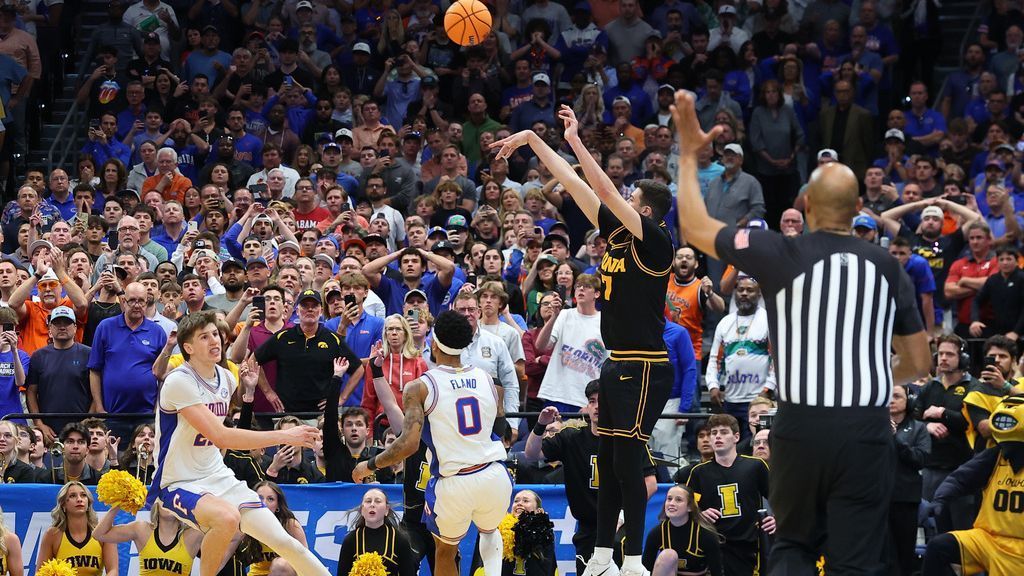
TAMPA, Fla. — Down by two points against defending national champion and No. 1 seed Florida, Iowa forward Alvaro Folgueiras took a pass from guard Bennett Stirtz and drilled a go-ahead 3-pointer with 4.5 seconds left that clinched a 73-72 victory Sunday night, sending Benchmark International Arena into an absolute frenzy and the ninth-seeded Hawkeyes into the Sweet 16 for the first time since 1999.
It was Iowa’s second win against a No. 1 seed since seeding began in 1979 (versus Syracuse in the 1980 regional semifinals), according to ESPN Research. It also was the first game winner in the final five seconds against a top seed in the tournament since Kris Jenkins’ buzzer-beater for Villanova versus North Carolina in the 2016 national championship game.
“The play was drawn up for me to get downhill, and then this dude came up to me and he’s like, ‘I’m going to be ready, and I’m going to make it,'” Stirtz said of Folgueiras, who finished with 14 points and five rebounds off the bench. “That’s what he actually did.”
First-year Hawkeyes coach Ben McCollum was in disbelief.
“Did you say that?” he asked.
Folgueiras responded, “I did. That was me.”
McCollum replied, “He’s got …”
“Ultra confidence,” Stirtz said.
McCollum added: “Irrational confidence.”
Folgueiras needed it. So did his mother, Beatriz Campos, when she sent him to the United States from Málaga, Spain, to pursue his dreams of playing basketball.
“She sent a 16-year-old kid to America without knowing any English … without anything but dreams and hunger. And this one is for her and my dad. He’s watching up there,” said Folgueiras, whose father died when he was 9.
While the Hawkeyes celebrated on the court, Folgueiras ran into his mother’s arms. It was first time he had seen her since August and the first time she had watched him play a college game in person in two years.
“She told me, ‘I love you,’ 100 times. I said, ‘I love you,’ 100 times back,” Folgueiras said. “It’s super special having my mom here. She’s everything for me. Where would the world be without the moms? She’s super tough. She’s been through a lot of things in life.”
She often worked 14 hours a day to provide for Folgueiras and his brother, Ignacio.
“Sometimes, when I struggle through basketball — and basketball is life — I think of my mom as an example of resilience, and that really inspires me and gives me confidence,” Folgueiras said. “Because she’s not just a fighter; she’s a super special person. I’m so lucky to have her as a mom.”
Campos said through her longtime partner, Mike, “She’s very proud. This is her son. She’s very proud. We came down here from Spain. To watch him play, we never thought we would get into this, and that last point was incredible. It’s her son.”
She stood on the floor and held a sign that read, “YOU ARE THE BEST #7,” with a picture of Folgueiras. Fans took turns helping her hold it. She was just a few feet away from her son when he made his epic shot.
“I think no one really believed in us outside this locker room,” said Stirtz, who tallied 13 points, five rebounds and five assists.
Two nights prior, Florida cruised to a 114-55 win over Prairie View A&M for the second-largest victory margin in NCAA tournament history. There was concern over how the Hawkeyes would handle Florida’s tempo. But the Hawkeyes led for 66% of the game, were up by as many as 12 points and were the better team in the paint.
Still, it looked like they were about to let the game slip away. Stirtz missed a layup, and Gators guard Isaiah Brown grabbed the rebound then made 1 of 2 free throws after he was fouled, giving Florida a 72-70 lead.
Iowa, though, broke the Gators’ full-court press, and Folgueiras was wide open.
“He caught it in rhythm and buried it and didn’t hit anything but net,” McCollum said. “And it was surreal. Like, ‘Oh my gosh, he just made that.'”


How Jaxon Smith-Njigba’s contract extension impacts Seahawks

China sees rise in new FDI firms despite lower inflows
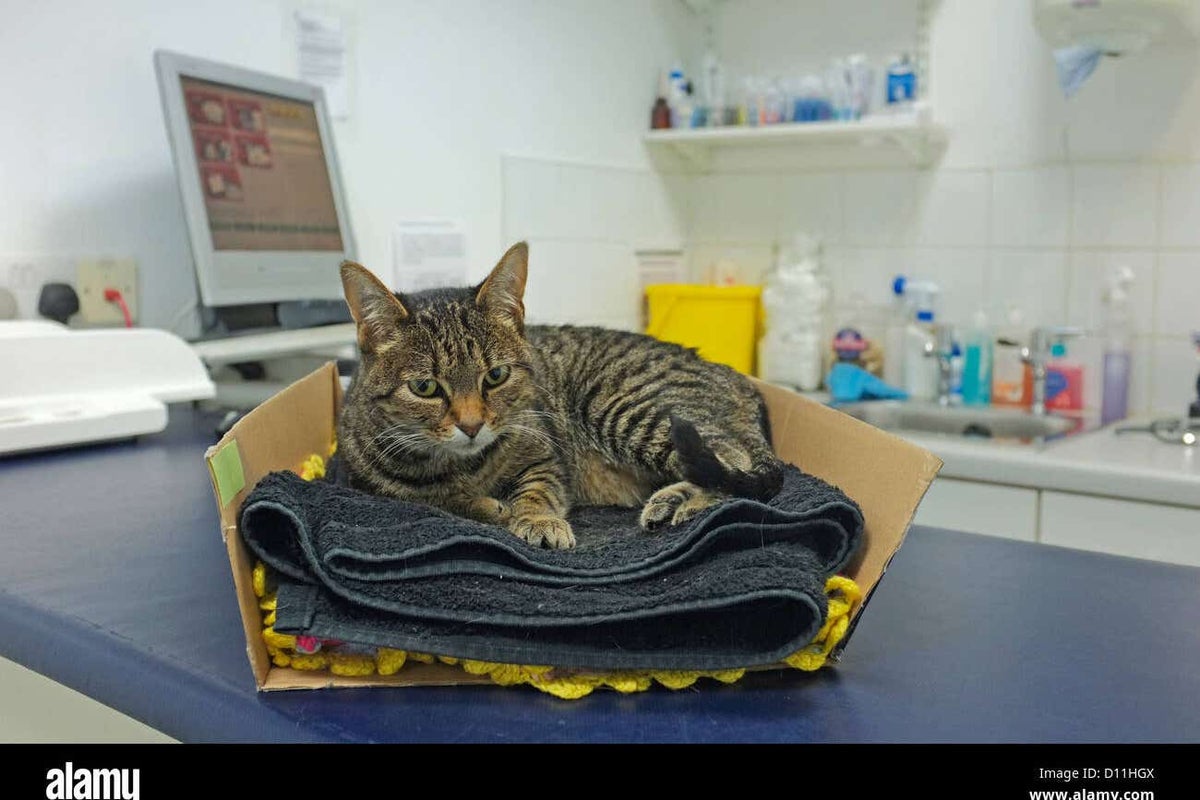
Vets to be legally required to publish price lists and cap prescription fees

Japan suffers shocking collapse to Venezuela in World Baseball Classic

Strategic oil stocks to be released ‘immediately’ in Asia and Oceania: IEA

New Income Tax Act 2025 To Take Effect From April 1: 10 Key Changes That Will Affect Your Money

-
 Sports1 week ago
Japan suffers shocking collapse to Venezuela in World Baseball Classic
-
 Entertainment1 week ago
Strategic oil stocks to be released ‘immediately’ in Asia and Oceania: IEA
-
Business1 week ago
New Income Tax Act 2025 To Take Effect From April 1: 10 Key Changes That Will Affect Your Money
-

 Sports1 week ago
Transfer rumors, news: Real Madrid open to Camavinga exit, as Premier League clubs circle
-

 Tech6 days ago
Justice Department Says Anthropic Can’t Be Trusted With Warfighting Systems
-

 Sports6 days ago
March Madness 2026 – How to watch in SA, start time, schedule, TV channel for NCAA championship basketball tournament
-

 Sports1 week ago
PCB files complaint over allowing Bangladesh to take review on penultimate ball – SUCH TV
-
 Business7 days ago
Stocks and pound rise as US rate call approaches