

Tech
What should platform engineering look like? | Computer Weekly


Platform engineering is based on the principles of product management and the product model applied to digital and IT systems. Fast-moving digital teams show resistance to strict process frameworks such as the Information Technology Infrastructure Library (ITIL) and IT service management (ITSM), and autonomous digital or IT product teams are becoming self-sufficient, reducing the need for traditional infrastructure engineers.
Platform engineering, grounded in product management principles, offers an approach to modernising IT operations. By injecting product thinking into platform teams, Forrester believes technology organisations can position themselves for the future.
What is platform engineering?
Forrester has compiled a capability model for platform engineering that includes frequently covered technical aspects and less frequently covered management capabilities. It is an inventory of things you should think deeply about and ensure you have covered via your organisational resources, which might include not only dedicated organisations, but also cross-functional processes, enablement teams, or other mechanisms.
Your capabilities are how your customers experience the platform. They are your front door, so to speak. Your customers will discover your platform, onboard onto it, provision it, interact with its application programming interfaces (APIs), leverage patterns for security and performance, and call for help via these capabilities. And no, there is no such thing as an entirely automated self-service platform.
Users and developers need to be able to discover the platform and its services. Managing your platform like a product means you understand the onboarding journey of users and invite them to be part of the process of defining – and even contributing to – developer platform capabilities.
They will expect easy, frictionless authorisation and access, with few, if any, human-in-the-loop workflow-based approvals. Once provisioned and actively developing, they will need information about the ongoing status of the services they are consuming.
Usually, larger organisations will have a service catalogue or portal capability for IT services. If this does not exist, you must fund and create it. Developer-focused portals – for example, Spotify Backstage, Harness Internal Developer Portal, Atlassian Compass – are gaining popularity. Toyota of North America, for instance, includes consumable blueprints, a discoverable software catalogue, education and training resources, and operational reporting for FinOps and other metrics in its developer portal.
Access to platform services and resources is typically a two-stage process, with initial provisioning (setting up accounts) followed by day-to-day demand (provisioning virtual machines, clusters, and so on). While setting up the account may require some human approvals, day-to-day demand requires API access.
A platform that cannot provision, configure and manage base resources via APIs is not a true platform. Typically, platforms support APIs to instantiate and configure required resources, such as processing nodes, data stores, queues, pipelines and observability probes. There are significant API design questions. Many organisations generally have API engineering capabilities, but may not have explored the nuances of supporting self-service provisioning.
Users of the platform also require ready access to documentation on how to use it. How will these be created and maintained? Typically, a wiki is used for core system quick starts and how-to guides. Forrester recommends documenting patterns as code and managing them via source control. It is also advisable to define the processes, roles and responsibilities for those in charge of these resources. Saying that it is everyone’s responsibility is tempting, but that approach does not work at scale or in the long run.
Support is another key capability. Platforms are typically highly leveraged. Users building tenant applications may not understand the system. The system may not behave as expected. For these and other reasons, you will likely need some level of on-call support. Human contact is required, even in the age of ChatGPT.
Most organisations have ticketed support management, such as with BMC Software and ServiceNow, for example. This may be used to support the base platforms, and tenant applications may leverage it. However, as Forrester notes, fewer have a robust major incident/critical event management capability, which is essential. Such capabilities are based on products like PagerDuty or Everbridge.
Operational capabilities
The focus for many platform engineering architectures and frameworks is the operational capabilities, especially those that are more technical. While there are many kinds of infrastructure platform components, the fundamental DevOps chain capabilities appear in most platform engineering discussions.
Forrester recommends that deployments and operational architectures are controlled for governance and policy. Increasingly, this is done as code, such as through Open Policy Agent and similar approaches. Required design patterns, configurations and hardening standards should all be checked. Are software-bill-of-materials (SBOM) checks increasingly mandatory? What are the consequences if they fail? If there is a change management process, how is risk calculated? Are chaos tests recommended or required by policy?
The platform’s direct (administrative/developer) users must be identified and authorised, and the products and applications they are building will require identity and access services, which might be quite different from the services controlling administrator access to the platform. Which are you supporting?
Forrester recommends that IT decision-makers check whether common directory services are available to administrators, if there is privileged access management and, if multifactor authentication (MFA) is being used, whether single sign-on, and/or directory services are available for users of the tenants. The pipeline needs to offer security testing such as software composition analysis, SBOM generation and static application security testing.
Considering that applications, or workloads, are installed on resources once provisioned, it is useful to have a full set of development pipeline resources within infrastructure platforms. These should include access to source control and package management, perhaps via proxying cloud services such as GitHub or GitLab.
In addition, the IT infrastructure on which the workload is deployed will require provisioning of base IT resources, which will need to be configured and managed. This is generally achieved through infrastructure automation. IT decision-makers should check whether run-time provisioning is based on Terraform or is hyperscaler-specific. Does the platform provide a proxy layer to a cloud provider?
Once initially provisioned, configuration may be a separate concern – for example, with Red Hat, Chef, or Perforce Software [Puppet] – which can also control for drift. There is a wide variation, which depends on technical feasibility.
Deployment support
Platform engineering can include AIOps, so IT decision-makers should also look at how the platform itself is monitored and observed, and how operational insights are generated.
What is the relationship between AIOps and action (for example, support)? Forrester recommends that IT decision-makers assess services like monitoring, logging and tracing that are available to tenant applications. How is user experience understood? For instance, an application performance management or AIOps tool might be available as part of the platform for real-time insights that span platforms and encompass the whole IT estate. These insights may then be published on a developer portal.
Finally, Forrester notes the significance of platform reliability. IT decision-makers should assess how the platform itself is managed for resilience, availability and learning. For example, site reliability engineers might have a specific function in defining the platform approach, leading major incident response and retrospectives, and reviewing operations. A retrospective could lead to identifying a risk for which a chaos engineering approach might be used as a control.
Overall, Forrester regards platform engineering as a viable approach to tackle traditional team silos in areas such as compute, storage, networking and middleware, where teams struggle to meet market demands for innovation and employees prefer a collaborative and responsive work environment. As such, product-centric thinking in IT platform management can be used to enhance service delivery.
This article is based on an excerpt of The Forrester platform engineering capability model. The author, Charles Betz, is vice-president principal analyst and leads Forrester’s enterprise architecture team.

The latest brain-computer interface could help people recover from severe depression. Motif Neurotech announced Monday that the US Food and Drug Administration has approved a human study to trial the company’s blueberry-sized brain implant that sits in the skull and delivers electrical stimulation to treat depression.
The Houston-based startup, founded in 2022, is part of a budding industry pursuing technology to read and interpret brain signals. While other companies exploring similar technology, like Elon Musk’s Neuralink, Paradromics, and Synchron, are developing devices to enable paralyzed people to communicate and use computers, Motif is aiming to ease depression in people who have not benefited from medication.
The company’s device is implanted in the skull just above the dura, the brain’s protective membrane. It targets the central executive network, a part of the brain that is responsible for high-level cognitive functions and is underactive in major depressive disorder. The implant emits specific patterns of stimulation to turn “on” this network.
Motif’s device would allow patients to receive therapeutic brain stimulation at home. “Through frequent electrical stimulation, we think we can drive that neuroplasticity that creates stronger connectivity within the central executive network for patients with depression, so that they can get out of bed in the morning, call their friends, go to the gym,” says Jacob Robinson, Motif’s cofounder and CEO.
Courtesy of Motif
Electrical stimulation has been used for decades to treat depression, and Motif’s approach is just the latest iteration. Electroconvulsive or “shock” therapy began in the 1930s and is still used today in cases where patients don’t benefit from antidepressants. Deep brain stimulation, which involves surgically implanting electrodes into the brain, is occasionally used experimentally but is not FDA approved. A much milder form of stimulation known as transcranial magnetic stimulation, or TMS, was approved in 2008. While it can be highly effective, it typically requires a lengthy treatment regimen of five treatments a week for six weeks.
A study from 2021 found that during a 12-month period in the United States, nearly 9 million adults were undergoing treatment for major depressive disorder, and of those, almost 3 million were considered to have treatment-resistant depression, when symptoms do not improve after at least two, and often more, antidepressant medications.
Motif’s device can be implanted in a 20-minute outpatient procedure without the need for brain surgery. It’s powered by wireless magnetoelectric technology that Robinson developed while at Rice University and is charged with a baseball cap that patients will wear when receiving the stimulation.

David Silver gave the world its very first glimpse of superintelligence.
In 2016, an AI program he developed at Google DeepMind, AlphaGo, taught itself to play the famously difficult game of Go with a kind of mastery that went far beyond mimicry.
Silver has since founded his own company, Ineffable Intelligence, that aims to build more general forms of AI superintelligence. The company will do this, Silver says, by focusing on reinforcement learning, which involves AI models learning new capabilities through trial and error. The vision is to create “superlearners” that go beyond human intelligence in many domains.
This approach stands in contrast to how most AI companies plan to build superintelligence, by exploiting the coding and research capabilities of large-language models.
Silver, speaking to WIRED from his office in London, says he thinks this approach will fail. As amazing as LLMs are, they learn from human intelligence—rather than building their own.
“Human data is like a kind of fossil fuel that has provided an amazing shortcut,” Silver says. “You can think of systems that learn for themselves as a renewable fuel—something that can just learn and learn and learn forever, without limit,” he says.
I’ve met Silver a few times and—despite this proclamation—he’s always struck me as one of the more humble people in AI. Sometimes, when talking about ideas he considers silly, he flashes a puckish grin. Right now, though, he’s deadly serious.
“I think of our mission as making first contact with superintelligence,” he says. “By superintelligence I really mean something incredible. It should discover new forms of science or technology or government or economics for itself.”
Five years ago, such a mission might have seemed ridiculous. But tech CEOs now routinely talk about machines outpacing human intelligence and replacing entire categories of workers. The idea that some new technical twist might unlock superhuman AI capabilities has recently spawned a raft of billion-dollar startups.
Ineffable Intelligence has so far raised $1.1 billion in seed funding at a valuation of $5.1 billion—an enormous sum by European AI standards. Silver has also recruited top AI researchers from Google DeepMind and other frontier labs to join his endeavor.
Silver says he will give all of the money he makes from equity in Effable Intelligence—a sum that could amount to billions if he is successful—away to charity.
“It’s a huge responsibility to build a company focusing on superintelligence,” he tells me. “I think this is something that has to be done for the benefit of humanity, and any money that I make from Ineffable will will go to high-impact charities that save as many lives as possible.”
Total Focus
Silver met Demis Hassabis, the CEO of Google DeepMind, at a chess tournament when they were kids, and the pair later became lifelong friends and collaborators.
They remained close after Silver left Google DeepMind, which he did only because he wanted to chart a completely new path. “I feel it’s really important that there is an elite AI lab that actually focuses a hundred percent on this approach,” he says. “That it’s not just a corner of another place dedicated to LLMs.”
The limits of the LLM-based approach can be seen, Silver says, with a simple thought experiment. Imagine going back in time and releasing a large language model in a world that believed the world was flat. Without being able to interact with the real world, the system, he says, would remain an avid flat-earther, even if it continued to improve its own code.
An AI system that can learn about the world for itself, however, could make its own scientific discoveries.
The best iPhone charger depends on several factors. Are you topping off your battery on the go? Do you want to charge your iPhone as quickly as possible? Are you charging it overnight on your nightstand? The best gear recommendation is going to change with the situation. Luckily, the WIRED Reviews team tests iPhone chargers in the field all year long. There’s not a day that goes by that at least one of us is not assessing at least one iPhone charger. I’ve gathered up our favorite picks for every scenario.
Be sure to check out our related buying guides, like the Best Power Banks, the Best 3-in-1 Chargers, and the Best Wireless Chargers.
Table of Contents
The Best iPhone Chargers
Best Wall Charger for iPhone
This Anker charger is slick and has folding prongs so it’s easy to travel with, but the best part is that it can charge your phone at 40 watts (average is 20 to 27 watts). That means you can get up to 50 percent battery life in only 20 minutes. Not all iPhone models support charging this fast—it’s limited to iPhone 17, iPhone 17 Pro, and iPhone 17 Pro Max—but you may as well future-proof your gear if you’re shopping for a wall charger, even if your phone can’t take full advantage of those speeds yet.
Best Power Bank for iPhone
-Portable-Charger-Reviewer-Photo-(no-border)-SOURCE-Simon-Hill.jpg)
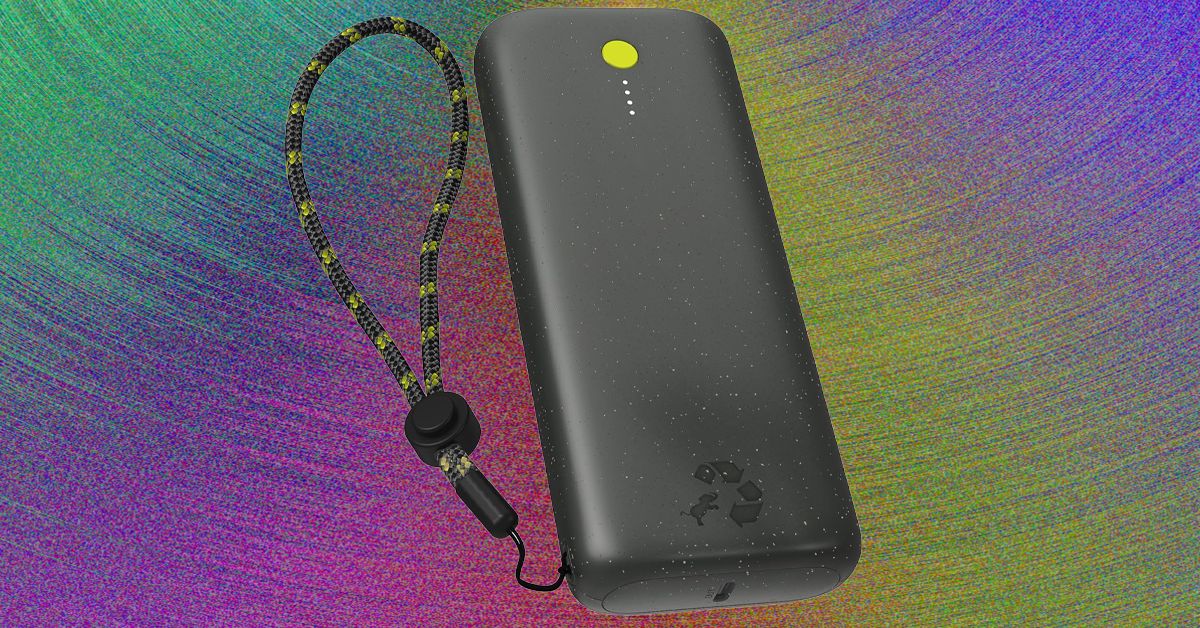
We do recommend the Anker Laptop Power Bank as our top-pick power bank, but if you’re only trying to top off your iPhone, this is a very reliable and neat-looking power bank. It’s svelte, smaller than a deck of cards, and can deliver 20 watts to two devices at once. Nimble also makes a slightly larger version, which has a larger capacity and can charge at up to 65 watts. Aside from the cool design featuring speckled colors and a lanyard loop, Nimble also uses bioplastics, recycled materials, and minimal packaging. A USB-C charger is included in the box.
Best MagSafe Portable Charger for iPhone
.jpg)
Anker
MagGo Power Bank (10K) (Qi2)
This 10,000-mAh power bank can charge your device at up to 15 watts, but it’ll also charge older devices at a slower rate. It has a built-in kickstand and an LED display that lets you know how much power is left at a glance. It works in portrait or landscape modes. Be aware that it won’t be able to charge most phones fully more than once, but it’s hard to beat if you’re seeking wireless charging on the go. If you want a bigger capacity or faster charging, you don’t want MagSafe.
Best 3-in-1 Charger for iPhone

Belkin
3-in-1 Qi2 Charging Stand
The Belkin 3-in-1 can charge your compatible iPhone at 15 watts, plus your AirPods and your Apple Watch at the same time. The charging pad can be tilted to your preferred angle, including in landscape orientation if you want to watch a video or put your phone in StandBy mode. The USB-C cable is permanently attached, which you may or may not like. Check our best 3-in-1 chargers buying guide for additional picks.
Best 2-in-1 Charger for iPhone

Photograph: Louryn Strampe
Mophie
2-in-1 Wireless Charging Stand
I love a 3-in-1 charger as much as the next tech nerd, but sometimes they’re overkill. My Apple Watch battery usually lasts all day long, but I can chew through my older AirPods battery before my lunch break hits, and my iPhone battery might be depleted too, depending on whether or not I’m streaming Max Velocity off to the side. This 2-in-1 charger has been my steadfast desktop companion. Mophie makes another version that tops off your Apple Watch and iPhone instead of your headphones, which might be what you want if you’re rocking wired headphones or you’re making intense use of a walking pad throughout the day. There’s a 40-watt wall charger in the box—a rarity these days!—plus a USB-C cable that winds neatly into the base. It’s easy to adjust the angle of your iPhone as well, and I’ve found the base very sturdy. If you want to charge, but not necessarily all of the possible devices simultaneously, these might be what you seek.

Anker
Prime USB-C to USB-C Cable
This braided nylon USB-C cable has a durable exterior made from recycled plastic. The cable is rugged, with Anker promising that it can operate in temperatures ranging from negative 40 degrees to 176 degrees Fahrenheit. It’s backed by a lifetime warranty. It’s got a built-in cable management loop. It’s more than enough cable for your iPhone. Read our guide to the Best USB-C Cables for more picks.

Ugreen
USB-C to Lightning Cable
If your iPhone is still rocking the Lightning cable, this is gonna be way better than whatever shoddy cable Apple sent you. It’s durable and is Made for iPhone-certified, so you won’t have any problems getting it to work. It comes in 3-, 6-, or 10-foot lengths with a two-year warranty. Best of all, the exterior casing will stay intact, unlike what you’d probably get with Apple’s cables.


Trump calls for Jimmy Kimmel to be fired over jokes made before White House Correspondents’ Dinner shooting

Intellia Therapeutics says its Crispr-based treatment succeeds in pivotal trial

PCB shares ticket pricing details for PSL 11 Qualifier in Karachi – SUCH TV

-

 Sports1 week ago
NCAA men’s gymnastics championship: All-time winners list
-

 Sports1 week ago
WWE WrestleMania 42 Night 2: Live match results and analysis
-

 Politics6 days ago
UK’s Starmer seeks to deflect blame over Mandelson appointment
-

 Fashion1 week ago
UK’s Sosandar returns to profitability amid robust FY26 performance
-
 Business1 week ago
No fuel shortage: Govt assures 100% domestic LPG, PNG, CNG supply amid Hormuz energy crunch – The Times of India
-

 Entertainment7 days ago
Lee Anderson, Zarah Sultana kicked out of UK Parliament for calling PM ‘liar’
-
 Business7 days ago
How Trump’s psychedelics executive order could unlock stalled cannabis reform
-

 Sports1 week ago
Quetta Gladiators opt to bowl after winning toss against Peshawar Zalmi in PSL 11 clash