

Business
When is the Budget and what might be in it?

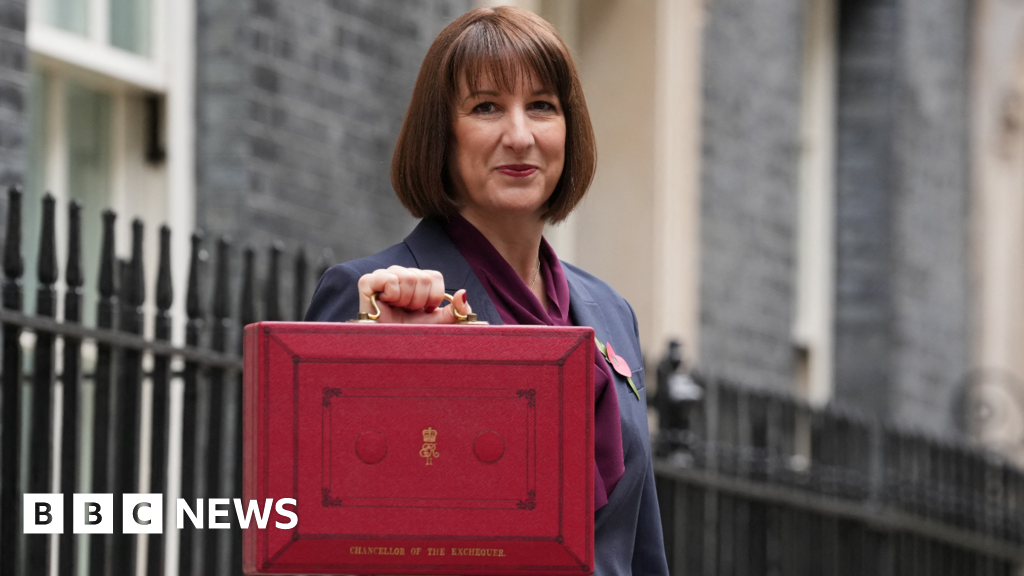
Chancellor Rachel Reeves has acknowledged she is considering tax rises and spending cuts ahead of her autumn Budget on 26 November.
Before the 2024 general election, Labour promised not to increase income tax, National Insurance or VAT for working people.
But the Institute for Fiscal Studies (IFS) says she will “almost certainly” have to raise taxes to make up a £22bn shortfall in the government’s finances.
The chancellor of the exchequer’s Budget statement outlines government plans for raising or cutting taxes. It also includes big decisions about spending on public services such as health, schools and police.
The statement is made to MPs in the House of Commons. It usually starts at about 12:30 UK time – after Prime Minister’s Questions – and lasts for about an hour.
The Leader of the Opposition, Conservative MP Kemi Badenoch, will give an immediate response. MPs will then debate the measures for four days, before voting on them.
There has been a lot of speculation that Reeves will have to raise taxes because she needs more money in order to meet her self-imposed rules for government finances.
She has two main rules, which she describes as “non-negotiable”:
- Not to borrow to fund day-to-day public spending by the end of this parliament
- To get government debt falling as a share of national income by the end of this parliament
The IFS said finding £22bn would allow the government to maintain the £10bn buffer it currently has, but argued there was a “strong case” for trying to increase it further.
The £10bn margin Reeves left herself after her Spring Statement in March was one of the lowest a chancellor has given themselves since 2010, with the average for the period standing at £30bn.
Income Tax and National Insurance (NI)
The government could extend the current freeze on income tax and NI thresholds, which is due to end in 2028.
Freezing the thresholds means that, as salaries rise over time, more people reach an income level at which they start paying tax or qualify for higher rates. This is often referred to as a “stealth tax”.
Speaking to the BBC in September, Reeves did not rule out extending the freeze.
The Resolution Foundation think tank – which has close links to some members of the government – believes some personal taxes will have to rise.
As part of a package of measures, it recommended cutting 2p from the employee NI rate, while adding the same amount to income tax.
Such a move would potentially affect pensioners, landlords and the self-employed more than workers. Their tax would increase but they wouldn’t benefit from a matched cut to NI.
Reeves has signalled that she is likely to focus on wealthy individuals, arguing “those with the broadest shoulders should pay their fair share”.
She may change the rules for limited liability partnerships (LLPs), which are sometimes used by high earning professionals such as lawyers and accountants.
Those who operate as LLPs are treated as self-employed and do not have to pay employers’ NI. The Times reported that changing this could raise £2bn.
Help with the cost of living
In October, Reeves told the BBC that she would take “targeted action to deal with cost of living challenges” while inflation remains high.
The BBC understands that the government could intervene to bring down gas and electricity bills. This could happen by reducing some regulatory levies currently added to bills, or by cutting the current 5% rate of VAT charged on energy.
The Sunday Times previously reported that it might fall to zero.
Property taxes
Reports suggest the government may reform property taxes. This could include replacing stamp duty – a tax buyers pay on properties above a certain value in England and Northern Ireland – with a property tax.
Landlords could have to pay more taxes, and council tax could be replaced.
Some people selling their main residence may have to pay capital gains tax.
Youth employment guarantee
In September, Reeves said that young people who have been out of work for 18 months will be given paid placements to help them secure full-time employment.
Isa reform
In July, the chancellor ruled out any immediate reform to cash Isas (Individual Savings Accounts). There had been speculation that she wanted to reduce the annual allowance to push people into investing in shares instead.
However, the FT has reported that she may announce a cut in the cash ISA limit from the current £20,000 to £10,000.
Pension changes
There has also been speculation about possible changes to pension rules, such as the level of tax relief available to savers and the size of the cash lump sum which can be withdrawn.
Cutting the higher rate tax relief on pension contributions would save the Treasury money, but may make pension savings less attractive.
Business taxes
The TUC, the umbrella group for trade unions in the UK, has called for higher taxes on online gaming companies and on banks’ profits.
In September, the chancellor told ITV News that “there is a case for gambling firms paying more”.
The Sunday Times reported that William Hill owner Evoke could close up to 200 of the chain’s betting shops in an attempt to stem losses, with the exact number being influenced by any changes to taxes on the sector.
Inheritance tax
In last year’s Budget, the government said that from April 2026, inherited agricultural assets worth more than £1m, which were previously exempt from inheritance tax, would be taxed at a rate of 20%.
In October, the Sunday Times reported that ministers were exploring changes to this, However, Farming Minister Dame Angela Eagle told the BBC’s Farming Today programme there was “no likelihood” of the policy being changed.
The Labour government says that boosting the economy is a key priority.
A growing economy usually means people spend more, extra jobs are created, more tax is paid and workers get better pay rises.
The UK economy has been slowing in recent months after a strong start to 2025.
The latest figures show that the economy grew by 0.1% in August, after a 0.1% contraction in July.
Over the three months to August, UK GDP grew by 0.3%, down from the 0.6% growth seen between March and May.
Meanwhile, government borrowing – the difference between public spending and tax income – reached £20.2bn in September. That was the highest level seen for the month in five years, driven by an increase in debt interest payments.
Prices are also still rising faster than expected.
Inflation held steady at 3.8% in the year to September, the same as in July and August, which was lower than expected, but still above the Bank of England’s 2% target.
In August, the Bank cut interest rates for the fifth time in a year, taking the cost of borrowing to the lowest level for more than two years.
It made the cut because of concerns that the jobs market was weakening, with data showing job vacancies were continuing to fall and wage growth was slowing.
However, the Bank held rates at its next meeting in September, arguing the UK was “not out of the woods” on inflation.
In October, the International Monetary Fund (IMF) forecast that the UK was set to be the second-fastest-growing major economy in 2025.
However, it also predicted that the UK will face the highest rate of inflation among G7 nations in both 2025 and 2026, driven by rising energy and utility bills.
Business
US stock markets today (May 6, 2026): Wall Street rallies to record highs, crude oil tumbles on Strait of Hormuz reopening hopes – The Times of India
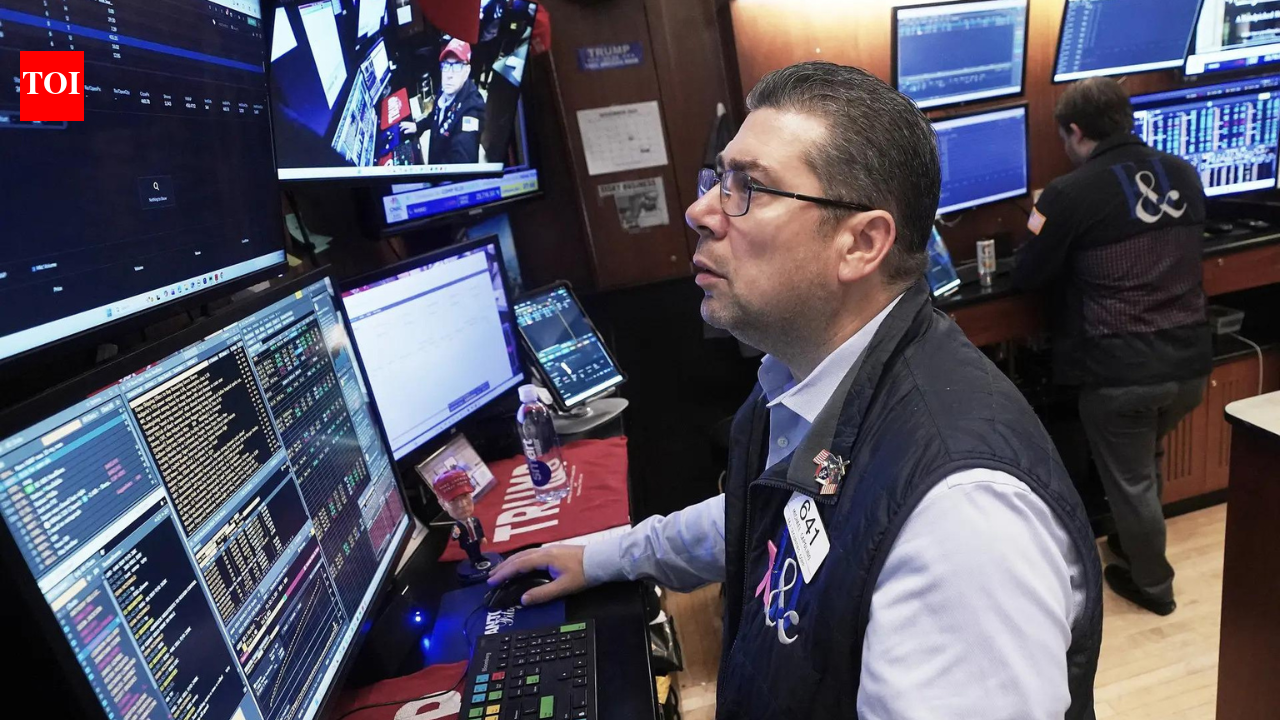
US stock markets surged on Wednesday while oil prices plunged sharply as investors bet on a possible breakthrough in US-Iran negotiations that could reopen the Strait of Hormuz and restore global crude supplies, AP reported.The S&P 500 climbed 0.8 per cent and headed towards another record close. The Dow Jones Industrial Average rose 487 points, or 1 per cent, while the Nasdaq Composite gained 0.8 per cent.Brent crude, the international oil benchmark, slumped 5.7 per cent to $103.61 per barrel after falling from levels above $115 earlier this week. At one point during the session, Brent briefly dropped below $97 before recovering some losses.The rally came after US President Donald Trump said the Strait of Hormuz could be “OPEN TO ALL” if Iran accepts a reported agreement, though he did not disclose details of the proposed deal.The Strait of Hormuz has remained at the centre of the global energy crisis since the Iran conflict disrupted oil tanker movement through the Persian Gulf, pushing crude prices sharply higher and stoking inflation fears worldwide.Markets also drew optimism from Trump’s indication that the US may scale back efforts to reopen the strait through military means, while China called for a comprehensive ceasefire after talks between Chinese and Iranian foreign ministers.Asian and European markets also rallied strongly. South Korea’s Kospi surged 6.5 per cent to cross the 7,000 mark for the first time, while Hong Kong’s Hang Seng rose 1.2 per cent. London’s FTSE 100 gained 2.2 per cent and France’s CAC 40 climbed 2.9 per cent.On Wall Street, technology and AI-linked stocks led gains after strong earnings reports.AMD jumped 19.3 per cent after reporting better-than-expected quarterly profit and revenue. CEO Lisa Su said continued growth in artificial intelligence demand had boosted the company’s performance.The chipmaker also projected revenue growth of around 46 per cent in the current quarter.Super Micro Computer rallied 14.2 per cent after posting earnings above analyst estimates.CVS Health gained 8.2 per cent after beating first-quarter expectations and raising its full-year forecasts.Stocks of companies with high fuel costs also rose sharply amid hopes of lower oil prices. United Airlines climbed 5.2 per cent, while Carnival and Royal Caribbean gained 5.5 per cent and 5.2 per cent, respectively.In the bond market, Treasury yields fell as easing oil prices reduced inflation concerns. The yield on the 10-year Treasury dropped to 4.35 per cent from 4.43 per cent a day earlier.Lower bond yields generally reduce borrowing costs for households and businesses and tend to support equity valuations.
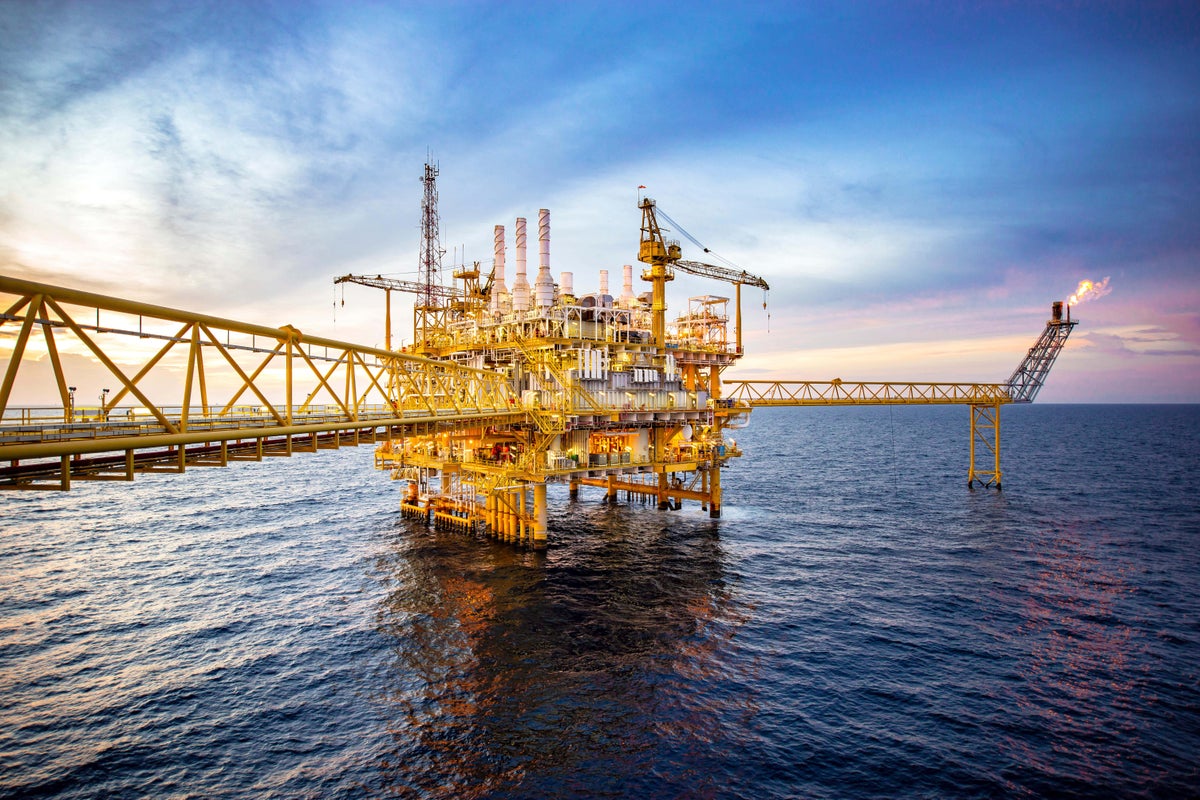
Oil prices have fallen sharply to below 100 US dollars a barrel on fresh hopes of an end to the Iran war and unblocking of the crucial Strait of Hormuz.
The cost of benchmark Brent crude dropped 11% to under 98 dollars a barrel in afternoon trading on Wednesday as US President Donald Trump said he was pausing efforts to guide stranded ships out of the strait to finalise a deal with Iran on ending the conflict.
But he confirmed a US blockade of Iranian ports would remain in place while talks were held to end the war.
Stock markets across the UK and Europe surged in response, with London’s FTSE 100 Index soaring 2.6% to 10485.9.
In France, the Cac 40 was 3.3% higher and Germany’s Dax was 2.8% higher.
Investor sentiment was boosted on reports that Iranian officials were travelling to China ahead of a summit between Mr Trump and Chinese leader Xi Jinping.
A ceasefire with Iran is already in place, but it has been increasingly fragile.
The US military is trying to reopen a path in the Strait of Hormuz, which would allow oil tankers to resume shipments from the Persian Gulf.
The blockage of the strait, through which a fifth of the world’s oil is carried, has sent oil and energy prices soaring worldwide.
Chris Beauchamp, chief market analyst at investing and trading platform IG, said: “There does seem to have been some real progress on key issues, and perhaps a pathway has been found that strikes a deal amenable to both sides.
“Such a result would allow markets to go back to focusing on earnings growth and a recovery in economic momentum, putting the worries of the last two months behind them.”
Long-term UK government borrowing costs also eased back, as gilts recovered from Tuesday’s sell-off thanks to optimism over inflation concerns should the Iran war come to an end.
The yield on 30-year UK government bonds, also known as gilts, fell back to 5.63%, having reached their highest level since 1998 on Tuesday, at 5.798%.
Ten-year gilt yields fell to 4.94%, having hit a six-week high of 5.102% on Tuesday.
Gilt yields move counter to the value of the bonds, meaning their prices fall when yields rise.
Business
Sebi sets Rs 20,000 crore threshold for ‘significant indices’; Sensex, Nifty among benchmarks covered – The Times of India
Markets regulator Sebi has introduced a new framework to classify stock market benchmarks as “significant indices” if mutual fund schemes tracking them have a daily average cumulative assets under management (AUM) of more than Rs 20,000 crore for each of the preceding six months, PTI reported.The move is aimed at strengthening transparency, governance and accountability in the index ecosystem.“It is specified that a Benchmark or Index (including index of indices) based on listed securities shall be considered as ‘significant Indices’, if the daily average cumulative AUM tracking the Benchmark or Index across schemes of Mutual Fund(s) exceeds Rs 20,000 crore for each of the past six months, ending on June 30 and December 31 each year,” Sebi said in a circular.The regulator said the threshold will be reviewed on a half-yearly basis, and once classified as significant, an index will continue in that category unless its tracked AUM falls below the threshold for three consecutive years.The framework follows the introduction of the Sebi (Index Providers) Regulations, 2024, which govern entities administering such indices.Sebi also released an initial list of indices that qualify under the new norms. These include major benchmarks such as the BSE Sensex, Nifty 50, Nifty 500 and BSE 500, along with several sectoral, debt and hybrid indices managed by NSE Indices Ltd, BSE Index Services Pvt Ltd and CRISIL.Under the new rules, index providers offering significant indices must apply for Sebi registration within six months.However, indices already notified or authorised as benchmarks by the Reserve Bank of India under relevant RBI provisions have been exempted from this requirement.Existing index providers can continue operations during the transition phase if they file registration applications within the stipulated timeline.Sebi also said entities already registered in another category with the regulator but engaged in index-related activities will have to create a separate legal entity within two years to undertake index provider operations.The regulator clarified that grievance redressal mechanisms under the new regulations will apply only to significant indices administered by Sebi-registered index providers.


‘Project Freedom’: Trump pauses Hormuz escort mission at Pakistan, others’ request

India approves $595 mn cotton mission as supply tightens
US stock markets today (May 6, 2026): Wall Street rallies to record highs, crude oil tumbles on Strait of Hormuz reopening hopes – The Times of India

A Brain Implant for Depression Is About to Be Tested in Humans

Pro wrestling star Steph De Lander reveals how colleague’s advice helped lead her to title triumph at ACW

‘I had £20,000 stolen and had to fight a 13-month fraud reporting rule to get it back’

-
 Tech1 week ago
A Brain Implant for Depression Is About to Be Tested in Humans
-
 Sports1 week ago
Pro wrestling star Steph De Lander reveals how colleague’s advice helped lead her to title triumph at ACW
-
Business1 week ago
‘I had £20,000 stolen and had to fight a 13-month fraud reporting rule to get it back’
-

 Entertainment1 week ago
Norway joins Type 26 Frigate Programme to boost NATO naval power
-

 Entertainment1 week ago
Melania Trump says ABC should ‘take a stand’ on late-night host Kimmel
-
 Business7 days ago
PSX plunges over 4,800 points | The Express Tribune
-

 Tech1 week ago
This Ambitious Laptop Doesn’t Leave Much Room for Your Hands
-

 Tech6 days ago
Almost half of UK businesses hit by cyber attacks | Computer Weekly