Business
‘Why Are Americans Paying For AI In India?’: Trump’s Trade Advisor Raises Data Centre Energy Costs
Last Updated:
Peter Navarro questions US electricity powering AI services like ChatGPT for users in India, raising trade and energy concerns amid rising US electricity costs.
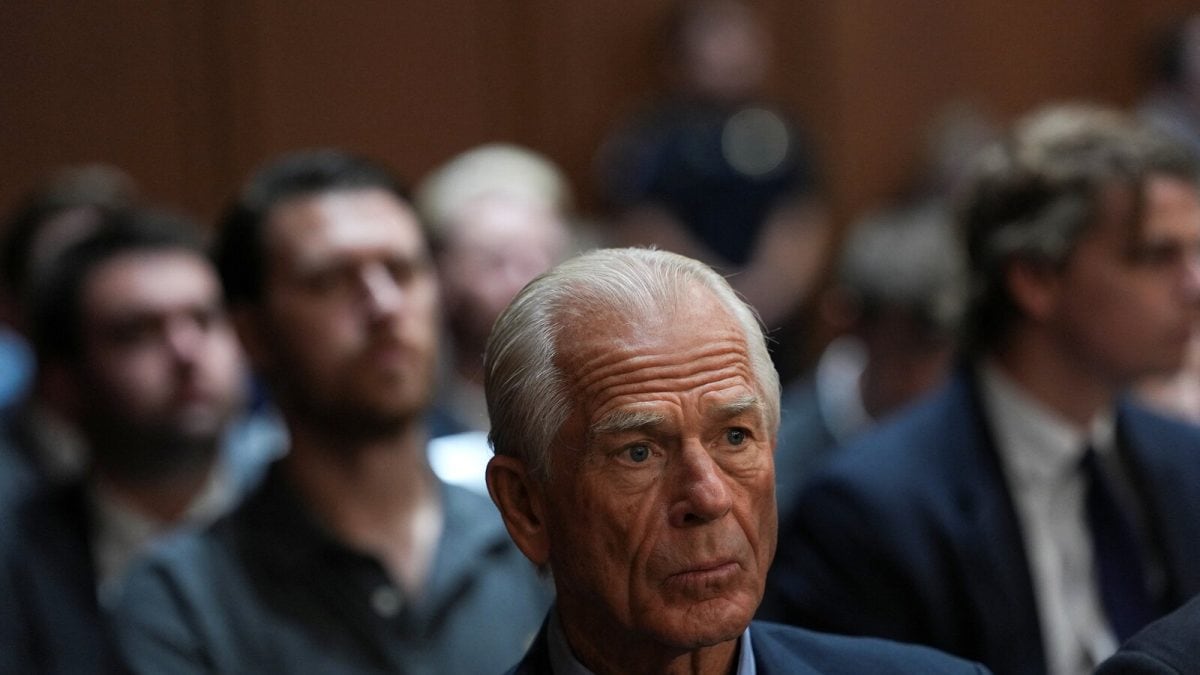
Peter Navarro questions US electricity powering AI services like ChatGPT for users in India, raising trade and energy concerns amid rising US electricity costs. (REUTERS/Kent Nishimura
US President Donald Trump’s trade adviser, Peter Navarro, has ignited a fresh political and economic debate by questioning why American electricity and infrastructure are being used to power artificial intelligence services that cater to users overseas, particularly in India.
Speaking on the podcast Real America Voice with former White House chief strategist Steve Bannon, Navarro raised concerns about US-based AI platforms operating domestically while serving millions of users abroad. He singled out OpenAI’s popular chatbot ChatGPT, arguing that its growing global footprint has trade and energy implications for the United States.
“Why are Americans paying for AI in India?” Navarro asked during the discussion. “ChatGPT operates on US soil and uses American electricity, servicing large users of ChatGPT in India and China and elsewhere around the world.” According to him, this raises fundamental questions about whether US taxpayers and consumers should bear the cost of powering AI systems that primarily benefit foreign markets.
Focus on electricity costs and data centres
Navarro’s remarks come amid mounting concern in Washington over the rapid expansion of AI data centres, which require vast amounts of electricity to run powerful servers around the clock. He suggested that the boom in AI infrastructure is already contributing to higher power prices for American households.
“We’re looking very, very carefully at this whole problem of AI data centres driving up the cost of electricity for Americans,” Navarro said. “You can expect strong action from President Trump on this. So keep an eye on that.”
Trade tensions with India in the backdrop
Navarro’s statements come at a sensitive moment in US–India relations. Washington and New Delhi are engaged in trade talks following a downturn after the Trump administration imposed a steep 50% tariff on Indian imports. This included a 25% additional duty linked to India’s continued purchase of Russian oil, a move the US has criticised amid the war in Ukraine.
Navarro has been one of the most vocal critics of India’s energy policy. In earlier remarks, he accused New Delhi of indirectly financing Russia’s war effort in Ukraine by buying discounted Russian crude and reselling refined products at higher prices on the global market.
“When India buys Russian oil at a discount and then Indian refiners, in partnership with Russian refiners, sell it at a premium to the rest of the world, Russia uses that money to fund its war machine,” Navarro had said.
US government moves on AI and energy
Against this backdrop, the Trump administration on Friday announced plans to work with US states to ensure that the rapid growth of the AI sector does not result in higher electricity bills for millions of Americans. According to data from the Energy Information Administration, the average electricity bill in the US rose by 5% in October compared with the same period last year, heightening political sensitivity around energy costs.
AI companies have increasingly come under scrutiny for the environmental and economic impact of large-scale data centres, which consume enormous amounts of power and water.
Washington D.C., United States of America (USA)
January 18, 2026, 20:04 IST
Read More
Business
Disney launches its Adventure cruise ship — a new foothold in Southeast Asia
Disney’s cruise line is going big in Asia.
This month, the company’s eighth and largest ship, the Disney Adventure, will embark on its maiden voyage, carrying passengers on three- and four-night journeys at sea from its berth in Singapore.
The vessel accommodates a whopping 6,700 passengers, around two-thirds more capacity than Disney’s Wish class ships, which are the Disney Wish, the Disney Treasure and the Disney Destiny. The Adventure can also carry around 2,500 crew members, about 1,000 more than on the Wish class ships.
“It takes a village to be able to support the type of service that we’re known for,” Joe Schott, president of Disney Signature Experiences, told CNBC.
The Disney Adventure sets sail at a time of rapid expansion for Disney’s cruise line. It is one of six vessels set to join the fleet by 2031. It’s also emblematic of the company’s global aspirations, which coincides with a sharp decline in international visitors venturing to the United States.
Mickey and Minnie Mouse pose in front of the Disney Adventure.
Disney
While tourism grew worldwide last year, the United States was the only major destination to see a drop in foreign visitors, according to the World Travel & Tourism Council. Overall, international travel to the U.S. fell 6%, the organization found. That decline continued into 2026, as January’s numbers were down 4.8% compared with the same month a year prior.
Travel bans, visa fees and invasive searches at ports of entry are all contributing to international travelers leaving the United States off their travel itineraries, according to the WTTC. Trade frictions, geopolitical unease and safety concerns have also contributed to the drop in demand for travel stateside, travel experts told CNBC.
Still, Disney’s domestic theme parks drive around two-thirds of revenue in its experiences division, which includes parks, cruises, resorts and consumer products. International destinations account for around one-fifth of revenue.
Expanding its fleet to new ports allows Disney to entice guests that may not have otherwise been able to venture to its theme parks or get on board one of its cruise ships. And Asia is a rapidly growing market.
A whole new market
Disney is no stranger to the Asian market. It already has a strong footprint of theme parks and resorts in Tokyo, Hong Kong and Shanghai.
“We have a really strong presence already up in the the northern part of Asia,” Schott said. “But, I think as you think about the southeast part of Asia, we don’t really have a physical presence. So, this is a great way to really be able to connect a whole lot of people that haven’t had the opportunity to do a physical Disney experience before.”
The cruise industry, in particular, in Asia has been in a state of rapid growth in the wake of the pandemic. In 2024, the region accounted for 2.6 million cruise passengers, a 13% increase from the previous year, according to data from the Cruise Lines International Association.
“Prior to 2024 we were really seeing a rise in the disposable income and the income levels of Southeast Asian travelers,” said Dulani Porter, executive vice president and partner at Spark, a creative agency that works with hospitality and tourism brands. “And so it was a very, very important market for any international tourism organization.”
That’s where the Disney Adventure comes in.
Initially destined to be a floating casino, the ship went up for sale part way through its construction when its parent company, Genting Hong Kong, went bankrupt in 2022. Disney swooped in and bought it.
“I think this was a great opportunity, because if we hadn’t acquired the ship the way we did, we wouldn’t be going into this market as soon as we are,” said Bruce Vaughn, president and chief creative officer of Walt Disney Imagineering. “And that’s a great thing.”
Previously, all of Disney’s cruise ships have left from domestic ports in Florida before traveling to international destinations. In the case of the Adventure, the ship is the destination. Stationed in Singapore, the vessel will voyage entirely at sea, with no port calls.
And Disney says demand is already there. Disney’s cruises are already 80% booked for fiscal 2026, Schott said.
A ‘brand ambassador’
The Disney Adventure’s size isn’t the only thing that sets it apart from the rest of the fleet. The ship has been tailored for consumers in Asia.
“Since the ship is going to be dedicated to Singapore and that market, we also wanted to make sure that we address what we thought would be unique to them,” said Vaughn.
This came in the form of selecting franchises and characters that are popular in the region, designing entertainment and relaxation areas catered to local tastes and providing a diverse selection of menus across its restaurants.
“We’re looking forward to servicing a brand-new audience,” Schott said. “In that respect, the ship is a brand ambassador.”
Guests on board the Adventure will be immersed in Disney’s more than 100 years of storytelling with character meet-and-greets as well as themed shopping and entertainment areas.
Situated in the middle of the ship is a deck designed to look like a street from San Fransokyo, the fictional city in “Big Hero 6.” The area is home to arcade games inspired by the movie, a replica of the Lucky Cat Cafe owned and operated by Aunt Cass as well as four movie theaters and dedicated tween and teen spaces.
A view of San Fransokyo street aboard the Disney Adventure.
Disney
The street also features the first-ever Duffy and Friends store at sea and a National Geographic shop. Disney executives told CNBC that these brands are incredibly popular with consumers in the region.
Duffy the Disney Bear is a character that was developed initially for a merchandise line at Walt Disney World’s Disney Springs, but gained attention when it was brought to Tokyo a few years later. In the last two decades, Duffy has been joined by seven other stuffed animal friends and has become one of the bestselling merchandise lines for the company.
In 2023, Disney reported the character generated $500 million in sales annually.
Disney characters in traditional Han costumes perform on the stage during a special edition of “Enjoying the Moon with Duffy and Friends” event celebrating the Mid-Autumn Festival at the Shanghai Disney Resort on September 17, 2024 in Shanghai, China.
Vcg | Visual China Group | Getty Images
In designing the Disney Adventure, the company was also conscious of local traditions. For many in Asia, vacations aren’t just for a nuclear family, but for extended family and even large groups of friends.
“I think one of the biggest distinctions that I’m seeing with South Asian cultures [is] travel really is about spending more time together,” Porter said. “Not to generalize, but North American cruisers will choose cruising because the kids can go do their thing and the parents can go do their thing, all contained into a ship.
“For Asian travelers, that is a very meaningful time spent together, where the grandparents and the kids and the parents and the grandparents, everybody is really trying to maximize all of that time together,” she said.
Both Vaughn and Schott detailed layers of experiences available to cruise guests that cater to different age ranges, both kids and kids at heart.
There’s Marvel Landing on the upper deck of the ship that features a rollercoaster, a spinning attraction and car-chase ride all inspired by The Avengers. In the same area is a sundeck, infinity pool and a bar.
Wayfinder Bay is an open-air area with amphitheater-like seating that doubles as a performance venue. And there’s D Lounge, which features a number of private karaoke rooms.
“We’ve had to think about that quite extensively in our parks in the region … multigenerational travel is just part of the formula,” said Schott.
Also part of the formula is Disney’s dining experience.
Aboard the Disney Adventure, guests will have an eclectic selection of food and beverages to try, with an emphasis on flavors that are popular in the region.
The Disney Adventure will have burgers and classic American fare at Stitch’s Ohana Grill, bubble teas at the Ursula-inspired Bewitching Boba and Brews, as well as pitas and kebabs at the Ms. Marvel-inspired Cosmic Kebabs.
There will also be Indian cuisine at Mowgli’s Eatery and Polynesian-inspired fare at Gramma Tala’s Kitchen.
Rotational dining is also featured on the cruise ship, a staple of Disney’s service.
While passengers have the option to grab quick-service meals and snacks throughout the ship, several of its restaurants are included in a prescheduled dining plan. Guests have reservations for each of these themed restaurants and rotate through them during their cruise.
Disney rotates the restaurant staff, too, to follow each group of passengers to their scheduled restaurant. As a result, guests have the same servers, busboys and restaurant managers throughout their trip, and the waitstaff gets to know the guests — and their preferences.
“I think at the end of the day, this entry into the market needs to be a really strong one for us,” Schott said. “So we’re looking forward to really being able to deliver the Disney-level of service at an extraordinary level.”
Business
Stock markets rebound and energy prices ease but fears remain over Iran war
European and US stock markets have recovered and oil and gas prices eased, sending some relief to investors after a bruising start to the week despite war in the Middle East stoking fears about the longer-term hit to the economy.
In the UK, the FTSE 100 gained about 80 points to close 0.8% higher at 10,567.65, having slumped nearly 3% on Tuesday amid worries of a prolonged conflict.
Stocks were also rebounding across Europe, with Germany’s Dax up 1.8% at the end of the day, and France’s Cac rising 0.8%.
Over on Wall Street, trading got off to a positive start, with the S&P 500 up 0.85% and Dow Jones 0.65% higher by the time European markets closed.
Global financial markets are largely being led by the movement of wholesale energy prices, which were spiking on Monday and Tuesday as concerns grew about disruption to supply in affected parts of the Middle East.
But there was some steadying to prices on Wednesday, with Brent crude oil down about 0.5% to 80.9 dollars a barrel, and a European benchmark for natural gas slipping by about 9%.
Despite easing back slightly, the prices of both commodities remains substantially higher than last week.
Analysts at Cornwall Insights warned on Wednesday that household energy bills are forecast to rise by 10% from July following the sharp increases in wholesale gas prices.
However, it said the final price cap figure would be based on average wholesale prices over a three-month period, meaning that it would depend on how long gas prices stayed elevated and how long the period of volatility continued.
The share prices of London-listed energy giants BP and Shell were down about 2% on the back of easing prices.
Russ Mould, investment director for AJ Bell, said: “The FTSE 100 and other European markets took their cue from US gains to trade firmly higher, with some of the names caught up in the heavy selling at the start of the week bouncing back from their lows.
“This presents a salutary reminder to investors caught up in the recent volatility that ups and downs are a natural feature of financial markets.
“But the waters remain choppy. Wall Street has been oscillating between healthy gains and more modest moves higher, which hints at continuing nervousness about the outlook amid what remains a fast-moving set of events in the Middle East.”
Business
Rupee falls to all-time low of 92.05 against dollar as oil surge, foreign outflows rattle markets – The Times of India
The Indian rupee weakened sharply on Wednesday, slipping to a record closing low of 92.05 against the US dollar as soaring crude oil prices and global risk aversion linked to the Iran crisis weighed heavily on the domestic currency.The rupee depreciated by 56 paise during the session, pressured by rising energy costs, foreign fund outflows and broad-based weakness in domestic equities, PTI reported.At the interbank foreign exchange market, the rupee opened at 92.05 and slid further to an intraday record low of 92.35 against the greenback. It eventually ended the session at 92.05, marking its lowest-ever closing level.The domestic forex market remained shut on Tuesday due to the Holi holiday. On Monday, the rupee had already fallen 41 paise to settle at 91.49 against the US dollar.Forex traders said the global risk-off mood triggered by the US-Iran conflict strengthened the dollar and intensified pressure on emerging market currencies, including the rupee.Foreign investors sold equities worth Rs 8,752.65 crore on a net basis on Wednesday, according to exchange data, further weighing on the currency.“A sharp escalation in Middle East conflict and the consequent spike in oil prices have reduced investor risk appetite. Higher oil prices increase inflation concerns and fiscal pressure on India (a major oil importer), leading to selling in bonds and rising yields,” said Anil Kumar Bhansali, Head of Treasury and Executive Director, Finrex Treasury Advisors LLP.Meanwhile, the dollar index, which measures the greenback against a basket of six currencies, was trading 0.23 per cent lower at 98.82.“The dollar index crossed 98 levels comfortably on the risk-off situation prevailing all around the globe with stocks and bond markets getting hit badly, along with Gold and Silver, with predominance of the dollar,” Bhansali said.Brent crude, the global oil benchmark, was trading 1.29 per cent higher at USD 82.46 per barrel in futures trade, as supply concerns intensified after US attacks on Iran and Tehran’s retaliatory actions raised fears over energy flows through the Strait of Hormuz.Dilip Parmar, Research Analyst at HDFC Securities, said, “The Indian rupee recorded its steepest two-session decline since May 2025, as soaring energy prices intensified fears of persistent inflation and a widening trade deficit.This prevailing risk-off sentiment, coupled with high energy costs, is expected to keep the currency under pressure in the near term. Investors are closely monitoring the longevity of the Middle East conflict, as a prolonged standoff would likely drive up the import cost of energy and precious metals while hindering export growth.”According to Parmar, the spot USDINR pair faces immediate resistance at 92.60, while key support is seen at 91.80.On the domestic equity market front, the BSE Sensex dropped 1,122.66 points to close at 79,116.19, while the NSE Nifty declined 385.20 points to settle at 24,480.50.
-
Business6 days agoIndia Us Trade Deal: Fresh look at India-US trade deal? May be ‘rebalanced’ if circumstances change, says Piyush Goyal – The Times of India
-
Business1 week agoHouseholds set for lower energy bills amid price cap shake-up
-
Politics6 days agoWhat are Iran’s ballistic missile capabilities?

-
Politics7 days agoUS arrests ex-Air Force pilot for ‘training’ Chinese military
-
Sports1 week agoTop 50 USMNT players of 2026, ranked by club form: USMNT Player Performance Index returns
-
Business6 days agoAttock Cement’s acquisition approved | The Express Tribune
-
Fashion6 days agoPolicy easing drives Argentina’s garment import surge in 2025
-
Sports7 days agoSri Lanka’s Shanaka says constant criticism has affected players’ mental health