

Business
Why Warner Bros. Discovery shareholders might opt for Paramount’s offer — and why they might not


Ted Sarandos, CEO of Netflix and David Zaslav, CEO of Warner Bros. Discovery.
Mario Anzuoni | Mike Blake | Reuters
Hours before Warner Bros. Discovery agreed to sell its studio and streaming assets to Netflix, Ted Sarandos, the co-CEO of Netflix, called WBD CEO David Zaslav to inform him Netflix wouldn’t be bidding any higher.
WBD shareholders now have a chance to call Sarandos’ bluff.
WBD shareholders have until Jan. 8 to tender their shares to Paramount for $30 in cash, though that deadline may be artificial. Paramount can extend it all the way to WBD’s annual meeting, which hasn’t been set yet but this year took place June 2.
If Paramount acquires 51% of outstanding WBD shares, it would control the company, even though the WBD board already agreed to sell the company’s studio and streaming assets to Netflix. Both Netflix and Paramount can use the coming days and weeks to speak with WBD shareholders to gauge whether they’d like to take Paramount’s offer or stick with the board’s recommendation to sell to Netflix.
To tender or not to tender, that is the question. There are sound arguments for both sides. The decision also presents a game theory element for shareholders who may simply want a bidding war rather than caring about the right buyer.
To tender
There are two overarching reasons why a shareholder might tender their holdings to Paramount.
The first is if the investor believes Paramount’s $30-per-share, all-cash offer for the entirety of WBD is more valuable than Netflix’s $27.75-per-share bid for just the Warner Bros. film studio and HBO Max streaming business. The second is a belief that tendering shares is the best way to force a bidding war between Netflix and Paramount.
A shareholder could decide Paramount’s current offer is better than Netflix’s if they think it has a higher likelihood of regulatory approval or if they believe Discovery Global — the portfolio of linear cable networks including CNN, TNT, Discovery, HGTV and TBS that’s set to be spun out — will have minimal value as a publicly traded company.
Paramount Skydance CEO David Ellison told CNBC earlier this month he values Discovery Global at $1 per share, given his prediction on the likely multiple (2 times earnings before interest, taxes, depreciation and amortization) at which it will trade based on current valuations for similar linear cable networks. If WBD doesn’t agree to sell the entire company to Paramount, it plans to split Discovery Global out as its own publicly traded entity in mid-2026.
Paramount’s argument is that $30 per share is already greater than Netflix’s $27.75-per-share offer plus $1 for Discovery Global.
David Ellison, CEO of Paramount Skydance, exits following an interview at the New York Stock Exchange (NYSE) in New York City, U.S., December 8, 2025.
Brendan Mcdermid | Reuters
Paramount’s bid is also all cash, while Netflix’s bid includes 16% equity with a so-called “collar,” which means shareholders won’t know exactly how much Netflix stock they’ll actually receive until the deal closes.
As for regulatory approval, Paramount has played up arguments that a combined Netflix and HBO Max streaming business would be anticompetitive. Netflix has more than 300 million global paying customers. The idea of the largest streamer buying HBO Max has already raised concerns with politicians, including President Donald Trump, who said there may be a “market share” issue with a Netflix deal.
While Paramount would combine Paramount+ with HBO Max, Paramount+ has about 80 million subscribers, presenting less of a risk to competition.
The second, more nuanced argument to tender is to maximize upside even if the assets ultimately go to Netflix.
Ellison has already made it known Paramount’s $30-per-share offer isn’t best and final. Tendering could cause Netflix to come back with a higher offer, which may then prompt Paramount to raise its bid as well.
GAMCO Investors chairman and CEO Mario Gabelli told CNBC earlier this month “the notion of Company A and Company B having a bidding war — that’s what we like as part of the free market system.”
He added last week that while he was previously leaning toward tendering his shares to Paramount, “the most important part is to keep it in play.”
Not to tender
Other shareholders may believe, in contrast, that not tendering is the best way of jumpstarting a bidding war. If Paramount sees that it’s not getting traction with shareholders as the annual meeting gets closer, it may raise its bid to get more shareholders on board.
There are additional reasons not to tender. Shareholders may want the Netflix and Discovery Global equity portion of the Netflix proposal.
In a WBD filing last week, the company said a mystery “Company C” proposed to acquire Discovery Global and its 20% stake in WBD’s streaming and studios business for $25 billion in cash. That bid was rejected by the WBD board as “not actionable.”
Still, the mystery bid suggests there may be an interested buyer in all of Discovery Global if it gets spun out, which could result in far more than $1 per share, according to Rich Greenfield, an analyst at LightShed Partners. That’s a good reason not to tender, he said, because it makes the Netflix offer much more valuable than Paramount’s bid.
Ensuring WBD splits Discovery Global is also the safe play for shareholders in case regulators block a Paramount-WBD merger, Greenfield said. Since the Paramount deal is for all of WBD, including CNN, Ellison’s bid — which includes roughly $24 billion from Middle Eastern sovereign funds — may run into regulatory and political hurdles, Greenfield noted.
“You want the split to happen,” Greenfield said in an interview. “If the Paramount deal doesn’t get regulatory approval, now you’ve prevented the split from happening. You’re stuck in 2027 with declining cable networks, and you haven’t spun them off. Does the U.S. really want a company funded by more Middle Eastern money than money from the Ellisons owning CNN?”
‘Where’s Poppa?’
WBD’s board has argued part its reasoning for rejecting Paramount’s $30-per-share bid was its concern with financing, noting more funding comes from Middle Eastern sovereign wealth funds than the Ellison family, which has committed about $12 billion.
Paramount altered the terms of its deal Monday to help address funding concerns. Oracle founder Larry Ellison, the father of David and one of the world’s five wealthiest people, agreed to provide “an irrevocable personal guarantee of $40.4 billion of the equity financing for the offer and any damages claims against Paramount,” should the existing financing fall through, Paramount said in a statement.
Paramount also said Monday it will publish records confirming the Ellison family trust “owns approximately 1.16 billion shares of Oracle common stock and that all material liabilities of the Ellison family trust are publicly disclosed.” Paramount has said the family trust will backstop the financing. WBD’s board had previously argued the trust is an “opaque entity,” preferring a direct commitment from the Ellisons.
Notably, even with the Monday announcement, the Ellisons haven’t increased their personal equity investment, which still stands at $12 billion. Internally, some WBD executives have cited the 1970 Carl Reiner movie “Where’s Poppa?” when speaking about the bid, according to a person familiar with the matter. WBD has pushed for the Ellisons to commit more personal money to the deal.
Still, a WBD shareholder may not care where the funding is coming from as long as it’s there. The three SWFs involved in the deal are the Saudi Arabian Public Investment Fund (PIF), Abu Dhabi’s L’imad Holding Company and the Qatar Investment Authority (QIA). The PIF and QIA, in particular, are known institutions that have contributed billions of dollars to other U.S.-based deals.



Motorists are facing higher fuel prices ahead of Easter break due to the conflict in the Middle East, the RAC says.
Source link

Hyderabad: Pharma player Hetero on Friday said it has rolled out exports of its generic semaglutide injection portfolio as part of a multi-year plan to widen access to treatments for type 2 diabetes and obesity in more than 75 countries.The Hyderabad-based pharmaceutical company said initial rollouts are under way in Africa, Asia and the Middle East, with additional launches planned in other markets subject to regulatory approvals.The injectable therapies will be sold under the brand names Truglyx, Rolmodl and Moto G. Semaglutide belongs to the GLP-1 class of medicines, which are used in diabetes care and weight management.Hetero said the export launch is part of its broader strategy to improve access to advanced cardio-metabolic therapies, particularly in emerging markets.The company said the products will be offered in multi-dose disposable pen devices designed in line with innovator formats and will be available in several strengths, including 0.25 mg, 0.5 mg, 1 mg, 2 mg, 1.7 mg and 2.4 mg, allowing dosing flexibility for both diabetes and obesity treatment.Hetero said it is also awaiting approval from India’s Central Drugs Standard Control Organisation (CDSCO) after completing clinical trials in type 2 diabetes and obesity and plans an India launch after regulatory clearance.Hetero managing director Dr Vamsi Krishna Bandi said the company aims to provide high-quality, affordable generic semaglutide through a single global product platform backed by its manufacturing and development capabilities.He said Hetero would use its commercial networks across Asia, the Middle East, Africa and Latin America to support supply and access. The Hyderabad-headquartered Hetero operates in more than 145 countries and employs over 30,000 people.
Business
India-US trade deal update: Piyush Goyal meets USTR Jamieson Greer, discusses next steps in BTA talks – The Times of India
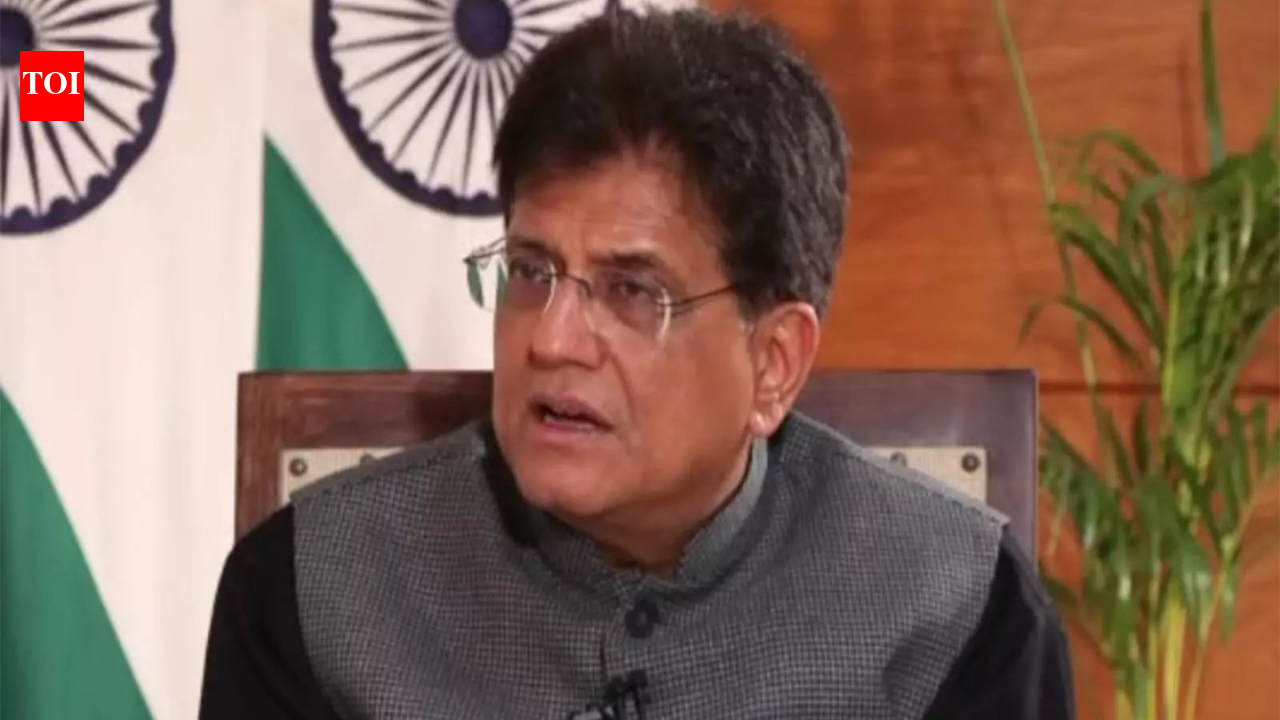
Commerce and industry minister Piyush Goyal on Friday met US Trade Representative Jamieson Greer and reviewed the next steps in negotiations for the proposed India-US bilateral trade agreement (BTA).The meeting took place on the sidelines of the 14th ministerial conference (MC14) of the World Trade Organisation in Yaounde, Cameroon, where both sides also exchanged views on issues related to the WTO agenda.“Had a very productive discussion with @USTradeRep Jamieson Greer on the sidelines of the WTO Ministerial Conference. Exchanged views on the #WTOMC14 agenda, next steps in the India-US BTA negotiations and explored ways to further deepen our economic cooperation and bilateral trade ties,” Goyal said in a social media post.The development comes amid ongoing efforts by both countries to finalise an interim trade pact. Last month, India and the US announced that they had finalised a framework for the first phase of the agreement, though it is yet to be signed.The two sides had earlier announced a trade deal on February 2, followed by a joint statement on February 7 outlining the contours of the agreement.As part of the framework, the US had agreed to reduce tariffs on Indian goods to 18%. However, the tariff structure has since undergone changes after the US Supreme Court struck down sweeping tariffs imposed under earlier measures.Following the ruling, US President Donald Trump introduced a 10% tariff on all countries for a period of 150 days starting February 24.In view of these developments, a planned meeting between chief negotiators of India and the US — aimed at finalising the legal text of the agreement — has been postponed. The pact was earlier expected to be signed this month.An official had earlier said that the interim trade agreement would be signed once the new global tariff framework of the US is fully in place.

Asda boss rejects profiteering claims as petrol price tops 150p

Britney Spears turns a new page after recent legal trauma

This Premium Sennheiser Soundbar Is $1,000 Off

-

 Entertainment1 week ago
Val Kilmer revived 1 year after death through AI
-

 Fashion7 days ago
China’s textile & apparel exports surge 17% to $50 bn in Jan-Feb 2026
-
 Business1 week ago
Video: The Effects of High Oil Prices
-
 Business7 days ago
Flipkart group CFO to leave co amid IPO plans – The Times of India
-

 Sports7 days ago
Rating Adidas’ 2026 World Cup away shirts: Argentina, Spain, Mexico and more
-

 Sports7 days ago
American Conference Commissioner Tim Pernetti thanks Trump for Army-Navy game executive order
-
Tech1 week ago
The Corsair 4000D RS PC Case Keeps Your System Cool
-

 Fashion1 week ago
The hidden $1.62 war tax now embedded in every garment you source