

Sports
World Cup kit ranking: Which teams will look best in 2026?

While it goes without saying that lifting the FIFA World Cup trophy aloft remains the ultimate prize in soccer, there is a far more important contest taking place among the qualifying nations as we continue to hurtle toward the tournament opener on June 11.
Naturally, we are referring to the battle to reign supreme in the style stakes at this summer’s tournament in Canada, Mexico and the United States, which is already raging across the continents before a ball has even been kicked.
Now that the playoffs are settled and all 48 of the World Cup qualifiers are formally confirmed, it’s time to thoroughly examine the home and away kits they intend to parade on football’s grandest stage.
– One thing to know about each of the 48 World Cup teams
– Ranked: All 48 national teams that can win the World Cup this summer
– Meet the World Cup debutants: Cape Verde, Curaçao, Jordan, Uzbekistan
It’s fair to say that the away kits are ruling the roost this time as designers let their creativity flow without the need to adhere to strict, traditional home colors and templates. We’ve got jerseys inspired by folk art, iconic buildings, local culture, flags, textiles, animals and even surrealist painters.
Heavy hitters Nike, Adidas and Puma boast the vast majority of kits on show, but there are a few choice entries from other, bijou sports brands who are about to have the fruits of their labors scrutinized by a watching global audience of millions.
With a couple of months still left to go until that opening game in Mexico City, several participating nations are yet to finalize their World Cup wares: Bosnia and Herzegovina, Iraq, Iran, Jordan, Panama, Tunisia and Uzbekistan are all still to unveil their tournament home and away kits, while Curaçao are yet to cook up a home kit for their first-ever World Cup appearance.
So we are still waiting for the full lineup of 96 home and away jerseys for all 48 competing nations. However, most of the kits have now been officially released and, with that, it’s time to rank them all!
81. Qatar away (Adidas)
Alas, even the fabled Adidas trefoil cannot do much to elevate what is essentially a plain white training shirt with bog-standard maroon trim. The Arabic name for Qatar (قطر) is printed on the back of the neck, but that — quite literally — is it.
The Swiss have impressed in recent years by releasing interesting conceptual kits inspired by Alpine railway stations and even the country’s high-tech digital passports. However, they will be arriving at the 2026 World Cup with an alternate jersey that is as green as it is nausea-inducing — i.e., very.
79. Canada away (Nike)
Scrappy stuff from the co-hosts, whose off-putting splattered shirt looks like it’s been worn while re-grouting the bathroom. Just straight-up awful.
Not to be confused with the All Blacks, their famous rugby union team, New Zealand’s monochrome home kit has a soft Māori fern motif in the material to help cement that important cultural link to the islands.
77. Ecuador home (Marathon)
The shirt is plain, but we do like the inspirational motto stamped under the collar: Soñar, Trascender y Hacer Historia (“Dream, Transcend and Make History”). Hopefully it spurs the Tri on to equaling or even beating their best World Cup performance, which came in 2006 when they made it through to the round of 16.
76. Qatar home (Adidas)
A perfunctory maroon design that is saved from being an entirely generic template kit by the zigzag strip running down the center of the shirt, inspired by the Qatari flag.
75. Cape Verde away (Capelli Sport)
The triangular print graphic that wraps around both Cape Verde’s new home and away shirt is inspired by the interconnecting flight paths that run between all of the African nation’s 10 islands. However, beyond that neat little detail, it’s all a bit generic.
It’s white, with a clunky red bar across the chest and a large Turkish flag stamped directly in the center of it all. We’re not saying that zero imagination went into the design process, but it certainly wasn’t much more than that.
73. Switzerland home (Puma)
Switzerland have failed to capture our imagination with a home kit release since roughly the dawn of time, and the latest edition is not about to change that. It’s a vast improvement on the away kit, but it is guilty of an equally grievous sartorial sin: being desperately, desperately boring.
72. Cape Verde home (Capelli Sport)
Much like the white away shirt, Cape Verde’s home shirt is covered in an all-over print inspired by the flight routes between the airports on all of the country’s 10 islands. While we’re not exactly wowed, the home variant ranks slightly higher by virtue of being a marginally more interesting colour.
Minimalistic bordered on bland, the Saudi away shirt is retro-adjacent with basic dark green and gold trim. There is a hatched pattern in the fabric that is supposed to resemble traditional Arabic weaving, but it does little to excite.
70. Haiti away (Saeta)
Haiti’s home and away shirts have the same layout, with the latter rendered in white and pale gray. The design is steeped in national pride with images of cinder cone mountains and palm trees, but perhaps the most unusual detail is the illustration of a group of Haitian freedom fighters who are flying their flag of independence.
69. Czechia away (Puma)
We can see what Puma was aiming for here, but we sadly must conclude that they missed the mark entirely, with an ostentatious graphic design supposedly inspired by the beautiful Bohemian cut glass for which the Czechs are historically famous. Sadly, the shirt reflects precisely none of that delicate artisanship.
68. Egypt away (Puma)
Slightly less on-the-nose than the home shirt, Egypt’s white away jersey actually doesn’t have much in the way of standout detail other than the thick black crew collar and a faint, grayed-out pattern made up of cross-section diagrams of a pyramid. The parade of seven stars over the EFA crest denotes how many times the Pharaohs have been crowned champions of Africa.
67. Türkiye home (Nike)
Nike’s primary design quandary when cooking up Türkiye’s kits is merely where to place the iconic swoosh logo each time. The Crescent-Stars have once again been plied with two dreary templates — one white, one red. A graphic reminiscent of peacock feathers has been added for a bit of extra zest, but not much.
66. Canada home (Nike)
Probably the weakest of the home nation kit sets, Canada’s home shirt is a modicum more stylish that their splotchy away variant with the silhouette of the maple leaf used to create a compelling quartered design.
65. Haiti home (Saeta)
While hardly the snazziest kits on display at the World Cup, we do have to applaud Haiti for attempting to cram as many patriotic images of their homeland onto their kit as is humanly possible. The volcanos, palm trees and images of Haitian independence definitely look better against the oceanic blue background of the home shirt.
It might be plain, but we really like the particular shade of orange-tinted gold used here. This jersey would look equally fitting if worn by the country’s national men’s rugby union team, the Wallabies.
63. Senegal home (Puma)
The primary Senegal shirt is inspired by the famous old “Car Rapide” buses that are covered in hand-painted designs and used to whiz people around the streets of Dakar. However, a lot of that vibrancy was lost with the decision to fade down the graphics on the jersey, leaving it looking rather washed-out.
62. Austria home (Puma)
Though the manufacturer’s blurb suggests Austria’s new home kit design is “deeply rooted” in the country’s adventurous spirit, we’d posit that there is actually nothing remotely intrepid about it at all. It’s a serviceable red and black template, and nothing more.
61. Congo DR away (Umbro)
Released ahead of the 2025 Africa Cup of Nations, Congo’s away kit sees the light blue and white palette of the home jersey flipped with the zebra skin print replaced by a graded diamond pattern that rises from the lower hem before fading out.
Paraguay are celebrating reaching their first World Cup in 16 years with what is unfortunately a fairly mediocre shirt. The red stripes are constructed using a neat stippled effect, but the design just looks like a half-baked doodle.
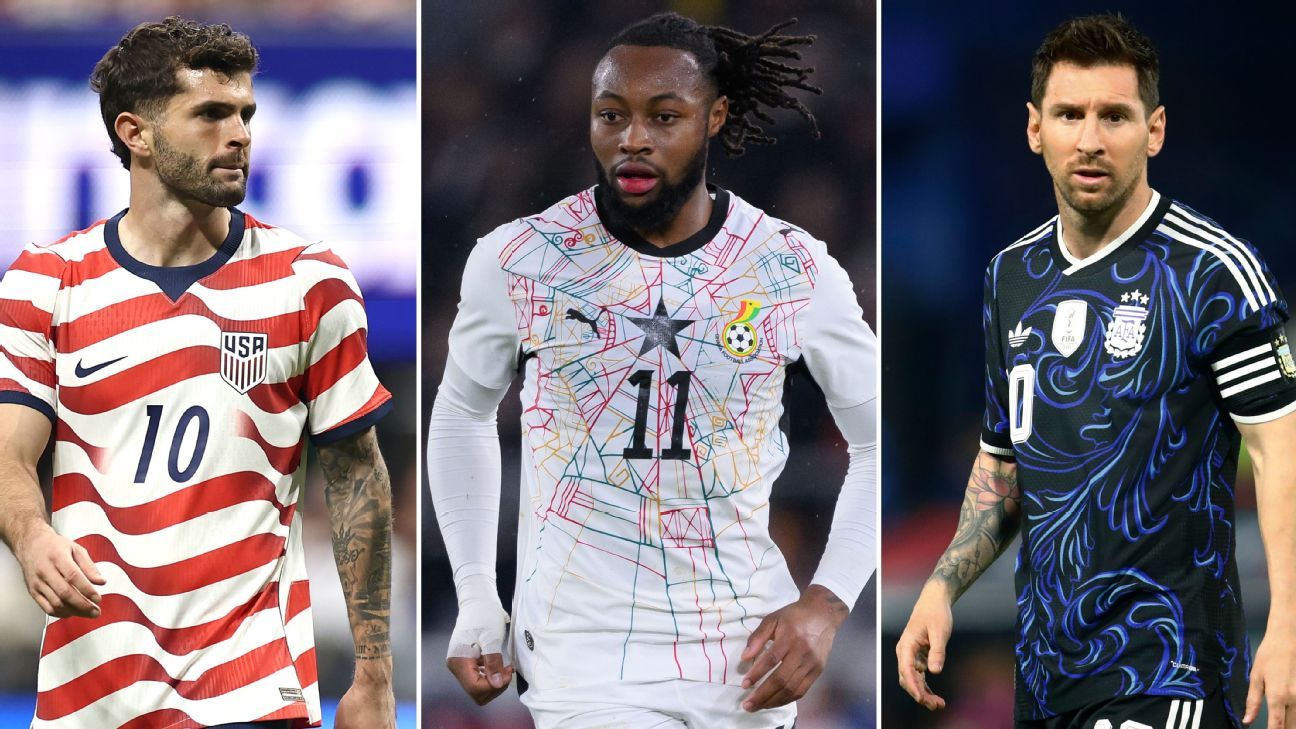
59. Ghana home (Puma)
With a design inspired by Kwaku Ananse, a figure from West African folklore often depicted as a spider, the new Ghana home shirt has a multicolored web scribbled all over it that emanates out from the central Black Star crest. It’s one of the wilder designs on show at the tournament and might divide opinion, but we suspect many will appreciate the madness.
58. Croatia away (Nike)
When it comes to international football kit design, some things you can just go ahead and hang your hat on. Croatia’s unfaltering palette is as close to enshrined as it’s possible to get: red and white home, moody blue away. And so shall it be forever and ever.
An aggressively bright orange shirt is speckled all over with a cacophony of animal print patterns. There are also flecks of green under the arms and dots of white in the various logos to complete the triptych of national colors. Hardly subtle, but we like the energy.
56. Ecuador away (Marathon)
Ecuador are punching well above their weight with a lean, svelte polo-style shirt in navy that is accented with gold detailing and a textured knit in the material lifted from the lines and angles of their EFF federation shield.
55. Egypt home (Puma)
While the overall design isn’t particularly earth-shattering, we do like the deep, regal shade of red used for Egypt’s World Cup home shirt. The frontage is gussied up with a star-shaped graphic that combines the Great Pyramids with the ankh, an ancient symbol of life and immortality.
54. Sweden home (Adidas)
You tend to know what you’re getting when it comes to Sweden’s home kit, and after branching out with a rather lovely pale yellow shirt for 2024, we’re back on a familiar footing again this time around.
53. Scotland home (Adidas)
Rudimentary stuff from Scotland here, whose home kit is dark blue and white with a Saltire cross pattern formed in the fabric. Not the most inspiring shirt the Tartan Army will ever wear, but we suspect it’ll do the job.
52. Colombia home (Adidas)
They might have missed out last time around, but Colombia are back at the World Cup with a fairly straightforward yellow home kit in tow. Closer inspection reveals a butterfly motif in the material that serves as a tribute to Colombian novelist Gabriel García Márquez, who frequently used the insects in his work to symbolize hope and rejuvenation.
51. Morocco away (Puma)
The Atlas Lions’ away kit is white with a light sand-colored pattern that forms a central bib down the front of the jersey. The ornate line drawing is inspired by the intricate designs used to decorate traditional Moroccan tiles, rugs and textiles.
50. Czechia home (Puma)
Conceived as a tribute to the Puma shirts worn by the 1996 Czech side that finished as runners-up at the European Championship, this modern equivalent features similar embroidered taping that has been relocated from the sleeves to the collar and cuffs. We’re not sold on the button-up collar, but otherwise, we like what we see.
Portugal’s 2026 home kit channels the energy of the ocean in the hope that the team wearing it will “make waves” on football’s biggest stage this summer. We can forgive the tenuous pun because the shirt itself is actually rather nice.
48. Senegal away (Puma)
Senegal’s new away kit is nowhere near as cluttered as the home jersey, with the national tricolor of green, yellow and red on full display. There is also a vertical panel that runs down the center of the shirt that contains a pattern inspired by tribal textiles. Note the second star which has been added above the crest to represent victory in the AFCON final in January, despite the decision by CAF to strip the country of its title and award it to Morocco.
As bright and bold as you might expect, South Africa’s canary-yellow home shirt draws inspiration from the similar design worn by Bafana Bafana at their 2010 home World Cup — the thought being that it might help bring the entire nation together once again.
46. Paraguay away (Puma)
A mélange of blacks and blues make up a shadowy camo pattern. The monochrome white logos are a nice contemporary touch but as with Paraguay’s new home kit, but it lacks much in the way of visual staying power.
45. Australia away (Nike)
A lush watercolor gradient sees green-blue base notes give way to a bright orange-pink burst around the collar and shoulders. The design is supposedly inspired by the intense colors of sunrise over the outback, and we can certainly see what they were going for.
44. Congo DR home (Umbro)
DR Congo’s sky blue home jersey has a central band of zebra skin. It’s lovely, although it sits slightly incongruously given that their team nickname is the Leopards.
43. Austria away (Puma)
Here’s a kit that has steadily grown on us since its release. Austria’s unorthodox away kit has a minty green marble effect laced with hyper-saturated pink and purple veins and then as is that wasn’t enough, they’ve gone and overlaid a geometric golden arch pattern with the whole thing intended to conjure images of the ornate tables in traditional Viennese coffeehouses. There’s a lot going on, but it’s all starting to jell for us.
42. Belgium home (Adidas)
Red, black and yellow with a flame theme for what feels like the fifth successive home kit, the Red Devils will at least look suitably infernal at the 2026 World Cup. It’s decent, but we’ve seen it all before.
41. Germany away (Adidas)
The final away shirt to be produced for Germany by Adidas before Nike take the reins from 2027 is a bit of a letdown. Rather than celebrating their 70-year relationship with Die Mannschaft, Adidas have trotted out a design that has the distinct whiff of “off the peg” about it. It’s fine, but we expected more.
40. Saudi Arabia home (Adidas)
A dark, forest-green base provides a verdant bed for a pattern with purple accents that is influenced by traditional Arabic geometric decoration. After years of boring template kits, it’s nice to see the Saudis attempting something a bit different once again.
39. New Zealand away (Puma)
A lovely little kit inspired by Hau, which is the Māori word for “wind.” As such, the jersey is covered with swirling clouds intended to symbolize the four winds that have brought the team together. Very stylish.
38. Japan home (Adidas)
Japan’s home shirt is instantly recognizable in deep blue, red and white. There’s always a clever twist and this time it arrives in the form of a concentric ribbed pattern that occupies the entire center of the torso and resembles the haze that forms on the horizon between the sky and sea.
37. Algeria home (Adidas)
The basic template is formed from a chalky white base with green-and-red trim but the faded sandy gold stripes that appear on the upper chest are apparently inspired by Algeria’s arid deserts and rocky mountains. The choice of crest is a little confusing with the use of a simplified “Algeria” roundel rather than the usual (and far superior) Algerian Football Federation emblem.
36. Portugal away (Puma)
Awash with nautical whimsy, Portugal’s new away kit is white with an azure blue wave crashing over the top. The rolling surf is then split into two hemispheres with a plunging V-shape hemisphere that sits slightly awkwardly across the belly. It’s a tad messy but at least they attempted something a bit different.
35. Croatia home (Nike)
It might be basically unchanged for 30-plus years and become hopelessly predictable as a result, but it simply wouldn’t be a proper World Cup without that iconic Croatian checkerboard on show. The central clearing is this year’s minor design alteration — which is a vast improvement on 2024’s comically oversized blocks.
34. Sweden away (Adidas)
Once again, Sweden have rolled out a blue and yellow away kit to pair with their yellow and blue home kit, but the 2026 model does at least have a little more depth to it. The glacial blue base is overlaid with a 1970s-style Scandi ripple pattern in vertical stripes along the length of the torso.
Inspired by the tiger and its skill as an ambush hunter, the red-and-black Korean home shirt has a marled fur print suffused into the material that will hopefully induce the same ruthless attacking prowess from their national football team.
32. Colombia away (Adidas)
Seemingly always equipped with a stylish away kit, Colombia’s alternate jersey this time around is ultramarine blue and zingy lemon yellow. The wavy columns of lozenges do have a lovely aquatic “shimmer” to them.
31. England home (Nike)
A fairly obvious attempt to re-create the aesthetic of the 1990s Umbro retro kits so beloved by England fans. It does feel as though the design process entailed scanning every England shirt from 1984 to 1994 into a computer in order to create the precise mathematical halfway between all of them. In fairness, it does look so much better with the contrasting red names and numbers applied.
30. Uruguay home (Nike)
Imbued with garra charrua (the Uruguayan fighting spirit), this ultra-prim home kit is modelled on several of the classic Celeste shirts worn down through the ages. The immaculate white polo collar feels classy, as do the refined touches of navy trim.
29. Norway home (Nike)
A return to the oversized flag graphic that adorned Norway’s kits in 1998, the last time they appeared at a World Cup. The entwined graphic visible within the cross itself is inspired by the wood carving found on the 12th-century Urnes stave church, which dates from the Viking era.
28. Spain home (Adidas)
Having gone with a two-tone red-and-yellow design for 2024, Spain have chucked dark blue back into the equation for 2026. The block sleeves help to break up what is a fairly unpretentious design though the delicate pinstripes on the torso offer some much-needed visual texture.
Given the home shirt is plastered in red-and-white stripes, it’s perhaps inevitable that the corresponding away shirt is spangled with stars in order to complete the full set. There are subtle hints of the USMNT’s iconic, patriotic 1994 World Cup attire, but it’s altogether more subdued this time around — and all the more stylish for it.
26. Scotland away (Adidas)
Clearly inspired by the national team’s candy-colored “Rosebery” uniforms of the early 1900s, Scotland’s energetic away kit also harkens back to some of the more dazzling kits worn through the 1980s and ’90s. However, rather than being overtly garish, the coral tone is refreshing and the navy pinstripes look sharp.
25. Ivory Coast away (Puma)
As is almost always the case, the Elephants’ away shirt is predominantly white though the 2026 design is far more elaborate than usual. Indeed, the torso is festooned with dappled patterns inspired by national flora and fauna, including elephants (naturally), baobab flowers and palm trees. It has the look of a 1970s vinyl tablecloth — and we rather like it.
Solid stuff from the Dutch, who really have opted for a “Maximum Oranje” theme to accompany their 2026 World Cup campaign. The design is clean and minimalist, with the focus put squarely on the national colors in lieu of any other extraneous detail beyond the iridescent black KNVB crest
As you might expect, Lionel Messi and his band of merry reigning world champions will be defending their title while wearing their familiar Albiceleste stripes. While the established design doesn’t offer an awful lot of creative leeway, there is a gradient present within the vertical bars that apparently references the three slightly different shades of blue worn by Argentina when they won their three World Cups in 1978, 1986 and 2022.
22. Brazil away (Nike)
Designed in collaboration with the Jordan brand, Brazil’s new away kit is perhaps somewhat curiously inspired by the vivid coloration of the highly toxic poison dart frogs of the Amazon rainforest. The mottled graphic is black-and-navy with the contrasting trim overlaid in canary yellow and neon aqua. We also rather enjoy the oversized CBF federation crest and its wonky centralized placement.
21. England away (Nike)
The combination of rich red, navy and white, coupled with centralized logos and a jacquard pattern woven into the fabric (made up of lions and stars) amounts to a decent, solid effort from England. The only minor bone of contention is the unusual trapezoid neckline that seems to sit awkwardly on the collarbone and definitely works better with some Nike designs than others. All in all, it’s marginally more aesthetically pleasing than the home version and looks better in long-sleeve format too.
20. South Korea away (Nike)
Korea’s upbeat away kit is one of several floral designs evident at the 2026 World Cup and comes in a suitably appropriate purple lavender hue. The all-over blossom graphic lends a light and airy feel, while the glow-in-the-dark logos must surely go down as a World Cup first.
19. Netherlands away (Nike)
Basically a straight color swap of the home shirt, with a central band of orange added across the midriff in which a modernized, holographic KNVB crest is housed. Even more so than the home jersey, the Dutch away kit looks like it’s been airlifted in from the early 2000s, and we imagine your opinion of it will be directly shaped by how you feel about that era of kit design in general. For what it’s worth, we’re firmly in favor.
18. South Africa away (Adidas)
Bafana Bafana have an underrated hit on their hands here with a lush gold and forest green away kit. Along with the beautiful vertical stripes (made up of triangular hand-drawn tile patterns), the trefoil adds a smidge of luster amid an array of national federation logos including the Protea flower emblem, which has become an important symbol of national identity in modern South Africa.
17. Germany home (Adidas)
Germany have once again returned to the well and revived the yellow, black and red Bundesflagge diamonds of the late 1980s/early 1990s. This is the final home kit that long-time suppliers Adidas will be designing for Die Mannschaft before Nike take over next year and while it scratches the nostalgic itch, we were hoping to see a bombastic send-off rather than a pale cover version of a classic hit.
16. Norway away (Nike)
Norway have taken the strange choice of releasing a full “blackout” stealth kit for the World Cup that will almost certainly fall foul of FIFA’s stringent design/broadcast regulations. Regardless, it looks fantastic and the Viking theme present on the home shirt continues here with the application of Runic patterns on the sleeves and socks.
15. Mexico away (Adidas)
While it’s not a patch on the nostalgia-heavy Aztec design of the home kit, Mexico’s World Cup away kit is likely to prove equally popular on the terraces. The white shirt is clean and cool with minimal flag-themed trim and a zig-zag pattern referencing the Azoteas (external staircases that offer rooftop access) found on traditional Mexican buildings.
14. Algeria away (Adidas)
Looking like it was plucked directly out of the early 1980s — which was when Algeria first qualified for the World Cup, coincidentally — the 2026 away kit has a dapper, restrained retro feel without being too ostentatious. The two-tone green striped design looks effortlessly smart.
13. Ghana away (Puma)
Way more mellow than their frantic home shirt, Ghana’s alternate shirt comes in a pleasant shade of gold-yellow that is decorated with the kind of geometric pattern usually found on Kente cloth products, traditionally worn by royalty. The national colours are further represented in the flashes of red and green trim.
12. France home (Nike)
Les Bleus hardly ever put a foot wrong when it comes to dressing their national teams, and the 2026 home shirt can comfortably rub shoulders with their previous World Cup finery. The dark blue base tone is actually made up of various complimentary hues that have been hashed together in a diagonal pattern. We also love the pristine white fold over collar and the bronze textured logos that provide simple contrast and oodles of extra panache.
11. Morocco home (Puma)
While relatively understated at first glance, Morocco’s 2026 home shirt just gets nicer and nicer the more you stare at it. The material itself has a subtle texture to it, and the centralized crest looks fantastic. The real star of the show, however, is the Fes-style embroidered taping that adorns both the cuffs and the unusually shaped button collar.
10. Spain away (Adidas)
There’s a tangible opulence to Spain’s 2026 World Cup away kit which sees a rich creamy base overlaid with simple maroon and burnished gold decor. An ornate coiled vine pattern can be found woven into the fabric which is lifted from the gold-leaf illuminations used to embellish many ancient Spanish literary manuscripts. Put simply, there’s nothing not to like about it.
9. Belgium away (Adidas)
Belgium’s away shirt is inspired by their national federation crest and the Belgian surrealist artist René Magritte in the form of a pastel pink and blue abstract graphic that conceptually incorporates both by melding the “B” of the crest with the silver sphere shapes from Magritte’s 1928 work “La Voix des Airs.” Magnifique.
8. Brazil home (Nike)
Inspired, if only very loosely, by their great 1970 World Cup-winning side of Pele, Jairzinho and Rivellino, the latest Brazil home shirt is canary yellow with simple, chunky blocks of dark green trim at the collar and cuffs. The unusual notched neckline that Nike has applied to several of its kits looks good here and the geometric diamond pattern in the fabric is an abstracted take on the national flag. Looks even better when paired with the Selecao’s classic blue shorts/white socks combo too.
7. Argentina away (Adidas)
It would appear that Argentina’s relatively garish away kit has divided opinion among fans, but we happen to appreciate the unique design. The black shirt is covered all over in a tumble of foliage and fronds picked out in lighter blue shades that are inspired by the Fileteado Porteño folk art style that can be found adorning everything from buildings to buses to bicycles on the streets of Buenos Aires.
6. Mexico home (Adidas)
Obviously produced in homage to one of the greatest World Cup kits ever created, co-hosts Mexico have based their 2026 primary kit on the incredibly elaborate Aztec design worn by El Tri at the 1998 finals in France. It must be said that the contemporary reworking (which features an imprint of the Piedra del Sol, one of the most famous surviving Aztec sculptures) doesn’t quite have the same extraordinary level of pizzazz as the original but the effect is still very much felt.
5. United States home (Nike)
A throwback to the glory years of 1994, when the USMNT last hosted a World Cup. The red-and-white stripes are back though this time they have been applied horizontally across the shirt. Much like the ’94 precursor, the bands have also been given a clever wave effect to replicate the gentle ripple of Old Glory as it flutters in the breeze.
4. Curaçao away (Adidas)
Another surefire smash among kit collectors, Curacao’s lemon yellow away shirt is positively awash in sunshine vibes. Inspired by the Caribbean island’s capital city of Willemstad and the colorful buildings that line the waterways in the Punda and Otrobanda districts, the dashes of pastel pink, turquoise and orange (matched with a tricolor trefoil) radiate in harmony to create a dreamy feel. We can’t wait to see what the home kit looks like.
3. France away (Nike)
You simply have to hand it to France; they know how to dress for a World Cup. Coupling nicely with their jazzy home shirt, the away variant comes in a minty shade of verdigris that is inspired by the copper cladding of the Statue of Liberty, gifted by France to the United States and dedicated in 1886 as a symbol of the cordial relationship between the two nations. The gorgeous metallic copper logos and dainty tricolore banding on the sleeve cuffs serve as the perfect finishing touches.
2. Japan away (Adidas)
Taking styling pointers from retro baseball jerseys, Japan have certainly hit it out of the park with their achingly lovely World Cup away kit. The soft, off-white shirt is lined 12 rainbow pinstripes — 11 to represent the team on the pitch and the 12th red central stripe signifying the wider Japanese football family. It’s proved to be an instant sellout, and it’s not hard to see why.
1. Uruguay away (Adidas)
There’s not a lot to separate the kits at the top of the order, but Uruguay’s wonderfully esoteric away kit just nudges it for us. The shirt is presented as a tribute to their history-making World Cup team of 1930, who won the inaugural tournament to become football’s very first world champions. The inky indigo shirt has a shimmering mantle around the neck in blue and electric orange which resembles ancient indigenous armor and is intended as a visual metaphor for the 2026 team’s desire to guard their ancestral throne. Very fantastical. Very, very cool.

LINCOLN, Neb. — Pryce Sandfort, the 3-point shooting specialist who helped lead Nebraska to its first NCAA Tournament win and a Sweet 16 appearance, will return to the Cornhuskers next season, the school announced on X on Monday.
Sandfort transferred to Nebraska after two years at Iowa and had a breakout season in which he earned Associated Press All-Big Ten second-team honors. He averaged 18.1 points to lead the Huskers, and he was first in the Big Ten and fourth nationally with 3.69 3s per game. His 129 3s were the most in program history.
Coach Fred Hoiberg wrote on X that Sandfort had drawn a lot of interest from NBA teams but he decided to return to school to keep working on his game.
“He feels like we have a lot of unfinished business after this year,” Hoiberg said, “and he wants to solidify his legacy in Lincoln and put himself in the best position for a long professional career. It’s a testament to him for betting on himself and wanting to do it here at Nebraska.”
ALMOST EXACTLY ONE year ago, the Florida Gators gymnastics team was sitting in the stands in Fort Worth, Texas, watching four teams compete for the national title.
There had been high expectations for the No. 3-ranked squad, but the Gators had been stunned by Missouri in the semifinals, and missed out on advancing to the championship round by one-tenth of a point.
When they returned home, the gymnasts experienced a range of almost grief-like emotions: sadness, anger, despair. But they didn’t dwell for long. About a week after getting back to campus, all of the members of the team who would be returning came together for a meeting. There were no coaches in attendance or even a formal agenda, just a resolution to not let the same thing happen the next year.
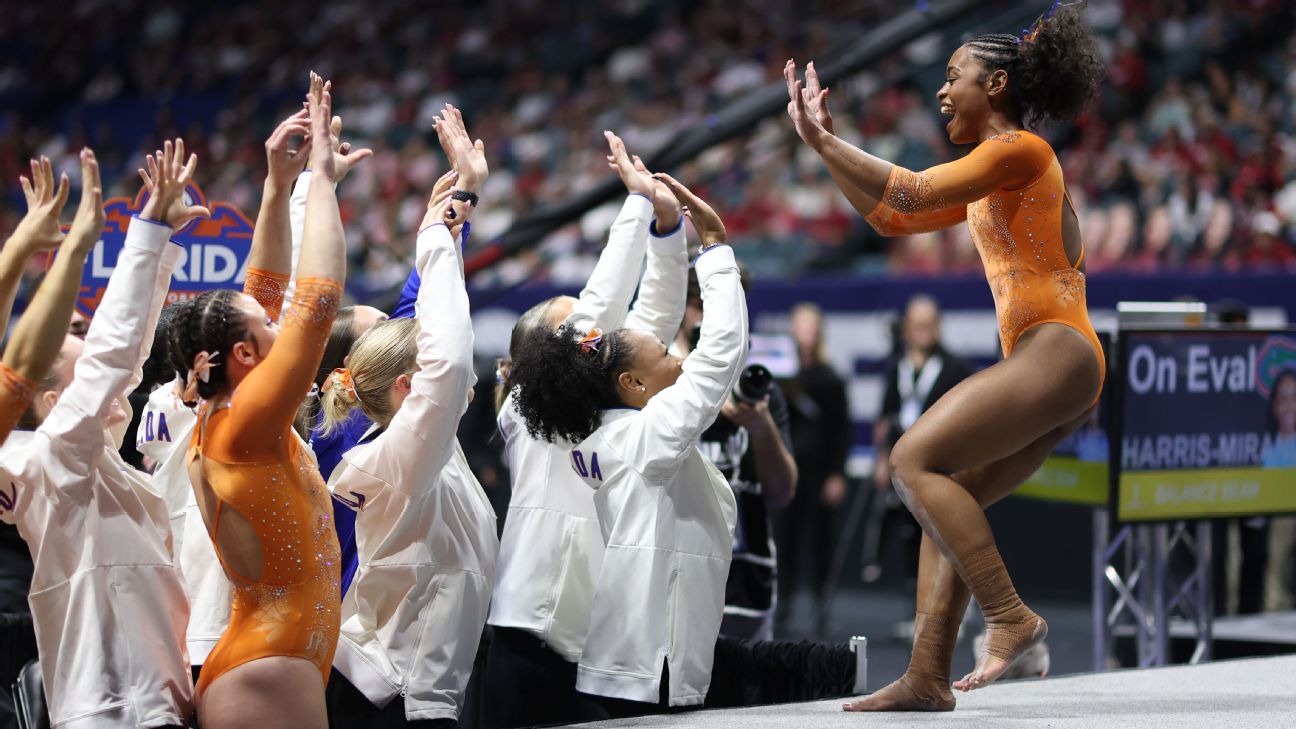
“We were just so hurt by how [the season] ended, we realized we needed to figure out what we were going to be as a team, before these freshmen came in, and we all needed to be on the same page,” senior Selena Harris-Miranda told ESPN. “We needed to know what we’re working towards and how we’re going to do this. And that’s when we came up with ‘The Promise.'”
They were inspired by the 2008 speech by then-Florida quarterback Tim Tebow, which is immortalized on a plaque at the football stadium and something that is “just seen everywhere on campus and part of the culture,” according to Harris-Miranda. Junior Skylar Draser first came up with the idea of the team adopting Tebow’s message and making it their own. Draser showed everyone a video of Tebow’s impassioned plea, highlighting his final words specifically:
“You have never seen any player in the entire country play as hard as I will play the rest of this season, and you’ll never see someone push the rest of the team as hard as I will push everybody the rest of this season. You’ll never see a team play harder than we will the rest of the season.”
The team embraced Draser’s idea immediately and meticulously crafted their own version of “The Promise” at a team retreat in September. Focusing on accountability and being there for one another, it has been the Gators’ mantra all season long and is displayed prominently at the entrance of the team’s training facility.
“Our team will hold ourselves and each other responsible to embrace the hard, show up 100% and unite together. We have a team mentality and resiliently step up to any challenge. We are unbreakable and we won’t back down. A win for one is a win for all.”
The words, and perhaps the bond and unity behind them, have helped lead the Gators back to Fort Worth again this year. After a strong season, which saw the team win its first SEC championship since 2023, No. 3-seeded Florida will need to continue to “embrace the hard” in Thursday’s semifinal (4:30 p.m. ET on ESPN) as it takes on No. 2 LSU, No. 6 Georgia and No. 7 Stanford with the top two teams advancing to Saturday’s national championship.
And this year, everything feels different. With six former national team members — including three world champions — and a slew of gymnasts capable of contending for individual titles, Florida’s depth of talent is unmatched. The sting of last year’s exit has subsided, but it created a connection that remains, and with that comes a confidence and a belief that could carry the Gators to their first national championship title since 2015.
“We’re so much more bonded now,” Harris-Miranda said. “These are my teammates, my girls for life probably, because we were in here sweating, bleeding, crying, doing all the things. We’ve gone through all the hard conversations. It was like building a family. It’s literally a sisterhood — annoying sisters sometimes — but they’re also my best friends.
“It would mean the world to forever have that trophy and the ring and cement our legacy and those forever bonds.”
RILEY MCCUSKER WASN’T SURE at the end of last season if she would be returning. She was a senior and had already been through all of the “last” hallmarks and even had her Senior Night. But due to an injury that sidelined her for the 2024 season, she had one final year of eligibility if she wanted it.
With lofty post-gymnastics goals, including medical school, she was still on the fence about her decision when the team-only meeting took place following the semifinal exit. She recused herself from participating but offered her full support and guidance if needed. But she noticed there was something different about the energy in the gym over the summer when the team returned. Everyone seemed so excited and the freshmen were “so eager to begin their college journeys and learn” from the upperclassmen. It reminded McCusker of how much she still loved the sport. She decided to stay.
Now, approaching the last week of her gymnastics career — after balancing an internship this semester with Dr. Ellen Casey, a team physician for USA Gymnastics, and applying to medical schools — McCusker couldn’t be happier with her choice.
“I think I knew from the beginning how special this group is. I’ve been saying, ‘This is the best team I’ve ever been on in my five years as a Gator’ from preseason,'” McCusker told ESPN. “I think this team is my favorite team that I’ve been on so far. I feel like we did a complete turn from last season and just the way we’re approaching this season. We’re really having so much fun with it and we’re competing freely.”
With a beach retreat that involved a slew of icebreakers and activities, including one game that involved team members wearing blindfolds and having to identify their teammates based solely on animal sounds, as well as various team parties, trips to the movies and events throughout the fall semester, the team grew close in a way that felt organic. McCusker said everyone bought in quickly to the idea of “A win for one is a win for all” and it helped further create unity.
When the group told head coach Jenny Rowland and the rest of the staff about their idea for “The Promise,” they were quickly met with support.
“We said, ‘Jenny, this is what we want to commit to this year as a team,’ and we talked about all of it with her,” Harris-Miranda said. “We said, ‘This is what we want as a team and we want it on the wall as soon as you walk into the gym.’ The coaches are always like, ‘We’re on the boat with you but you guys are driving it,’ and they were all so receptive to it.”
The season hasn’t been without challenges. On Feb. 6, the Gators, then ranked No. 2, were handed a surprising loss on the road against No. 7 Missouri. Struggling on their opening rotation on bars, usually their best event, the team never fully recovered and recorded a season-low 196.50. The following week, Florida lost again to top-ranked Oklahoma in front of a sold-out crowd at home. It was the team’s first loss at the Stephen C. O’Connell Center in over two years and marked the first time the Gators had lost back-to-back SEC meets since 2006.
But the defeats marked a clear turning point. After the loss to the Sooners, the Gators regrouped. They had tough conversations about what had gone wrong and what could have been done differently. They watched film and offered words of support to one another. No one blamed anyone else and they resolved to get back on track but also to not put too much emphasis on winning. The experience allowed them, yet again, to be vulnerable with one another.
For Kayla DiCello, a junior who was sidelined last season due to an Achilles rupture, further building such a connection only made her more confident in the meets going forward.
“Trust is 100% one of the most important things to have on a team because doing gymnastics alone is very hard,” DiCello said to ESPN. “And when you’re up on the beam, if you don’t feel the trust from the girls standing there supporting you, it kind of makes you feel a little bit unsure. So the fact that we have such a good bond now and such deep trust with each other, it makes it so much easier to go up there and know that I have the rest of the team supporting me. They have my back and I have their back.”
The Gators haven’t lost since.
At the SEC championships in March, Florida battled for the first three rotations with Oklahoma and LSU for the lead. The Sooners held the ever-so-slight edge going into the final event, but the Gators remained focused. They huddled together before starting on bars, an event in which they are ranked No. 1 in the country.
“I remember as we were standing there together, Selena was saying, ‘Every little thing counts, it’s not over till it’s over,” McCusker said. “She said, ‘We know how to do this. Let’s just go up there and hit it.’ And I think that’s what we all did.”
Harris-Miranda’s words to her teammates could not have been more true. Senior eMjae Frazier, a transfer from California, opened the rotation with a 9.90. Junior Anya Pilgrim followed with a 9.925. Sophomore Skye Blakely and DiCello were both nearly flawless with 9.975s. Harris-Miranda then earned a perfect 10.0, her first of the season on bars. It all came down to McCusker, on her only event of the day. She had no idea just how close the score was, but she said she had been “feeding off of everyone else’s confidence” in the routines before her and felt ready to go. She earned a 9.925 to secure the win by 0.025 of a point over Oklahoma.
The team was all together as the final scores flashed on the screen.
“We were all clustered there, just staring at the scoreboard and waiting to see, and then the moment it happened, I just felt an unbelievable amount of joy just come over me,” DiCello said. “I started crying, I was so excited. I was just really proud of our entire team and all of the work that we put in to get ourselves up to this point because I mean, our season has been anything but a straight line. So figuring out what we need from meet to meet and just fixing it from there to get us to this point, and then to see it all play out, has just been truly amazing.”
After they received the championship trophy, the team remained on the stage celebrating for what Harris-Miranda guessed to be about 40 minutes.
“No one wanted to leave,” she said.
Two days later, the team gathered together yet again. This time it was on the outdoor pool deck at the football practice facility — “So Florida, right?” said Harris-Miranda — to learn its fate for the NCAA postseason. Assigned to Tempe, Arizona, as the top seed in the region, Florida rolled through its two meets to claim the title at the regional finals and punch its ticket to Fort Worth yet again.
WHEN TEBOW VOICED his now immortal words 18 years ago, it was just after the Gators had been handed a stunning defeat by Mississippi, a 22-point underdog, at home — ending the team’s hopes for a perfect season.
At the end of his postgame press conference, Tebow, then the reigning Heisman Trophy winner, delivered the instantly iconic speech. Harris-Miranda was 4 years old at the time, Draser and DiCello were 3, and while McCusker was 7, it’s impossible to believe any member of the current Gators gymnastics team has any real memory of the speech when it happened.
But it’s something that remains ingrained in the Florida athletic department and Harris-Miranda, who transferred from UCLA following her sophomore season, joked is something that a recruit has to know before committing to the school. And after the disappointing exit in 2025, the Gator gymnasts could relate exactly to what Tebow felt in that moment.
Like Tebow, it was something they didn’t want to feel again.
The team doesn’t talk about their promise every day at this point. They don’t need to. In addition to its visible spot at the entrance of the practice facility, it’s something DiCello says is just a core part of the team’s identity now. “We live it every day when we step into the gym,” she added.
At a recent team meeting, Harris-Miranda remembered looking around the room and appreciating the talent and the determination of those sitting around her.
“I was thinking, ‘Literally the best athletes in the country are sitting in this room. We have everything we need right in this room,'” Harris-Miranda said. “It’s so motivating. I used to watch Riley McCusker on YouTube all the time and was obsessed with how she did her hair and how she just would train in the gym, her work ethic and all these things, and to now be her teammate, it feels so full circle and I’m so proud to be right here next to her.
“And that’s the thing, everyone on this team has this same work ethic, and we all push each other every day to be better. Iron sharpens iron.”
On Thursday, the Gators will have the chance to put everything they’ve learned and worked on over the past year to the test and find their way back to Saturday’s championship meet. It wouldn’t be the first time in Florida history a team recovered in such a spectacular way from a devastating loss.
After Tebow’s Gators lost that game in 2008, they went on to have an undefeated remainder of the season. In the BCS National Championship, Florida defeated top-ranked Oklahoma, 24-14, to reclaim its place atop the sport’s hierarchy.
The gymnastics team may have a fairy-tale ending this week. It’s of course the ultimate goal — but it also won’t be the only definition of a successful season for those on the team.
“It would be the icing on the cake for sure,” McCusker said. “But I remember watching an interview with [Olympic gold-medal winning figure skater] Alysa Liu and she said it wasn’t even about the medal for her, it was instead about the performance and the work she put into it. And that’s honestly how I feel about this year. If we can go out these last meets and do the best gymnastics we can do and stick together as a team and do it for each other, that’s a win to me.”

KARACHI: The legacy of Pakistan’s fast bowling continues to command global respect, and few understand the craft better than West Indies legend Courtney Walsh.
From the greats of the past to the rising stars of today, Walsh believes Pakistan’s production line of fast bowlers remains as potent as ever, with Shaheen Afridi standing out as a complete modern-day pacer.
Speaking to Geo News during the ongoing Pakistan Super League, which is part of Rawalpindiz setup as coach, Walsh pointed to conditions and skill development as the foundation of Pakistan’s fast-bowling success across generations.
“I think the conditions here,” he said when asked what makes Pakistani pacers different from the rest of the world.
“You have to have good skill sets, and you’ve got quality bowlers here from over the years. I mean, you go back, way back, went from Sarfraz up till now, Wasim, Waqar, those guys. All those guys have been good fast bowlers for Pakistan, and the youngsters have come on, and they’ve learned their trade as well,” he added.
At the heart of the current pace attack, Walsh sees Afridi as a symbol of discipline and consistency, qualities he believes define great fast bowlers.
“Shaheen is someone who I’ve always admired, the way he conducts himself, the way he plays, he’s never given that attitude and just his own skill set and the pride that he plays when he plays for Pakistan and even in franchise cricket. And that’s what you want to see in fast bowlers, and he has all those qualities.”
He also acknowledged the depth in Pakistan’s pace resources, naming Naseem Shah and Mohammad Wasim Jr among those carrying the tradition forward.
“As you mentioned, Naseem and those guys, yes, they’re up there with it, and the quality is always going to be there. But I’ve always singled him (Shaheen) out for the way he executes, the way he goes about his job, keeping it simple and just trying to do the basics consistently.”
While Walsh’s words reflect admiration for Pakistan’s pace culture, his current role in franchise cricket has given him a different perspective on the modern game. Working within the fast-paced environment of the PSL, he highlighted the challenges of coaching in a format where preparation time is minimal.
“It’s a lot different because you don’t have as much time with the players as you have with the international side. You come straight into the competition, so you have to sort of hit the ground running. And it’s interesting. It’s good to see because you’ve got professional players as well who know what they want to do and how to go about doing it. So it’s more or less guidance and a lot more discussions than actually coaching.”
Despite not-so-encouraging results for his side, Walsh described his experience in the league as positive, underlining the competitive environment and team spirit.
“It’s been very good, very happy to be here. It’s the first time I’ve been involved with the Pindiz team as well. So, very good. The results might not be showing that at the moment, but it’s good; the guys are looking after us. And we’re just trying to put some games together where we can do well. But apart from that, everything, the atmosphere and everything has been good.”
The evolution of cricket, particularly in the T20 era, has placed bowlers under increasing pressure, a reality Walsh readily acknowledges. Yet, he finds encouragement in how fast bowlers have adapted to survive in a format dominated by batters.
“I’m happy. I’m happy to see what I’m seeing in terms of the number of fast bowlers who have gone through the game and have done well. The game has evolved from the time I played until now. It’s good to see. A good skill set has to be used. Consistency and the challenges are out there. But I’m happy that the quality of fast bowlers that we have on the circuit can make a name for themselves. Because, as you mentioned, T20 is a very challenging game and it’s more suited for batters. So when you have fast bowlers doing well at that, I’m very happy.”
Even so, he believes the balance between bat and ball remains a concern, with surfaces and conditions playing a crucial role.
“Give them a more balanced surface to play on in terms of where the ball can do a little bit, comes off the wicket and seam around a little bit. It’s a little bit of seam, so it’s a bit challenging. But in today’s game, we know that everyone wants to see runs being scored and big sixes being hit. So that’s a challenge for the bowlers. But some of them have coped with it pretty well, where they try to minimise the amount of boundaries they go for. And that in itself is a skill set you have to practice.”
Beyond the technical aspects, Walsh also addressed a broader shift in cricket, the growing preference among players for shorter formats over Test cricket.
“I think it’s going to happen where some guys are just happy to play the shorter format, and they want to be T20 specialists. One, they might not have the ability to play Test cricket and two, they might just want to play as long as they can play. But the T20 cricket is a shorter, faster game. A lot of excitement, and at the end of the day, to be honest as well, you get a decent paycheck, so you can’t blame the guys for wanting to do that. I think if Test cricket wants to challenge that, then they have to look to market it more and then a lot more incentives as well.”
For the next generation of fast bowlers, however, Walsh’s message remains rooted in timeless principles: discipline, hard work and consistency.
“Be prepared to work hard, be disciplined, be consistent in what you want to do and practice your skill set so that you can be the best at what you want to be at. Nothing beats consistency, and nothing beats hard work. So once you put the work in and you’re consistent in what you want to get done, then the execution part will take care of itself.”
Among the young players in his current setup, one name has already caught his eye.
“Yeah, Raza, who hasn’t played a game as yet. He’s got pace, just needs to work on his control, but he’s got good raw pace and good action. And I think in time, he might get the game, hopefully before the series is over. But I’m expecting big things from him once they can look after him and keep him going. But he’s got good ability.”
Away from the game, the PSL has also provided Walsh an opportunity to reconnect with former rivals and friends, a reminder of cricket’s enduring bonds.
“Yes, my desire is to meet some of them. I’ve got Inzamam in my set-up. I saw Latif when he came over. Moin is a coach with one of the teams, so I bumped into him as well. Basit Ali sent a message: Ramiz Raja is doing a bit of commentary. So you’ve seen some of the guys that you’ve played against, but it’ll be nice to be able to move around and catch up with some of these guys.”


Nicolas Cage set to return to ‘Longlegs’ franchise with new movie

This Windows Laptop Makes the MacBook Neo Look Overpriced
Help to Buy mostly helped high earners, IFS says

-

 Fashion1 week ago
India’s exports face reset as EU links trade to carbon metrics: EY
-

 Entertainment7 days ago
Queen Elizabeth II emotional message for Archie, Lilibet sparks speculation
-

 Tech6 days ago
As the Strait of Hormuz Reopens, Global Shipping Will Take Months to Recover
-

 Tech7 days ago
Azure customers up in arms over ‘full’ UK South region | Computer Weekly
-

 Entertainment1 week ago
Lamar Odom shocking response to Khloé Kardashian account of his overdose
-

 Fashion7 days ago
CII submits 20-pt agenda to Indian govt to back firms hit by Iran war
-

 Tech6 days ago
This AI Button Wearable From Ex-Apple Engineers Looks Like an iPod Shuffle
-

 Tech1 week ago
A Single Strike Won’t Shut Off the Gulf’s Desalination System