

Tech
Your Favorite Streamer’s DJI Mic Kit Is Just $109 Right Now—$60 Off

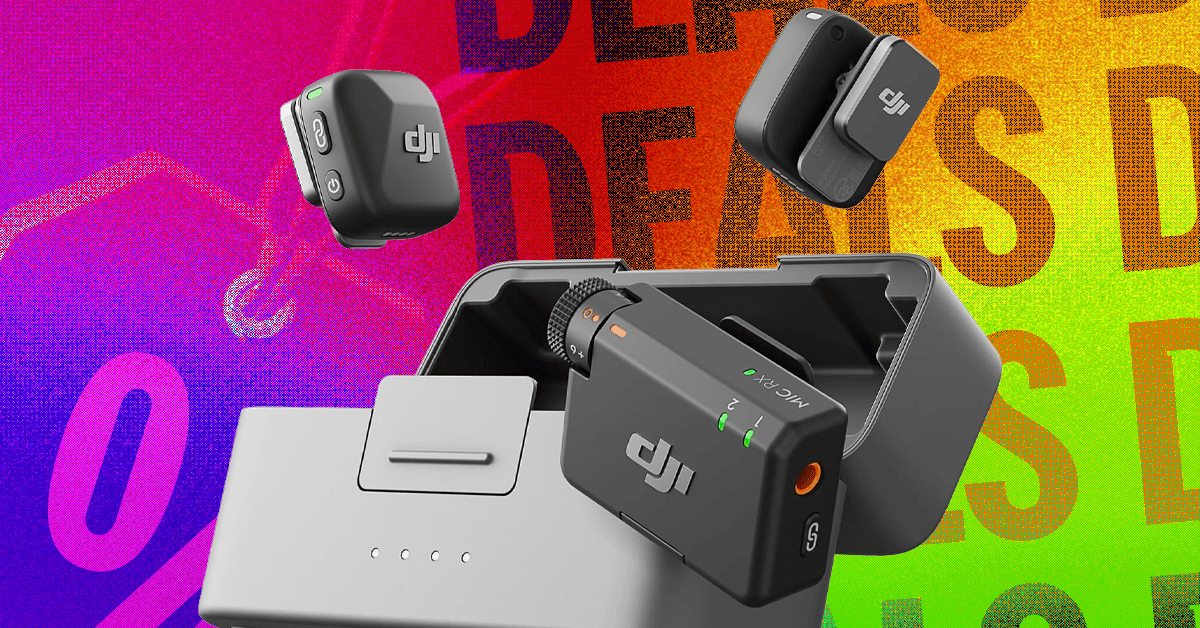
Looking to upgrade the audio for your phone or action camera footage? Amazon is offering $60 off the DJI Mic Mini kit. Our reviewer gave DJI’s lavalier mic, a 7/10 and this kit includes two mics, a receiver, and a handy charging case. That’s the lowest price yet for this bundle at just $109, and it’s a great value on this easy-to-use and lightweight microphone.
These little mics and their fuzzy windscreens have become increasingly popular over the last year, popping up on collars and in the hands of YouTubers and livestreamers across a number of social media platforms. They sound crisp and clear, and they do a great job of cutting out all the ambient noise that smartphone mics tend to pick up when recording.
They’re also generally very easy to use, with iPhones automatically preferring the wireless mics, and Android phones just needing them selected in the camera app. They have much better battery life than the slightly older and fancier DJI Mic 2 (9/10, WIRED Review), partially because they don’t record locally, but they’re a lot cheaper and lighter in return.
While you can buy the individual bits à la carte, the bundles includes two of the wireless microphones, the wireless receiver, a set of windscreens in two colors, all the charging and connective cables you’ll need for both cameras and phones, and a charging case for the mics and receiver. You can also pick up a receiver and mic on their own for just $59, but given all the small bits and parts, the kit seems well worth the extra cash.
Our reviewer, Julian Chokkattu, did find the setup required a bit of manual dexterity, which tends to come with the territory. The receiver, for example, plugs directly into your phone, and you shouldn’t need to take your case off, but it requires a surprising amount of force to connect or disconnect. The reduced footprint also means it’s easy to lose some of the smaller bits and plastic covers. There were some oddities with the app, too, involving updates and connection types, but nothing that’s cause for concern once you have everything set up the way you like.













I was delighted to see that the Acer Chromebook Plus 516 didn’t skimp on a crappy touchpad. That goes a long way toward improving the experiencing of actually using the laptop on a moment-by-moment basis. I wasn’t annoyed every time I had to click-and-drag or select a bit of text. This one’s biggest weakness is definitely the screen, which is true of just about every cheap Chromebook I’ve tested. The colors are ugly and desaturated, giving the whole thing a sickly green tint. It’s also not the sharpest in the world, as it’s stretching 1920 x 1200 pixels across a large, 16-inch screen. But in terms of usability and performance, the Acer Chromebook Plus 516 is a great value, combining an Intel Core i3 processor with 8 GB of RAM and a 128 GB of storage. For a Chromebook that’s often on sale for $350, it’s a steal.
While we’re here, let’s go even cheaper, shall we? Asus has two dirt-cheap Chromebooks that I tested last year that I was mildly impressed by. The Asus Chromebook CX14 and CX15. Notice in the name that these are not “Chromebook Plus” models, meaning they can be configured with less RAM and storage, and even use lower-powered processors. That’s exactly what you get on the cheaper configurations of the CX14 and CX15, which is how you sometimes get prices down to as low as $130. I definitely recommend the version with 8 GB of RAM, but regardless of which you choose, the both the CX14 and larger CX15 are mildly attractive laptops. You’d know that’s a big compliment if you’ve seen just how ugly Chromebooks of this price have been in the past.
With these, though, I appreciate the relatively thin bezels and chassis thickness, as well as the larger touchpad and comfortable keyboard. The CX15 even comes in a striking blue color. The touchpad isn’t great, nor is the display. Like the Acer Chromebook Plus 516, it suffers from poor color reproduction and only goes up to 250 nits of brightness. It only has a 720p webcam too, which makes video calls a bit rough. But that’s going to be true of nearly all the competition (and there isn’t much).
Of the two models, I definitely prefer the CX14 though, as it doesn’t have a numberpad and off-center touchpad, which I’ve always found to be awkward to use. Look—no one’s going to love using a computer that costs the less than $200, but if it’s what you can afford, the Asus Chromebook CX14 will at least get you by without too much frustration.
Whatever you do, don’t just head over to Amazon and buy whatever ancient Chromebook is selling for $100 for your kid. It’s worth the extra cash to get something with better battery life, a more modern look, and decent performance.
Other Good Chromebooks We’ve Tested
We’ve tested dozens and dozens of Chromebooks over the past years, having reviewed every major release across the spectrum of price. Unlike Macs and Windows laptops, Chromebooks tends to stick around a bit longer though, and aren’t refreshed as often. I stand by my picks above, but here are a few standouts from our testing that are still worth buying for the right person.
Photograph: Daniel Thorp-Lancaster
Tech
Interview: Critical local infrastructure is missing link in UK cyber resilience | Computer Weekly

Critical local infrastructure that supports council services, social care services and local transport in the UK is falling through the gaps in government and business planning for cyber resilience, claims Jonathan Lee, director of cyber strategy at cyber security company TrendAI.
In an interview with Computer Weekly, Lee says that municipal areas, such as London or Greater Manchester, could be at risk from multiple cyber attacks that could damage local infrastructure, causing escalating problems for residents that could add up to severe disruption.
“We need to be thinking about what would happen if multiple attacks happened at the same time across the city region – and the human impact of not being able to do your job properly, not being able to travel around and not being able to deliver public services,” he says.
The Cyber Security and Resilience Bill (CSRB), which is currently going through Parliament, aims to ensure that critical national services, such as healthcare, water, transport and energy, are protected against cyber attacks that cost the economy billions of pounds a year. But local infrastructure has been relatively neglected, claims Lee.
The National Cyber Security Centre’s (NCSC) Cyber Assurance Framework, for example, aims to help operators of critical national infrastructure (CNI) demonstrate a base level of cyber security preparedness – but it is not mandatory, and not every organisation that should implement it is implementing it.
Whole of society risk
“We need to be more stringent in making sure that people are taking this seriously and are looking not just at their own organisation, but are looking at the whole of society risk,” says Lee.
Attacks on public services, such as council-run social care, can have a catastrophic, knock-on effect on the NHS and patient care, he adds.
There is a need for more “top-down” advice for regional infrastructure providers, from organisations such as the NCSC, which is not as well known as it could be among the companies and public sector bodies that provide local infrastructure.
“The message has got to be diffused down into local levels to ensure that a consistent message is spread out, and that can also be through industry partners. That is something I feel quite strongly about,” says Lee.
The Cyber Essentials programme, which has been updated to include new requirements for organisations to use multifactor authentication (MFA), and requirements for cloud providers to patch vulnerabilities within 14 days, has helped build resilience, but only for organisations that choose to adhere to it.
Keeping the resilience score
The UK government is also intending to publish a Cyber Action Plan in the coming months, which will guide organisations to get basic security right and improve their cyber security over time.
Although there is no shortage of initiatives and action plans, there is a danger that many of these plans will be left on a shelf.
One approach is for organisations to rate themselves on a scorecard for cyber resilience, on a scale of, say, 1 to 100, and to report their progress back to board-level directors.
“We need a mechanism to measure how impactful these interventions are, whether it be things like the Cyber Assessment Framework, Cyber Essentials or legislation,” says Lee.

Two of Big Tech’s most influential billionaires, Sam Altman and Elon Musk, will go head-to-head in a highly anticipated trial beginning April 27. In Musk v. Altman, a judge, advised by a jury, will ultimately determine whether OpenAI has strayed from its founding mission to ensure that artificial general intelligence (AGI) benefits humanity, and the ruling could influence how the world’s leading AI developer controls and distributes its technology. For now, you can learn more about the trial here.
On the Panel
On May 8, a panel of WIRED experts will go live to answer your questions about this consequential case.
- Zoë Schiffer: WIRED’s director of business and industry, who oversees coverage of business and Silicon Valley.
- Maxwell Zeff: a senior writer at WIRED covering the business of artificial intelligence. He writes the weekly Model Behavior newsletter, which focuses on the people, communities, and companies behind Silicon Valley’s AI scene.
- Paresh Dave: a senior writer at WIRED covering the inner workings of Big Tech companies. He writes about how apps and gadgets are built and about their impacts while giving voice to the stories of the underappreciated and disadvantaged.
Ask a Question
Submit all your burning questions about this historic legal battle at WIRED’s next, subscriber-only livestream scheduled for May 8 at noon ET / 9 PT. To leave questions in advance as the trial unfolds, head to the comment section below.
Become a Subscriber
The event will be streamed right here. For subscribers who are not able to join, a replay of the livestream will be available after the event. Not a subscriber yet? Subscribe now to get access to this livestream, plus full access to WIRED.
In the meantime, check out past livestreams on Big Tech and the military, the future of electric vehicles, and more.


Life sciences lab real estate is clawing back from disaster. Here’s what that means for investors

Men’s college basketball buzz: State of blue blood rebuilds

IRGC seizes Israeli ship, second vessel for violations in Strait of Hormuz

-

 Fashion6 days ago
France’s LVMH Q1 revenue falls 6%, shows resilience amid Iran war
-

 Entertainment1 week ago
Is Claude down? Here’s why users are seeing errors
-

 Sports1 week ago
PSL 11: Peshawar Zalmi win toss, opt to field first against Quetta Gladiators
-

 Tech1 week ago
The Deepfake Nudes Crisis in Schools Is Much Worse Than You Thought
-

 Tech1 week ago
Bremont Is Sending a Watch to the Moon’s Surface
-

 Tech1 week ago
Human-machine teaming dives underwater
-
 Business1 week ago
BP sees ‘exceptional’ oil trading result as Iran war sends crude costs soaring
-

 Fashion1 week ago
What no one is saying about the 2026 apparel slowdown