

Politics
Zelensky prepares for high-stakes talks with Trump in Washington

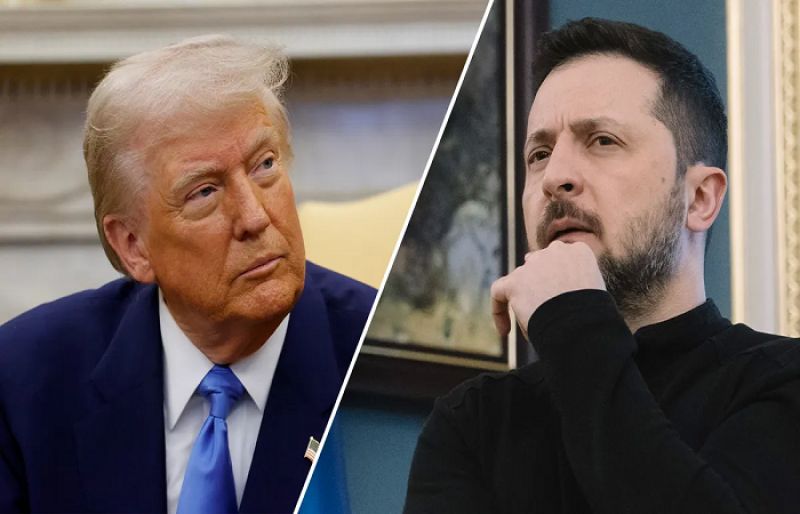

Ukraine’s President Volodymyr Zelensky is flying to Washington on Monday under intense US pressure to agree to a swift end to Russia’s war, but he remains adamant about protecting Kyiv’s interests — while seeking to avoid a repeat of his earlier Oval Office clash with Donald Trump.
Trump extended the invitation to Zelensky after hosting Vladimir Putin, Ukraine’s chief adversary, at a high-profile summit in Alaska a move that stunned many in Ukraine, where hundreds of thousands have been killed since Russia’s 2022 invasion.
The Alaska talks ended without the ceasefire Trump had hoped for.
On Saturday, the US president renewed his call for a rapid, comprehensive peace deal, bluntly saying that Kyiv should accept because “Russia is a very big power, and they’re not.”
Such stark language has put the burden back on Zelensky, leaving him in a precarious position as he prepares for his first return to Washington since his heated Oval Office encounter with Trump in February, which broke down in acrimony.
At that time, Trump publicly scolded him before the world’s media, warning that Zelensky did not “hold the cards” in peace talks and that Kyiv’s stubbornness could push the world closer to a third world war.
Trump’s pursuit of a quick deal defies the intense diplomacy by European allies and Ukraine to convince him that a ceasefire should come first, rather than, as sought by the Kremlin, once a settlement is agreed.
A source familiar with the matter told Reuters that European leaders had also been invited to Monday’s meeting between Trump and Zelensky, though it was unclear who would attend.
Trump briefed Zelensky on his talks with Putin during a call on Saturday that lasted more than an hour and a half, the Ukrainian leader said. They were joined after an hour by European and NATO officials, he added.
“The impression is he wants a fast deal at any price,” a source familiar with the conversation said.
The source said Trump told Zelensky that Putin had offered to freeze the front lines elsewhere as part of a deal, if Ukraine fully withdrew its troops from the eastern Donetsk and Luhansk regions, something Zelensky said was not possible.
Trump and US envoy Steve Witkoff told the Ukrainian leader that Putin had said there could be no ceasefire before that happened, and that the Russian leader could pledge not to launch any new aggression against Ukraine as part of an agreement.
Kyiv has publicly dismissed the idea of withdrawing from internationally recognised Ukrainian land as part of a deal, and says the industrial Donetsk region serves as a fortress holding back Russian advances deeper into Ukraine.
Oleksandr Merezhko, head of the Ukrainian parliament’s foreign affairs committee, told Reuters by phone that Trump’s emphasis on a deal rather than a ceasefire carried great risks for Ukraine.
“In Putin’s view, a peace agreement means several dangerous things Ukraine not joining NATO, his absurd demands for denazification and demilitarisation, the Russian language and the Russian church,” he said.
Any such deal could be politically explosive inside Ukraine, Merezhko said, adding he was worried that Putin’s ostracism in the West had ended.
Avoiding a repeat of the Oval Office row is critical for Zelensky to preserve relations with the US, which still provides military assistance and is the key source of intelligence on Russia’s military activity.
For Ukraine, robust guarantees to prevent any future Russian invasion are fundamental to any serious settlement.
Two sources familiar with the matter said Trump and the European leaders discussed potential security guarantees for Ukraine similar to the transatlantic NATO alliance’s mutual support pledge during their call.
It says, in effect, that an attack on one is treated as an attack on all.
One of the two sources, who requested anonymity to discuss sensitive matters, said European leaders were seeking details on what kind of US role was envisaged.
Zelensky has repeatedly said a trilateral meeting with the Russian and US leaders is crucial to finding a way to end the full-scale war launched by Russia in February 2022.
Trump this week voiced the idea of such a meeting, saying it could happen if his talks in Alaska with Putin were successful.
“Ukraine emphasises that key issues can be discussed at the level of leaders, and a trilateral format is suitable for this,” Zelensky wrote on social media on Saturday.
Putin’s aide, Yuri Ushakov, told the Russian state news agency TASS that a three-way summit had not been discussed in Alaska.

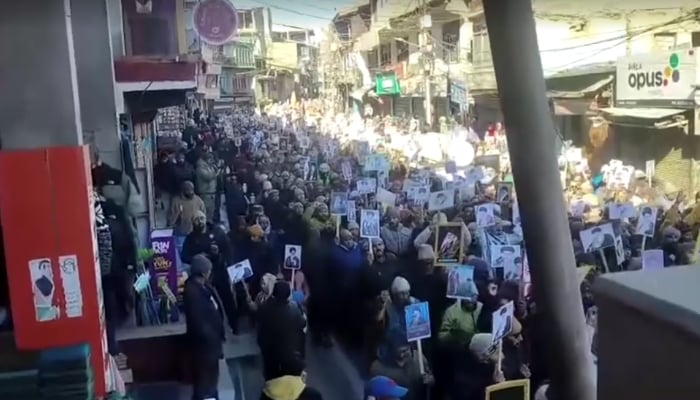
Pro-Iran protesters carried posters of Supreme Leader Ayatollah Ali Khamenei and chanted slogans in the Indian-occupied Ladakh region, as Iran’s leadership tries to quell domestic unrest.
The rally was held under the banner of the Imam Khomeini Memorial Trust, according to a report by The Times of India.
Several processions set off from different parts of Kargil, with large crowds carrying banners of Khamenei and chanting slogans in his support.
The processions converged at the Old Taxi Stand in Kargil, where the main gathering was held, drawing thousands of men and women from across the district, the publication reported.
Protesters raised slogans against the United States and Israel, targeting US President Donald Trump and Israeli Prime Minister Benjamin Netanyahu.
Tehran is seeking to deter US President Donald Trump’s repeated threats to intervene on behalf of anti-government protesters.
Some experts and regional diplomats warn that military intervention could backfire by smothering protests in Iran, fueling an intensified crackdown on those who participated and triggering retaliatory Iranian missile attacks on US bases in the Middle East.
The US is withdrawing some personnel from bases in the Middle East, a US official said on Wednesday, after a senior Iranian official said Tehran had warned neighbours it would hit American bases if Washington strikes.
However, Trump said late Wednesday that killings in Iran’s protests were subsiding and he believed there was no plan for large-scale executions of protesters.
Iranian Foreign Minister Abbas Araqchi had also said there was “no plan” by Iran to hang people, when asked about the anti-government protests.
“There is no plan for hanging at all,” the foreign minister told Fox News in an interview on the “Special Report with Bret Baier” show. “Hanging is out of the question,” he said.
- Turkish FM stresses need for broader regional cooperation, trust.
- Says issues could be resolved if nations “be sure of each other”.
- Bloomberg reports Ankara in advanced talks to join defence pact.
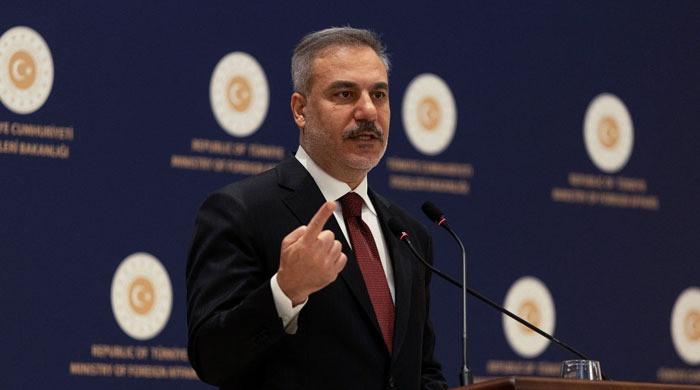
Turkish Foreign Minister Hakan Fidan said on Thursday that talks have been held on a possible defence pact with Pakistan and Saudi Arabia, but no agreement has been signed.
Responding at a press conference in Istanbul to a question about whether there might be such an alliance, Fidan pointed to what he said was a need for broader regional cooperation and trust, and added that regional issues could be resolved if relevant countries would “be sure of each other”.
His comments follow a Bloomberg report last week that said Ankara was at an “advanced stage of discussions” to join the Strategic Mutual Defence Agreement (SMDA) between Pakistan and Saudi Arabia.
The publication, citing people familiar with the matter, reported that the talks were likely to conclude with a deal.
The SMDA between Pakistan and Saudi Arabia treats an attack on either nation as an act of aggression against both. It was signed on September 17, 2025, during Prime Minister Shehbaz Sharif’s visit to Saudi Arabia.
The Bloomberg report stated that Turkiye was mulling joining the pact amid concerns over the reliability of the United States, and its increasingly overlapping interests with those of Saudi Arabia and Pakistan in South Asia.
Pakistan and Turkiye maintain decades-long defence ties, under which Ankara is building corvette warships for the Pakistan Navy.
Turkiye has also upgraded numerous F-16 fighter jets of the Pakistan Air Force, and also shares its drone technology with Islamabad.
Pakistani officials credit the country’s military success against India in the May 2025 conflict to strengthened defence agreements.
On Wednesday, PM Shehbaz said Pakistan was engaged in discussions with multiple countries on defence agreements, including the sale of its fighter jets.
“After Pakistan won the war last year, the demand for Pakistani fighter jets has increased […] many countries are actively engaged with us to acquire the jets,” the premier said while addressing a meeting of the federal cabinet.
Prior to that, Minister for Defence Production Raza Hayat Haraj told the BBC that Islamabad was in talks with several countries over potential agreements to sell JF-17 Thunder fighter jets.
Pakistan and India went to war in May last year after India launched an unprovoked attack on Pakistan following the attack on tourists in the Indian Illegally Occupied Jammu and Kashmir (IIOJK).
New Delhi maintains that the terrorists who killed 26 tourists in IIOJK’s Pahalgam were Pakistanis — an accusation that Islamabad has denied and has also asked India to partake in a neutral investigation.
Pakistan, during the 87-hour conflict, downed its six fighter jets, including three Rafale, and dozens of drones.
The war between the two nuclear-armed nations ended on May 10 with a ceasefire agreement brokered by the United States.
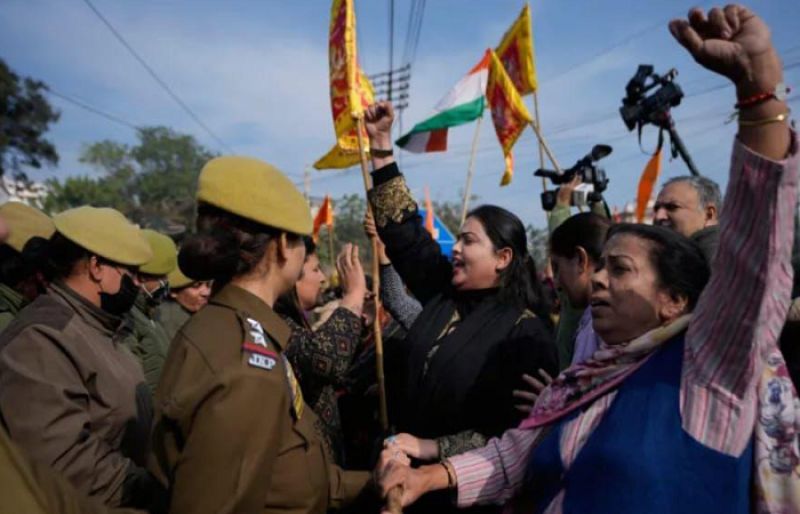

On January 6, the National Medical Commission (NMC), India’s federal regulator for medical education, revoked the recognition of the Shri Mata Vaishno Devi Medical Institute (SMVDMI), located in Reasi district, a mountainous area overlooking the Pir Panjal range that separates the Jammu plains from the Kashmir Valley.
The decision came weeks after protests erupted over the religious composition of the college’s first-ever MBBS batch, launched in November.
Of the 50 students admitted, 42 were Muslims, most of them residents of Kashmir, while seven were Hindus and one was a Sikh.
The college, founded by a Hindu religious charity and partly funded by the government, had launched its first five-year Bachelor of Medicine and Bachelor of Surgery (MBBS) programme this year.
Admissions to medical colleges across India—both public and private—are conducted through a centralized system based on the National Entrance Examination Test (NEET), administered by the federal National Testing Agency (NTA).
More than two million students appear for the exam annually, competing for approximately 120,000 MBBS seats nationwide.
Students who score high typically enter public colleges, where fees are lower but cutoffs are steep. Those meeting the minimum threshold but falling short of public college cutoffs often enroll in private institutions, including SMVDMI.
One such student was Saniya Jan, an 18-year-old from Kashmir’s Baramulla district, who described her selection as a dream come true.
“It was a dream come true – to be a doctor,” she told Al Jazeera. She chose SMVDMI during counselling because it was 316 kilometers from her home, comparatively closer than other medical colleges.
Her parents drove her to Reasi when classes began in November. “My daughter has been a topper since childhood. I have three daughters, and she is the brightest. She really worked hard to get a medical seat,” her father, Gazanfar Ahmad, said.
However, soon after the academic session began, local Hindu groups launched protests, demanding that Muslim students’ admissions be scrapped.
Protesters argued that since the college was largely funded by offerings from devotees at the Mata Vaishno Devi Temple, a prominent Hindu shrine, Muslim students had “no business being there.”
Demonstrations continued for weeks, with protesters gathering daily outside the college gates and raising slogans.
Legislators from Prime Minister Narendra Modi’s Bharatiya Janata Party (BJP) wrote petitions to Kashmir’s Lieutenant Governor, urging that admissions be reserved exclusively for Hindu students.
The lieutenant governor serves as the federally appointed administrator of the disputed region.
As protests escalated, demands extended to the complete closure of the college.
On January 6, the NMC announced it had withdrawn the college’s authorization, citing failure to meet “minimum standard requirements” for medical education.
According to the commission, the college suffered from deficiencies in teaching faculty, hospital bed occupancy, outpatient flow, library facilities, and operating theatres. A day later, the letter of permission allowing the college to operate was formally withdrawn.
Students, however, strongly disputed these claims. “I don’t think the college lacked resources,” said Jahan, a student who gave only her second name. “Some colleges only have one cadaver per batch. This college had four, and every student got individual dissection time.”
Another student, Rafiq, said relatives studying in government medical colleges in Srinagar lacked similar facilities. “Even they don’t have the kind of facilities that we had here,” he said.
Saniya’s father echoed these views, saying that during admission everything appeared normal. “The college was good. The faculty was supportive. It looked like no one cared about religion inside the campus,” he said.
Political analyst Zafar Choudhary, based in Jammu, questioned the timing of the NMC’s decision. “Logic dictates that infrastructure would have improved since classes began. So how did these deficiencies suddenly appear?” he asked.
He also dismissed the protesters’ demands as baseless, noting that admissions are religion-neutral. “There is a system in place. Students give multiple preferences, and selections are based on merit. How is it their fault?” he said.
Al Jazeera attempted to contact SMVDMI’s executive head, Yashpal Sharma, for comment, but he did not respond.
The college has issued no public statement since losing its authorization.
Students have since packed their belongings and returned home.
Another student, Salim Manzoor, pointed out that Hindu students are enrolled under reserved quotas in a medical college in Muslim-majority Kashmir, questioning why Muslim students were now being targeted elsewhere.
The BJP has denied claims that Muslim students were unwelcome, saying concerns stemmed from “religious sentiments” tied to the shrine.
BJP spokesperson Altaf Thakur said the recognition was withdrawn solely due to regulatory shortcomings and not religious bias.
Last week, Omar Abdullah, chief minister of Indian-administered Kashmir, announced that affected students would be accommodated in other medical colleges through supernumerary seats, ensuring their education is not disrupted.
He strongly condemned the protests, stating: “You have played with the future of medical students. If ruining students’ futures brings you happiness, then celebrate it.”
Regional legislator Tanvir Sadiq said the university housing the medical college had received more than $13 million in government funding since 2017, making all Kashmiris stakeholders. “Anyone lawfully domiciled in Kashmir can study there,” he said.
Nasir Khuehami, head of the Jammu and Kashmir Students’ Association, warned that framing education along religious lines could dangerously communalize the sector.
He noted that Muslim-run minority institutions across India do not exclude Hindu students.
Back in Baramulla, Saniya waits anxiously for her future to be decided. “I cleared one of the hardest exams in India and earned my seat on merit,” she said. “Now everything has crashed. This happened because of our identity. They turned our merit into religion.”

Want to go to the national championship game? Got (at least) $2,700?

Pro-Iran protests held in Indian-occupied Ladakh

Burberry celebrates Year of the Horse 2026 with Shanghai campaign

-
 Politics1 week ago
UK says provided assistance in US-led tanker seizure
-

 Entertainment1 week ago
Does new US food pyramid put too much steak on your plate?
-
 Entertainment1 week ago
Why did Nick Reiner’s lawyer Alan Jackson withdraw from case?
-
 Business1 week ago
Trump moves to ban home purchases by institutional investors
-
 Sports1 week ago
PGA of America CEO steps down after one year to take care of mother and mother-in-law
-
 Sports4 days ago
Clock is ticking for Frank at Spurs, with dwindling evidence he deserves extra time
-
 Business1 week ago
Bulls dominate as KSE-100 breaks past 186,000 mark – SUCH TV
-
 Business1 week ago
Gold prices declined in the local market – SUCH TV