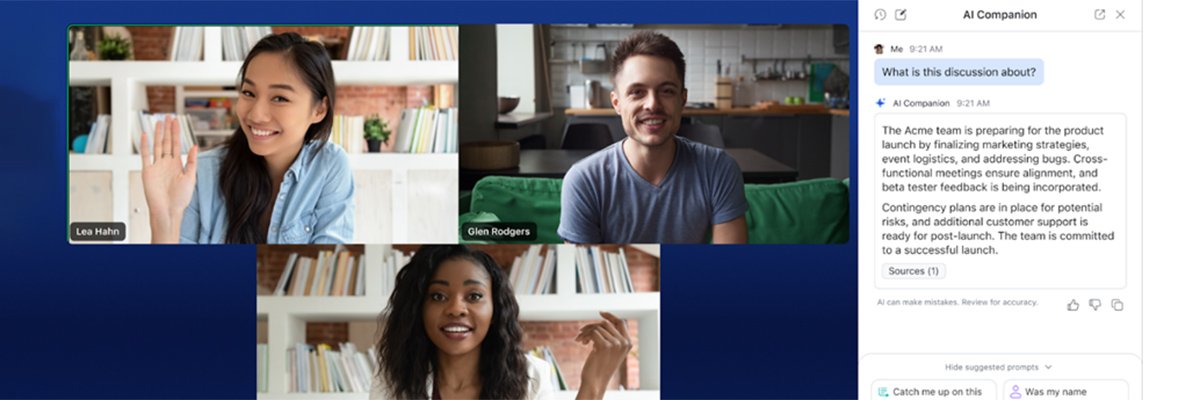
Noting that every conversation moves work forward, and aligning with its goal to connect conversations, enterprise data and workflows so people can move seamlessly from discussion to execution, Zoom has added an agentic search function to its platform and extended its My Notes system to mobile devices.
The bigger picture message from the artificial intelligence (AI)-first work and communications platform provider is that it is aiming to close the gap between conversation and execution. That is to say that despite conversations happening everywhere – on mobile devices, across platforms and in-person – Zoom believes the systems of record that have traditionally supported work aren’t keeping up.
By bringing the power of My Notes to mobile and making enhancements to its AI Companion platform, Zoom said that whether a discussion happens in a boardroom, over coffee, or on a call, the outcome is the same: clear next steps and work that gets done after every conversation so people can stop losing momentum.
The company observed that with manual notetaking, thoughts are often incomplete, action items are missed, and hours are spent reconstructing context after the fact. While most note-taking tools capture conversations, Zoom said few help finish the work that results from them.
“Work happens everywhere, and now notetaking can come with you, enabling you to never miss an important insight or key decision, whether in a virtual meeting or a spontaneous coffee shop meet-up,” said Zoom chief product officer Russell Dicker. “My Notes is a key part of taking conversations to completion, which allows work to move forward seamlessly, so you can focus on the people in front of you instead of worrying about how to reconstruct the conversation context later.”
My Notes is described as an AI-first personal notetaker that, when on mobile, allows users to capture and act on conversations from Zoom and in-person meetings, staying present in the moment while AI handles the documentation and initiates next steps.
My Notes is a key part of taking conversations to completion, which allows work to move forward seamlessly, so you can focus on the people in front of you instead of worrying about how to reconstruct the conversation context later Russell Dicker, Zoom
It works across video conferencing platforms, Zoom, Microsoft Teams, Google Meet and in-person conversations. Instead of just transcribing messages, it is designed to capture, organise and convert every discussion into actionable next steps, right where the conversation happens. Notes stay personal by default, but users can share summaries with their team via Zoom Canvas, Chat or Slack, and create reusable templates for recurring meetings such as one-to-ones, brainstorms or client calls.
Key features, according to Zoom, include the ability to build from the conversation out, capturing “what matters” and connecting it directly to what happens next. My Notes automatically generates concise summaries, extracts action items and tracks decisions, so users can focus on conversations instead of documenting them.
Automated workflows can be triggered directly from My Notes, such as sending follow-up emails or creating tasks, so next steps happen while context is still fresh. Workflows are available both to hosts and participants.
Select predefined templates designed for a specific role – sales, marketing, IT, HR – or with custom workflows created when scheduling a meeting. These can be attached during a My Notes session and managed with follow-up actions afterwards. Users can review, edit and approve steps, combining automation efficiency with human oversight.
Expanded agentic search capabilities are said to mean that unlike traditional search, which only looks within a single app, agentic search for Custom AI Companion lets users query across 10 available third-party connectors, now with extended capabilities for Salesforce (such as specific account information), Workday (such as employee records or time-off balances), and ServiceNow (such as IT tickets or incident status), as well as Zoom Meetings, Chat, Phone and Canvas.
With built-in reasoning and context awareness, agentic search not only retrieves information but also interprets intent, surfacing the most relevant insights and next steps.
The result, according to Zoom, is that “nothing falls through the cracks”.
In the aftermath of a devastating earthquake, unpiloted aerial vehicles (UAVs) could fly through a collapsed building to map the scene, giving rescuers information they need to quickly reach survivors.
But this remains an extremely challenging problem for an autonomous robot, which would need to swiftly adjust its trajectory to avoid sudden obstacles while staying on course.
Researchers from MIT and the University of Pennsylvania developed a new trajectory-planning system that tackles both challenges at once. Their technique enables a UAV to react to obstacles in milliseconds while staying on a smooth flight path that minimizes travel time.
Their system uses a new mathematical formulation that ensures the robot travels safely to its destination along a feasible path, and that is less computationally intensive than other techniques. In this way, it generates smoother trajectories faster than state-of-the-art methods.
The trajectory planner is also efficient enough for real-time flight using only the robot’s onboard computer and sensors.
Named MIGHTY, the open-source system does not require proprietary software packages that can cost hundreds of thousands of dollars. It could be more readily deployed in a wider variety of real-world settings.
In addition to search-and-rescue, MIGHTY could be utilized in applications like last-mile delivery in urban spaces, where UAVs need to avoid buildings, wires, and people, or in industrial inspection of complex structures, such as wind turbines.
“MIGHTY achieves comparable or better performance using only open-source tools, which means any researcher, student, or company — anywhere in the world — can use it freely. By removing this cost barrier, MIGHTY helps democratize high-performance trajectory planning and opens the door for a much broader community to build on this work,” says Kota Kondo, an aeronautics and astronautics graduate student and lead author of a paper on this trajectory planner.
Kondo is joined on the paper by Yuwei Wu, a graduate student at the University of Pennsylvania; Vijay Kumar, a professor at UPenn; and senior author Jonathan P. How, a Ford professor of aeronautics and astronautics and a principal investigator in the Laboratory for Information and Decision Systems (LIDS) and the Aerospace Controls Laboratory (ACL) at MIT. The research appears in IEEE Robotics and Automation Letters.
Overcoming trade-offs
When Kondo was a child, the Fukushima Daiichi nuclear accident occurred following the Great East Japan Earthquake. With school cancelled, Kondo was stuck at home and watched the news every day as workers explored and secured the reactor site. Some workers still had to enter hazardous areas to contain the damage and assess the situation, exposing them to high doses of radioactive material.
“I became passionate about creating autonomous robots that can go into these dynamic and dangerous situations, then come back and report to humans who stay out of harm’s way,” Kondo says.
This task requires a strong trajectory planner, which is software that decides the path a robot should follow to safely get from point A to point B.
But many existing systems force tradeoffs that limit performance.
While some commercial systems can rapidly generate smooth trajectories, they can cost hundreds of thousands of dollars. Open-source alternatives often underperform compared to commercial solvers or are difficult to use.
With MIGHTY, Kondo and his colleagues developed an open-source system that produces high-quality, smooth trajectories while reacting to obstacles in real-time, and which runs fast enough for flight using only onboard components.
To do this, they overcame a key challenge that limits many open-source systems.
These methods usually estimate how long it will take the robot to get from point A to point B as a first step. From that fixed estimation of travel time, the planner finds the best path to reach the destination.
While using a fixed travel time allows the planner to rapidly generate a trajectory, it has drawbacks. For one, if the UAV must go far out of its way to avoid obstacles, it could be forced to crank up the speed to meet the fixed travel-time budget. This makes it harder to avoid sudden hazards.
A MIGHTY method
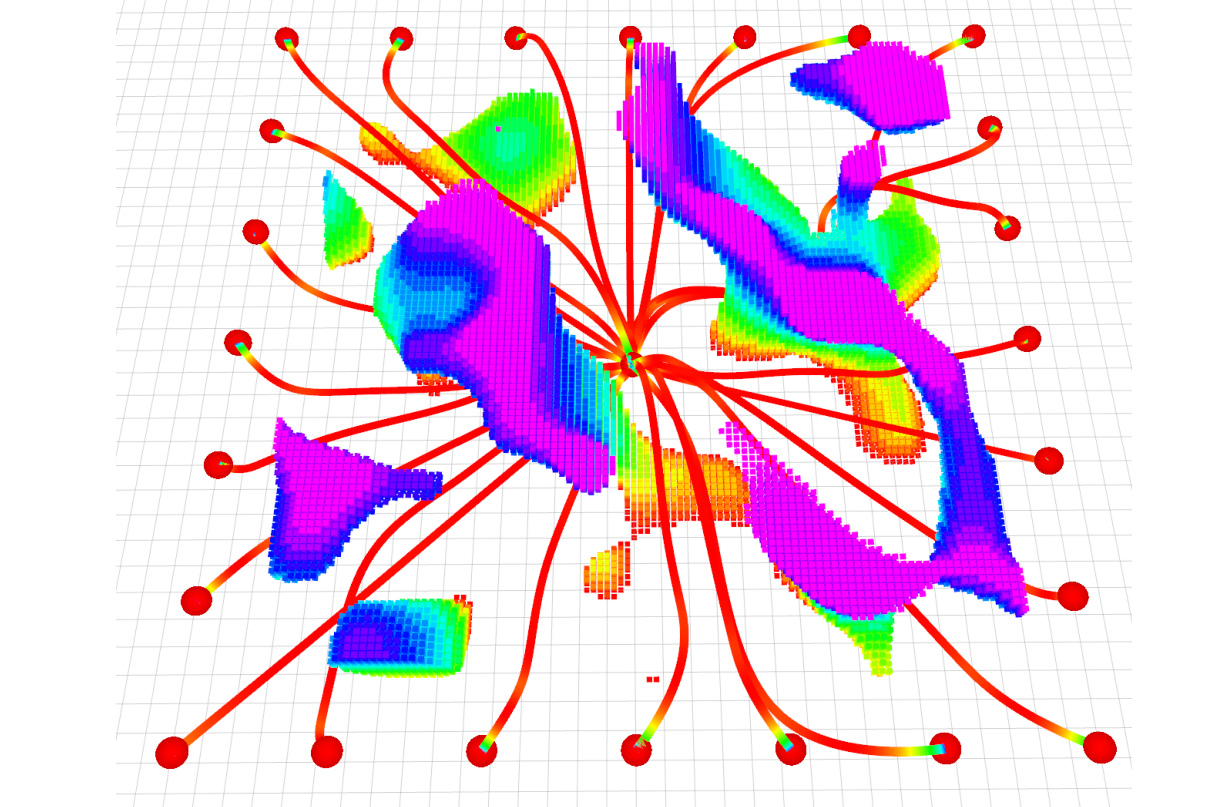
Instead, MIGHTY uses a mathematical technique, called a Hermite spline, that optimizes the travel time and flight path together, in a single step, to form a smooth trajectory that can be precisely controlled.
“Optimizing the spatial and temporal components together gets us better results, but now the optimization becomes so much bigger that it is harder to solve in a feasible amount of time,” Kondo says.
The researchers used a clever technique to reduce this computational overhead.
Instead of generating a trajectory from scratch each time, MIGHTY makes an initial guess of a trajectory. Then it refines the trajectory through an iterative optimization, using a map of the scene generated by the UAV’s lidar sensors.
“We can make a decent guess of what the trajectory should be, which is a lot faster than generating the entire thing from nothing,” Kondo says.
This enables MIGHTY to react in real-time to unknown obstacles while keeping the trajectory smooth and minimizing travel time. The system utilizes the UAV’s onboard components, which is important for applications where a robot might travel far from a base station.
In simulated experiments, MIGHTY needed only about 90 percent of the computation time required by state-of-the-art methods, while safely reaching its destination about 15 percent faster than these approaches.
When they tested the system on real robots, it reached a speed of 6.7 meters per second while avoiding every obstacle that appeared in its path.
“With MIGHTY, everything is integrated in one piece. It doesn’t need to talk to any other piece of software to get a solution. This helps us be even faster than some of the commercial solvers,” Kondo says.
In the future, the researchers want to enhance MIGHTY so it can be used to control multiple robots at once and conduct more flight experiments in challenging environments. They hope to continue improving the open-source system based on user feedback.
“MIGHTY makes an important contribution to agile robot navigation by revisiting the trajectory representation itself. Hermite splines have already been successfully used in visual simultaneous localization and mapping, and it is nice to see their advantages now being exploited for trajectory planning in mobile robots. By enabling joint optimization of path geometry, timing, velocity, and acceleration while retaining local control of the trajectory, MIGHTY gives robots more freedom to compute fast, dynamically feasible motions in cluttered environments,” says Davide Scaramuzza, professor and director of the Robotics and Perception Group at the University of Zurich, who was not involved with this research.
This research was funded, in part, by the United States Army Research Laboratory and the Defense Science and Technology Agency in Singapore.
The note from the communications team then, quite remarkably, lists some stats in an attempt to paint the launch in a positive light, as opposed the retail bin-fire it seemingly was: “We have received millions of clicks on our website. This new collaboration is literally making social media explode, with over 6 billion views within one week; by now, it is already 11 billion. All in all, the Royal Pop Collection is captivating the entire world, not least because the Royal Pop is, quite surprisingly, not a wristwatch.”
Audemars Piguet seems unhappy with how Swatch has handled the launch of its collaboration on the Royal Pop. AP told WIRED that “we understand the questions around the Royal Pop launch experience. As retail operations are handled by Swatch and their local teams, Swatch is best placed to comment on the operational handling of the launch. From AP’s perspective, safety and a positive experience for clients and teams remain the priority.” The brand did not respond when asked if it considered Swatch’s handling of the Royal Pop launch a “safe and positive experience”.
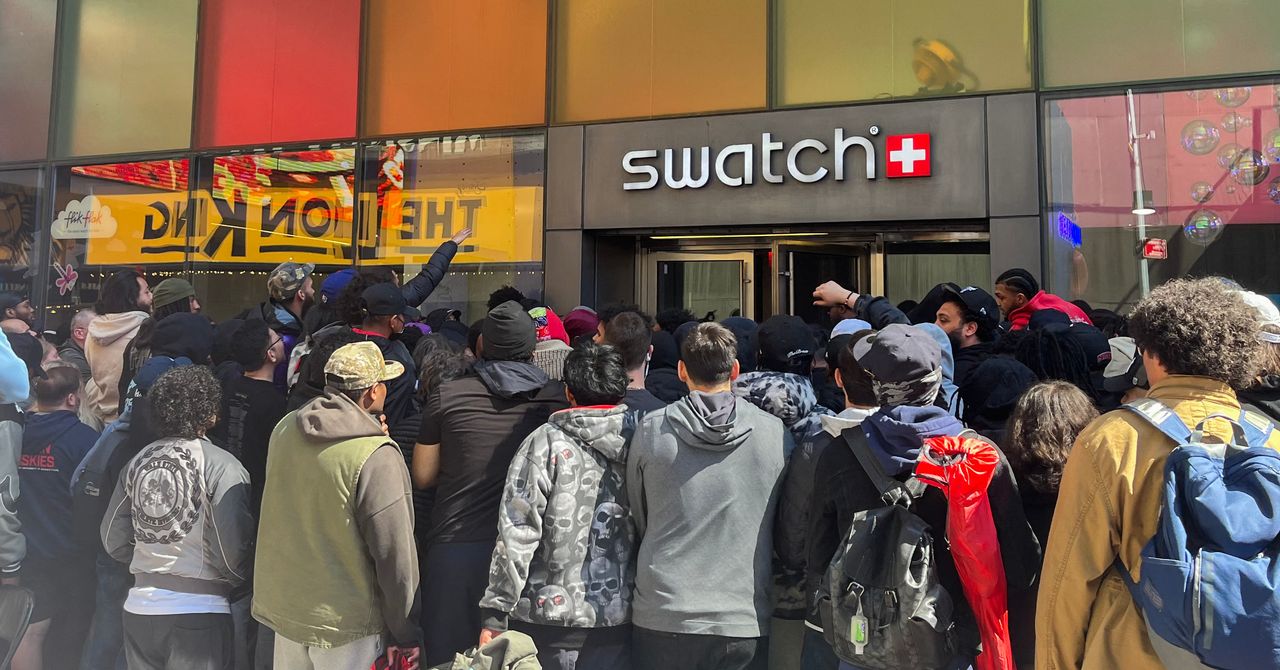
The madness of the Royal Pop launch is that, considering all that could have been learned from the MoonSwatch release in 2022, Swatch decided to repeat the playbook that went so badly wrong four years ago. This is a move, according to experts, that was entirely avoidable and utterly unnecessary.
Hype With No Control
“Luxury drops cannot rely on surprise, scarcity and social frenzy as the strategy, then act surprised when human behaviour follows,” says Kate Hardcastle, author of The Science of Shopping and advisor to brands including Disney, Mastercard, Klarna and American Express. “Retailers are already dealing with heightened tensions around theft, aggression and crowd management globally. Add a highly restricted product, long queues, resale economics, social media amplification and the emotional intensity attached to luxury access, and the environment can escalate very quickly if not expertly managed.”
Hardcastle confirms that what is particularly difficult for Swatch here is that the MoonSwatch launch already provided a live blueprint of the risks. “Once a brand has experienced scenes involving crowd surges, disappointment and policing,” she says, “the obligation shifts from reacting to proactively engineering a safer customer experience. Successful luxury houses increasingly control the experience with far greater precision.”
Neil Saunders, managing director of retail at Global Data, is even more candid. “The chaos does not reflect well on Swatch, and it probably makes Audemars Piguet wonder what on Earth it has gotten itself into,” he says. “Wanting to create some hype is understandable, but not being able to control it becomes damaging both commercially and for the brand image. Swatch should understand this better than most as it has been through this before with MoonSwatch.”
Not only Saunders and Hardcastle, but scores of commenters on Swatch’s Instagram post, point out well-known and obvious solutions that would have mitigated or entirely avoided the Royal Pop’s shambolic release.
“We have seen other premium or limited launches use staggered collection windows, verified appointment systems, geo-ticketing, VIP allocation tiers, timed QR access, private client previews and controlled queue technology to reduce volatility while preserving excitement,” says Hardcastle, adding that some combine digital ballots with curated in-store experiences so consumers feel part of an occasion rather than participants in a scramble.
Anyone who has had chickenpox shares one distinct memory: the relentless, all-consuming itch.
Ciara DiVita was only 3 years old when she caught the virus, but she remembers it well—along with the oven mitts she was made to wear to stop herself scratching. She also recalls being taken to hang out with her cousin while covered in blisters, in the hopes of deliberately infecting them.
DiVita, now 30, was actually the second in the chain, having been taken by her parents to catch chickenpox from an infectious friend. “I imagine the chain continued and my cousin gave it to someone else at a chickenpox play date,” she says.
A lot has changed over the past three decades, most notably the development of a chickenpox vaccine, meaning the virus is no longer the childhood rite of passage it once was.
Thanks to the vaccine’s success, children today are much less likely to be exposed to the infection at school or on the playground.
Chickenpox parties are also largely considered a relic of the past—a strategy many Gen X and millennial children were subjected to before vaccines became routine. But much like the virus itself—latent, opportunistic—they haven’t disappeared entirely.
Before a vaccine existed, chickenpox, which is caused by the varicella-zoster virus, felt unavoidable. In temperate countries like the UK and the US, around 90 percent of children caught the virus before adolescence (in tropical countries the average age of infection is higher).
It’s nothing to do with chickens. The splotchy, scratchy, highly contagious disease is possibly named after the French word for chickpea, pois chiche, according to one theory, because the round bumps caused by the virus resemble their size and shape. While most infant cases are mild, adolescents and adults are more likely to develop severe complications.
This is where the idea of “getting it over and done with” emerged from, according to Maureen Tierney, associate dean of clinical research and public health at Creighton University in Omaha, Nebraska.
“You were trying to have your child get the disease when they were at the greatest chance of not having complications,” Tierney says, explaining that, generally speaking, the older the patient, the more severe the infection can be.
While varicella-zoster is usually a mild, self-limiting disease in children, it can be much more severe—and sometimes life-threatening—in adults.
“I had an otherwise healthy adult patient who died of chickenpox pneumonia when I was first practicing,” Tierney says. “You never forget those scenarios.”
The virus spreads rapidly through respiratory droplets and contact with fluid from its characteristic blisters, meaning if one child contracts it, siblings and classmates are likely to be next, if unvaccinated.
Before the existence of social media, the idea that children should deliberately infect each other spread just as rapidly around communities—in conversations in the school yard, church groups, and pediatric waiting rooms—leading to the popularity of so-called chickenpox parties.
Parents swapped advice about oatmeal baths and calamine lotion and arranged to bring children together when one was thought to be infectious—despite the practice never being an official medical recommendation.
“They thought, well, if it’s going to happen to my kid anyway, it might as well happen in a controlled environment,” says Monica Abdelnour, a pediatric infectious disease specialist at Phoenix Children’s Hospital. “The families were ready to encounter this infection, deal with it, and then move on.”
While the majority of children who develop chickenpox feel well again within a week or two, around three in every 1,000 infected experience a severe complication such as pneumonia, serious bacterial skin infections, encephalitis (inflammation of the brain), or meningitis.










 Entertainment6 days ago
 Tech1 week ago
 Fashion6 days ago
 Entertainment1 week ago
 Entertainment1 week ago
 Sports1 week ago
 Tech1 week ago
 Tech1 week ago