

Fashion
$6 bn of India’s T&A exports to the EU concentrated in 20 HS codes

Analysis at the product level
Over $6 billion of India’s textile and apparel exports to the EU are concentrated in just 20 four-digit HS codes, out of a total export base of ~$7.5 billion, making the India–EU FTA a sharply product-specific opportunity rather than a broad-based boost.
Finished apparel emerges as the primary beneficiary, as tariff parity improves India’s competitiveness against other Asian suppliers.
India and the European Union have signed the long-awaited Free Trade Agreement (FTA), with the pact expected to come into force in early 2027 (or earlier) following ratification. While trade flows will remain largely unchanged in the near term, product-wise export data indicates that the agreement could reshape India’s textile and apparel exports to the EU over the medium term, with gains concentrated in finished apparel rather than intermediate products.
India’s EU-facing textile and apparel exports are highly concentrated. The top 20 four-digit HS codes account for more than $6 billion, out of total textile and apparel exports of roughly $7.5 billion to the EU, underscoring where the FTA’s eventual impact is likely to be most visible.
Apparel dominates India’s EU export basket
Finished apparel forms the backbone of India’s textile and apparel exports to the EU, led by women’s wear, knitted garments, and core woven apparel. Home textiles represent the second pillar, while yarns, fabrics, and fibre-based products contribute a smaller share in value terms.
Table 1: India’s total Textile and Apparel exports to the EU-27 – Top 20 four-digit HS codes (2025)
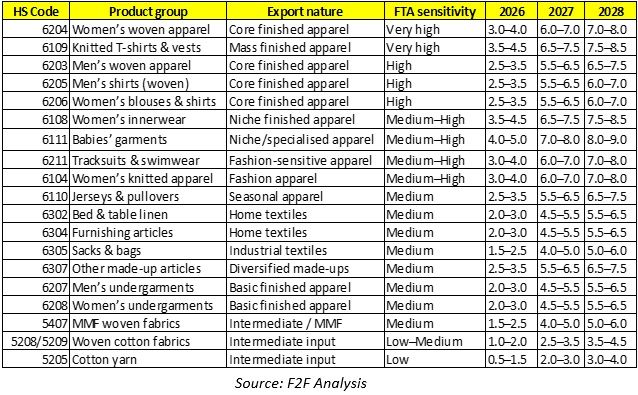
Export growth in 2026 is expected to remain moderate as buyers focus on audits, compliance checks, and limited pilot orders ahead of implementation. A clearer divergence is expected from 2027, once tariff concessions take effect, with finished apparel emerging as the most responsive category.
Table 2: India–EU textile exports – Product-wise growth outlook (YoY growth %, indicative)
What to watch till 2027
Product readiness is expected to improve fastest in high-volume apparel categories, while home textiles see incremental upgrades rather than greenfield expansion. Compliance alignment, particularly on sustainability and traceability will be a key differentiator, with cotton-based segments better positioned than MMF apparel. Buyer engagement is likely to intensify through audits and pilot orders ahead of implementation, while competing suppliers such as Bangladesh and Vietnam are expected to defend share through pricing and buyer integration rather than capacity expansion. Final tariff schedules and rules of origin will determine which products benefit first.
The India–EU FTA signals a medium-term reset, not an immediate surge. With over $6 billion concentrated in the top 20 product groups, finished apparel is best positioned to lead post-2027 gains, while home textiles compound steadily and intermediates remain less responsive.
Fibre2Fashion News Desk (AA)











The upcoming official visit to Russia by Vietnamese Prime Minister Pham Minh Chinh is expected to open new opportunities to advance bilateral trade ties to a higher level, according to a domestic news agency.
Vietnam-Russia trade reached $700 million in the first two months this year—down by 5.1 per cent YoY.
The decline, however, is perceived as short-term, with the overall long-term growth trajectory being stable.
The upcoming official visit to Russia by Vietnamese PM Pham Minh Chinh is expected to open new opportunities to advance bilateral trade ties to a higher level.
To boost bilateral trade, the Vietnamese Ministry of Industry and Trade (MoIT) plans to refine and expand cooperation mechanisms, fully utilise existing agreements, particularly the Eurasian Economic Union (EAEU)-Vietnam free trade agreement (FTA), and balance trade structures.
EAEU, established in 2015, comprises Russia, Armenia, Belarus, Kazakhstan and Kyrgyzstan.
Flexible joint-venture models that maximise economic complementarity will be given priority along with vigorous trade promotion and business connectivity.
An annual Vietnam-Russia trade and investment forum will serve as a stable dialogue channel for enterprises, trade promotion bodies, commerce chambers and officials.
The ministry will also organise specialised trade and investment missions to Russia, support participation in fairs, exhibitions and seminars, and help Vietnamese firms connect with major distribution networks, especially supermarket chains and large e-commerce platforms.
Fibre2Fashion News Desk (DS)
The Misto segment recorded annual revenue of KRW 829.6 billion, down 9.6 per cent YoY due to US restructuring and inventory clearance. However, operating profit rebounded to KRW 74.7 billion, signalling a strong turnaround, with the segment delivering its fourth consecutive quarter of profitability.
Misto Holdings has reported revenue of KRW 4.47 trillion (~$2.97 billion) in 2025, up 4.7 per cent YoY, with operating profit rising 31.6 per cent.
While the Misto segment declined, profitability improved.
Growth was driven by Greater China and steady Acushnet performance.
In Q4, revenue rose 6.3 per cent, led by Acushnet, while the company returned KRW 285.4 billion to shareholders.
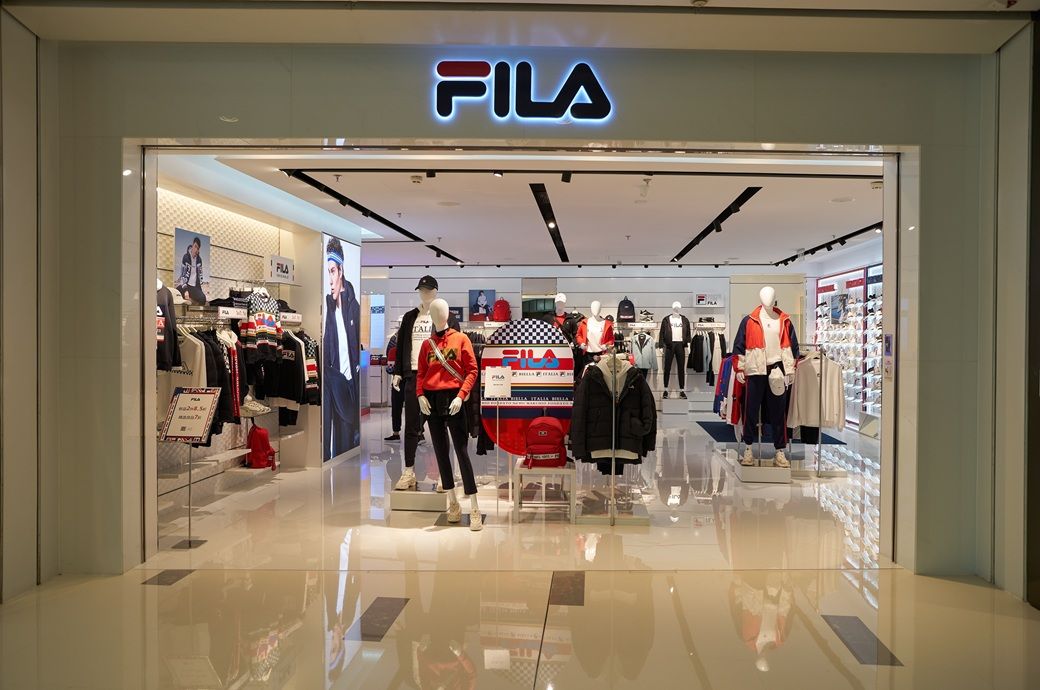
The growth momentum was led by Greater China, which delivered triple-digit expansion in 2025 as the company scaled its presence through leading K-fashion brands such as Marithe+Francois Girbaud, Matin Kim, Rest and Recreation, and Raive. In Korea, Fila continued to benefit from stable demand in its footwear franchise models, Misto Holdings said in a press release.
The Acushnet segment maintained steady performance, supported by robust demand for golf equipment and premium positioning, contributing to overall earnings stability.
“2025 was a meaningful year in which we further clarified our identity as a global brand portfolio company following our corporate name change. Based on the expansion of our Greater China business, improved profitability in the Misto segment, and Acushnet’s solid growth, we strengthened the stability of our earnings. We will continue to enhance brand value, maintain profitability-focused management, and execute our shareholder return policy to support sustainable growth,” said Ho Yeon (Aaron) Lee, CFO of Misto Holdings.
Meanwhile, in the fourth quarter (Q4), revenue rose 6.3 per cent YoY to KRW 915.2 billion, supported by profitability-focused operations, restructuring of its US business, and continued growth at Acushnet despite macroeconomic uncertainty.
Acushnet remained a key contributor in Q4, with revenue increasing 10.9 per cent YoY to KRW 698.3 billion, driven by strong sales of Titleist T-Series irons and SM10 wedges, along with higher average selling prices for FootJoy golf shoes.
Misto Holdings also advanced its shareholder return strategy, returning approximately KRW 285.4 billion through dividends and share repurchases in 2025, achieving 57.1 per cent of its three-year target.
Fibre2Fashion News Desk (SG)

However, actual use of foreign direct investment (FDI) in the Chinese mainland declined during the same period, falling 5.7 percent year on year (YoY) to ¥161.45 billion ($23.43 billion), as mentioned in official ministry figures.
China established 8,631 new foreign-invested firms in the first two months of the year, up 14 per cent YoY, even as actual FDI inflows fell 5.7 per cent to ¥161.45 billion ($23.43 billion).
High-tech industries attracted ¥63.21 billion ($9.19 billion), rising 20.4 per cent and accounting for 39.2 per cent of total inflows, while investment from Canada and Switzerland surged sharply.
Sector-wise, FDI inflows totalled ¥47.52 ($6.90 billion) in manufacturing and ¥111.22 billion ($16.17 billion) in services, indicating continued dominance of the service sector in attracting foreign capital. High-tech industries remained a key growth area, drawing ¥63.21 billion ($9.19 billion) in investment, up 20.4 per cent year on year (YoY) and accounting for 39.2 percent of the national total.
In terms of source countries, investment from Canada and Switzerland recorded strong gains, surging 210 per cent and 41.3 per cent respectively compared with the same period last year, highlighting a shift in the composition of foreign capital entering the Chinese market.
Fibre2Fashion News Desk (JP)


Mortgage rate rises ‘coming thick and fast’

Vietnam-Russia trade down 5.1% YoY in Jan-Feb 2026; decline temporary

Gas shortages push India’s poor back to wood and coal

-

 Entertainment1 week ago
Strategic oil stocks to be released ‘immediately’ in Asia and Oceania: IEA
-
 Business1 week ago
Stocks To Watch: Tata Motors, IndiGo, Jindal Stainless, GMR Airports, Hindalco, And Others
-
 Business1 week ago
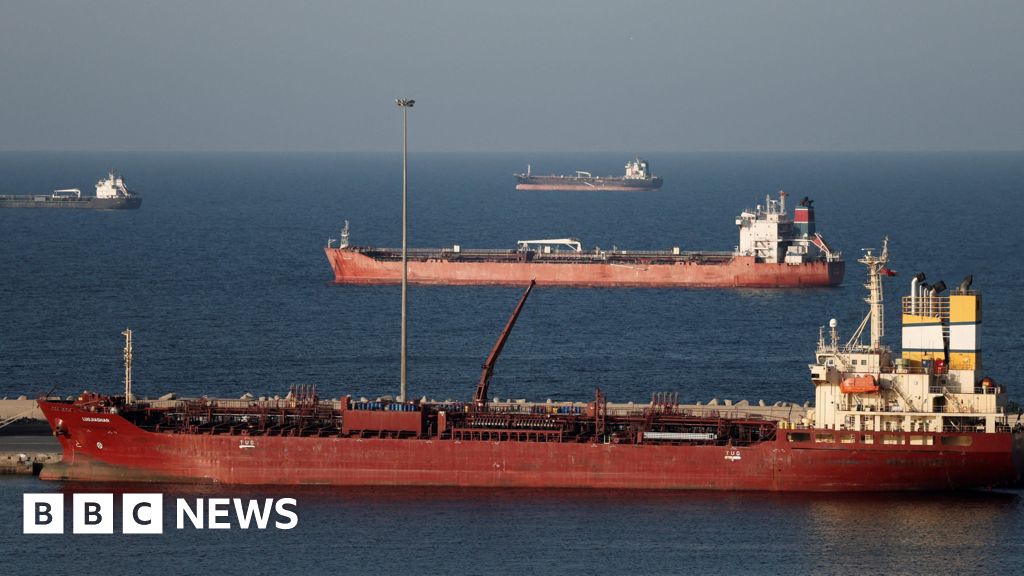
UK looking at all options to secure Strait of Hormuz, says Ed Miliband
-

 Tech1 week ago
Early Deals From the Amazon Spring Sale That Passed Our BS Test
-

 Tech6 days ago
Justice Department Says Anthropic Can’t Be Trusted With Warfighting Systems
-

 Sports1 week ago
Team USA advances to World Baseball Classic final after win over Dominican Republic
-

 Sports6 days ago
March Madness 2026 – How to watch in SA, start time, schedule, TV channel for NCAA championship basketball tournament
-

 Sports1 week ago
More Iran women’s soccer players decide to leave Australia