

Fashion
US PMI slips to 52 in Sept, tariffs slow factory output & new orders

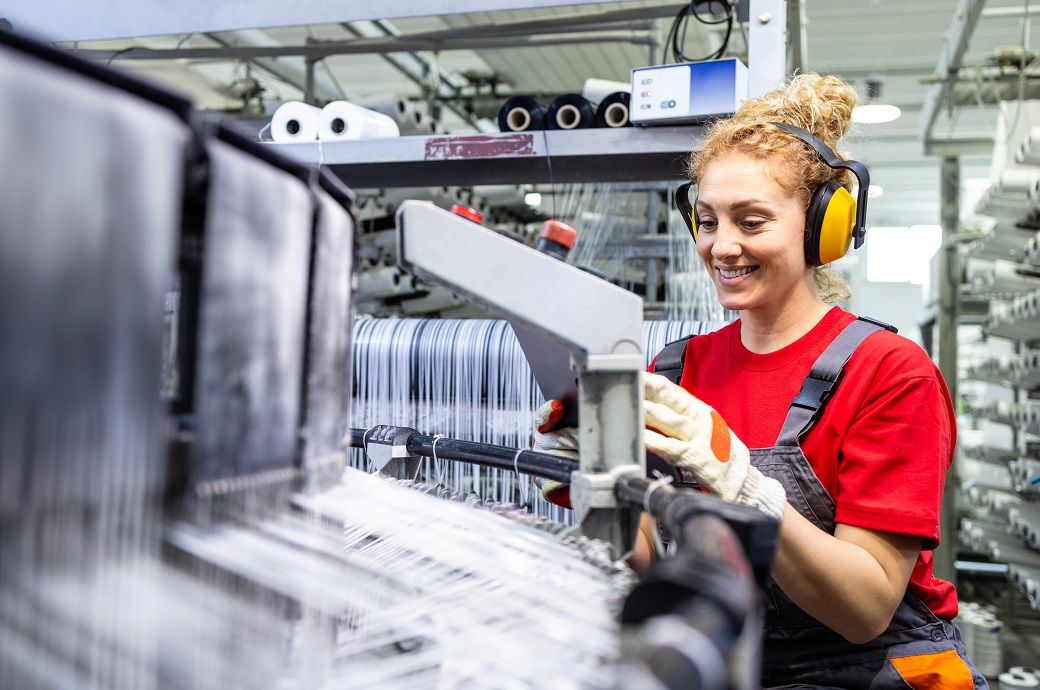
The latest survey showed a weaker gain in production, whilst new order book growth softened as tariffs continued to weigh on exports. Tariffs and broader policy uncertainty also dampened firms’ assessment of the business outlook, but expectations of manufacturing production reshoring and hopes of better demand in the year ahead meant sentiment remained positive overall, S&P Global said in a press release.
Cost pressures meanwhile were again elevated, with tariffs reportedly the dominant factor pushing up overall purchase prices. Whilst firms sought to pass on higher supplier costs to clients, competitive pressures and signs of faltering demand meant output charge inflation softened to an eight-month low.
The S&P Global US Manufacturing PMI slipped to 52 in September from 53 in August, indicating slower expansion.
Tariffs weighed on exports—especially to Canada and Mexico—and drove up costs, while production and new orders rose modestly.
Despite weaker demand, employment increased, and optimism persisted on reshoring prospects.
Selling price inflation eased to an eight-month low.
Weaker growth emanated from a slowdown in new order book gains. Although up for a ninth successive month, new orders rose only modestly and at a pace below the survey average. Exports were a source of demand weakness, falling overall for a third month in a row. Tariffs were reported to have weighed on export sales especially to Canada and Mexico.
A slowdown in demand growth led to weaker output gains in September. Overall output increased at a much weaker pace than August’s recent high. However, rising to a faster degree than new orders, production increased sufficiently for firms to add to their stocks of finished goods for a second month in succession.
Work outstanding declined at the fastest pace for five months, in part due to an expansion of labour capacity. September’s survey showed that employment rose solidly as firms filled vacancies and as part of business expansion plans.
A positive outlook also helped encourage manufacturers to take on additional staff, with several anticipating an increase in sales over the next 12 months. In some instances, tariffs were seen as driving an expansion of domestic focused industrial output.
The overall business activity expectations subsequently improved slightly compared to August. That was despite some ongoing uncertainty amongst the panel related to trade and wider federal government policies.
Meanwhile, tariffs continued to push up input prices during September, with vendors reportedly raising their charges. Although input cost inflation weakened since August, it remained elevated in the context of the survey history. High prices discouraged purchasing activity in September, which overall rose only slightly on the month. Where buying rose, this was linked to a desire to bolster inventories, in part due to tariff and supply-side uncertainty. Difficulties importing goods and stock shortages were again noted as driving average vendor delivery times higher in September.
Regarding manufacturers’ own selling prices, these rose at a noticeably slower pace in September as competitive pressures and slower demand growth weighed on company pricing power. Although still rising at a historically strong pace, output price inflation softened in September to its lowest level since January, added the release.
“US manufacturing production rose for a fourth successive month in September, but the upturn lost momentum as companies reported a drop in order book growth alongside a buildup of unsold finished goods inventories,” said Chris Williamson, chief business economist at S&P. “Despite a slowing in demand growth, many factories produced more goods, using up raw materials that had been stockpiled ahead of tariff implementation. This poses a downside risk to future production in the absence of a pickup in demand, though also hints at some alleviation of price pressures: there is already evidence of companies offering excess stock to customers at reduced rates.”
“A growing uncertainty, however, relates to supply chains, with September seeing an increase in tariff-related vendor delays, which threaten to curb production and push up prices if these difficulties persist or intensify,” added Williamson.
Fibre2Fashion News Desk (SG)












Imports of knitted apparel and clothing accessories (Chapter **) were valued at $***.*** million in January ****, slightly lower than $***.*** million a year earlier. The imports of non-knitted apparel and clothing accessories (Chapter **) totalled $***.*** million, down *.** per cent from $***.*** million in January ****.
South Korea typically exports fabrics and textile materials while importing readymade garments. During January ****, exports of man-made filaments, strips and similar materials (Chapter **) were valued at $***.*** million, down *.** per cent from $***.*** million a year earlier. Exports of knitted or crocheted fabrics (Chapter **) reached $***.*** million, easing *.** per cent from $***.*** million.

The additional week in the fourth quarter of fiscal 2025, compared to the fourth quarter of fiscal 2024, contributed approximately $37.0 million in consolidated net sales. On a comparable week basis, net sales grew 3.4 per cent. On a reported basis including the extra week in fiscal 2025, the US retail, international, and US wholesale segments grew 9.4 per cent, 10.2 per cent, and 3.4 per cent, respectively. US retail comparable net sales increased 4.7 per cent. Changes in foreign currency exchange rates used for translation in the fourth quarter of fiscal 2025, as compared to the fourth quarter of fiscal 2024, had a favourable effect on consolidated net sales of approximately $3.0 million, or 0.3 per cent.
Carter’s reported Q4 fiscal 2025 sales of $925.5 million, up 7.6 per cent, boosted by a $37 million extra week; on a comparable basis, sales rose 3.4 per cent.
Growth spanned US retail, international, and wholesale segments.
Operating income edged up to $84.7 million, though margin dipped to 9.2 per cent.
Full-year sales increased 1.9 per cent to $2.9 billion.
Operating income increased $1.5 million, or 1.8 per cent, to $84.7 million, compared to $83.2 million in the fourth quarter of fiscal 2024. Operating margin decreased 50 basis points to 9.2 per cent, reflecting incremental tariff costs, investments in product mix and make, and higher performance-based compensation provisions, partially offset by higher pricing, lower corporate expenses, and an asset impairment charge in the prior year period.
“Carter’s delivered improved fourth quarter results with each of our business segments posting sales growth over last year. We see momentum building behind our products and demand creation initiatives, which have driven an improvement in the rate of traffic, new customer acquisition, higher realised pricing, and increased penetration of the best portions of our product assortments. All of this gives us confidence that our strategies are gaining traction,” said Douglas C Palladini, chief executive officer & president.
“2025 was a year of meaningful progress in stabilising our business while responding to significant new tariffs. We took actions to right-size our cost structure and we launched several important initiatives to improve the productivity of our merchandise assortments and store fleet. We also strengthened our balance sheet and liquidity with the successful refinancing of our long-term debt and a new asset-based revolving credit facility in place,” Palladini added.
Consolidated net sales increased $54.3 million, or 1.9 per cent, to $2.90 billion, compared to $2.84 billion in fiscal 2024, reflecting growth in our US retail and international segments that were partially offset by a decline in the US wholesale segment. The additional week in fiscal 2025, compared to fiscal 2024, contributed approximately $37.0 million in consolidated net sales. On a comparable week basis, net sales grew 0.6 per cent. On a reported basis including the extra week in fiscal 2025, the company’s US retail and international segments grew 3.5 per cent, and 6.3 per cent, respectively, while US wholesale net sales declined 2.0 per cent. US retail comparable net sales increased 1.4 per cent. Changes in foreign currency exchange rates used for translation in fiscal 2025, as compared to fiscal 2024, had an unfavourable effect on consolidated net sales of approximately $6.7 million, or 0.2 per cent, the company said in a press release.
“While we are encouraged by our progress, much work remains. Excluding the recent tariff developments, for 2026 we are planning growth in net sales as we build on the momentum of our product and demand creation strategies. We are also planning growth in operating income. We will remain focused and disciplined in our investments and overall spending and expect solid contributions from productivity initiatives. We believe the recent news regarding tariffs will be net positive for Carter’s, but it will take some time to fully understand the implications for our business and the broader marketplace. Our talented and dedicated teams and I are committed to returning Carter’s to long-term sustainable, profitable growth over time,” Palladini concluded.
Fibre2Fashion News Desk (RR)

The model will be fuelled by both domestic and foreign direct investment. The country’s tax-to-GDP ratio currently sits at the bottom level globally.
Rashed Al Mahmud Titumir, Prime Minister’s Adviser Finance and Planning, recently outlined a comprehensive road map to overhaul the country’s economic framework, setting a target to raise the tax-GDP ratio to 15 per cent by 2035, while taking the nation forward on a path of investment-led growth.
A key pillar of this transition is a significant increase in internal resource mobilisation, he said.
A key pillar of this transition is a significant increase in internal resource mobilisation, he said.
“The previous consumption-led growth model was unsustainable and had left the country burdened by a mountain of debt accumulated particularly between 2009 and 2024,” he told a recent roundtable on the government’s priorities in the short-to-medium term.
The roundtable was organised by the Centre for Policy Dialogue (CPD) and The Daily Star newspaper.
There is a need for a tax culture rooted in investment, production and employment, he was cited as saying by domestic media reports.
He identified several systemic maladies in the current revenue structure that require urgent reform.
The government intends to move from greenfield incentives (based on identity and influence) to performance-based subsidies (ex-post subsidies), he said, adding that this model, which proved successful in the garments sector, will reward actual results rather than potential.
Fibre2Fashion News Desk (DS)


South Korea’s apparel imports slightly lower at $1 billion in January

Emirates resumes some Dubai flights – what’s the latest on travel to UK?

Vibes war? Trump pitches Iran conflict on ‘feeling’

-
 Business1 week ago
Attock Cement’s acquisition approved | The Express Tribune
-

 Politics1 week ago
US arrests ex-Air Force pilot for ‘training’ Chinese military
-

 Politics1 week ago
What are Iran’s ballistic missile capabilities?
-
 Business1 week ago
India Us Trade Deal: Fresh look at India-US trade deal? May be ‘rebalanced’ if circumstances change, says Piyush Goyal – The Times of India
-

 Fashion1 week ago
Policy easing drives Argentina’s garment import surge in 2025
-

 Sports1 week ago
LPGA legend shares her feelings about US women’s Olympic wins: ‘Gets me really emotional’
-

 Sports1 week ago
Sri Lanka’s Shanaka says constant criticism has affected players’ mental health
-

 Entertainment1 week ago
Bobby J. Brown, “The Wire” and “Law & Order: SUV” actor, dies of smoke inhalation after reported fire