

Business
Royal Mail fined £21m by Ofcom for missing delivery targets

Emer MoreauBusiness reporter
 Getty Images
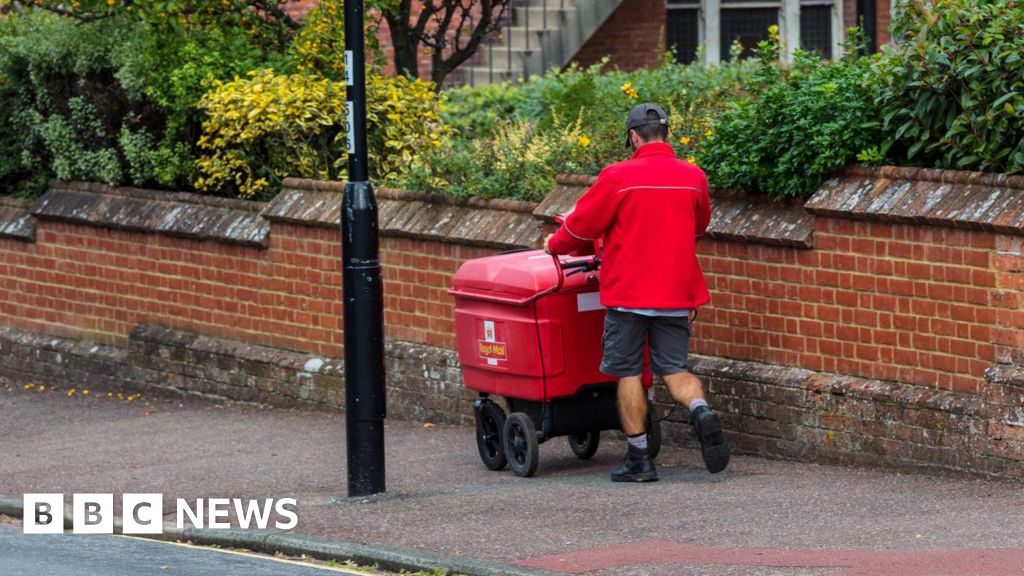
Royal Mail has been fined £21m after almost a quarter of first-class post arrived late, Ofcom has announced.
It is the third-largest fine the communications watchdog has ever issued and follows its investigation after Royal Mail missed its targets for both first and second-class post in 2024/25.
Ian Strawhorne, director of enforcement at Ofcom, said: “Millions of important letters are arriving late, and people aren’t getting what they pay for when they buy a stamp.”
Royal Mail said it will “continue to work hard to deliver further sustained improvements to our quality of service”.
It delivered 77% of First Class mail and 92.5% of Second Class mail on time in the 2024/25 financial year, which was short of its 93% and 98.5% targets.
This is the third time it has been fined over delivery delays in recent years, with penalities of £5.6m in November 2023 and £10.5m in December 2024.
Ofcom said the fine would have been £30m, but it had reduced it by 30% to reflect Royal Mail’s admission of its failings.
The regulator warned fines were “likely to continue” unless the company urgently delivers “a credible improvement plan”.
‘Empty promises’
Ofcom said Royal Mail published an improvement plan for last year, aimed at delivering 85% of first-class post on time and 97% of second-class post, but “this has not materialised”.
Mr Strawhorne said: “Royal Mail must rebuild consumers’ confidence as a matter of urgency. And that means making actual significant improvements, not more empty promises.”
Ofcom’s investigation found the company “breached its obligations by failing to provide an acceptable level of service without justification”.
It said the actions taken by Royal Mail to try and reach its targets were “insufficient and ineffective”.
The fine, Ofcom said, reflected the “harm suffered by customers” as a result of Royal Mail’s poor service.
Citizens Advice said the postal service’s track record was “woeful” but that the fines may not push the company to do better.
“When these failures are just an ordinary part of doing business, Ofcom’s fine risks becoming another operating cost, doing little to encourage the company to improve its service,” Tom MacInnes, director of policy at Citizens Advice, said.
“Missed post has real life consequences, with people left waiting for urgent medical appointment letters, legal documents and benefit decisions.”
Second-class scrapped on Saturdays
Under the universal service obligation (USO), Royal Mail is required by law to deliver letters six days a week and parcels five days a week to every address in the UK.
Since July, some areas only receive second-class letters every other weekday and not on Saturday, a change proposed by Ofcom earlier this year.
Responding to Ofcom, a Royal Mail spokesperson said: “We acknowledge the decision made by Ofcom today and we will continue to work hard to deliver further sustained improvements to our quality of service.”
The spokesperson said that the reduction of second-class deliveries in some areas enabled the company to “drive a step change in quality of service”.
Royal Mail has also made changes in recruitment and training and has provided more support in delivery offices, the spokesperson added.
The fine will be paid to the Treasury.
Royal Mail was bought by Czech billionaire Daniel Kretinsky for more than £5bn last year. It posted a profit in September, following three years of losses.

The approval came as Donald Trump is to attend a dinner with billionaire Paramount backers the Ellisons.
Source link
Business
France Ends Airport Transit Visa Requirement for Indian Travellers | Business – The Times of India
France has lifted the airport transit visa requirement for Indian nationals with effect from April 10, the French Embassy in India announced on Thursday.Indian nationals holding ordinary passports are no longer required to obtain an airport transit visa when passing through the international zone of airports located on French territory during a layover en route to a third country.The change follows a decree amending the 2010 regulations on documents and visas required for the entry of foreigners into French territory. The decree was adopted and published in the French Official Gazette (Journal Officiel) on April 9, 2026.MEA welcomes the moveThe Ministry of External Affairs welcomed the announcement.“We welcome the announcement on the operationalisation of visa-free transit for Indian nationals transiting through French airports,” MEA Spokesperson Randhir Jaiswal said.He recalled that the removal of the transit visa requirement for Indian passport holders was agreed between Prime Minister Narendra Modi and French President Emmanuel Macron during their meeting in Mumbai in February this year.“The government of France has now operationalized this agreement,” Jaiswal added.Who benefitsThe measure applies to Indian nationals transiting through mainland France exclusively by air, remaining in the international airport zone without entering French territory.President Macron had announced during his visit to India in February that measures would be taken to ease travel for Indian nationals via France.
Poll
What do you think is the main advantage of this visa policy change?
The updated procedures have been reflected on the France-Visas platform.

Comcast topped Wall Street’s revenue and earnings estimates for the first quarter on Thursday, lifted by NBC’s sports slate in February and improving broadband customer losses.
The company said it lost 65,000 broadband customers compared with 183,000 losses in the same period last year. Heightened competition from wireless providers like Verizon and T-Mobile has led to quarterly customer losses for Comcast and its cable peers in recent years – which has weighed on these companies’ stocks in particular.
In response, Comcast in the last year has shifted its strategy and introduced more competitive pricing packages in a bid to reduce the broadband losses. The company has also leaned on its mobile business for growth, which added 435,000 new lines during the quarter. In total, Comcast now has 9.7 million mobile customers.
The company also reported 322,000 cable TV customer losses – fewer than the 427,000 in the same period last year.
Revenue for Comcast’s connectivity and platforms unit, which includes its Xfinity-branded broadband, cable TV, and mobile businesses, decreased 2% to $17.32 billion.
The company’s stock climbed as much as 8% in premarket trading.
Here’s how Comcast performed for the period compared with average analyst estimates, according to LSEG:
- Earnings per share: 79 cents adjusted vs. 73 cents expected
- Revenue: $31.46 billion vs. $30.43 billion expected
Comcast’s net income fell nearly 36% to $2.17 billion, or 60 cents per share, compared to $3.38 billion, or 89 cents a share, during the same period last year. Adjusting for one-time items including amortization and investments, Comcast reported earnings per share of $0.79.
Adjusted earnings before interest, taxes, depreciation and amortization were down roughly 17% to $7.93 billion.
Comcast’s overall revenue increased roughly 5% to $31.46 billion for the quarter.
Revenue got a boost from Comcast’s NBCUniversal, which aired a slate of sports – including the Super Bowl, Winter Olympics and NBA All-Star Weekend, during the quarter – that the company coined as “Legendary February.”
The media business, which is made up of NBCUniversal, recorded a nearly 61% increase in revenue to $7.28 billion during the quarter. Excluding the Olympics and Super Bowl – which provided significant boosts to advertising sales – revenue for the unit was up about 13%.
Live sports remains the highest rated programming on traditional TV and streaming, and beckon the most advertising dollars. The Super Bowl, in particular, breaks records annually when it comes to its pricey commercial spots. NBC received an average $8 million per 30-second ad, CNBC reported.
Domestic advertising for the media unit was up 135% to $3.45 billion for the quarter. Excluding the Super Bowl and Winter Olympics, it was up 4.7% to $1.54 billion.
NBC’s sports roster also helped lift streaming service Peacock during the quarter. Peacock subscribers increased 12% year over year to 46 million. Peacock nearly doubled revenue to $2.1 billion compared to the same period last year. The streamer recorded a quarterly loss of $432 million compared to a loss of $215 million in the prior year period.
Adjusted EBITDA for the media segment decreased to a loss of $426 billion due to higher operating expenses related to the costs associated with the Winter Olympics and Super Bowl, as well as the cost of the NBA rights.
NBCUniversal is part of the overall content and experiences segment, which also includes the film studio and theme parks – each of which saw sales climb year-over-year.
Revenue for the film studio was up 21% to $3.43 billion, while Universal theme parks revenue increased 24% to $2.33 billion. The theme parks were boosted by the opening of Epic Universe last May.

Warner Bros shareholders approve Paramount’s $111bn takeover

Spoiler alert! "Survivor" castaway on elimination from game, role on the jury

‘Summer House’ is going to get cancelled? details revealed

-

 Fashion1 week ago
France’s LVMH Q1 revenue falls 6%, shows resilience amid Iran war
-

 Entertainment1 week ago
Is Claude down? Here’s why users are seeing errors
-

 Tech1 week ago
The Deepfake Nudes Crisis in Schools Is Much Worse Than You Thought
-

 Sports1 week ago
PSL 11: Peshawar Zalmi win toss, opt to field first against Quetta Gladiators
-

 Politics1 week ago
Iran in continuous message exchange with mediator Pakistan after US talks: Report
-
 Business1 week ago
Standard Life buys rival in £2b deal to create savings giant
-

 Tech1 week ago
CYBERUK ’26: UK lagging on legal protections for cyber pros | Computer Weekly
-

 Sports1 week ago
World Cup kit ranking: Which teams will look best in 2026?