

Business
Blame game over Air India crash goes on

Theo LeggettInternational Business Correspondent
 Getty Images
Nearly five months after a plane crash in India which killed 260 people, the investigation has become mired in controversy – with the country’s Supreme Court the latest to weigh in.
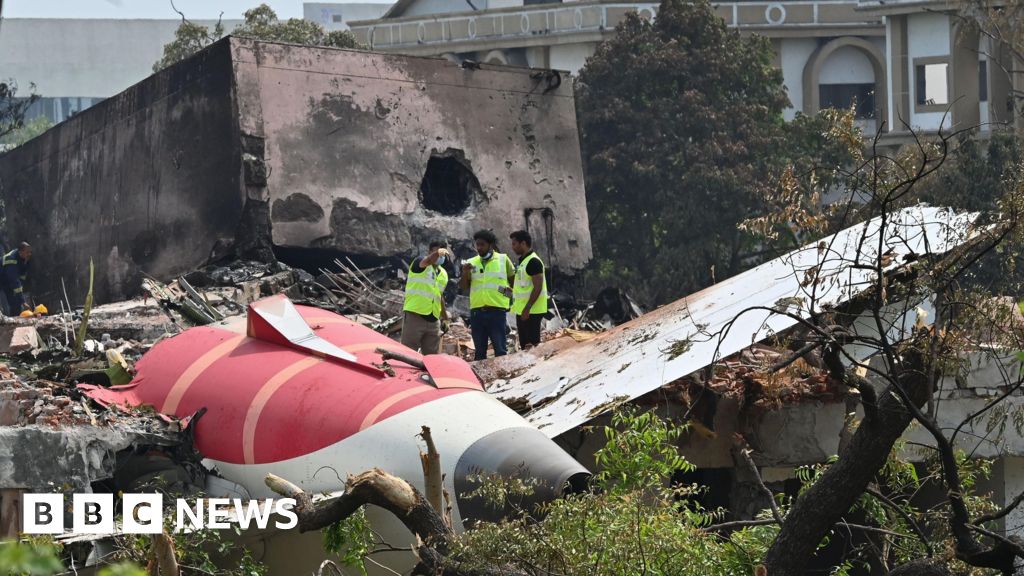
Flight 171 was en route to London from Ahmedabad in western India on 12 June. It crashed into a building just 32 seconds after taking off.
An interim report was released in July, but critics argue it unfairly focused on the actions of the pilots, diverting attention away from a possible fault with the aircraft.
On Friday, a judge in India’s Supreme Court insisted that nobody could blame the aircraft’s captain.
His comments came a week after the airline’s boss insisted there was no problem with the aircraft.
During a panel discussion at the Aviation India 2025 summit in New Delhi in late October, Air India’s chief executive Cambell Wilson admitted that the accident had been “absolutely devastating for the people involved, for the families of those involved, and the staff”.
But he stressed that initial investigations by Indian officials, summed up in a preliminary report, had “indicated that there was nothing wrong with the aircraft, the engines or the operation of the airline”.
He added although Air India was working with investigators it was not involved directly.
Because the accident happened in India, the investigation is being led by the country’s Air Accident investigation Bureau (AAIB). However, because the aircraft and its engines were designed and built in America, US officials are also taking part.
A month after the accident, the AAIB published a preliminary report. This is standard procedure in major accident investigations and is meant to provide a summary of the known facts at the time of publication.
The report will typically draw on information gleaned from examination of the crash site, for example, as well as basic material downloaded from the flight data recorder. It will not normally make firm conclusions about the cause of the accident.
However, the 15-page report into Air India 171 has proved controversial. This is largely due to the contents of two short paragraphs.
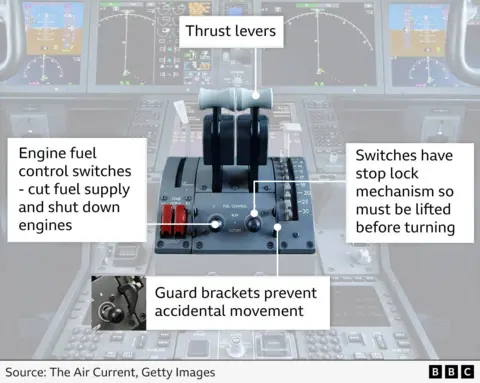
First, it notes that seconds after takeoff, the fuel cutoff switches – normally used when starting the engines before a flight and shutting them down afterwards – had been moved from the “run” to the cutoff position.
This would have deprived the engines of fuel, causing them to lose thrust rapidly. The switches were moved back to restart the engines, but too late to prevent the disaster.
It then says: “In the cockpit voice recording, one of the pilots is heard asking the other why did he cutoff. The other pilot responded that he did not do so.”

That indirectly-reported exchange sparked intense speculation about the role of the two pilots, Captain Sumeet Sabharwal and his first officer Clive Kunder, who was flying the plane at the time.
A former chair of the National Transportation Safety Board, Robert Sumwalt, claimed the report showed “this was not a problem with the airplane or the engines”.
“Did somebody deliberately shut down the fuel, or was it somehow or another a slip that they inadvertently shut off the fuel?” he said during an interview with the US network CBS.
Indian aviation safety consultant Capt. Mohan Ranganathan strongly implied that pilot suicide could have caused the accident, in an interview with the country’s NDTV channel.
“I don’t want to use the word. I’ve heard the pilot had some medical history and… it can happen,” he said.
Mike Andrews, a lawyer acting on behalf of victims’ families, thinks the way in which information has been released has “led people unfairly and inappropriately to blame those pilots without all the information”.
“An aircraft like this – that is so complex – has so many things that could go wrong,” he explains.
“To seize upon those two very small, decontextualised pieces of information, and automatically blame pilots for suicide and mass murder… is unfair and wrong.”
That view is echoed by Capt. Amit Singh, founder of the Safety Matters Foundation, an organisation based in India that works to promote a safety culture in aviation.
He has produced a report which claims the available evidence “strongly supports the theory of an electrical disturbance as the primary cause of the engine shutdown” that led to the disaster.
He believes an electrical fault may have caused the Full Authority Digital Engine Control (FADEC), a computerised system which manages the engines, to trigger a shutdown by cutting off the fuel supply.
Meanwhile the flight data recorder, he suggests, may have registered the command to shut off the fuel supply, rather than any physical movement of the cutoff switches in the cockpit.
In other words, the switches themselves may not have been touched at all, until the pilots tried to restart the engines.
Capt. Singh has also challenged the way in which the investigation has been carried out in India’s Supreme Court.
He told the BBC the way in which the preliminary report was framed was biased because it “appears to suggest pilot error, without disclosing all the technical anomalies that occurred during the flight”.
Meanwhile the Supreme Court itself has already commented on the issue.
It has been considering a petition filed by Pushkarraj Sabharwal, the father of Capt. Sumeet Sabharwal. The 91-year-old has been seeking an independent judicial inquiry into the tragedy.
“It’s extremely unfortunate, this crash, but you should not carry this burden that your son is being blamed. Nobody can blame him for anything,” Justice Surya Kant told him.
A further hearing is expected on 10 November.
‘Flat out wrong’
The theory that an electrical fault could have caused the accident is supported by the US-based Foundation for Aviation Safety (FAS).
Its founder is Ed Pierson, a former senior manager at Boeing, who has previously been highly critical of safety standards at the US aerospace giant.
He believes the preliminary report was “woefully inadequate… embarrassingly inadequate”.
His organisation has spent time examining reports of electrical issues on board 787s. They include water leaks into wiring bays, which have previously been noted by the US regulator, the Federal Aviation Authority. Concerns have also been voiced in some other quarters.
“There were so many of what we consider electrical oddities on that plane, that for them to come out and to all intents and purposes direct the blame to the pilots without exhaustively going through and examining potential system failures, we just thought was flat out wrong,” he says.
He believes there was a deliberate attempt to divert attention away from the plane and on to the pilots.
The FAS has called for wholesale reform of current international air accident investigation procedures, citing “outdated protocols, conflicts of interest and systemic failures that endanger public trust and delay life-saving safety improvements”.
‘Keeping an open mind’
Mary Schiavo, an attorney and former inspector general at the US Department of Transportation, disagrees that the pilots have been deliberately put under the spotlight.
She thinks the preliminary report was flawed, but only because investigators were under intense pressure to provide information, with worldwide attention focused on them.
“I think they were just in a hurry, because this was a horrific accident and the whole world was watching. They were just in a hurry to push something out,” she says.
“Then, in my opinion, the whole world jumped to conclusions and right away was saying, ‘this is pilot suicide, this was intentional’.
“If they had to do it over again, I don’t think they would have put those little snippets from the cockpit voice recording in,” she says.
Her own view is that “a computer or mechanical failure… is the most likely scenario”.
International rules for air accident investigations stipulate that a final report should appear within 12 months of the event, but this is not always adhered to. However, until it is published, the true causes of the accident will remain unknown.
A former air accident investigator who spoke to the BBC emphasised the importance of “keeping an open mind”, until the process has been completed.
Boeing has always maintained that the 787 is a safe aircraft – and it does have a strong record.
The company told the BBC it would defer to India’s AAIB to provide information about the investigation.

UK high streets and shopping destinations are showing signs of recovery as more than 13 retail stores opened each week over the past year, according to new figures.
However, England and Wales have still seen more than 6,000 retail premises vanish from local communities over the past five years.
Analysis of Valuation Office Agency data by tax firm Ryan, found that there were 507,810 retail premises across England and Wales at the end of 2025.
It said the figures showed that a recent contraction across the sector has appeared to stabilise, with a 723 net increase in the number of retail stores compared with a year earlier.
Property numbers increased across every region of England and Wales, with the exception of the North West, which saw a decline of 41.
It suggests that parts of the sector are now beginning to rebalance following significant structural contraction seen since the pandemic.
The creation of new retail units also comes as many retail real estate firms, such as Hammerson, have turned empty large units, often former department stores, into a greater number of smaller units.
Other retail groups, such as John Lewis, have moved away from ambitions to transform some retail property for other uses such as rental accommodation.
Nevertheless, the retail sector is still facing pressure from higher business rates for many firms, increased labour costs and concerns over consumer sentiment.
The data also shows that there has also been significant decline over the past few years, with a net reduction of 6,045 retail properties since the end of 2020.
London recorded the largest five-year regional reduction, with 1,266 retail premises disappearing over the period, followed by the South East (-1,191), North West (-719) and North East (-672).
The figures show retail premises which have permanently disappeared from communities altogether, having either been demolished or converted for alternative use.
The figures come as Ryan’s 2026 annual business rates review highlighted that the retail sector saw a 9.3% increase in rateable values at the 2026 business rates revaluation despite the major shift in the retail landscape since the pandemic.
Alex Probyn, practice leader for Europe and Asia-Pacific property tax at Ryan, said: “The pandemic accelerated structural changes that were already emerging across the retail sector, including changing consumer behaviour, hybrid working patterns and a reduced reliance on traditional retail floorspace in many locations.
“Many locations were arguably over-retailed before Covid and high streets have evolved towards more mixed-use environments, with retail space being rebalanced alongside growing demand for residential, leisure, hospitality and service-led uses.
“The revaluation outcome does suggest a large proportion of retail premises have seen bigger increases in their assessments than underlying market conditions and rental evidence would have led occupiers to expect.
“Retailers should therefore carefully review and, where appropriate, challenge their assessments.”

Indians sharply cut back on overseas travel spending in March, with remittances for foreign trips dropping by more than $212 million from the previous month, according to Reserve Bank of India data. The fall in outbound travel expenditure came amid rising oil prices linked to the Middle East conflict and persistent pressure on rupee, even as travel remained the single largest component of outward remittances under the Liberalised Remittance Scheme (LRS).In March, travel-related remittances fell to $1.09 billion from $1.3 billion in February and $1.65 billion in January. The decline came at a time when the West Asia conflict pushed oil prices higher and weakened rupee to record lows. Amid the situation, Prime Minister Narendra Modi urged citizens to cut down on foreign travel and adopt measures such as carpooling. Lower overseas travel spending could reduce foreign exchange outflows and help ease pressure on rupee.According to the RBI’s data on outward remittances by resident individuals, travel continued to account for the largest share of money sent abroad under the LRS in March. Total remittances during the month stood at $2.59 billion.The RBI tracks overseas spending across categories including travel, studies abroad, maintenance of close relatives, overseas investments, and property purchases. Under the LRS framework, resident individuals, including minors, can remit up to $250,000 in a financial year for permitted current or capital account transactions.Within the travel segment, the biggest component remained the ‘other travel’ category, which covers holiday spending and international credit card settlements. Indians spent $623.05 million under this category in March, accounting for nearly 57 per cent of total travel-related remittances during the month.Expenditure linked to education travel, including hostel and fee payments, stood at $450.16 million. Business travel, pilgrimage, and overseas medical treatment together accounted for $21.39 million.The data also showed a rise in remittances meant for the maintenance of close relatives abroad. Such transfers increased to $389.78 million in March from $266.18 million in February.At the same time, spending under the ‘studies abroad’ category declined. This category includes payments made for educational services accessed remotely without travelling overseas, such as correspondence courses. Remittances under this head stood at $151.71 million in March, compared to $175.68 million in February and $267.42 million in January.For the financial year 2024-25, Indians remitted a total of $29.56 billion under the LRS. Travel made up the largest portion of this amount at $16.96 billion.The RBI figures further showed that investments by Indians in overseas equity and debt instruments rose significantly to $440.22 million in March from $265.99 million in February.Meanwhile, outward remittances for the purchase of immovable property overseas declined to $38.68 million in March, down from $51.36 million a month earlier.

Gold and silver are expected to take cues from developments in the ongoing US-Iran talks this week, with analysts forecasting a largely steady trend for gold prices while silver may continue to outperform amid geopolitical tensions and elevated crude oil prices.Investors are also likely to track a series of economic indicators from the United States, including GDP data, housing numbers, consumer confidence figures and the Personal Consumption Expenditure (PCE) inflation print, as markets look for signals on the Federal Reserve’s next policy move.“Gold price momentum next week looks sideways, while silver still looks positive as focus will again be on the peace negotiations between the US and Iran to end the war,” said Pranav Mer, Vice President, EBG – Commodity & Currency Research, JM Financial Services Ltd.Trading activity in domestic commodity futures markets will be curtailed on Thursday morning due to Bakri Id.On the MCX, gold futures ended the previous week at Rs 1.58 lakh per 10 grams after posting marginal gains, while silver futures settled lower at Rs 2.71 lakh per kilogram.“Gold traded in a range-bound manner last week, posting marginal gains of around 0.40% on the MCX to close near Rs 1,58,670 per 10 grams,” said Jateen Trivedi, VP Research Analyst – Commodity and Currency, LKP Securities.He noted that crude oil prices witnessed heavy profit booking during the week and corrected nearly 7% from recent highs, easing concerns around inflationary pressure globally.“At the same time, the rupee recovered from weaker levels of 97 against the US dollar to strengthen near 95.70, which limited upside momentum in domestic gold prices despite stable international bullion trends,” Trivedi added.In international trade, Comex gold futures closed the week 1% lower at $4,523.2 per ounce. Silver futures also weakened, slipping nearly 2% to $76.20 per ounce.“Gold prices moved in a consolidative range over the past few sessions, but ended the week with a marginal loss. Prices were steady amid a lack of fresh direction in the market — be it on the economy front or the US-Iran war front,” Mer said.According to analysts, uncertainty surrounding the geopolitical situation has continued to keep markets on edge, particularly as statements from both Washington and Tehran have frequently shifted.On Sunday, US President Donald Trump said that an agreement between the US and Iran aimed at reducing tensions in the Gulf region and reopening the Strait of Hormuz was close to being finalised.Posting on Truth Social, Trump said the deal had been “largely negotiated” and that only final formalities remained.However, Iranian media disputed Trump’s remarks regarding the full reopening of the Strait of Hormuz, stating that Tehran would continue to maintain control over the key waterway.Analysts said the contrasting positions from both sides are likely to keep bullion prices sensitive to any fresh headlines emerging from the region.Meanwhile, market participants are also expected to monitor comments from Federal Reserve officials after Kevin Warsh formally succeeded Jerome Powell as head of the US central bank on Friday during a period of geopolitical tensions, market volatility and persistent inflation pressures.

Shop numbers return to growth after years of decline, say experts

Drake sets new record at ‘Iceman,’ ‘Habibti’ and ‘Maid of Honour’

Patti LaBelle on being called a legend: “I have earned it”

-

 Entertainment1 week ago
Where Pete Davidson, Elsie Hewitt stand after breakup: Details revealed
-

 Politics1 week ago
Rising diesel costs from Iran war strain US school budgets
-

 Tech1 week ago
Why Is Your Grill So Dumb? The Best Grills Set Temp Like an Oven
-

 Tech1 week ago
This Solar-Powered Smart Sprinkler Keeps My Lawn Watered Without Any Power Cables
-

 Fashion1 week ago
RMG trade bodies seek policy support from Bangladesh PM
-

 Fashion1 week ago
India calls for aligning standards, customs procedures with Africa
-

 Fashion6 days ago
Nigeria Kwara Garment Factory, KWS Garment Production Village ink pact
-

 Fashion7 days ago
India’s Pearl Global’s FY26 revenue crosses $521 mn milestone