Connect with us

Business

Waterstones would sell books written by AI, says chain’s boss

Published

on

Waterstones would sell books written by AI, says chain’s boss

Felicity Hannah,Big Boss Interviewand

Michael Sheils McNamee,Business reporter
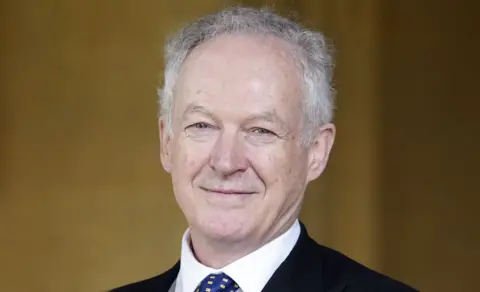
PA Head and shoulders shot of James Daunt against a blurred pale background. He is smiling slightlyPA

Waterstones would stock books created using artificial intelligence, the company’s boss has said, as long as they were clearly labelled, and if customers wanted them.

However, James Daunt, a veteran of the bookselling industry, said he personally did not expect that to happen.

“There’s a huge proliferation of AI generated content and most of it are not books that we should be selling,” he said.

But it would be “up to the reader”.

An explosion in the use of artificial intelligence, or AI, has prompted heated debate in the publishing industry, with writers concerned about the impact on their livelihoods.

In a wide-ranging interview with the BBC’s Big Boss podcast, Daunt said while Waterstones uses AI for logistics they currently try to keep AI generated content out of the shops.

“As a bookseller, we sell what publishers publish, but I can say that instinctively that is something that we would recoil [from],” he said.

Daunt, who is heading into his 36th Christmas season in the book trade, said Waterstones’ success had been built on handing more control to individual store managers to serve their own communities.

“Head office is there to make life easier,” he said.

“Make sure the books that they order turn up on time, but do not tell [managers] where to put them.”

Daunt also said he was a bit of an outlier in welcoming last week’s Budget and he raised the prospect of a stock market flotation of the book chain.

‘Disdain for AI’

A report published last month by the University of Cambridge found that more than half of published authors feared being replaced by artificial intelligence.

Two-thirds also said their work had been used without permission or payment to train the large language models which lie behind generative AI tools.

But some writers use AI themselves, especially for research, and AI tools are being used to edit novels, and even produce full-length works.

“Do I think that our booksellers are likely to put those kind of books front and centre? I would be surprised,” Daunt says.

“Who’s to know? [Technology firms] are spending trillions and trillions on AI and maybe it’s going to produce the next War and Peace.

“And if people want to read that book, AI-generated or not, we will be selling it – as long as it doesn’t pretend to [be] something that it isn’t.

“We as booksellers would certainly naturally and instinctively disdain it,” Daunt said.

Readers value a connection with the author “that does require a real person” he added. Any AI-generated book would always be clearly labelled as such.

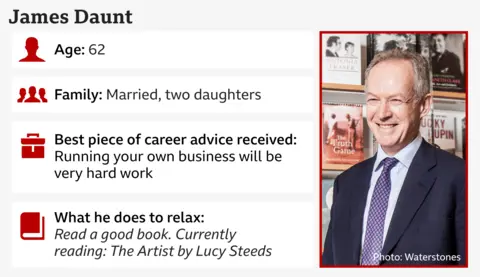
A profile of James Daunt. Age: 62, Family, Married with two daughters / best piece of career advice received: Running your own business will be very hard work / what he does to relax: read a good book - currently reading, The Artist by Lucy Steeds

The softly spoken former banker has overturned convention before.

When he took over at Waterstones in 2011, he took the bold decision to end the practice of publishers paying to have their books displayed prominently in stores. It cost him £27m in lost revenue and prompted a “nervous breakdown” among publishers, he said, but it paid off and in 2016 the company returned to profit.

Now Waterstones staff write their own book recommendations, choose books of the month, and the manager selects what goes on the display tables.

As well as books, the chain stocks pens, reading lights, games, wrapping paper and other stationery.

The strategy has helped it defy the decline on the High Street, with around ten new stores opening a year, and profits in 2024 of £33m against sales of £528m.

Waterstones is part of a wider stable, including Foyles and Blackwell’s, owned by hedge fund Elliott Advisers.

Daunt has also been appointed chief executive of Barnes and Noble, the large US bookstore chain also owned by Elliot Advisers.

Share sale

Success on both sides of the Atlantic has led to speculation that shares in Waterstones and Barnes and Noble could be jointly floated in either New York or London.

“It feels like an inevitability and probably better than being flipped to the next private equity person,” says Daunt.

Private owners naturally aim to sell businesses on, he points out. “It’s what they do.”

But it is not clear that London, which he says has been “suffering” as a location for initial public offerings lately, would be considered suitable.

“We’re based out of London but we have a huge American business; Barnes and Noble is much larger than Waterstones.”

Helpful rate change

As for last week’s Budget, Daunt says it sometimes feels like he might be “the only person who is sympathetic” to the situation the chancellor is in.

The government has drawn the ire of the business community for raising employer National Insurance and the minimum wage and not coming up with more growth-boosting measures.

But the Budget included changes that were “very helpful” to companies like his, said Daunt.
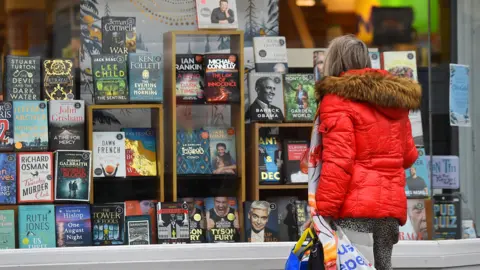
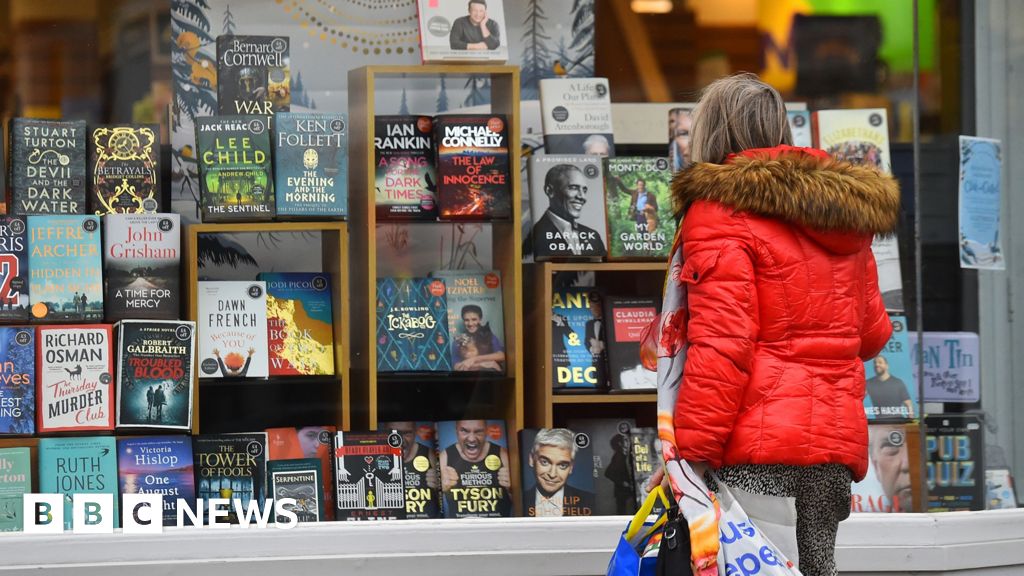
Getty Images A person in a red puffer coat holds shopping bags as they look at book titles displayed in a window of a Waterstones branch in Crewe in 2020.Getty Images

Waterstones has seen success despite a general trend of High Street decline over the past decade

Business rates will be lower for retailers operating out of small sites, while larger business properties, like warehouses will pay more.

Daunt said that although Waterstones does have larger premises, levelling the playing field between High Street and online retailers was something he has been calling for for a long time.

With the days of advent now ticking past, the company is well into the se portion of the year when Waterstones makes about 70% of its annual profit.

He says the post-pandemic rebound, with people returning to bookshops, does not seem to have gone away.

Personally he has also retained his love of reading, even after 36 years in the industry. But he does have one bad book habit, he said.

“Because I read professionally, I do a rather awful thing which is start a lot of books and then not finish them.

“I love the excitement of opening up a first novel and not knowing what’s going to come of it. But if it isn’t quite that good, I’ll just move on.”



Source link

Continue Reading
Click to comment

Leave a Reply

Your email address will not be published. Required fields are marked *

Business

Gold price today: How much 22K, 24K gold cost in Delhi, Mumbai & other cities – Check rates – The Times of India

Published

on

Gold price today: How much 22K, 24K gold cost in Delhi, Mumbai & other cities – Check rates – The Times of India


Gold prices remained high on Monday as investors continued to seek safety amid rising geopolitical tensions and trade-related uncertainties.Gold and silver prices surged to fresh record levels as escalating geopolitical risks and shifting US monetary expectations boosted demand for safe-haven assets. Renewed unrest in Iran, fresh US tariff threats against several European countries over Greenland and broader global uncertainty supported buying in precious metals.On the MCX, gold February futures jumped nearly Rs 3,000, or over 2%, to hit a fresh all-time high of Rs 1,45,500 per 10 grams. Silver also outperformed, with futures rising sharply to record levels.In international markets, spot gold climbed 1.7% to a new high of $4,673 an ounce, while silver rose about 3% to around $94 per troy ounce. Overseas silver futures surged more than 6% to hit a record $94.35 per ounce.

Gold prices in Delhi today

Gold prices in Delhi rose on Monday. The price of 24-carat gold stood at Rs 14,584 per gram, up by Rs 191. The rate for 22-carat gold was Rs 13,370 per gram, higher by Rs 175, while 18-carat gold was priced at Rs 10,942 per gram, up by Rs 143.

Gold prices in Mumbai today

In Mumbai, 24-carat gold was priced at Rs 14,569 per gram, up by Rs 191. The price of 22-carat gold stood at Rs 13,355 per gram, up by Rs 175, while 18-carat gold was trading at Rs 10,927 per gram, up by Rs 143.

Gold prices in Chennai today

Gold prices in Chennai also moved higher. The price of 24-carat gold was Rs 14,673 per gram, up by Rs 186. The rate for 22-carat gold stood at Rs 13,450 per gram, up by Rs 170, while 18-carat gold was priced at Rs 11,230 per gram, up by Rs 140.

Gold prices in Ahmedabad today

In Ahmedabad, 24-carat gold was trading at Rs 14,574 per gram, up by Rs 191. The price of 22-carat gold rose to Rs 13,360 per gram, up by Rs 175, while 18-carat gold was priced at Rs 10,932 per gram, up by Rs 143.

Gold prices in Bhubaneswar today

Gold prices in Bhubaneswar rose on Monday, with 24-carat gold at Rs 14,569 per gram, up by Rs 191. The rate for 22-carat gold was Rs 13,355 per gram, up by Rs 175, while 18-carat gold stood at Rs 10,927 per gram, up by Rs 143.

Gold prices in Hyderabad today

In Hyderabad, gold prices remained firm. The price of 24-carat gold stood at Rs 14,569 per gram, up by Rs 191. The rate for 22-carat gold was Rs 13,355 per gram, up by Rs 175, while 18-carat gold was priced at Rs 10,927 per gram, up by Rs 143.

Gold prices in Kolkata today

Gold prices in Kolkata also moved higher. The price of 24-carat gold was Rs 14,569 per gram, up by Rs 191. The rate for 22-carat gold stood at Rs 13,355 per gram, up by Rs 175, while 18-carat gold was priced at Rs 10,927 per gram, up by Rs 143.

Gold prices in Jaipur today

In Jaipur, 24-carat gold was priced at Rs 14,584 per gram, up by Rs 191. The price of 22-carat gold stood at Rs 13,370 per gram, up by Rs 175, while 18-carat gold was trading at Rs 10,942 per gram, up by Rs 143.

Gold prices in Lucknow today

Gold prices in Lucknow rose on Monday, with 24-carat gold at Rs 14,584 per gram, up by Rs 191. The rate for 22-carat gold was Rs 13,370 per gram, up by Rs 175, while 18-carat gold was priced at Rs 10,942 per gram, up by Rs 143.

Gold prices in Bengaluru today

In Bengaluru, gold prices were higher, with 24-carat gold trading at Rs 14,569 per gram, up by Rs 191. The price of 22-carat gold stood at Rs 13,355 per gram, up by Rs 175, while 18-carat gold was priced at Rs 10,927 per gram, up by Rs 143.

Gold prices in Patna today

Gold prices in Patna also edged higher. The price of 24-carat gold stood at Rs 14,574 per gram, up by Rs 191. The rate for 22-carat gold was Rs 13,360 per gram, up by Rs 175, while 18-carat gold was priced at Rs 10,932 per gram, up by Rs 143.


Source link

Continue Reading

Business

‘Europe won’t be blackmailed,’ Danish PM says in wake of Trump Greenland threats

Published

on

‘Europe won’t be blackmailed,’ Danish PM says in wake of Trump Greenland threats


Reuters Danish Prime Minister Mette Frederiksen speaks at a press conference Reuters

Mette Frederiksen and other European allies are standing in solidarity with Greenland, despite Trump’s threat of tariffs

Denmark’s Prime Minister Mette Frederiksen says “Europe won’t be blackmailed” by Donald Trump’s tariff threats over Greenland.

She and other European leaders issued a joint statement on Sunday saying the plan risks a “dangerous downward spiral” with the US.

Early on Monday morning, Trump said, “NATO has been telling Denmark, for 20 years, that “you have to get the Russian threat away from Greenland.” […] Now it is time, and it will be done!!!”

The US president has said he will impose new taxes on eight US allies in February if they oppose his proposed takeover of the autonomous Danish territory.

Trump insists Greenland is critical for US security and has not ruled out taking it by force – a move that has drawn widespread criticism.

In a post on Truth Social in the early hours of Monday morning, Trump said that Nato has been telling Denmark to “get the Russian threat away from Greenland” for 20 years. Denmark, he continued, “has been unable to do anything about it”.

The new tariffs would be imposed on Denmark, Finland, France, Germany, the Netherlands, Norway, Sweden and the UK.

In their joint statement, the eight countries said that “tariff threats undermine transatlantic relations”, reiterating that they “stand in full solidarity with the Kingdom of Denmark and the people of Greenland”.

The countries stressed they are “committed to strengthening Arctic security as a shared transatlantic interest” as members of the Nato military alliance.

“We stand ready to engage in a dialogue based on the principles of sovereignty and territorial integrity that we stand firmly behind,” the statement reads.

Separately, Frederiksen wrote on Facebook: “We want to cooperate and we are not the ones seeking conflict. And I am happy for the consistent messages from the rest of the continent: Europe will not be blackmailed.”

“It is all the more important that we stand firm on the fundamental values that created the European community.”

Meanwhile, UK Prime Minister Sir Keir Starmer said he had had phone calls on Sunday with Frederiksen, as well as European Commission President Ursula von der Leyen and Nato Secretary-General Mark Rutte, before speaking to Trump.

A spokeswoman for Starmer’s office said he had reiterated his position that Greenland’s security was a priority for all Nato members. “He also said that applying tariffs on allies for pursuing the collective security of Nato allies is wrong,” the spokeswoman added.

Trump has threatened to impose a 10% tariff on goods from Denmark, Norway, Sweden, France, Germany, the UK, the Netherlands and Finland, which would come into force on 1 February, but could later rise to 25% – and would last until a deal was reached.

“These Countries, who are playing this very dangerous game, have put a level of risk in play that is not tenable or sustainable,” he wrote, adding: “This is a very dangerous situation for the Safety, Security and Survival of our Planet”.

The US president insists Greenland is critical for US security and has said previously that Washington would get the territory “the easy way” or “the hard way”.

Greenland is a sparsely populated but resource-rich and its location between North America and the Arctic makes it well placed for early warning systems in the event of missile attacks and for monitoring vessels in the region.

US Treasury Secretary Scott Bessent on Sunday told NBC News’ Meet the Press that “Greenland can only be defended if it is part of the US, and it will not need to be defended if it is part of the US”.

“I believe that the Europeans will understand that this is best for Greenland, best for Europe and best for the United States,” he said.

Speaking to BBC Newshour, Norwegian Foreign Minister Espen Barth Eide said mutual respect for sovereignty is the “non-negotiable” core principle of international law and co-operation.

“If we are to live in peace and if we are to be able to co-operate on shared problems, we have to start by the mutual recognition of each others sovereignty and territorial integrity,” she added.

“We will not give up” on constructive dialogue with the US, says Danish Foreign Minister

It is still unclear how the tariffs will affect those Trump has already imposed on the UK and EU. French President Emmanuel Macron, who is working to co-ordinate the European response to the tariff threats, said he would request that the EU activate its “anti-coercion instrument” if Trump does impose them.

The US president is due to speak at the World Economic Forum in Davos, Switzerland on Wednesday on the theme “how can we co-operate in a more contested world?” Macron, as well as the leaders of Germany and the EU, will also be attending the annual conference.

Canadian Prime Minister Mark Carney, who will also be there, said his country was “concerned by the recent escalation” and that it would be “significantly increasing Arctic security — strengthening our military and investing in critical infrastructure”.

“Canada strongly believes that the best way to secure the Arctic is by working together within Nato,” he also wrote on X.

Mark Rutte, meanwhile, said he had spoken to Trump “regarding the security situation in Greenland and the Arctic”.

“We will continue working on this, and I look forward to seeing him in Davos later this week,” he added.

EPA/Shutterstock People take part in a protest under the slogans 'Hands off Greenland' and 'Greenland for Greenlanders' in Copenhagen, Denmark, 17 January 2026.EPA/Shutterstock

Protests were held over the weekend in both Denmark and Greenland

Public anger in both Denmark and Greenland at Trump’s threats over Greenland appears undiminished. Demonstrations against Trump’s takeover plans were held in Greenland’s capital, Nuuk, on Saturday – before the tariff announcement – as well as in Danish cities.

These rallies coincide with a visit to Copenhagen by a delegation from the US Congress. Its leader, Democratic Senator Chris Coons, described Mr Trump’s rhetoric as “not constructive”.

The island’s representative to the US has said that the last time Greenlanders were asked if they wanted to be part of the US, in January 2025, only 6% were in favour of doing so, while 85% were against.

A recent poll suggests that most Americans also oppose US control of Greenland. A Reuters/Ipsos poll, which was released last Wednesday, indicated just 17% of Americans support the US taking Greenland, compared to 47% who said they opposed Trump’s push to acquire the island.


Source link

Continue Reading

Business

‘Credit score company encouraged me to borrow again when I was nearly debt-free’

Published

on

‘Credit score company encouraged me to borrow again when I was nearly debt-free’


BBC A graphic design of red, black and cream, with arrows, a pound sign and a hand holding three credit cards.BBC

A woman who had a £10,000 credit card debt has told BBC Panorama how a credit-rating service, which she thought would help her bring her finances under control, encouraged her to take out yet more cards.

As well as keeping track of her credit score, the ratings firm – Experian – bombarded her with emails promoting high-interest credit card offers once she came close to paying off her debt.

Millions in the UK are struggling to keep up with card repayments, but consumer groups say offers of extra credit – including from credit-scoring companies – can make matters worse for already vulnerable people.

Experian told Panorama it has been developing a process to identify potentially vulnerable customers and to stop sending them marketing emails. The options it sent the woman who spoke to the BBC, it added, could have allowed her to pay off her debt sooner or at a lower cost.

Credit cards have never been more popular – about 35 million people in the UK have one, according to industry figures. The annual percentage interest rate, or APR – including fees and charges – can range from 0% to more than 60%. But for people with an average credit history it is typically about 25%.

Panorama has also spoken to people who say their lenders nudged them towards taking on new debts, despite the fact they were struggling financially.

One man told us how his bank had increased his credit limit, even though he had racked up almost £7,000 of debt during a manic episode linked to bipolar disorder. Another man described how he is now selling his home, after becoming overwhelmed by credit card debt when work dried up and his marriage broke down.

The woman with a £10,000 debt, mother of five Amanda – who receives universal credit and has requested anonymity – went to a debt charity for help. It took years, but Amanda says she got on top of her debt.

She had signed up with credit-score provider Experian and, like many people, thought checking her credit score was a responsible thing to do.

“It was really useful. I’d get the monthly alert of the status of my financial affairs,” she says.

A woman's hands are holding a mobile phone, and her right-hand thumb is scrolling through emails. The background is blurred.

Amanda shows the BBC emails from credit-score firm Experian

Credit agencies such as Experian gather data on customers based on information including their debt levels, number of credit applications, and whether they pay their bills on time.

A better credit report means someone could be offered the most competitive interest rates and may find it easier to borrow – however the decision about whether to offer credit is made by each individual lender.

As Amanda came closer to paying off the last of her credit card debt, she says Experian started sending her more than just monthly credit report updates: “It would be offers in the lines of, ‘your credit card approval rate has increased’, inviting you to look at lenders.”

Amanda says she was sent emails with “constant” offers for high-interest, so-called credit builder cards, which allow customers to improve their credit scores if debts are paid on time.

But, typically, these cards have higher interest rates, meaning that those making only minimum repayments are likely to be paying off their debt for a long time.

“I thought I’ll just have the one [credit card], keep it as an emergency,” Amanda told us. “But the minute you take out one, you get more emails, again, to apply for another one, and another one and another one.”

What Amanda didn’t know was that agencies such as Experian – the UK’s biggest credit-rating agency – are also paid commission to promote credit card lenders’ products.

More than half of nearly 3,500 low- and medium-income adults who responded to a new survey by the Centre for Responsible Credit – a research, policy and campaigning group – said they had received credit card marketing from their credit-score providers.

Half of those asked felt they had been offered more credit than they could afford, while a quarter had felt pressured into taking out more credit.

Experian told Panorama it gives its customers “as much information as possible to help them access credit they can afford”.

It said that it helps people “understand their options for switching existing debt to lower or 0% interest options, helping people repay sooner and for less”.

Experian added that it works closely with debt charities and that “getting the right support is the most important step and should be the priority over your credit score”.

A wall has more than a dozen classic guitars hanging from it in two lines. A man with a beard and short hair, in a black coat, is in the bottom of the frame, looks up to the right.

Tom Richardson went on a spending spree which started in his local guitar store

Concerns have also been raised about vulnerable borrowers having their credit limits increased without asking.

Tom Richardson, an academic who researches debt and mental health, says his own experience left him shocked. He has bipolar disorder, and about a year ago, during what he describes as a severe manic episode, he walked into his local guitar shop.

“I just came in for a bit of a look. There wasn’t anything in particular I wanted,” he says.

However, by the time he left the shop, he had bought a guitar, a ukulele and another piece of equipment. He then went online and bought more, putting everything on his credit card.

“Electric guitar, speakers, guitar pedals, a guitar amp, a trumpet, some sort of bongos, some pads for my computer music equipment,” he recalls buying.

“When you’re manic, when you’re impulsive, it just doesn’t feel like real money.”

By the time the episode ended, he says he was close to his card’s £7,000 credit limit. With help from family, he started to pay the balance down and told his bank, Santander, about his medical diagnosis.

Six months later, Santander increased his credit limit to £9,000.

“I was trying to do the sensible thing and reduce the debt,” says Tom, “and the default response was to offer me more credit. It was mind-boggling.”

His experience is not unusual, research suggests. Four in 10 credit card holders across all lenders were offered a limit increase in the past year, with little distinction made between those struggling and those not, a survey by debt charity StepChange found.

Santander told us that when Tom first signed up to his credit card, he opted in to automatic credit card limit increases. The bank said it monitors “customer spending closely against past transactions in order to spot any unusual and unaffordable behaviour”.

Another risk for those trying to get out of debt lies in how credit card repayments are structured.

One 2018 study by the regulator – the Financial Conduct Authority (FCA) – found 1.6 million people only paid the minimum amount each month, typically between 2-5% of their outstanding balances.

However, if this minimum payment percentage is less than the monthly interest rate, the debt will grow – even if the card holder stops using their card for spending.

This can dramatically extend how long a debt lasts and how much interest is paid.

The credit card industry profits from something called “anchoring”, says Grace Brownfield, from National Debtline, an independent debt advice charity.

A bald man wearing black rimmed glasses and a black top is looking towards the camera. He is sitting at a wooden table. The background - a conservatory and garden - is blurred.

Michael Crompton ended up with £21,000 of debt across three credit cards

By displaying a minimum payment amount on bills, it encourages many consumers to subconsciously identify that as the ideal payment amount, in effect anchoring what they pay to the suggested figure.

“There’s some evidence that that encourages people to only make the minimum repayment, even if they could afford to pay more than that,” says Brownfield. Because of this, she says, people are paying more in interest typically. “That’s where the credit card companies are… making their money.”

Screenwriter Michael Crompton says credit cards became a financial lifeline during years of freelance work.

“They were offered to me left, right and centre,” he says. “I used them as a back-up.”

He ended up with £21,000 of debt across three cards.

When his work started drying up he began only paying “a minimum” amount – he wasn’t paying off any capital. Over time, lenders repeatedly raised his credit limits.

Then, when his marriage ended, the debt became overwhelming.

“I was paying hundreds of pounds a month and not touching the balance,” he says. “It just escalates and escalates. You feel like a failure, and you don’t know who to tell.”

The FCA estimates about 2.8 million people across the UK are in persistent credit card debt, which is defined as – over 18 months – paying more in interest and charges than the amount they have borrowed.

That number of people has fallen slightly since 2018, FCA data shows, when rules came in requiring lenders to check potential customers’ affordability and credit history.

But critics argue the changes have not gone far enough. James Daley of consumer group Fairer Finance says lenders should intervene earlier when spending patterns suggest a customer is in distress, rather than extending their credit limits.

The FCA says its reforms on persistent debt and affordability, introduced in 2018, now save borrowers £1.3bn a year. “Lenders should only provide credit to people who can afford to repay,” it says, adding that it is currently reviewing the rules, and will “not hesitate to act” if it identifies issues.

UK Finance, which represents lenders, says credit-card providers are committed to lending responsibly and “comply with strict regulatory rules to assess affordability when agreeing borrowing limits”.

It also said “support is provided by lenders to those at risk of, or in, financial difficulty”.

Tom says he still owes about £5,000, while Amanda is trying to keep on top of her finances.

Michael – who is 66 – is selling his home and hopes to pay off his debts so he can retire debt-free.

“I know it’s my responsibility,” he says. “But when you’re struggling, the last thing you need is more credit. What you need is someone to say: ‘Stop and get help.'”

What can I do if I can’t pay my debts?

  • Talk to someone. You are not alone and there is help available. A trained debt adviser can talk you through the options. Here are some organisations to get in touch with.
  • Take control. Citizens Advice suggest you work out how much you owe, who to, which debts are the most urgent and how much you need to pay each month.
  • Ask for a payment plan. Energy suppliers, for example, must give you a chance to clear your debt before taking any action to recover the money

Tackling It Together: More tips to help you manage debt


Source link

Continue Reading

Trending