

Business
Waterstones would sell books written by AI, says chain’s boss


Felicity Hannah,Big Boss Interviewand
Michael Sheils McNamee,Business reporter
 PA
PAWaterstones would stock books created using artificial intelligence, the company’s boss has said, as long as they were clearly labelled, and if customers wanted them.
However, James Daunt, a veteran of the bookselling industry, said he personally did not expect that to happen.
“There’s a huge proliferation of AI generated content and most of it are not books that we should be selling,” he said.
But it would be “up to the reader”.
An explosion in the use of artificial intelligence, or AI, has prompted heated debate in the publishing industry, with writers concerned about the impact on their livelihoods.
In a wide-ranging interview with the BBC’s Big Boss podcast, Daunt said while Waterstones uses AI for logistics they currently try to keep AI generated content out of the shops.
“As a bookseller, we sell what publishers publish, but I can say that instinctively that is something that we would recoil [from],” he said.
Daunt, who is heading into his 36th Christmas season in the book trade, said Waterstones’ success had been built on handing more control to individual store managers to serve their own communities.
“Head office is there to make life easier,” he said.
“Make sure the books that they order turn up on time, but do not tell [managers] where to put them.”
Daunt also said he was a bit of an outlier in welcoming last week’s Budget and he raised the prospect of a stock market flotation of the book chain.
‘Disdain for AI’
A report published last month by the University of Cambridge found that more than half of published authors feared being replaced by artificial intelligence.
Two-thirds also said their work had been used without permission or payment to train the large language models which lie behind generative AI tools.
But some writers use AI themselves, especially for research, and AI tools are being used to edit novels, and even produce full-length works.
“Do I think that our booksellers are likely to put those kind of books front and centre? I would be surprised,” Daunt says.
“Who’s to know? [Technology firms] are spending trillions and trillions on AI and maybe it’s going to produce the next War and Peace.
“And if people want to read that book, AI-generated or not, we will be selling it – as long as it doesn’t pretend to [be] something that it isn’t.
“We as booksellers would certainly naturally and instinctively disdain it,” Daunt said.
Readers value a connection with the author “that does require a real person” he added. Any AI-generated book would always be clearly labelled as such.

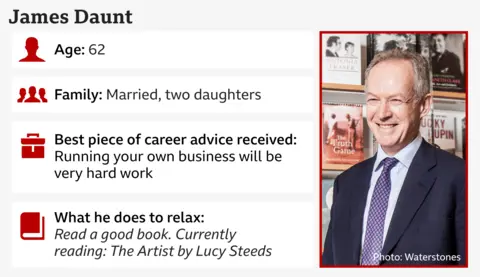
The softly spoken former banker has overturned convention before.
When he took over at Waterstones in 2011, he took the bold decision to end the practice of publishers paying to have their books displayed prominently in stores. It cost him £27m in lost revenue and prompted a “nervous breakdown” among publishers, he said, but it paid off and in 2016 the company returned to profit.
Now Waterstones staff write their own book recommendations, choose books of the month, and the manager selects what goes on the display tables.
As well as books, the chain stocks pens, reading lights, games, wrapping paper and other stationery.
The strategy has helped it defy the decline on the High Street, with around ten new stores opening a year, and profits in 2024 of £33m against sales of £528m.
Waterstones is part of a wider stable, including Foyles and Blackwell’s, owned by hedge fund Elliott Advisers.
Daunt has also been appointed chief executive of Barnes and Noble, the large US bookstore chain also owned by Elliot Advisers.
Share sale
Success on both sides of the Atlantic has led to speculation that shares in Waterstones and Barnes and Noble could be jointly floated in either New York or London.
“It feels like an inevitability and probably better than being flipped to the next private equity person,” says Daunt.
Private owners naturally aim to sell businesses on, he points out. “It’s what they do.”
But it is not clear that London, which he says has been “suffering” as a location for initial public offerings lately, would be considered suitable.
“We’re based out of London but we have a huge American business; Barnes and Noble is much larger than Waterstones.”
Helpful rate change
As for last week’s Budget, Daunt says it sometimes feels like he might be “the only person who is sympathetic” to the situation the chancellor is in.
The government has drawn the ire of the business community for raising employer National Insurance and the minimum wage and not coming up with more growth-boosting measures.
But the Budget included changes that were “very helpful” to companies like his, said Daunt.
 Getty Images
Business rates will be lower for retailers operating out of small sites, while larger business properties, like warehouses will pay more.
Daunt said that although Waterstones does have larger premises, levelling the playing field between High Street and online retailers was something he has been calling for for a long time.
With the days of advent now ticking past, the company is well into the se portion of the year when Waterstones makes about 70% of its annual profit.
He says the post-pandemic rebound, with people returning to bookshops, does not seem to have gone away.
Personally he has also retained his love of reading, even after 36 years in the industry. But he does have one bad book habit, he said.
“Because I read professionally, I do a rather awful thing which is start a lot of books and then not finish them.
“I love the excitement of opening up a first novel and not knowing what’s going to come of it. But if it isn’t quite that good, I’ll just move on.”

NI Affairs Committee told even if conflict ends immediately it will take time for supply chains to return to normal.
Source link

The president also said the US will continue to blockade Iran’s ports until peace talks progress.
Source link
Business
High-Skilled Immigration: US tightens screws on high-skilled immigration: Denial rates surge across key visa categories – The Times of India

For Indian tech and medical professionals, researchers and even global achievers eyeing to work in the US, the path is becoming increasingly uncertain. New data shows that even the most elite immigration routes, once seen as relatively stable, are now facing sharply higher rejection rates, signalling a broader tightening of legal migration pathways.The US has significantly increased denial rates for high-skilled immigration categories in fiscal 2025 (year ending Sept 30, 2025), reflecting a policy-driven shift to restrict legal migration even for highly qualified professionals according to a new analysis by the National Foundation for American Policy (NFAP).“The latest data show that Trump administration officials intend to make it difficult for even the most highly skilled individuals from around the world to work in the US,” said Stuart Anderson, executive director of NFAP.A change of this magnitude indicates a crackdown on approvals, the analysis noted, pointing to a sharp rise in rejection rates despite no formal regulatory changes.
Green card routes for top talent see sharpest rise
The steepest increases are in employment-based green card categories used by highly accomplished professionals. The increase in denials occurred within a single year, despite no new regulations indicating a shift in adjudication standards.
- EB-1 (extraordinary ability): Denial rates nearly doubled from 25.6% in Q4 FY2024 to 46.6% in Q4 FY2025
- EB-2 National Interest Waiver (NIW): Denials rose from 38.8% in Q4 FY2024 to 64.3% in Q4 FY2025
Over a longer period, the trend is even sharper: NIW denial rates rose from 4.3% in FY2022 to 44.8% in FY2025, states the report.
Temporary work visas also tightening
Denial rates have also increased across key temporary work visa categories, particularly toward the end of FY2025:
- O-1 visas: Denial rates rose from 5.0% in Q4 FY2024 to 7.3% in Q4 FY2025 . These visas are meant for individuals with extraordinary ability in fields such as science, technology, arts, education, business or sports. It is typically used by top researchers, startup founders, artists and senior professionals with a strong record of achievement.
- L-1A visas: Denial rates increased from 8.0% in Q4 FY2024 to 9.6% in Q4 FY2025. These visas are used by multinational companies to transfer senior executives or managers from an overseas office to a US office. It is a key route for leadership mobility within global firms.
- L-1B visas: Denial rates rose from 8.1% in Q4 FY2024 to 9.2% in Q4 FY2025. These visas are also for intracompany transfers, but specifically for employees with specialised knowledge and are often used for technical experts and niche-skilled staff.
H-1B remains stable—but pressure persists
The H-1B visa, widely used by Indian IT professionals, has not seen a comparable increase in denial rates, the denial rates remained stable at around 2.0%–2.1% in FY2025. This is attributed to a 2020 legal settlement, which limits changes to adjudication standards without formal rulemaking.However, policy pressure continues through other measures. President Trump has signed an executive order mandating a $100,000 fee to petition for an H‑1B worker outside the US. Further, selection in the lottery for H-1B cap visas is linked to wages and there is a proposal to increase wages across all levels.
Backlogs and delays worsen the squeeze
For the Indian diaspora, these statistics are worrying. Between Q4 FY2024 and Q4 FY2025, backlogs rose across key immigration filings. Pending I-129 petitions—used by employers to sponsor non-immigrant workers such as H-1B, L-1 and O-1 visa holders — increased by more than 54,000. The backlog for I-140 petitions, which are employer-sponsored applications for employment-based green cards, rose by 58,400.At the final stage, delays also deepened: the backlog for I-485 applications—filed by individuals to adjust status to permanent residence (green card) within the US—continued to grow.
Bottom line
The data signals a clear shift: legal immigration pathways are narrowing over FY2025, particularly in the latter half of the fiscal year, driven by stricter adjudication rather than new laws.

Energy prices ‘could stay high into winter’

The Best Chromebooks Are Doing Their Best to Course Correct

‘Benidorm’ actor Elsie Kelly dies aged 89; cause of death revealed

-

 Fashion6 days ago
France’s LVMH Q1 revenue falls 6%, shows resilience amid Iran war
-

 Entertainment7 days ago
Is Claude down? Here’s why users are seeing errors
-
 Business1 week ago
Delta Air Lines unveils first new Delta One suite in premium cabin arms race
-

 Fashion1 week ago
Asia claims largest share of markets on Kearney FDI Confidence Index
-

 Sports7 days ago
PSL 11: Peshawar Zalmi win toss, opt to field first against Quetta Gladiators
-

 Tech1 week ago
The Deepfake Nudes Crisis in Schools Is Much Worse Than You Thought
-

 Tech1 week ago
Bremont Is Sending a Watch to the Moon’s Surface
-

 Tech1 week ago
Human-machine teaming dives underwater