

Tech
3D-printed gyroidal solid oxide cells offer lighter, more compact energy solutions

Over the past decades, energy engineers have been developing a wide range of new technologies that could power electronic devices, robots and electric vehicles more efficiently and reliably. These include solid oxide cells (SOCs), electrochemical devices that can operate in two different modes, as fuel cells or as electrolyzers.
Fuel cells are devices that can convert the energy in specific chemicals into electricity via chemical reactions. Electrolyzers, on the other hand, are technologies that can split water (H2O) or other molecules using electricity, to produce hydrogen (H2) or other desirable chemicals.
Most SOCs developed so far are two-dimensional (2D) and consist of flat structures with stacked layers of different materials. This 2D design, however, limits the extent to which the devices can be reduced in size while also increasing their weight, as it relies on metallic interconnects to enable the flow of energy and seal different components.
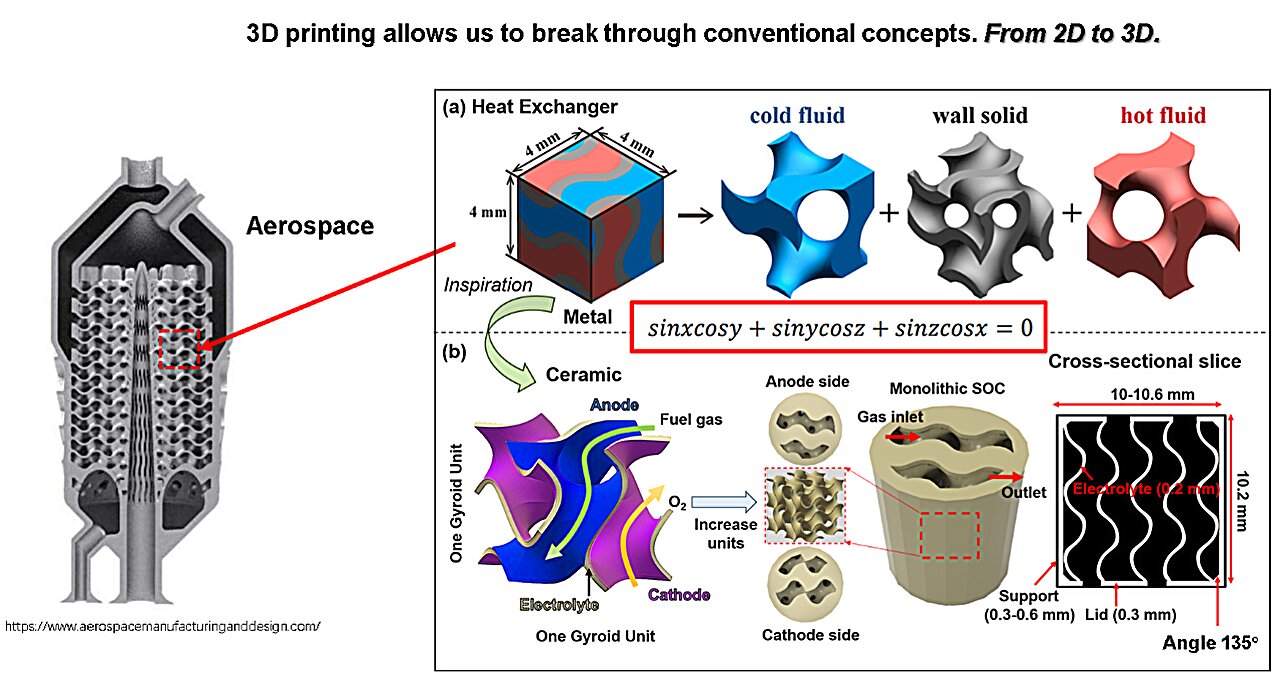
Researchers at the Technical University of Denmark recently designed new three-dimensional (3D) SOCs with a periodic surface structure known as a gyroid. These cells, outlined in a paper published in Nature Energy, can be fabricated using 3D printing, also known as additive manufacturing.
“The use of gyroid structures in heat exchangers has been shown to reduce weight, improve compactness, and increase efficiency,” Prof. Vincenzo Esposito, corresponding author of the paper, told Tech Xplore. “We replace the metal with an ion-conducting ceramic, thereby realizing the 3D-SOC concept. The 3D-SOC is well-suited for applications that demand lightweight construction, compactness, and stability, such as those in the aerospace and automotive industries.”

The monolithic gyrodial SOCs developed by Prof. Esposito and his colleagues have three primary components: a dense ceramic electrolyte, a porous fuel electrode and a porous oxygen electrode. Like other SOCs, they can operate in two different modes, namely as fuel cells or as electrolyzers.
“In the fuel cell (SOFC) mode, the cell generates electricity using fuel gases such as H₂, CH₄, and CO, normally called X to Power,” said Prof. Esposito. “In the electrolysis (SOEC) mode, it produces fuel gases and O₂ by electrolyzing H₂O or CO₂, called Power to X.”
To fabricate their 3D SOCs, the researchers first realized their monolithic ceramic frame, which includes an electrolyte, the sealing and support structure. This entire structure was manufactured using 3D printing technology.
Subsequently, they coated the fuel electrode and oxygen electrode on the electrolyte’s surfaces. Finally, they co-sintered the electrolyte, fuel electrode and oxygen electrode together, ultimately attaining a functioning monolithic gyroid SOC.
“Compared to conventional SOC stack technology, the 3D-SOC has an extremely simplified manufacturing process,” explained Dr. Zhipeng Zhou, lead author of the paper. “A conventional SOC stack requires the integration of numerous components, including single cells, metallic interconnects, and sealants. In contrast, the 3D-SOC can be fabricated using only 3D printing, coating, and co-sintering processes.”

In contrast with 2D SOCs, the 3D device developed by the researchers can be scaled up without the need for additional components, which in turn reduces its overall weight. In addition, the team’s new design enables greater space for the electrolyte, while minimizing the cell’s size and maximizing its compactness.
“The 3D-SOC is flexible and could be upscaled without metallic interconnects,” said Dr. Zhou. “The complete elimination of metallic interconnects significantly improved the stability of the SOC system and reduced its cost.”
The recent work by Prof. Esposito, Dr. Zhou and their colleagues opens new exciting possibilities for the fabrication of 3D SOCs. In the future, the devices they designed could be improved further and deployed in various settings, particularly within the aerospace and automotive industries.
“Some examples include NASA’s Mars program and Airbus’ SOFC aircraft (HYLENA | Airbus),” said Dr. Venkata Nadimpalli, corresponding author of the paper. “From a scientific perspective, the 3D-SOC features fundamentally different structures compared to conventional SOC designs. As a result, conclusions drawn from traditional SOCs may not apply to 3D-SOCs, due to their distinct gas distribution and heat transport properties.”
Prof. Esposito, Dr. Zhou and Dr. Nadimpalli hope that their study will soon inspire other research groups to design similar 3D SOCs that are compact, highly performing and more scalable.
Written for you by our author Ingrid Fadelli,
edited by Gaby Clark, and fact-checked and reviewed by Robert Egan—this article is the result of careful human work. We rely on readers like you to keep independent science journalism alive.
If this reporting matters to you,
please consider a donation (especially monthly).
You’ll get an ad-free account as a thank-you.
More information:
Zhipeng Zhou et al, Monolithic gyroidal solid oxide cells by additive manufacturing, Nature Energy (2025). DOI: 10.1038/s41560-025-01811-y.
© 2025 Science X Network
Citation:
3D-printed gyroidal solid oxide cells offer lighter, more compact energy solutions (2025, August 20)
retrieved 20 August 2025
from https://techxplore.com/news/2025-08-3d-gyroidal-solid-oxide-cells.html
This document is subject to copyright. Apart from any fair dealing for the purpose of private study or research, no
part may be reproduced without the written permission. The content is provided for information purposes only.












New York has banned state employees from using insider information to trade on prediction markets. In an executive order signed today and viewed by WIRED, Governor Kathy Hochul forbade the state’s government workforce from using “any nonpublic information obtained in the course of their official duties” to participate on prediction market platforms, or to help others profit using those services.
“Getting rich by betting on inside information is corruption, plain and simple,” Hochul said in a statement provided to WIRED. “Our actions will ensure that public servants work for the people they represent, not their own personal enrichment. While Donald Trump and DC Republicans turn a blind eye to the ethical Wild West they’ve created, New York is stepping up to lead by example and stamp out insider trading.”
The order was not spurred by any specific insider trading incidents involving New York state employees. “There are no known instances of this behavior to date,” says New York State Executive Chamber deputy communications director Sean Butler.
This is the latest in a wave of initiatives meant to curb insider trading on prediction markets like Kalshi and Polymarket, the two most popular of these platforms in the United States. California Governor Gavin Newsom issued a similar executive order last month, banning Golden State employees from prediction market insider trading. Yesterday, Illinois Governor JB Pritzker followed suit.
In addition to these executive orders, Congress has also introduced several bills intended to curb market manipulation and corruption in the industry, including legislation barring elected officials from participating in prediction markets. Some individual politicians are discouraging or outright barring their staff from buying event contracts on those platforms. According to CNN, the White House recently warned executive branch staff not to trade on prediction markets. When WIRED asked the White House about its policies on these markets earlier this year, it pointed to existing regulations prohibiting gambling activity but did not respond to requests for clarification on whether it considered prediction market participation to be gambling.
The Commodity Exchange Act, which covers derivative markets, does already prohibit insider trading, which means that both public servants and people in the private sector are breaking the law if they enact insider trades on event contracts. Rather than establishing new rules, the New York executive order serves primarily to underline the state’s commitment to enforcing existing laws and to clarify how these laws and its Code of Ethics for employees apply to prediction markets.
However, with so many high-profile examples of suspected insider trading on Polymarket focused on geopolitical events, from the capture of former Venezuelan leader Nicolas Maduro to strikes in the ongoing Iran war, many onlookers—including prominent lawmakers—see this as such a combustible issue. They’re racing to write laws and orders restating and emphasizing existing rules.
“This makes sense, and we already do this. At Kalshi, insider trading violates our rules, and we enforce them when we catch insiders,” Kalshi spokesperson Elisabeth Diana says. “Government employees should be aware that trading on federally regulated markets using material nonpublic information violates the law.” (Polymarket did not immediately respond to a request for comment.)
Facing backlash, Polymarket and Kalshi have recently announced new initiatives to combat insider trading.
In February, Kalshi publicized its decision to suspend and fine two individuals for violating its market manipulation policies; the company also confirmed that it had flagged the cases to the Commodity Futures Trading Commission, the federal agency overseeing prediction markets. In March, it rolled out a beef up market surveillance arm, preemptively blocking political candidates from trading on markets related to their campaigns.

I was delighted to see that the Acer Chromebook Plus 516 didn’t skimp on a crappy touchpad. That goes a long way toward improving the experiencing of actually using the laptop on a moment-by-moment basis. I wasn’t annoyed every time I had to click-and-drag or select a bit of text. This one’s biggest weakness is definitely the screen, which is true of just about every cheap Chromebook I’ve tested. The colors are ugly and desaturated, giving the whole thing a sickly green tint. It’s also not the sharpest in the world, as it’s stretching 1920 x 1200 pixels across a large, 16-inch screen. But in terms of usability and performance, the Acer Chromebook Plus 516 is a great value, combining an Intel Core i3 processor with 8 GB of RAM and a 128 GB of storage. For a Chromebook that’s often on sale for $350, it’s a steal.
While we’re here, let’s go even cheaper, shall we? Asus has two dirt-cheap Chromebooks that I tested last year that I was mildly impressed by. The Asus Chromebook CX14 and CX15. Notice in the name that these are not “Chromebook Plus” models, meaning they can be configured with less RAM and storage, and even use lower-powered processors. That’s exactly what you get on the cheaper configurations of the CX14 and CX15, which is how you sometimes get prices down to as low as $130. I definitely recommend the version with 8 GB of RAM, but regardless of which you choose, the both the CX14 and larger CX15 are mildly attractive laptops. You’d know that’s a big compliment if you’ve seen just how ugly Chromebooks of this price have been in the past.
With these, though, I appreciate the relatively thin bezels and chassis thickness, as well as the larger touchpad and comfortable keyboard. The CX15 even comes in a striking blue color. The touchpad isn’t great, nor is the display. Like the Acer Chromebook Plus 516, it suffers from poor color reproduction and only goes up to 250 nits of brightness. It only has a 720p webcam too, which makes video calls a bit rough. But that’s going to be true of nearly all the competition (and there isn’t much).
Of the two models, I definitely prefer the CX14 though, as it doesn’t have a numberpad and off-center touchpad, which I’ve always found to be awkward to use. Look—no one’s going to love using a computer that costs the less than $200, but if it’s what you can afford, the Asus Chromebook CX14 will at least get you by without too much frustration.
Whatever you do, don’t just head over to Amazon and buy whatever ancient Chromebook is selling for $100 for your kid. It’s worth the extra cash to get something with better battery life, a more modern look, and decent performance.
Other Good Chromebooks We’ve Tested
We’ve tested dozens and dozens of Chromebooks over the past years, having reviewed every major release across the spectrum of price. Unlike Macs and Windows laptops, Chromebooks tends to stick around a bit longer though, and aren’t refreshed as often. I stand by my picks above, but here are a few standouts from our testing that are still worth buying for the right person.
Photograph: Daniel Thorp-Lancaster
Tech
Interview: Critical local infrastructure is missing link in UK cyber resilience | Computer Weekly

Critical local infrastructure that supports council services, social care services and local transport in the UK is falling through the gaps in government and business planning for cyber resilience, claims Jonathan Lee, director of cyber strategy at cyber security company TrendAI.
In an interview with Computer Weekly, Lee says that municipal areas, such as London or Greater Manchester, could be at risk from multiple cyber attacks that could damage local infrastructure, causing escalating problems for residents that could add up to severe disruption.
“We need to be thinking about what would happen if multiple attacks happened at the same time across the city region – and the human impact of not being able to do your job properly, not being able to travel around and not being able to deliver public services,” he says.
The Cyber Security and Resilience Bill (CSRB), which is currently going through Parliament, aims to ensure that critical national services, such as healthcare, water, transport and energy, are protected against cyber attacks that cost the economy billions of pounds a year. But local infrastructure has been relatively neglected, claims Lee.
The National Cyber Security Centre’s (NCSC) Cyber Assurance Framework, for example, aims to help operators of critical national infrastructure (CNI) demonstrate a base level of cyber security preparedness – but it is not mandatory, and not every organisation that should implement it is implementing it.
Whole of society risk
“We need to be more stringent in making sure that people are taking this seriously and are looking not just at their own organisation, but are looking at the whole of society risk,” says Lee.
Attacks on public services, such as council-run social care, can have a catastrophic, knock-on effect on the NHS and patient care, he adds.
There is a need for more “top-down” advice for regional infrastructure providers, from organisations such as the NCSC, which is not as well known as it could be among the companies and public sector bodies that provide local infrastructure.
“The message has got to be diffused down into local levels to ensure that a consistent message is spread out, and that can also be through industry partners. That is something I feel quite strongly about,” says Lee.
The Cyber Essentials programme, which has been updated to include new requirements for organisations to use multifactor authentication (MFA), and requirements for cloud providers to patch vulnerabilities within 14 days, has helped build resilience, but only for organisations that choose to adhere to it.
Keeping the resilience score
The UK government is also intending to publish a Cyber Action Plan in the coming months, which will guide organisations to get basic security right and improve their cyber security over time.
Although there is no shortage of initiatives and action plans, there is a danger that many of these plans will be left on a shelf.
One approach is for organisations to rate themselves on a scorecard for cyber resilience, on a scale of, say, 1 to 100, and to report their progress back to board-level directors.
“We need a mechanism to measure how impactful these interventions are, whether it be things like the Cyber Assessment Framework, Cyber Essentials or legislation,” says Lee.


Life sciences lab real estate is clawing back from disaster. Here’s what that means for investors

Men’s college basketball buzz: State of blue blood rebuilds

New York Bans Government Employees from Insider Trading on Prediction Markets

-

 Fashion6 days ago
France’s LVMH Q1 revenue falls 6%, shows resilience amid Iran war
-

 Entertainment1 week ago
Is Claude down? Here’s why users are seeing errors
-

 Sports1 week ago
PSL 11: Peshawar Zalmi win toss, opt to field first against Quetta Gladiators
-

 Tech1 week ago
The Deepfake Nudes Crisis in Schools Is Much Worse Than You Thought
-

 Tech1 week ago
Bremont Is Sending a Watch to the Moon’s Surface
-

 Tech1 week ago
Human-machine teaming dives underwater
-
 Business1 week ago
BP sees ‘exceptional’ oil trading result as Iran war sends crude costs soaring
-

 Fashion1 week ago
What no one is saying about the 2026 apparel slowdown