

Business
FBR moves against private-practice doctors over tax non-filing, discrepancies | The Express Tribune

As per data, 31,524 doctors declared zero income but collectively filed tax refund claims amounting to Rs1.3b
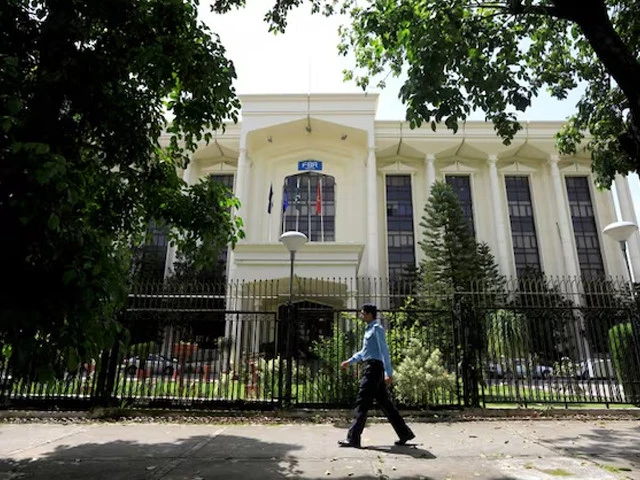
A policeman walks past the Federal Board of Revenue (FBR) office building in Islamabad on August 29, 2018. Photo: REUTERS
The Federal Board of Revenue has decided to tighten the noose around private-practice doctors, clinics and private hospitals allegedly involved in tax evasion amounting to billions of rupees.
The decision has been taken in light of the latest statistics obtained during FBR’s data analysis, which revealed large-scale alleged tax evasion by doctors across the country. Despite having taxable income, more than 73,000 registered doctors were found to have not filed income tax returns.
According to FBR officials, the latest data shows that there are 130,243 registered doctors nationwide. However, during the current year, only 56,287 registered doctors filed income tax returns, while over 73,000 medical professionals did not submit any returns at all—despite being engaged in one of the country’s highest-earning professions.
The findings highlight stark discrepancies between the visible scale of private medical practices and the income declared to the FBR. The data shows that in 2025, as many as 31,870 doctors declared zero income from private practice, while 307 doctors reported losses, even though their clinics in major cities remain consistently crowded with patients. Only 24,137 doctors declared business income.
Even among those doctors who do file tax returns, the tax paid is disproportionately low compared to their potential earnings. Some 17,442 doctors earning more than Rs1 million annually paid an average of only Rs1,894 per day in tax.
Meanwhile, 10,922 doctors with annual incomes between Rs1 million and Rs5 million paid just Rs1,094 per day. Around 3,312 doctors earning between Rs5 million and Rs10 million annually paid an average daily tax of Rs1,594.
In contrast, many doctors reportedly charge fees ranging from Rs2,000 to Rs10,000 per patient, yet fail to declare even the equivalent of a single patient’s daily fee as tax. The highest-earning group—3,327 doctors with annual incomes exceeding Rs10 million—paid only about Rs5,500 per day in tax.
Additionally, 38,761 doctors declared incomes of less than Rs1 million and paid an average daily tax of only Rs791. Alarmingly, 31,524 doctors who declared zero income collectively filed tax refund claims amounting to Rs1.3 billion.
The figures sharply contradict ground realities, where private clinics across the country are packed with patients every evening and consultation fees remain significantly high.
In comparison, a Grade-17 or Grade-18 government officer pays far more tax on a monthly basis than many doctors pay over an entire quarter, despite government employees having little to no opportunity to conceal income.
The situation raises a fundamental question: can the country rely on taxes from sectors whose incomes cannot be concealed, while high-income professions either underreport or completely hide their earnings?
The growing compliance gap underscores the urgent need for effective enforcement measures to restore fairness in the tax system. Compliance among high-income professions, the FBR believes, is no longer optional but has become essential for national economic stability.




Oil prices fell and Asian stock markets surged to record highs on Wednesday after Donald Trump said negotiations with Iran were making “great progress” toward a final agreement and announced a brief pause in US operations escorting ships through the Strait of Hormuz.
Brent crude tumbled 1.2 per cent to $108.51 a barrel, still well above its roughly $70 price before the war began, but lower than the highs of recent weeks.
Wall Street had already set records on Tuesday, with the S&P 500 rising 0.8 per cent to a new all-time high and the Nasdaq gaining 1 per cent, as oil pulled back sharply after briefly crossing $115 on Monday.
Strong corporate earnings underpinned the Wall Street rally. DuPont surged 8.4 per cent after the chemical giant reported better-than-expected first-quarter profits and raised its full-year forecasts, even as it acknowledged some impact from logistics disruptions in the Middle East.
Pinterest jumped 6.9 per cent after its number of active monthly users rose 11 per cent to 631 million, beating Wall Street’s sales and profit targets. AB InBev climbed 8.7 per cent after topping profit forecasts on growth for its Corona, Stella Artois and Michelob Ultra brands. “Cheers to beer,” chief executive Michel Doukeris said.
Palantir fell 6.9 per cent despite beating expectations, as its stock continued to struggle on worries about increased competition. American Electric Power rose 1.8 per cent and Cummins added 2.8 per cent after both reported stronger-than-expected results.
In Europe, markets were mixed. The CAC 40 rose 1.1 per cent in Paris while the FTSE 100 fell 1.4 per cent in London. Hong Kong’s Hang Seng fell 0.8 per cent. Many Asian markets were closed for holidays.
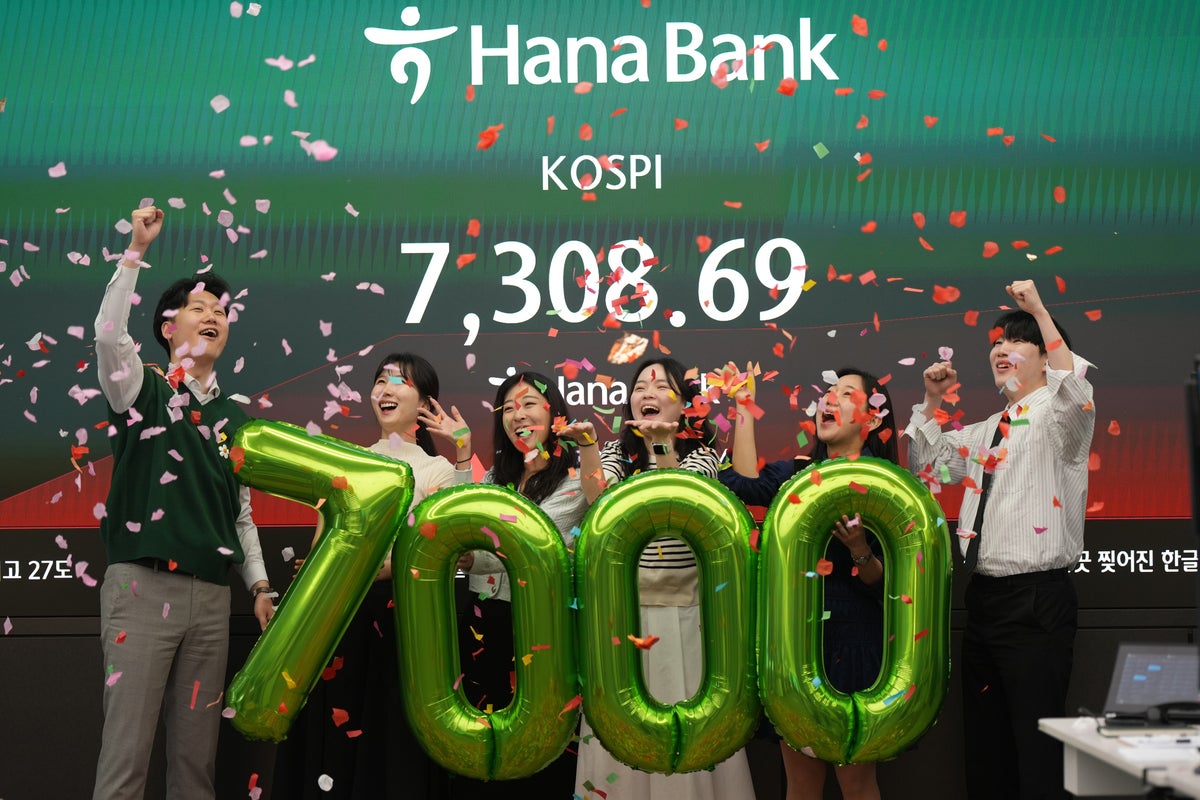
The momentum carried into Asia on Wednesday, where MSCI‘s broadest index of Asia-Pacific shares outside Japan jumped 2.3 per cent to a fresh all-time high. South Korea’s Kospi surged 5.1 per cent, clearing the 7,000 mark for the first time, as Samsung Electronics jumped 12 per cent and crossed a $1 trillion market valuation, overtaking Berkshire Hathaway.
The AI trade drove much of the enthusiasm. Advanced Micro Devices jumped 16.5 per cent in extended trading after forecasting second-quarter revenue above Wall Street expectations on strong demand from cloud computing companies accelerating spending on AI infrastructure.
“Due to the capital expenditure we are seeing from hyperscalers in the US, the earnings growth trajectory for sectors such as semiconductors, tech hardware, industrials and materials in Asia exceeds anything I have seen in a long time,” Rushil Khanna, head of equity investments for Asia at Ostrum, an affiliate of Natixis Investment Managers, told Reuters. “This capex is leading to material value creation in Asia as the provider of the picks and shovels to the AI ecosystem.”
The diplomatic backdrop of US-Iran talks also helped the markets. Mr Trump said he would briefly pause US operations escorting ships through the strait, which has been effectively closed since Iran blockaded it in late February, triggering a global energy shock. US defence secretary Pete Hegseth confirmed the ceasefire remained in place despite the US and Iran exchanging fire the previous day.
“Markets embraced a sense of calm and stability overnight, with the risk of escalation in the Middle East conflict viewed as having diminished,” analysts from Westpac wrote in a note.
Despite the optimism, analysts cautioned that significant uncertainties remained this week.
“A fragile ceasefire, a novel blockade, Friday’s NFP and diminishing odds of a US-Iran peace deal are all converging this week,” said Lukman Otunuga, head of market research at trading broker FXTM.
“Gold may find itself on the losing end of conflict-induced inflation fears, even as uncertainty grips markets.”
Gold rose 1.2 per cent to $4,609.59. The dollar index slipped 0.1 per cent, snapping a three-day winning streak, with the euro rising to $1.1724 and sterling to $1.3577.
The Australian dollar climbed 0.6 per cent to its highest since June 2022, buoyed by improved risk appetite and underpinned by a third consecutive interest rate rise from the Reserve Bank of Australia, which cited the Middle East conflict’s impact on fuel and commodity prices. The ten-year US Treasury yield held flat at 4.424 per cent.

Josh D’Amaro, chairman of Disney Experiences, speaks during the grand opening ceremony of Shanghai Disney Resort’s Zootopia-themed land on December 19, 2023 in Shanghai, China.
Vcg | Visual China Group | Getty Images
Disney will release its fiscal second-quarter results before the bell Wednesday. It will mark the first earnings call led by Josh D’Amaro since the former parks executive took over as CEO in March.
Under the new CEO, who replaced Bob Iger after his two turns at the helm totaling roughly 20 years, Disney has already been through a round of layoffs and has faced mounting political pressure surrounding its late night TV host Jimmy Kimmel.
“This earnings call marks Disney’s first real gut‑check under D’Amaro’s leadership, and a test of how his theme‑parks roots translate, or don’t, into the rest of the business,” said Mike Proulx, research director at Forrester. “Streaming is still the main event, but the market is consolidating. A potential combination of Paramount+ and HBO Max would reset the competitive calculus for Disney+.”
Streaming and TV results have gobbled up much of the focus for media investors across the board as the industry faces significant upheaval and consolidation.
Here’s how Disney is expected to perform in its fiscal second quarter, according to LSEG:
- Earnings per share: $1.49 expected
- Revenue: $24.78 billion expected
Last quarter Disney stopped reporting some details for the entertainment segment — which is comprised of its traditional TV, streaming and theatrical releases — including the breakdown of revenue and operating income for each segment. The company has also stopped reporting quarterly streaming subscriber numbers.
The consumer shift from pay TV bundles to streaming has weighed on media companies for years, with both distribution and advertising profits continuously decreasing. Still, traditional TV remains a cash cow, and investors have been keen to see how and when streaming can make up for the declines.
Updates on the state of Disney’s theme parks, which are part of its experiences unit and the profit driver of the company, will also be of particular interest on Wednesday.
In February, Disney provided second-quarter guidance that called for “modest” growth in operating income for the experiences division due to international visitation headwinds at domestic parks. That forecast was issued before the U.S. and Israel launched attacks on Iran roughly two months ago, causing a surge in oil prices.
This story is developing. Please check back for updates.
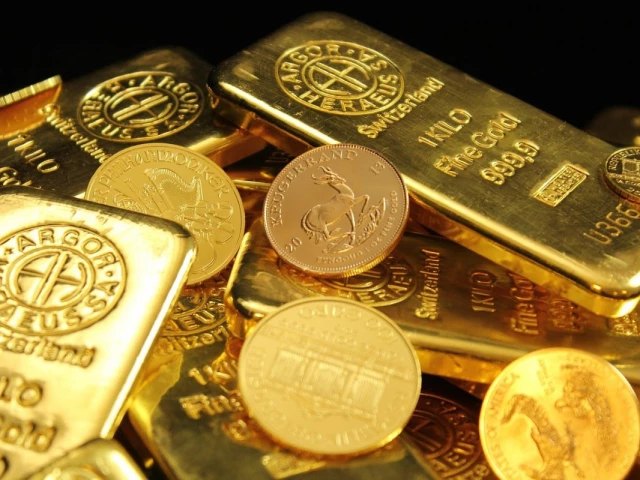
At current prices, the looted gold is worth around $70 million. PHOTO: PIXABAY
Gold and silver prices on Wednesday witnessed a sharp increase in both global and local markets after a three-day pause.
In the international bullion market, the price of gold rose by $111 per ounce to reach $4,666.
According to the All-Pakistan Gems and Jewellers Sarafa Association, following the increase in global prices, the local price of gold per tola increased by Rs11,100 to Rs488,962, while the price of 10 grams of gold rose by Rs9,517 to Rs419,206.
Similarly, silver prices also recorded an upward trend. The price of silver per tola increased by Rs223 to Rs8,072, while the price of 10 grams rose by Rs191 to Rs6,920.
Spot silver rose 4.6% to $76.16 per ounce, platinum gained 2.9% to $2,009.25 and palladium was up 2.4% at $1,521.50.
On Tuesday, gold prices per tola declined by Rs2,100 to reach Rs477,862, according to the All-Pakistan Gems and Jewellers Sarafa Association. Similarly, the 10-gram of gold decreased by Rs1,801, settling at Rs409,689. Silver price dropped by Rs65 to Rs7,849 per tola.
Read: Gold, Silver prices continue downward trend across markets
In the international bullion market, the price of gold per ounce fell by $21, bringing it down to $4,555.
On Monday, the price of gold per tola declined by Rs3,800 to Rs479,962, according to the All-Pakistan Gems and Jewellers Sarafa Association. Similarly, the 10-gram gold dropped by Rs3,257 to Rs411,490, reflecting a broader bearish trend. Silver prices also decreased by Rs100 to Rs7,914 per tola.
Globally, spot gold fell 1.9% to $4,526.88 per ounce, while US futures declined 2.3% to $4,537.90, indicating sustained selling pressure in the bullion market.


Moody’s raises Vietnam’s outlook to ‘positive’ from ‘stable’

Motorbikes, buses, rickshaws to use designated lanes on Karachi’s Sharea Faisal or face fines

Cambodia cuts 2026 growth forecast to 4.2% amid Middle East turmoil

A Brain Implant for Depression Is About to Be Tested in Humans

Pro wrestling star Steph De Lander reveals how colleague’s advice helped lead her to title triumph at ACW

‘I had £20,000 stolen and had to fight a 13-month fraud reporting rule to get it back’

-
 Tech1 week ago
A Brain Implant for Depression Is About to Be Tested in Humans
-
 Sports1 week ago
Pro wrestling star Steph De Lander reveals how colleague’s advice helped lead her to title triumph at ACW
-
Business1 week ago
‘I had £20,000 stolen and had to fight a 13-month fraud reporting rule to get it back’
-

 Entertainment1 week ago
Norway joins Type 26 Frigate Programme to boost NATO naval power
-

 Entertainment1 week ago
Melania Trump says ABC should ‘take a stand’ on late-night host Kimmel
-

 Tech1 week ago
Are tech leaders risking a cyber resourcing crisis? | Computer Weekly
-
 Business6 days ago
PSX plunges over 4,800 points | The Express Tribune
-
 Business1 week ago
Starmer says ‘tide could be turning’ on shoplifting epidemic