

Business
Walmart hikes sales and earnings outlook even as it says tariff costs are rising


The logos of Walmart and Sam’s Club are pictured in Cuautitlan Izcalli, Mexico, January 30, 2025.
Raquel Cunha | Reuters
Walmart on Thursday raised its full-year earnings and sales outlook as its online business posted another quarter of double-digit gains, even as the company said costs are rising from higher tariffs.
The big-box retailer topped Wall Street’s quarterly sales estimates but fell short of earnings expectations, the first time it missed on quarterly earnings since May 2022. The company said it felt pressure on profits for the period, including from some one-time expenses, such as restructuring costs, pricier insurance claims and litigation settlements.
Walmart said it now expects net sales to grow between 3.75% to 4.75% for the fiscal year, up from its previous expectations for 3% to 4%. It raised its adjusted earnings per share outlook slightly to $2.52 to $2.62, up from a prior range of $2.50 to $2.60 per share.
In an interview with CNBC, Chief Financial Officer John David Rainey said the company is working hard to keep prices low – including speeding up imports from overseas and stepping up the number of Rollbacks, or limited-time discounts, in its stores.
“This is managed on an item-by-item and category-by-category basis,” he said. “There are certainly areas where we have fully absorbed the impact of higher tariff costs. There are other areas where we’ve had to pass some of those costs along.”
But he added “tariff-impacted costs are continuing to drift upwards.”
Even so, Rainey said Walmart hasn’t seen a change in customer spending. For example, sales of private label items, which typically cost less than national brands, were roughly flat year over year, he said.
“Everyone is looking to see if there are any creaks in the armor or anything that’s happening with the consumer, but it’s been very consistent,” he said. “They continue to be very resilient.”
Here’s what the big-box reported for the fiscal second quarter compared with what Wall Street expected, according to a survey of analysts by LSEG:
- Earnings per share: 68 cents adjusted vs. 74 cents expected
- Revenue: $177.40 billion vs. $176.16 billion
Walmart shares fell about 2% in premarket trading Thursday.
Walmart’s net income jumped to $7.03 billion, or 88 cents per share, in the three-month period that ended July 31, compared with $4.50 billion, or 56 cents per share, in the year-ago quarter.
Revenue rose from $169.34 billion in the year-ago quarter.
Comparable sales for Walmart U.S. climbed 4.6% in the second quarter, excluding fuel, compared with the year-ago period, as both the grocery and health and wellness category saw strong growth. That was higher than the 4% increase that analysts expected. The industry metric, also called same-store sales, includes sales from stores and clubs open for at least a year.
At Sam’s Club, comparable sales jumped 5.9% excluding fuel, higher than the 5.2% that analysts anticipated.
E-commerce sales jumped 25% globally and 26% in the U.S., as both online purchases and advertising grew. In the U.S., Walmart said sales through store-fulfilled delivery of groceries and other items grew nearly 50% year over year, with one-third of those orders expedited. The company charges a fee for some of those faster deliveries, and others are included as a benefit of its subscription-based membership program, Walmart+.
Its global advertising business grew 46% year over year, including Vizio, the smart TV maker it acquired for $2.3 billion last year. Its U.S. advertising business, Walmart Connect, grew by 31%.
As Walmart’s online business drums up more revenue from home deliveries, advertising and commissions from sellers on its third-party marketplace, e-commerce has become a profitable business. The company marked a milestone in May — posting its first profitable quarter for its e-commerce business in the U.S. and globally.
Rainey said on Thursday that Walmart doubled its e-commerce profitability in the fiscal second quarter from the prior quarter.
In the U.S., shoppers both visited Walmart more and spent more on those trips during the quarter. Customer transactions rose 1.5% year over year and average ticket increased 3.1% for Walmart’s U.S. business.
As the largest U.S. retailer, Walmart offers a unique window into the financial health of American households. As higher duties have come in fits and starts — with some getting delayed and others going into effect earlier this month — Wall Street has tried to understand how those costs will ripple through the U.S. economy.
Walmart warned in May that it would have to raise some prices due to higher levies on imports, even with its size and scale. The company’s comments drew the ire of President Donald Trump, who said in a social media post that Walmart should “EAT THE TARIFFS.”
About a third of what Walmart sells in the U.S. comes from other parts of the world, with China, Mexico, Canada, Vietnam and India representing its largest markets for imports, Rainey said in May.
According to an analysis by CNBC of about 50 items sold by the retailer, some of those price changes have already hit shelves. Items that rose in price at Walmart over the summer included a frying pan, a pair of jeans and a car seat.
Rainey on Thursday declined to specify items or categories where Walmart had increased prices, saying the company is “trying to keep prices as low as we can.”
He said one of the company’s strategies has been bringing in inventory early, particularly for Sam’s Club as it gets ready for the second half of the fiscal year and its crucial holiday season. At the end of the quarter, inventory was up about 3.5% at Sam’s Club, Rainey said. It was up 2.2% for Walmart U.S.
Yet even with higher costs from tariffs, Walmart has fared better than its retail competitors as it has leaned into its reputation for value, competed on faster deliveries to customers’ homes and attracted more business from higher-income households.
The Arkansas-based retailer’s performance has diverged sharply from rival Target, which posted another quarter of sales declines on Wednesday and named the new CEO who will be tasked with trying to turn around the company.
Walmart has gained from Target’s struggles. It has followed the Target playbook by launching more exclusive and trend-driven brands, including grocery brand BetterGoods and activewear brand Love & Sports. It has also expanded its third-party marketplace to include prestige beauty brands and more.
Sales of general merchandise, items outside of the grocery department, were a bright spot for Walmart in the fiscal second quarter, Rainey said. That category struggled during peak inflation in recent years, as consumers spent less on discretionary items because of rising grocery bills.
Comparable sales for general merchandise rose by a low-single-digit percentage and accelerated throughout the quarter, Rainey said. He added clothing and fashion sales “really shined for us.”
1729471601-0/image-(8)1729471601-0-640x480.webp "Pakistan’s crisis differs from world | The Express Tribune")





Business
Private sector data: Over 2 lakh private companies closed in 5 years; govt flags monitoring for suspicious cases – The Times of India
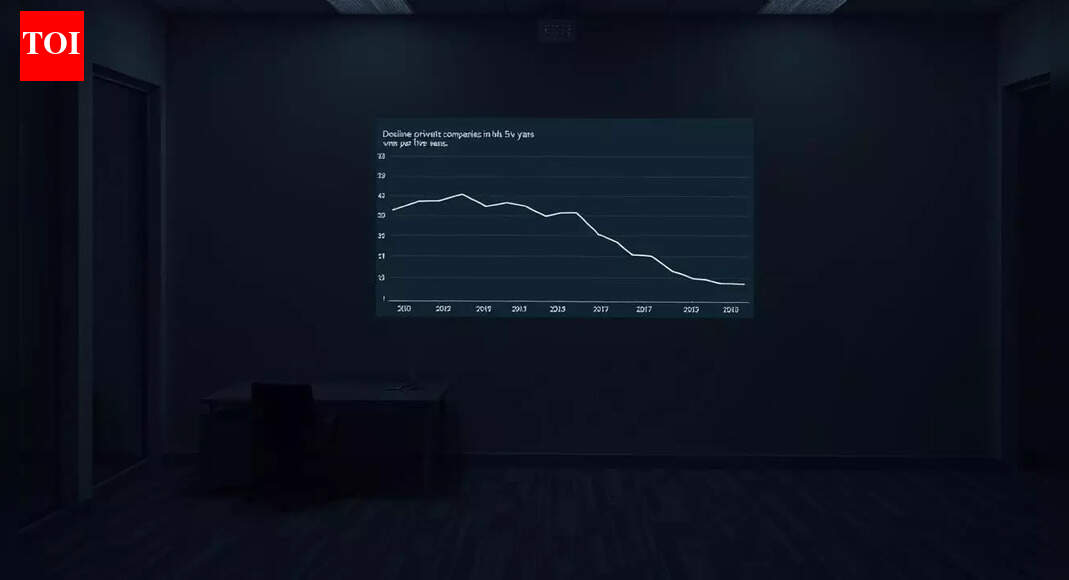
NEW DELHI: The government on Monday said that over the past five years, more than two lakh private companies have been closed in India.According to data provided by Minister of State for Corporate Affairs Harsh Malhotra in a written reply to the Lok Sabha, a total of 2,04,268 private companies were shut down between 2020-21 and 2024-25 due to amalgamation, conversion, dissolution or being struck off from official records under the Companies Act, 2013.Regarding the rehabilitation of employees from these closed companies, the minister said there is currently no proposal before the government, as reported by PTI. In the same period, 1,85,350 companies were officially removed from government records, including 8,648 entities struck off till July 16 this fiscal year. Companies can be removed from records if they are inactive for long periods or voluntarily after fulfilling regulatory requirements.On queries about shell companies and their potential use in money laundering, Malhotra highlighted that the term “shell company” is not defined under the Companies Act, 2013. However, he added that whenever suspicious instances are reported, they are shared with other government agencies such as the Enforcement Directorate and the Income Tax Department for monitoring.A major push to remove inactive companies took place in 2022-23, when 82,125 companies were struck off during a strike-off drive by the corporate affairs ministry.The minister also highlighted the government’s broader policy to simplify and rationalize the tax system. “It is the stated policy of the government to gradually phase out exemptions and deductions while rationalising tax rates to create a simple, transparent, and equitable tax regime,” he said. He added that several reforms have been undertaken to promote investment and ease of doing business, including substantial reductions in corporate tax rates for existing and new domestic companies.

Pakistan’s textile exports surged to $6.4 billion during the first four months of the 2025-26 fiscal year, marking the highest trade volume for the sector in this period.
According to the Pakistan Bureau of Statistics (PBS), value-added textile sectors were key contributors to the growth.
Knitwear exports reached $1.9 billion, while ready-made garments contributed $1.4 billion.
Significant increases were observed across several commodities: cotton yarn exports rose 7.74% to $238.9 million, and raw cotton exports jumped 100%, reaching $2.6 million from zero exports the previous year.
Other notable gains included tents, canvas, and tarpaulins, up 32.34% to $53.48 million, while ready-made garments increased 5.11% to $1.43 billion.
Exports of made-up textile articles, excluding towels and bedwear, rose 4.17%, totaling $274.75 million.
The report also mentioned that the growth in textile exports is a result of improved global demand and stability in the value of the Pakistani rupee.

UK investment bank Peel Hunt has given some support to under-pressure Chancellor Rachel Reeves over last week’s Budget as it said efforts to boost the London market and invest in UK companies were “positive steps”.
Peel Hunt welcomed moves announced in the Budget, such as the stamp duty exemption for shares bought in newly listed firms on the London market and changes to Isa investing.
It comes as Ms Reeves has been forced to defend herself against claims she misled voters by talking up the scale of the fiscal challenge in the run-up to last week’s Budget, in which she announced £26 billion worth of tax rises.
Peel Hunt said: “Following a prolonged period of pre-Budget speculation, businesses and investors now have greater clarity from which they can start to plan.
“The key measures were generally well received by markets, particularly the creation of additional headroom against the Chancellor’s fiscal rules.
“Initiatives such as a stamp duty holiday on initial public offerings (IPOs) and adjustments to the Isa framework are intended to support UK capital markets and encourage investment in British companies.
“These developments, alongside the Entrepreneurship in the UK paper published simultaneously, represent positive steps toward enhancing the UK’s attractiveness for growth businesses and long-term investors.”
Ms Reeves last week announced a three-year stamp duty holiday on shares bought in new UK flotations as part of a raft of measures to boost investment in UK shares.
She also unveiled a change to the individual savings account (Isa) limit that lowers the cash element to £12,000 with the remaining £8,000 now redirected into stocks and shares.
But the Chancellor also revealed an unexpected increase in dividend tax, rising by 2% for basic and higher rate taxpayers next year, which experts have warned “undermines the drive to increase investing in Britain”.
Peel Hunt said the London IPO market had begun to revive in the autumn, although listings activity remained low during its first half to the end of September.
Firms that have listed in London over recent months include The Beauty Tech Group, small business lender Shawbrook and tinned tuna firm Princes.
Peel Hunt added that deal activity had “continued at pace” throughout its first half, with 60 transactions announced across the market during that time and 10 active bids for FTSE 350 companies, as at the end of September.
Half-year results for Peel Hunt showed pre-tax profits jumped to £11.5 million in the six months to September 30, up from £1.2 million a year earlier, as revenues lifted 38.3%.
Peel Hunt said its workforce has been cut by nearly 10% since the end of March under an ongoing savings drive, with full-year underlying fixed costs down by around £5 million.
Steven Fine, chief executive of Peel Hunt, said: “The second half has started strongly, with the group continuing to play leading roles across both mergers and acquisitions and equity capital markets mandates.”


U.S. Black Friday online sales hit record $11.8 billion, Adobe reports

What if Sun goes dark? Experts examine deadly reality behind upcoming sci-fi film
Hail or Fail: Terry McLaurin makes strong return, but Commanders fall in OT

-

 Sports1 week ago
WATCH: Ronaldo scores spectacular bicycle kick
-

 Entertainment1 week ago
Welcome to Derry’ episode 5 delivers shocking twist
-

 Politics1 week ago
Washington and Kyiv Stress Any Peace Deal Must Fully Respect Ukraine’s Sovereignty
-
 Business1 week ago
Key economic data and trends that will shape Rachel Reeves’ Budget
-

 Tech6 days ago
Wake Up—the Best Black Friday Mattress Sales Are Here
-

 Politics1 week ago
53,000 Sikhs vote in Ottawa Khalistan Referendum amid Carney-Modi trade talks scrutiny
-

 Fashion1 week ago
Canada’s Lululemon unveils team Canada kit for Milano Cortina 2026
-

 Tech23 hours ago
Get Your Steps In From Your Home Office With This Walking Pad—On Sale This Week