

Business
FTSE 100 ends 2025 close to another record high

Stock prices in London closed in the red on Wednesday at the end of a shortened trading day, but the FTSE 100 index ended the year close to a new record despite a slight retreat on Wednesday.
The FTSE 100 index closed down 17.65 points, 0.2%, at 9,923.06. The FTSE 250 index ended down 75.93 points, 0.3%, at 22,482.43, and the AIM All-Share index closed down 1.07 points, 0.1%, at 765.89.
The FTSE 100 has registered a 22% gain over the course of 2025, ahead of the FTSE 250 index, which has climbed 9.0% and the AIM All-Share index, which has risen 6.4%.
In European equities on Wednesday, the CAC 40 in Paris closed down 0.5% after a shortened day of trading. The DAX 40 is closed. Financial markets in Paris and Frankfurt will be closed on Thursday for the New Year holiday, before reopening on Friday.
During 2025, the CAC 40 has climbed 10% while the DAX 40 is up 22%.
The pound was quoted at 1.3463 dollars at the time of the London equities close on Wednesday, down from 1.3475 dollars at Tuesday’s close. The euro was lower at 1.1754 dollars from 1.1762 dollars. Against the yen, the dollar was trading at 156.62 yen, up from 156.25 yen.
Stocks in New York were called lower. The Dow Jones Industrial Average and S&P 500 were called down 0.1%, while the Nasdaq Composite was called down 0.2%.
The yield on the US 10-year Treasury was quoted at 4.11% on Wednesday, narrowed slightly from 4.12% on Tuesday. The yield on the US 30-year Treasury was unchanged at 4.80%.
Miners have had a strong year on the FTSE 100 index, as Fresnillo shares have more than quintupled amid a rally in precious metal prices. Peers Endeavour Mining and Antofagasta have more than doubled over the course of 2025.
Elsewhere, shares in Babcock and Rolls-Royce have roughly doubled, while BAE Systems has shot up around 49%, in a largely strong 2025 for the aerospace and defence sector.
It has also been a strong year for some high street banking names, with Lloyds Banking Group adding around 79%, Barclays some 78% and NatWest 62%. Asia-focused Standard Chartered and HSBC have risen 84% and 50%, respectively.
Not faring as well, brewer Diageo has shed around 37% in 2025, while distribution and services firm Bunzl has also dropped 37%.
Advertising firm WPP would have been the worst FTSE 100-listed performer, slumping around 59%, were it not for its relegation from the index earlier this month.
Elsewhere among mid-caps, travel retail company WH Smith dropped 46% this year, with the bulk of that plunge coming from a single trading day in August, when an investigation found profit had been overstated in its North American division.
On AIM, financial technology provider Fiinu is the leading light, with shares closing at 8.48p on Wednesday, having ended last year at 0.5p.
In London on Wednesday, miners weakened after strong gains on Tuesday, with Fresnillo down 2.3% and Endeavour Mining 0.8% lower.
Elsewhere, among mid-caps, Senior shares climbed 0.5% as it prepared to start a £40 million share buyback programme after it completed the sale of its Aerostructures business to Sullivan Street Partners.
The disposal of the division to the London-based mid-market buyout firm was first announced back in July.
Senior will receive an initial £150 million consideration, with the remaining £50 million expected in the first half of 2026, depending on the 2025 earnings performance of Aerostructures.
Senior says it will use the initial cash proceeds to reduce debt and to fund the share buyback. This is expected to start following the release of the company’s annual results on March 2.
Princes Group shares closed down 1.2% as it said its parent company NewPrinces Spa has completed the acquisition of Plasmon Srl from Kraft Heinz Co for 124.3 million euros in cash.
The Liverpool, England-based food and beverage firm said Plasmon is a newly established company, which owns the business related to the manufacturing, packaging, marketing, selling and distribution of baby food and speciality nutrition food products.
This includes the number one baby food brand in Italy, Plasmon, as well as other brands including Nipiol, BiAglut, Aproten and Dieterba.
Princes said subsidiary Princes Italia Spa has entered an operating asset lease agreement with Plasmon, which will take effect on Thursday.
Under the terms of the lease, all operations related to the Plasmon business will be carried out by Princes Italia.
On the AIM market, MobilityOne shares more than doubled as it said its Malaysia subsidiary has received conditional approval from Labuan’s financial services authority to establish an additional subsidiary to carry on its Islamic digital banking business.
The Kuala Lumpur-based e-commerce payment solutions provider said its wholly-owned subsidiary, MobilityOne Sdn Bhd, also known as M1 Malaysia, will establish a subsidiary in Labuan to be named MBO Bank (Labuan) Ltd.
MobilityOne said the purpose of MBO Bank is to offer a “full suite of offshore financial services” through a Shariah-compliant platform to international clients, under the Labuan Financial Services Authority regulatory framework.
Due to the preparatory work required to meet the conditions of Labuan FSA approval, MobilityOne said it does not anticipate recording any revenue or earnings from the Islamic digital banking business in 2026.
Brent oil was slightly higher at 61.56 dollars a barrel at the time of the London equities close on Wednesday, from 61.44 dollars late on Tuesday.
Gold was lower at 4,315.00 dollars an ounce at Wednesday’s close, against 4,366.20 dollars on Tuesday.
The biggest risers on the FTSE 100 were Pershing Square, up 52p at 4,846p; Anglo American, up 29p at 3,085p; Marks & Spencer, up 2.5p at 330p; British Land, up 2.4p at 403.8p; and 3i Group, up 19p at 3,263p.
The biggest fallers on the FTSE 100 were Fresnillo, down 78p at 3,334p; Croda International, down 61p at 2,695p; Beazley, down 12p at 832p; Experian, down 46p at 3,363p; and Diploma, down 60p at 5,295p.
There are no local corporate events scheduled for the remainder of the holiday-shortened week.
When the market reopens on Friday, there will be swathe of manufacturing PMI readings across the globe.
Contributed by Alliance News.
Business
JPMorgan CEO Jamie Dimon in annual letter cites risks in geopolitics, AI and private markets

JPMorgan Chase CEO Jamie Dimon is calling for a broad recommitment to American ideals as his bank navigates geopolitical uncertainty, a teetering economy and the revolutionary impact of artificial intelligence.
Dimon in his annual letter to shareholders, published Monday, noted the country’s 250th anniversary as “the perfect time to rededicate ourselves to the values that made this great nation of ours — freedom, liberty and opportunity.”
“The challenges we all face are significant. The list is long but at the top are the terrible ongoing war and violence in Ukraine, the current war in Iran and the broader hostilities in the Middle East, terrorist activity and growing geopolitical tensions, importantly with China,” Dimon said. “Even in troubled times, we have confidence that America will do what it has always done — look to the values that have defined our singular nation and sustained our leadership of the free world.”
Dimon, the longtime leader of the world’s largest bank by market cap, is among the most outspoken of U.S. corporate leaders. His annual letter offers not only a matter of record for his firm’s performance, but also sweeping perspectives on the global state of affairs.
In Monday’s letter, Dimon noted headwinds including global conflicts, persistent inflation, private market upheaval and what he called “poor bank regulations.”
Dimon said that while regulations like those put in place after the 2008 financial crisis “accomplished some good things … they also created a fragmented, slow-moving system with expensive, overlapping and excessive rules and regulations — some of which made the financial system weaker and reduced productive lending.”
He specifically cited negative consequences of capital and liquidity requirements, the current construction of the Federal Reserve’s stress test and a “badly handled” process at the Federal Deposit Insurance Corp.
Dimon also said JPMorgan’s reaction to revised proposals for Basel 3 Endgame and a global systemically important bank, or GSIB, surcharge — issued by U.S. regulators last month — were “mixed.”
“While it was good to see that the recent proposals for the Basel 3 Endgame (B3E) and GSIB attempted to reduce the increase in required capital from the 2023 proposals, there are still some aspects that are frankly nonsensical,” Dimon said.
The CEO said with the aggregate proposed surcharges of about 5%, the bank would need to hold “as much as 50% more capital across the vast majority of loans to U.S. consumers and businesses when compared with a large non-GSIB bank for the same set of loans.”
“Frankly, it’s not right, and it’s un-American,” he said.
On trade and geopolitics
Dimon identified geopolitical tensions as the primary risk facing his bank, namely the wars in Ukraine and Iran and their impacts on commodities and global markets — deeming war “the realm of uncertainty.”
“The outcome of current geopolitical events may very well be the defining factor in how the future global economic order unfolds,” he said. “Then again, it may not.”
He also cited a “realignment of economic relations in the world” brought on by U.S. trade policy. U.S. President Donald Trump has made tariffs a signature policy of his second term in office, introducing higher duties on dozens of trade partners and import categories.
“The trade battles are clearly not over, and it should be expected that many nations are analyzing how and with whom they should create trade arrangements,” Dimon said. “While some of this is necessary for national security and resiliency, which are paramount, it is hard to figure out what the long-term effects will be.”
On private markets
Dimon also spoke to recent upheaval in the private markets, as fears around loans made to software firms spur massive redemption requests at private credit funds.
“By and large, private credit does not tend to have great transparency or rigorous valuation ‘marks’ of their loans — this increases the chance that people will sell if they think the environment will get worse — even if actual realized losses barely change,” Dimon said.
The executive added that actual losses are already higher than they should be relative to the environment.
“However this plays out, it should be expected that at some point insurance regulators will insist on more rigorous ratings or markdowns, which will likely lead to demands for more capital,” he said.
On AI
Dimon reiterated Monday that the pace of AI adoption is unlike any technology that came before it. He said while its implementation will be “transformational,” it remains to be seen how the AI revolution will unfold.
“Overall, the investment in AI is not a speculative bubble; rather, it will deliver significant benefits. However, at this time, we cannot predict the ultimate winners and losers in AI- related industries,” Dimon said.
“We will not put our heads in the sand. We will deploy AI, as we deploy all technology, to do a better job for our customers (and employees),” he wrote.
JPMorgan has been at the forefront of Wall Street firms introducing AI at every level of its business. Last year, JPMorgan Chief Analytics Officer Derek Waldron gave CNBC an early demonstration into how it’s using agentic AI to speed up work and improve results for customers and shareholders.
In February, Dimon said AI was reshaping JPMorgan’s workforce and that the bank had “huge redeployment plans” for employees.
“We have focused on some of the ‘known and predictable’ and some of the ‘known unknown’ events,” he said. “But huge technological shifts like AI always have second- and third-order effects as well that can deeply impact society. … We should be monitoring for this kind of transformation, too.”
— CNBC’s Leslie Picker and Ritika Shah contributed to this report.
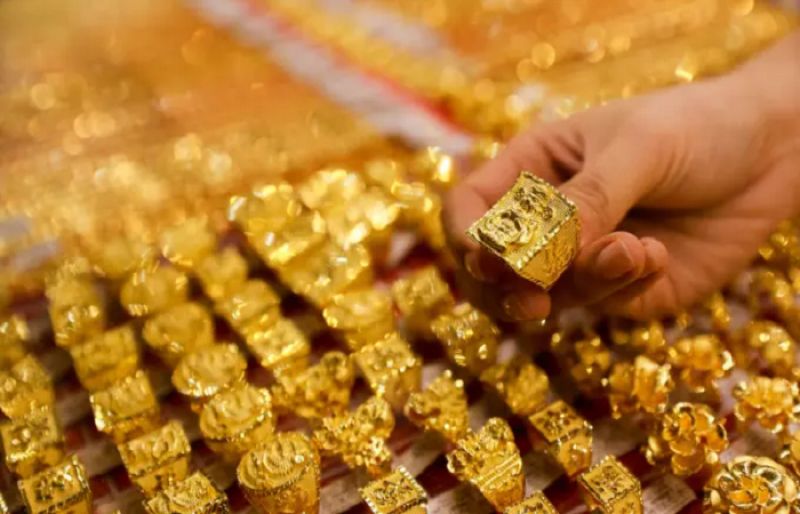
The prices of gold increased in the local market on Monday, with 24-karat gold per tola rising by Rs1,100 to settle at Rs491,462 compared to Rs490,362 on the previous trading day, according to rates issued by the All Pakistan Sarafa Gems and Jewellers Association.
Similarly, the price of 10 grams of 24-karat gold increased by Rs943 to Rs421,349 from Rs420,406, whereas 10 grams of 22-karat gold went up by Rs864 to Rs386,250 against Rs385,386.
In the international market, the price of gold increased by $11 to $4,687 per ounce from $4,676.
Meanwhile, the price of silver per tola decreased by Rs 50 to Rs 7,744 from Rs 7,794, while the price of 10 grams of silver declined by Rs 43 to Rs 6,639 from Rs 6,682.
The price of silver in the international market also decreased by $0.50 to $72.60 per ounce from $73.10.

Hyderabad: Aurobindo Pharma’s board on Monday approved a Rs 800 crore share proposal to buy back up to 54.23 lakh fully paid-up equity shares of the company of face value Rs 1 each at Rs 1,475 a share.The proposed buyback, which is subject to regulatory and statutory approvals, represents up to 0.93% of the total number of equity shares in the company’s total paid-up equity share capital.The Hyderabad-based generics drug maker informed the bourses that April 17, 2026, has been fixed as the record date to determine shareholder eligibility and entitlement for the buyback, which will be carried out through the tender offer route on a proportionate basis, in line with SEBI’s Buyback Regulations and the Companies Act.All eligible equity shareholders, including promoters and promoter group entities holding shares on the record date, will be entitled to participate in the offer for which the company has already constituted a buyback committee.The company also said the board or buyback committee may increase the buyback price and correspondingly reduce the number of shares to be bought back up to one working day before the record date but the overall size will remain unchanged.The Rs 800 crore buyback size excludes transaction costs and related expenses such as brokerage, taxes, filing fees, legal charges and publication expenses, it said.The latest buyback comes less than two years after the last buyback offer aggregating to Rs 750 crore that was made at Rs 1,460 a piece in August 2024 by the company.As of December 31, 2025, promoters and promoter group entities held 51.82% stake in the company, mutual funds 19.52%, foreign portfolio investors 13.94%, insurance companies 5.50%, and public shareholders and others 7.93%.


‘Sprit of resistance will continue’: Iran officials condemn Israeli assassination of IRGC intel. chief

One of Our Favorite 360 Cams Is 35 Percent Off

Why TV’s biggest series are coming to an end in 2026?

-

 Sports1 week ago
USMNT handed reality check by Doku, Belgium ahead of World Cup
-

 Sports1 week ago
2026 NCAA men’s hockey tournament: Schedule, results
-
Uncategorized4 days ago
[CinePlex360] Please moderate: “Trump signals p
-
Uncategorized1 week ago
[CinePlex360] Please moderate: “Further tariff
-

 Entertainment3 days ago
Joe Jonas shares candid glimpse into parenthood with Sophie Turner
-

 Tech3 days ago
Our Favorite iPad Is $50 Off
-

 Sports1 week ago
Man City show why they are worthy WSL title winners as tired United wilt
-

 Entertainment1 week ago
Demystifying the PTI