

Business
US stock market ends 2025 on a high note after volatile year

Danielle KayeBusiness reporter
 Michael Nagle/Bloomberg via Getty Images
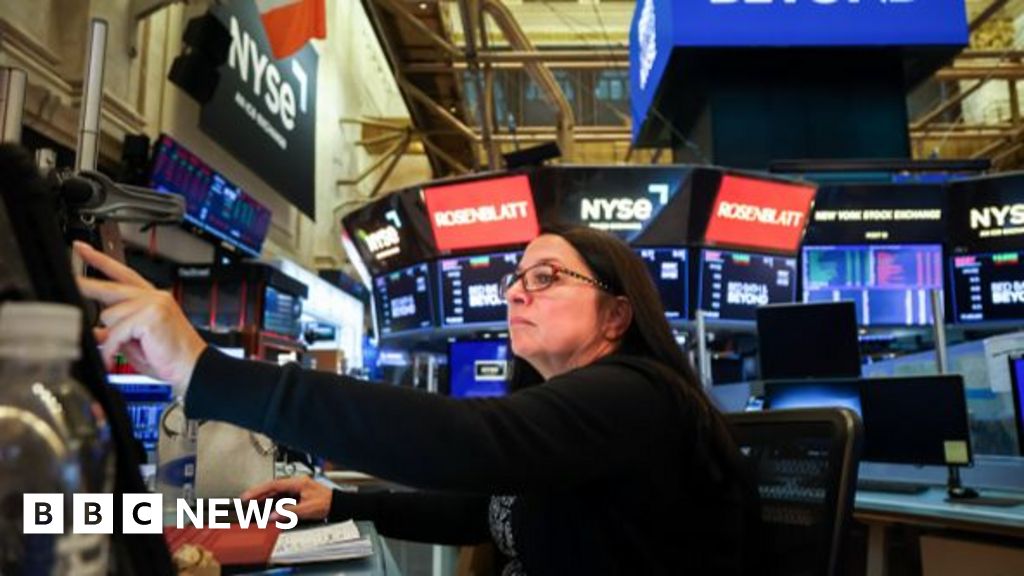
It’s been a roller-coaster year for financial markets – but US stock investors are heading into 2026 on a high note.
US President Donald Trump’s global trade tariffs sent shockwaves through markets in the spring. But by summer, the US saw record highs fuelled by strong company profits and confidence in artificial intelligence investments.
The S&P 500 index is on track to end the year up about 17%, the third consecutive year of double-digit gains.
Next year could shape up to be yet another big one for stock investors, analysts say. Still, with leadership changes at the US central bank and mounting concerns that AI stocks are overvalued, the path ahead might be bumpy.
The technology-heavy Nasdaq Composite index is poised for a 21% gain this year, while the Russell 2000 index of smaller companies is roughly 12% higher year-to-date.
In early April, when Trump announced sweeping tariffs on US trading partners, the S&P 500 fell to the brink of bear market territory – Wall Street’s term for a drop of 20% from the latest high. Both the Nasdaq Composite and Russell 2000 indexes did briefly tumble into bear markets.
But major indexes quickly bounced back after Trump walked back his steepest tariffs, easing Wall Street’s fears about a tariff-driven economic slowdown.
Stocks have since surged to new highs.
That’s been in spite of persistent jitters about the economy, Robert Edwards, chief investment officer at Edwards Asset Management, said in a note.
“The market continues to climb the wall of worry into next year,” he said.
He added that 2026 “should be another year of record setting for stocks”, pointing in part to expectations for lower borrowing costs, which could boost corporate earnings and drive stock prices higher.
Strong earnings growth in corporate America has been a key driver of the stock market rally since the tariff-driven whiplash in the spring, said Parag Thatte, an equity strategist at Deutsche Bank.
At the same time, geopolitical tensions, Trump’s tariffs and expectations of interest rate cuts added to investor demand this year for safe haven assets, such as gold and other commodities. The price of gold is on track for a nearly 70% yearly increase.
Bitcoin, on the other hand, has struggled to keep up with strong returns across stocks and gold.
Despite getting a boost earlier in the year from the Trump administration’s support for digital assets, the world’s largest cryptocurrency is poised to end 2025 slightly lower, after a sharp decline from its record highs in October.

 Reuters
Broadening beyond tech
Enthusiasm among investors about massive AI spending has helped several tech firms outperform the broader S&P 500.
The top five companies – Nvidia, Apple, Microsoft, Amazon and Alphabet – make up almost 30% of the overall index.
But in recent months, fears have mounted in Silicon Valley and beyond of an AI bubble bursting, as the values of tech companies linked to AI have soared and companies keep spending big on the burgeoning industry.
Analysts note that corporate earnings growth appears to be broadening out beyond the tech sector. That could offer investors a cushion, as tech company valuations remain under intense scrutiny.
Mr Thatte, with Deutsche Bank, said growth picked up for average-sized companies in the third quarter of 2025, not just for tech giants. He called this a “key development”.
But even with increasingly broad gains across the US stock market, whether the S&P 500 can maintain its momentum if the tech sector’s rally were to slow remains to be seen.
“The rotation is already happening,” Mr Thatte said, referring to investors pivoting away from Big Tech stocks. “It might be noisy along the way.”
There are also ongoing concerns among professional investors that some stocks outside of tech are overvalued, too.
Analysts at Vanguard predict annualized returns of about 3.5% to 5.5% for US stocks over the next decade – a relatively subdued outlook, compared to recent gains.
 JOHN G MABANGLO/EPA/Shutterstock
Policy risk is ‘not subsiding’
In 2025, the US economy “probably held up better than most people had expected,” said David Sekera, chief US market strategist at Morningstar.
The world’s largest economy picked up speed over the three months to September, expanding at an annual rate of 4.3%, up from 3.8% in the previous quarter – the strongest growth in two years.
But that’s not to say there aren’t big economic question marks in the months ahead.
There’s still the possibility that Trump tariff policies could prompt another jolt to markets. Negotations between Washington and major trading partners will be “an ongoing headline”, Mr Sekera said.
The US labour market has also shown signs of weakness. The unemployment rate rose to a four-year high of 4.6% in November, up from 4.4% in September, according to Labor Department figures.
“With policy risk not subsiding anytime soon,” analysts at Charles Schwab wrote in a research note, “the bar for a pullback or mini correction in the beginning of 2026 is not terribly high.”
Trump is also expected to name a new Federal Reserve chair in the coming weeks, to succeed Jerome Powell after his term ends in May.
The decision is “the big uncertainty” for investors heading into 2026, Paul Stanley, chief investment officer at Granite Bay Wealth Management, said in a note.
Trump, who has been pressuring Powell to lower interest rates, has said he will pick a Fed chair who he views as committed to easing borrowing costs.
Wall Street investors will be focused on understanding how the change in leadership will impact monetary policy moving forward.
“Fed chair transitions come with volatility,” Mr Stanley said.
That leaves investors facing down plenty of unpredictability, even as analysts anticipate another strong year ahead.
Mumbai: RBI has required banks to report all foreign exchange derivative deals involving the rupee undertaken in India and globally by their entire group, including overseas branches, subsidiaries, and parent entities. This brings into view offshore trades that were earlier largely invisible. This applies to both OTC deliverable and offshore non-deliverable contracts, meaning even speculative offshore bets on the rupee must now be disclosed. Banks now must report detailed transaction data-size, counterparty, maturity, and structure-no later than two working days, though trades below $1 million and certain already-reported or internal hedging transactions are exempt.

Sarah has now got her money back but there are calls to reform the deadline for reporting scams to banks.
Source link

Music streamer Deezer allows users to filter out AI music, so why does Spotify not offer the same?
Source link


‘Euphoria’ star Jessica Blair Herman unveils truth about feud amongst cast
Banks to report all related party forex derivative transactions: RBI – The Times of India

Josh Duhamel provides relationship update with ex-wife Fergie

-

 Sports1 week ago
NCAA men’s gymnastics championship: All-time winners list
-

 Sports1 week ago
WWE WrestleMania 42 Night 2: Live match results and analysis
-

 Politics7 days ago
UK’s Starmer seeks to deflect blame over Mandelson appointment
-

 Fashion1 week ago
UK’s Sosandar returns to profitability amid robust FY26 performance
-

 Entertainment1 week ago
Lee Anderson, Zarah Sultana kicked out of UK Parliament for calling PM ‘liar’
-
 Business1 week ago
No fuel shortage: Govt assures 100% domestic LPG, PNG, CNG supply amid Hormuz energy crunch – The Times of India
-
 Business1 week ago
How Trump’s psychedelics executive order could unlock stalled cannabis reform
-

 Sports1 week ago
Quetta Gladiators opt to bowl after winning toss against Peshawar Zalmi in PSL 11 clash